
No products in the cart.
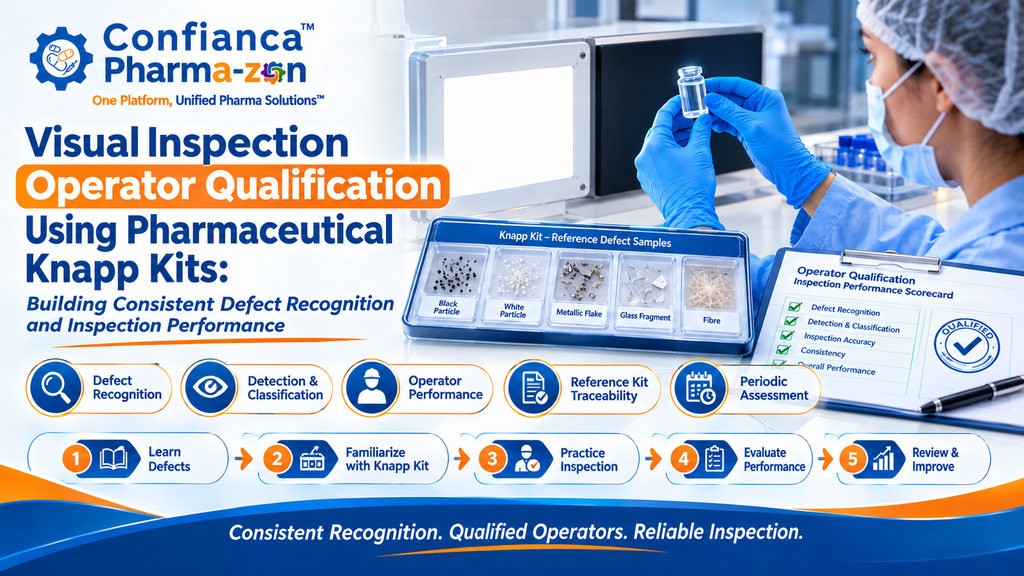
Visual Inspection Operator Qualification Using Pharmaceutical Knapp Kits: Building Consistent Defect Recognition and Inspection Performance
Introduction
Visual inspection is an important quality control activity in pharmaceutical manufacturing, particularly for injectable products. It helps identify visible defects and foreign particulate matter that may affect product appearance, quality, and patient safety.
However, the effectiveness of a visual inspection process depends on more than the inspection equipment or lighting conditions. Human performance, defect recognition capability, operator training, inspection environment, and inspection procedure all contribute to the overall effectiveness of the process.
One of the practical challenges faced by pharmaceutical manufacturers is ensuring that different inspection operators can recognize and classify defects consistently.
An operator may correctly identify a visible particle during one inspection session but fail to recognize a similar defect under different viewing conditions. Differences in experience, visual capability, fatigue, and inspection technique can influence inspection performance.
This is why structured visual inspection operator qualification is important.
Pharmaceutical Knapp Kits provide reference defects and controlled challenge materials that can be used to support operator training, qualification, and periodic performance evaluation.
Rather than relying exclusively on theoretical training, manufacturers can use Knapp Kits to expose operators to representative defect conditions and evaluate their ability to recognize and classify them.
This article explores how pharmaceutical Knapp Kits support operator qualification, how defect recognition can be evaluated, and how manufacturers can build a more consistent visual inspection training program.
1. Understanding Visual Inspection Operator Qualification
Visual inspection operator qualification is a structured process used to evaluate whether personnel can perform visual inspection activities according to established procedures and acceptance criteria.
The process generally focuses on the operator’s ability to:
- Identify visible particles.
- Recognize different defect categories.
- Distinguish acceptable and unacceptable conditions.
- Detect relevant container and product defects.
- Follow the approved inspection procedure.
- Maintain consistent inspection performance.
For injectable products, inspection activities may include evaluating glass containers for visible particulate matter, cosmetic defects, container damage, and other specified defects.
Operator qualification should be based on the manufacturer’s approved inspection procedure and the applicable product and process requirements.
It should also be supported by documented training and evaluation records.
2. Why Defect Recognition Consistency Matters
Different inspection operators may interpret the same visual defect differently.
For example, one operator may classify a small black particle as a critical defect, while another may overlook it or classify it differently.
Such variation can create challenges in maintaining consistent inspection performance.
Common factors that influence defect recognition include:
- Operator experience.
- Training quality.
- Visual acuity and relevant visual capability.
- Defect size and contrast.
- Product and container characteristics.
- Background and illumination.
- Inspection speed.
- Operator fatigue.
- Environmental conditions.
- Inspection procedure design.
A standardized training approach helps reduce avoidable variation and provides a more objective basis for evaluating operator performance.
3. Role of Pharmaceutical Knapp Kits in Operator Training
A pharmaceutical Knapp Kit is a reference kit containing representative visual defects or particulate challenges used to support visual inspection activities.
Depending on the kit design and intended application, it may include different particle types, sizes, colours, and defect conditions.
Examples of reference challenges may include:
- Black particles.
- White particles.
- Metallic particles.
- Glass-related particles.
- Fibres.
- Other representative visible defects.
Knapp Kits can be used as practical training tools to help operators become familiar with different visual defect characteristics.
They can also support structured qualification exercises where the operator’s detection and classification performance is evaluated against a predefined reference.
The specific contents and acceptance criteria should be established according to the intended application.
4. Developing a Structured Defect Recognition Training Program
An effective visual inspection training program should progress from basic defect awareness to practical performance evaluation.
Stage 1: Defect Awareness
Operators should understand the different types of defects that may be encountered during inspection.
Training should explain:
- Particle appearance.
- Defect categories.
- Relevant product-specific risks.
- Difference between product-related and container-related defects.
- Inspection procedure requirements.
The objective is to develop a common understanding of the defect classification system.
Stage 2: Reference Defect Familiarization
Operators should be introduced to representative defects using suitable reference materials.
A Knapp Kit can help demonstrate how different particle types appear under defined viewing conditions.
For example:
- Black particles may have strong visual contrast against a light background.
- White particles may be more difficult to recognize depending on the background.
- Metallic particles may show reflective characteristics.
- Fibres may require attention to their elongated shape and orientation.
This stage helps operators understand that not all particles have the same visual characteristics.
Stage 3: Practical Inspection Exercises
Operators can perform supervised exercises using the approved inspection setup.
The training should follow the established inspection procedure, including:
- Defined viewing conditions.
- Approved inspection movements.
- Specified observation periods.
- Suitable backgrounds.
- Appropriate illumination.
- Defined inspection sequence.
The objective is to develop repeatable inspection behaviour.
Stage 4: Qualification Evaluation
After training, operators can be evaluated using predefined challenge samples or suitable reference defect sets.
The evaluation should measure the operator’s ability to detect and correctly classify the included defects.
The qualification criteria should be defined before testing and should reflect the approved inspection procedure.
Stage 5: Periodic Performance Review
Qualification should not be treated as a one-time activity.
Manufacturers should establish suitable periodic assessment and retraining arrangements based on their procedures, risk assessments, and applicable requirements.
5. Understanding Defect Categories in Visual Inspection
A good training program should teach operators to recognize different defect categories rather than simply memorize particle colours.
Black Particles
Black particles can originate from several materials, including certain polymeric, metallic, carbonaceous, or environmental sources.
Their visual appearance depends on size, shape, contrast, and viewing conditions.
White Particles
White or translucent particles may be challenging because their contrast can be limited against particular backgrounds.
Training should expose operators to representative examples and relevant viewing conditions.
Metallic Particles
Metallic particles may have reflective or shiny characteristics.
However, reflectivity alone does not establish their material identity.
Fibres
Fibrous particles can appear elongated, curved, straight, or fragmented.
Their orientation can influence how easily they are detected.
Glass-Related Defects
Glass fragments and container-related defects require attention to their appearance, location, and possible impact on product acceptability.
These examples demonstrate why defect variety is important in operator training.
6. Measuring Operator Performance: Detection and Classification
A visual inspection qualification exercise should have clear evaluation criteria.
Two important performance parameters are detection and classification.
Defect detection evaluates whether the operator recognizes the presence of a defect.
Defect classification evaluates whether the operator correctly identifies the defect according to the approved classification system.
For example, an operator may detect that a container contains a particle but incorrectly identify its category.
Therefore, a comprehensive assessment may evaluate both recognition and classification.
A simple detection percentage can be calculated as:
Detection Rate (%) = (Number of Correctly Detected Defects / Total Number of Presented Defects) × 100
For example, if an operator correctly detects 18 out of 20 challenge defects:
Detection Rate = (18 / 20) × 100 = 90%
This is an illustrative calculation, not a universal qualification acceptance limit.
The manufacturer should define the applicable acceptance criteria based on its approved procedure and intended assessment.
7. Importance of Representative Defect Selection
The quality of an operator qualification program depends partly on the suitability of the challenge defects.
A training set should be representative of the defects relevant to the product and manufacturing process.
Important considerations include:
- Particle colour.
- Particle size.
- Particle material.
- Particle shape.
- Defect visibility.
- Container type.
- Product background.
- Inspection environment.
- Intended training or qualification purpose.
A defect set that contains only easily visible particles may not adequately challenge the inspection process.
Similarly, an excessively difficult or poorly characterized challenge set may not provide meaningful information about operator performance.
The selection of reference defects should therefore be justified and documented.
8. Connecting Knapp Kit Studies With Probability of Detection
Probability of Detection (POD) is an important concept in understanding the performance of a visual inspection system.
POD describes the likelihood that a particular defect will be detected under specified inspection conditions.
The probability may be influenced by:
- Defect size.
- Particle colour.
- Material characteristics.
- Product background.
- Illumination.
- Container geometry.
- Inspection method.
- Operator capability.
Knapp Kit-based studies can contribute to evaluating detection performance using representative defects.
However, the study design must be appropriate for the conclusions being drawn.
A simple operator qualification exercise should not automatically be interpreted as a complete POD validation of an inspection process.
For meaningful POD assessment, the manufacturer should define the relevant defect population, study conditions, sample distribution, statistical approach, and acceptance criteria.
9. Documentation and Traceability of Qualification Activities
Documentation is essential for demonstrating that operator training and qualification have been conducted in a controlled manner.
A typical qualification record may include:
- Operator identification.
- Training date.
- Training material details.
- Reference kit identification.
- Kit serial number or unique identification.
- Defect identification and classification.
- Challenge sequence.
- Inspection conditions.
- Number of presented defects.
- Correctly detected defects.
- Missed defects.
- Classification errors.
- Final evaluation.
- Trainer or evaluator details.
- Approval and review records.
Where relevant, records should also identify the applicable procedure and the version used during evaluation.
Proper documentation supports traceability and helps quality teams review inspection performance over time.
10. Common Mistakes in Visual Inspection Operator Qualification
Using Only Theoretical Training
Understanding defect terminology does not necessarily demonstrate practical inspection capability.
Hands-on evaluation is important.
Using Repetitive and Predictable Challenges
If operators repeatedly encounter the same defects in the same sequence, they may begin to memorize the pattern instead of demonstrating genuine recognition capability.
A controlled and appropriately varied challenge design can reduce this risk.
Ignoring Difficult-to-Recognize Defects
Training should not focus exclusively on high-contrast or easily visible particles.
Relevant challenging defects should be considered in the study design.
Failing to Document Missed Defects
Missed defects provide useful information about areas requiring additional training.
They should be documented and reviewed rather than overlooked.
Treating Qualification as a One-Time Event
Inspection capability may change over time due to fatigue, experience, procedural changes, and other factors.
Periodic performance review is therefore important.
11. Integrating Knapp Kits With Automated Visual Inspection Systems
Knapp Kits are also relevant to the broader evaluation of automated visual inspection systems.
Automated systems use cameras, lighting, image processing, and defect recognition algorithms to identify specified defects.
Reference defects can support controlled system challenges, subject to the equipment design and validated study protocol.
These exercises may help evaluate:
- Defect recognition capability.
- Detection consistency.
- System response to different particle types.
- Image acquisition performance.
- Classification accuracy.
- Repeatability under defined conditions.
The challenge set must be suitable for the automated system and its inspection configuration.
Manual and automated visual inspection activities may have different qualification requirements, so the study design should reflect the intended application.
12. Maintaining Knapp Kit Integrity and Reference Reliability
The reliability of a qualification program depends on the condition and traceability of its reference materials.
Manufacturers should establish suitable controls for:
- Kit identification.
- Defect documentation.
- Storage conditions.
- Handling practices.
- Physical integrity.
- Inspection and verification.
- Calibration or characterization requirements, where applicable.
- Periodic review.
Any damaged, altered, missing, or questionable reference material should be evaluated before further use.
The objective is to ensure that challenge materials remain suitable for their intended purpose.
13. How Confianca Pharmazon Supports Visual Inspection Qualification
Confianca Pharmazon provides pharmaceutical visual inspection solutions, including Visual Inspection Knapp Kits designed to support inspection training, qualification, and performance evaluation activities.
Our solutions focus on helping pharmaceutical manufacturers develop structured approaches to defect recognition and inspection system assessment.
Knapp Kit-based activities can support:
- Manual visual inspection training.
- Operator qualification exercises.
- Defect recognition practice.
- Reference defect evaluation.
- Inspection performance studies.
- Automated inspection challenges, where suitable.
The intended use and study acceptance criteria should always be aligned with the manufacturer’s approved procedures.
Conclusion
Consistent visual inspection performance depends on trained operators, representative reference defects, controlled inspection conditions, and documented qualification activities.
Pharmaceutical Knapp Kits provide a practical way to introduce operators to different defect characteristics and support structured inspection performance evaluations.
When integrated into a scientifically justified training and qualification program, these reference materials can help improve defect recognition, support inspection consistency, and strengthen pharmaceutical quality systems.
Visual inspection should not depend entirely on individual experience. It should be supported by defined procedures, suitable reference materials, and objective performance assessment.
Confianca Pharmazon – Supporting Reliable Pharmaceutical Visual Inspection Through Reference Defect Solutions.