
No products in the cart.
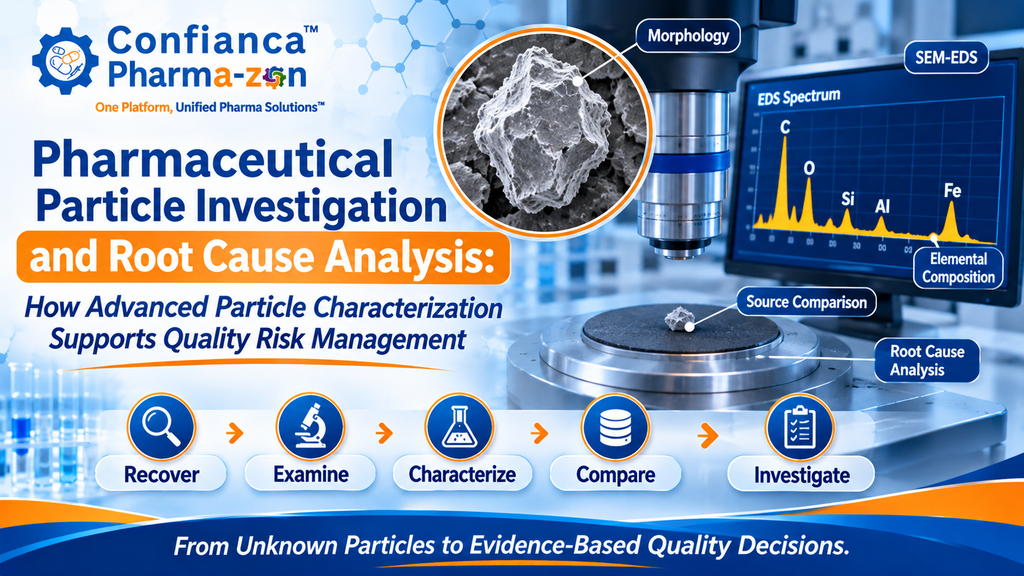
Pharmaceutical Particle Investigation and Root Cause Analysis: How Advanced Particle Characterization Supports Quality Risk Management
Introduction
Particulate contamination is one of the important quality concerns in pharmaceutical manufacturing, particularly in products intended for parenteral administration. The presence of unexpected particles in pharmaceutical products can raise questions about product quality, manufacturing conditions, packaging integrity, equipment performance, and potential contamination sources.
When a particle is observed during visual inspection or detected during laboratory testing, simply documenting its presence is not sufficient. Pharmaceutical manufacturers need to understand what the particle is, where it may have originated, how it entered the product or manufacturing environment, and whether similar contamination could affect other batches.
This is where pharmaceutical particle investigation and advanced particle characterization become valuable.
Particle characterization provides scientific information about the physical and chemical properties of foreign particles. By examining characteristics such as morphology, size, elemental composition, and material structure, laboratories can generate useful evidence to support contamination investigations.
For pharmaceutical quality teams, the objective is not merely to identify an unknown particle. It is to develop a scientifically defensible understanding of the potential contamination mechanism and support appropriate corrective and preventive actions.
This article explains how pharmaceutical particle investigation works, which analytical techniques support the process, how laboratory findings should be interpreted, and why systematic characterization is important for pharmaceutical quality management.
1. Understanding Pharmaceutical Particle Investigation
Pharmaceutical particle investigation is a structured analytical process used to examine unexpected particulate matter associated with pharmaceutical products, raw materials, packaging components, manufacturing equipment, and production environments.
Particles may originate from several sources, including:
- Manufacturing equipment and machinery.
- Stainless steel components and metallic surfaces.
- Glass containers, ampoules, and vials.
- Rubber stoppers and elastomeric components.
- Plastic containers, tubing, and polymeric materials.
- Fibres from garments, wipes, filters, and packaging.
- Environmental dust and airborne contamination.
- Raw materials and process-related residues.
The appearance of a particle can provide an initial indication of its possible nature. However, visual appearance alone cannot reliably establish its chemical identity.
For example, a dark particle may be metallic, carbonaceous, polymeric, or another material. Similarly, a transparent particle may originate from glass, plastic, or other substances.
A systematic pharmaceutical particle characterization process helps distinguish these possibilities using appropriate analytical methods.
2. Why Identifying the Root Cause Is More Important Than Simply Identifying a Particle
Identifying a particle’s composition is only one part of a complete contamination investigation.
Consider a pharmaceutical manufacturing facility where metallic particles are observed in an injectable product.
An elemental analysis may indicate that the particle contains iron, chromium, and nickel. These findings may be consistent with certain stainless steel materials.
However, this information alone does not establish the exact equipment or component responsible for the contamination.
The investigation may need to examine:
- Equipment contact surfaces.
- Transfer pipelines and fittings.
- Filling machine components.
- Agitators and mixing systems.
- Maintenance and equipment history.
- Previous manufacturing deviations.
- Cleaning and sanitization activities.
- Relevant manufacturing process stages.
The analytical findings should be compared with potential source materials and manufacturing records.
A strong pharmaceutical root cause analysis combines laboratory evidence, process knowledge, equipment assessment, and documented investigation findings.
3. Important Characteristics Evaluated During Particle Characterization
A comprehensive pharmaceutical particle investigation may evaluate several physical and chemical properties.
3.1 Particle Morphology
Morphology refers to the physical appearance and structural characteristics of a particle.
Important observations include:
- Particle shape.
- Surface texture.
- Edge characteristics.
- Degree of irregularity.
- Presence of cracks or fractures.
- Fibrous, spherical, flake-like, or fragmented appearance.
Morphological examination can help differentiate between different particle categories.
For example, a long, elongated structure may indicate a fibre, while an irregular angular fragment may be consistent with broken glass or a fractured solid material.
Morphology is useful for generating hypotheses, but it should not be treated as definitive chemical identification.
3.2 Particle Size Measurement
Particle size is another important characteristic in pharmaceutical particle characterization.
Size measurements can support:
- Comparison between particles from different samples.
- Evaluation of particle distribution.
- Investigation of possible fragmentation.
- Comparison with suspected source materials.
- Documentation of observed particulate matter.
The measurement method should be appropriate for the particle’s shape and dimensions.
For irregular particles, reporting only one dimension may not fully represent their geometry. Major and minor dimensions, or other suitable measurement parameters, may provide more meaningful information.
3.3 Elemental Composition
Elemental composition provides information about the chemical elements present in a particle.
Scanning Electron Microscopy with Energy Dispersive X-ray Spectroscopy (SEM-EDS) is commonly used to examine particle morphology and obtain elemental information.
Depending on the particle and analytical conditions, the technique can help detect elements such as:
- Iron (Fe).
- Chromium (Cr).
- Nickel (Ni).
- Silicon (Si).
- Aluminium (Al).
- Calcium (Ca).
- Sulphur (S).
- Oxygen (O).
- Sodium (Na).
Elemental results can support comparison with potential source materials.
However, elemental composition should be interpreted carefully. The presence of an element does not automatically establish the exact compound, alloy grade, or source of the particle.
3.4 Material Structure and Chemical Identification
Some investigations require additional analytical techniques to understand the material structure or chemical composition.
Depending on the particle type and investigation objective, laboratories may consider:
- Fourier Transform Infrared Spectroscopy (FTIR).
- Raman Spectroscopy.
- Optical Microscopy.
- SEM-EDS.
- Other suitable microscopic or spectroscopic techniques.
The analytical method should be selected according to the particle’s characteristics, expected material, sample quantity, and required information.
4. Role of SEM-EDS in Pharmaceutical Particle Investigation
SEM-EDS is a valuable analytical combination for examining unknown particles.
Scanning Electron Microscopy provides high-resolution images of the particle surface and morphology. Energy Dispersive X-ray Spectroscopy provides elemental information from the selected analytical region.
Together, these techniques can support investigations involving:
- Metallic particles.
- Glass-related fragments.
- Mineral or inorganic particles.
- Certain polymer-associated inorganic residues.
- Unknown foreign matter.
- Particles recovered from pharmaceutical products and process materials.
How SEM-EDS Investigation Is Generally Performed
Step 1: Sample Receipt and Documentation
The laboratory receives the sample and documents its identification, condition, source, and relevant investigation information.
Step 2: Sample Preparation
The particle is prepared using a suitable method that minimizes contamination and preserves its relevant characteristics.
Step 3: Microscopic Examination
The particle is examined to assess morphology, surface features, and measurable dimensions.
Step 4: Selection of Analytical Locations
Appropriate areas are selected for elemental analysis. Multiple locations may be useful when the particle is heterogeneous.
Step 5: EDS Spectrum Acquisition
Elemental spectra are acquired under suitable analytical conditions.
Step 6: Data Evaluation
The elemental findings are reviewed and interpreted in the context of the sample, substrate, analytical conditions, and potential interferences.
Step 7: Reporting
The report documents the analytical observations, images, spectra, elemental findings, and relevant limitations.
5. Understanding Elemental Composition Results
One of the most important parts of particle characterization is interpreting the elemental composition data correctly.
SEM-EDS results may be presented as weight percentage (%Wt) or atomic percentage (%At).
Weight percentage represents the relative mass contribution of the detected elements within the quantified analytical result. Atomic percentage represents their relative proportion by number of atoms.
These values are not interchangeable.
For example, a particle may show iron, chromium, and nickel as major detected elements. This combination may be consistent with a stainless-steel-related material.
However, the result should not automatically be used to declare a specific stainless steel grade without appropriate reference data and supporting evidence.
Analytical reports should also consider:
- Substrate contribution.
- Sample mounting materials.
- Surface contamination.
- Particle heterogeneity.
- Detection limitations.
- Measurement conditions.
- Background and matrix effects.
A scientifically reliable interpretation distinguishes between directly observed analytical findings and conclusions that require additional evidence.
6. Importance of Blank and Substrate Evaluation
During particle analysis, the particle may be mounted on a membrane, filter, stub, or other supporting material.
These materials can contribute signals to the analytical spectrum.
For example, a membrane may contain elements that are not part of the foreign particle itself. If these contributions are not evaluated, the final interpretation may incorrectly associate substrate elements with the particle.
A suitable investigation should therefore consider blank or substrate characterization whenever relevant.
This helps distinguish between:
- Elements originating from the particle.
- Elements associated with the supporting material.
- Background signals.
- Potential environmental or preparation-related contamination.
Proper substrate evaluation improves the reliability and defensibility of the analytical report.
7. Comparing Particle Findings With Potential Contamination Sources
After analytical characterization, the next step is to evaluate potential sources.
For example:
| Analytical Observation | Possible Source Category to Investigate |
|---|---|
| Iron, chromium, and nickel | Stainless steel equipment or components |
| Silicon-rich composition | Glass, silica-containing materials, or mineral matter |
| Aluminium-rich composition | Aluminium components or aluminium-containing materials |
| Carbon- and oxygen-rich features | Organic or polymeric materials, subject to further analysis |
| Calcium-rich inorganic particles | Mineral-based materials or process-related residues |
These are investigation leads, not definitive source identifications.
A reliable comparison should include reference samples, supplier information, equipment specifications, process records, and appropriate complementary testing.
8. Establishing a Scientifically Defensible Investigation Report
The analytical report is a critical part of pharmaceutical particle investigation.
A well-structured report should provide enough information for quality assurance, quality control, technical, and regulatory teams to understand the investigation.
A typical report may include:
- Sample identification.
- Sample receipt details.
- Analytical methodology.
- Equipment and analytical conditions, where relevant.
- Particle photographs.
- SEM micrographs.
- Particle measurement information.
- EDS spectra.
- Elemental composition results.
- Blank or substrate observations.
- Interpretation of analytical findings.
- Relevant analytical limitations.
- Conclusion.
The report should clearly distinguish measured results from interpretation and should avoid making unsupported claims about the exact source of contamination.
9. Using Particle Characterization to Strengthen CAPA
Corrective and Preventive Action (CAPA) is an important element of pharmaceutical quality management.
Particle characterization can support CAPA by providing technical information that helps investigate the potential origin and nature of foreign matter.
For example, if an investigation identifies a metallic particle, the manufacturer may evaluate:
- Equipment condition.
- Preventive maintenance records.
- Component wear.
- Process contact materials.
- Cleaning effectiveness.
- Inspection controls.
- Potential recurrence in other batches.
Preventive actions should address the identified or reasonably supported contamination mechanism rather than relying only on the particle’s appearance.
The effectiveness of CAPA should subsequently be evaluated through suitable monitoring and verification activities.
10. Common Challenges in Pharmaceutical Particle Analysis
Despite advances in analytical technology, particle investigation can involve several challenges.
Limited Sample Quantity
Some investigations involve only a few particles. Careful sample handling and analytical planning are essential to avoid unnecessary sample loss.
Mixed or Heterogeneous Particles
A particle may contain multiple materials or show different elemental compositions across its surface.
Analyzing only one location may not represent the entire particle.
Background Interference
Supporting membranes, mounting materials, and surrounding contamination can influence analytical observations.
Uncertain Source Identification
A material may be consistent with several possible manufacturing or packaging sources. Additional comparison and process investigation may be necessary.
Incomplete Investigation Information
Without details about the sample source, manufacturing process, packaging materials, and observed defect, the laboratory may have limited information for interpretation.
Providing relevant background information improves the usefulness of analytical findings.
11. How Confianca Pharmazon Supports Pharmaceutical Particle Characterization
Confianca Pharmazon supports pharmaceutical manufacturers with specialized analytical and technical solutions, including particle characterization-related services.
A systematic approach to particle examination can help pharmaceutical quality teams understand unknown particulate matter through documented analytical observations and appropriate characterization techniques.
The objective is to provide useful technical information that supports contamination investigations, material assessment, and quality decision-making.
By combining suitable analytical methods, microscopic observations, elemental data, and structured reporting, particle characterization can become a valuable part of a pharmaceutical manufacturer’s investigation strategy.
Conclusion
Pharmaceutical particle investigation requires more than identifying the visible appearance of an unknown particle. It requires a structured scientific approach that combines morphology, particle size, elemental composition, analytical interpretation, and manufacturing knowledge.
Advanced techniques such as SEM-EDS can provide valuable information about unknown foreign matter and support investigations into potential contamination sources.
However, reliable conclusions depend on appropriate sample preparation, substrate evaluation, analytical method selection, and careful interpretation of results.
For pharmaceutical manufacturers, integrating particle characterization into the quality investigation process can strengthen root cause analysis, improve technical understanding, and support more effective CAPA decisions.
Confianca Pharmazon – Supporting Pharmaceutical Quality Through Analytical Solutions and Technical Expertise.