
No products in the cart.
Designing Representative Defect Libraries for Pharmaceutical Visual Inspection: The Role of Knapp Kits in Pharmaceutical Quality Assurance
Introduction
Visual inspection is an important quality control activity in pharmaceutical manufacturing, particularly for injectable products supplied in ampoules, vials, cartridges, and prefilled syringes.
The purpose of pharmaceutical visual inspection is to identify visible defects and particulate matter that may affect product quality, container integrity, or compliance with established acceptance criteria.
However, the reliability of a visual inspection programme depends on more than the inspection equipment or the experience of individual operators. It also depends on whether the inspection process uses representative, well-defined, and consistently controlled defect references.
This is where pharmaceutical Knapp Kits play an important role.
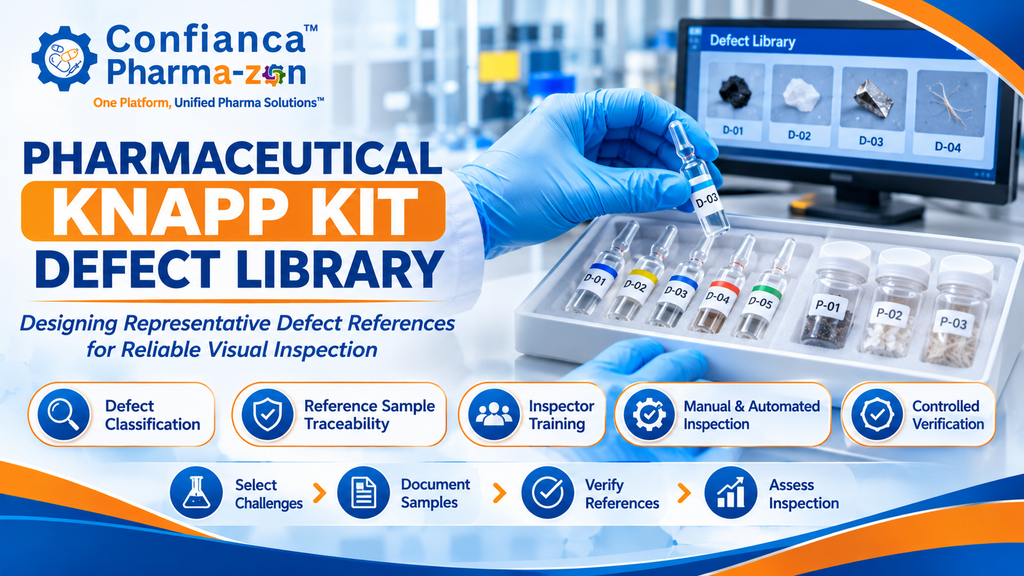
A Knapp Kit is a reference collection of containers containing defined particle challenges or other relevant visual inspection characteristics. It can be used to support visual inspection studies, personnel training, inspection system assessments, and performance monitoring.
An important aspect of a reliable Knapp Kit programme is the development of a representative defect library. A carefully designed defect library helps organizations establish consistent visual references, evaluate inspection performance, and improve defect classification practices.
This article explains how pharmaceutical manufacturers can develop, organize, document, and maintain representative defect libraries using Knapp Kits.
1. What Is a Pharmaceutical Knapp Kit?
A pharmaceutical Knapp Kit is a specialized reference kit containing selected containers with defined visual inspection challenges.
Depending on the study design and intended application, these challenges may include different types of particulate matter, particle sizes, colours, and other visual characteristics.
Knapp Kits are commonly used in pharmaceutical visual inspection programmes to evaluate the performance of inspection systems and support operator-related activities.
Typical applications include:
- Manual visual inspection studies.
- Automated visual inspection system evaluation.
- Inspector qualification activities.
- Inspection process performance verification.
- Defect recognition training.
- Visual inspection system comparison.
- Routine performance monitoring.
A Knapp Kit should be designed according to a documented study objective rather than simply containing a random selection of particles.
2. Why Representative Defect Libraries Are Important
A defect library provides a structured collection of visual references that helps pharmaceutical manufacturers establish consistency in inspection activities.
Without representative reference materials, different operators may interpret similar visual conditions differently.
For example, one operator may classify a small dark particle as a significant defect, while another may overlook it because of differences in experience, viewing conditions, or training.
A properly designed defect library can help reduce this inconsistency.
Major benefits
Standardized defect recognition
Defined reference samples provide a common visual basis for defect recognition and classification.
Improved training quality
New inspectors can learn to recognize different particle characteristics through practical examination.
Better inspection assessment
Reference samples help organizations evaluate whether an inspection system or operator can detect specified challenges under defined conditions.
Improved documentation
Each reference sample can be linked to an identification number, particle characteristics, photographs, and traceability records.
Long-term consistency
A controlled defect library helps maintain consistency when training new personnel or comparing inspection performance over time.
3. Understanding Different Defect Categories in Pharmaceutical Visual Inspection
A representative defect library should include suitable categories based on the products, containers, manufacturing processes, and inspection objectives.
3.1 Black Particles
Black particles are among the commonly considered visual challenges in pharmaceutical inspection studies.
Possible reference materials may include suitable black particulate materials selected according to the intended study design.
Important characteristics include:
- Particle dimensions.
- Shape.
- Contrast against the product background.
- Visibility under defined lighting.
- Particle movement.
- Container positioning.
Black particles may present different detection challenges depending on their size and morphology.
3.2 White Particles
White or light-coloured particles can be more difficult to detect in certain clear or light-coloured formulations.
Their visibility may depend on:
- Product colour.
- Container transparency.
- Particle dimensions.
- Background contrast.
- Lighting conditions.
- Particle movement.
A defect library should therefore consider the product and container combination rather than relying exclusively on particle colour.
3.3 Metallic Particles
Metallic particles may be included in visual inspection challenge programmes to represent selected metallic contamination scenarios.
Their reflective characteristics can create different visual effects under inspection lighting.
Relevant factors include:
- Reflectivity.
- Particle shape.
- Surface finish.
- Particle dimensions.
- Orientation.
- Movement within the container.
The actual material and characteristics should be appropriately identified and documented.
3.4 Fibre-Like Particles
Fibrous particles have distinctive elongated structures.
Their detection may depend on:
- Fibre length.
- Fibre thickness.
- Curvature.
- Colour.
- Orientation.
- Movement.
Fibres may behave differently from compact particles during container rotation or manual inspection.
3.5 Other Relevant Defect Types
Depending on the inspection objective, defect libraries may also address:
- Glass-related particles.
- Polymer fragments.
- Visible product-related particles.
- Container defects.
- Cosmetic defects.
- Closure-related visual defects.
The inclusion of each category should be justified by the intended application and relevant product risks.
4. Establishing a Scientific Defect Classification System
A defect classification system helps define how inspection challenges are grouped and documented.
A useful framework may include three broad categories.
Category A: Clearly detectable challenges
These are reference challenges that are expected to be readily visible under the defined inspection conditions.
Category B: Intermediate challenges
These represent more difficult visual conditions and can help evaluate inspection consistency.
Category C: Challenging or borderline conditions
These represent selected challenges near the practical limits of the defined inspection process.
These categories are illustrative and should not be confused with universal regulatory acceptance classifications.
The organization should establish its own documented criteria based on the applicable study protocol and product requirements.
5. How to Design a Representative Pharmaceutical Knapp Kit
Developing a representative Knapp Kit requires a systematic approach.
Step 1: Define the Study Objective
Before selecting reference samples, determine what the kit is intended to evaluate.
For example:
- Manual inspector qualification.
- Automated inspection system performance.
- Comparison between inspection technologies.
- Recognition of selected particle categories.
- Training and competency development.
The study objective determines which challenges should be included.
Step 2: Identify the Product and Container Configuration
A Knapp Kit should consider the actual container configuration wherever relevant.
Important characteristics include:
- Ampoule or vial type.
- Container size.
- Glass colour.
- Container geometry.
- Fill volume.
- Product appearance.
- Background characteristics.
A defect that is easily detectable in one container configuration may be more difficult to detect in another.
Step 3: Select Appropriate Particle Challenges
Select particles according to the study objective.
Consider:
- Material type.
- Colour.
- Particle dimensions.
- Morphology.
- Visual contrast.
- Representative contamination scenarios.
The selection should be scientifically justified and appropriately documented.
Step 4: Establish Reference Identification
Every container should have a unique identification number.
The identification system should connect the physical container to its reference documentation.
A sample register may include:
| Parameter | Required information |
|---|---|
| Sample ID | Unique identification |
| Container type | Ampoule, vial, or other |
| Particle category | Black, white, metallic, fibre, etc. |
| Particle size | Documented measurement |
| Particle material | Where established |
| Reference image | Approved photograph |
| Preparation date | Documented date |
| Verification status | Approved, under review, etc. |
Step 5: Establish Reference Images
Photographic documentation is important for traceability.
Images should be captured under suitable conditions and should clearly demonstrate the intended challenge.
Where possible, maintain:
- Overall container images.
- Particle close-up images.
- Measurement images.
- Reference comparison images.
Image records should be linked to the sample identification number.
Step 6: Verify the Reference Set
Before releasing the kit for use, verify the physical condition and documentation of each sample.
Verification may include:
- Container integrity.
- Sample identification.
- Particle presence.
- Reference image agreement.
- Document completeness.
- Suitability for the intended study.
Acceptance criteria should be defined in advance.
6. The Role of Particle Size in Knapp Kit Design
Particle size is an important parameter in designing visual inspection challenge sets.
However, size alone does not determine visibility.
Two particles having similar dimensions may exhibit different visual characteristics because of differences in:
- Colour.
- Shape.
- Surface reflectivity.
- Material.
- Transparency.
- Orientation.
For example, a dark particle may produce stronger contrast in a clear formulation than a transparent or light-coloured particle of comparable dimensions.
Similarly, a long, thin fibre may be visually different from a compact particle with the same maximum length.
Therefore, a representative Knapp Kit should consider particle size together with other visual characteristics.
Why size documentation matters
Documented particle dimensions help:
- Establish reference traceability.
- Compare samples.
- Support study reproducibility.
- Review changes over time.
- Maintain controlled reference records.
The measurement method and associated uncertainty should also be documented.
7. Manual and Automated Visual Inspection: Different Defect Library Requirements
Manual and automated inspection systems do not necessarily interact with visual challenges in the same way.
Manual Visual Inspection
Manual inspection depends on the inspector’s visual capability, training, attention, and adherence to the approved procedure.
A defect library for manual inspection should consider:
- Human visual perception.
- Defined viewing conditions.
- Inspection duration.
- Container handling.
- Rotation and observation technique.
- Inspector training.
- Study repeatability.
Automated Visual Inspection
Automated systems use cameras, lighting arrangements, image processing, and predefined algorithms.
A challenge library for automated inspection should consider:
- Camera configuration.
- Lighting conditions.
- Image resolution.
- Particle position.
- Particle movement.
- Container orientation.
- Inspection speed.
- Defect recognition logic.
An automated system may detect certain challenges more consistently than others depending on the equipment configuration.
Therefore, challenge samples should be selected to evaluate the intended system capabilities.
8. How Knapp Kits Support Inspection Training and Competency
A well-controlled Knapp Kit can serve as a practical training resource.
Training should not simply involve showing operators different particles.
Instead, the programme should help operators understand:
- The purpose of visual inspection.
- Different defect categories.
- Particle appearance.
- Inspection procedures.
- Viewing conditions.
- Correct sample handling.
- Reporting expectations.
- Documentation requirements.
Training records should include the operator’s identification, training date, applicable procedure, assessment method, and outcome.
Where competency assessment is required, acceptance criteria should be predefined and approved.
Training performance should not be treated as a substitute for a properly designed qualification study.
9. Maintaining and Controlling a Pharmaceutical Knapp Kit
A Knapp Kit is a controlled reference resource and should be managed through an appropriate lifecycle programme.
Important activities include:
Storage
- Maintain defined storage conditions.
- Protect reference containers from physical damage.
- Use suitable storage arrangements.
- Maintain sample identification.
- Prevent unauthorized modification.
Periodic Verification
- Inspect container integrity.
- Review particle visibility.
- Verify sample identification.
- Compare samples against approved reference records.
- Document any changes.
Change Management
Any change to the reference set should be assessed and documented.
Examples include:
- Replacement of damaged containers.
- Addition of new defect categories.
- Removal of unsuitable samples.
- Changes in reference measurement.
- Changes in intended application.
Traceability
Maintain a complete record of sample history, including preparation, verification, use, storage, and replacement.
10. Common Challenges in Defect Library Development
Inconsistent particle selection: A poorly selected challenge set may not adequately represent the intended inspection conditions.
Incomplete sample identification: Missing identification details can affect traceability.
Insufficient photographic documentation: Unclear images make reference comparisons difficult.
Uncontrolled sample replacement: Replacing samples without documentation can compromise the study’s integrity.
Unclear defect categories: Inconsistent definitions can create confusion between inspectors.
Ignoring container differences: Different container configurations can influence visual detectability.
A well-defined standard operating procedure helps address these challenges.
11. Regulatory and Quality Considerations
Pharmaceutical visual inspection programmes should be developed in accordance with applicable regulatory requirements and established industry guidance.
Relevant references may include:
- USP General Chapter <1790>, Visual Inspection of Injections.
- USP General Chapter <790>, Visible Particulates in Injections.
- EU GMP requirements applicable to sterile medicinal products, including Annex 1.
- Applicable national regulatory requirements.
- Internal pharmaceutical quality management procedures.
These references address different aspects of visual inspection, product quality, and sterile manufacturing. A Knapp Kit should be used as part of a scientifically justified inspection programme, not as a substitute for applicable compendial requirements.
The organization should establish its own approved protocols, acceptance criteria, and documentation procedures.
12. How Confianca Pharmazon Supports Pharmaceutical Visual Inspection
Confianca Pharmazon supports pharmaceutical manufacturers through specialized visual inspection solutions and reference materials.
Our relevant solutions include:
- Pharmaceutical Visual Inspection Knapp Kits.
- Particle reference sets.
- Visual inspection-related products.
- Visual Inspection Booth Automation.
- Vision System for Visual Inspection.
- Technical support for pharmaceutical visual inspection requirements.
These solutions can help pharmaceutical manufacturers strengthen their visual inspection programmes and establish more structured inspection practices.
The selection of an appropriate reference kit should always consider the product, container configuration, study objective, and applicable quality requirements.
13. Future Developments in Pharmaceutical Defect Libraries
The development of digital inspection technologies is creating new opportunities for managing reference defects.
Potential developments include:
- Digital defect libraries.
- High-resolution particle imaging.
- Image-based defect classification.
- Automated reference sample tracking.
- Digital inspection performance records.
- AI-assisted image analysis.
- Integrated inspection data management.
Digital tools can support consistency and documentation, while physical reference samples remain valuable for practical inspection and system evaluation.
Frequently Asked Questions (FAQs)
1. What is a pharmaceutical Knapp Kit?
A pharmaceutical Knapp Kit is a collection of reference containers containing defined visual inspection challenges, used for inspection studies, training, and performance assessment.
2. What is a defect library in pharmaceutical visual inspection?
A defect library is an organized collection of documented reference defects used to support consistent identification, classification, and inspection assessment.
3. Which particles are commonly included in Knapp Kits?
Depending on the application, reference challenges may include black, white, metallic, and fibre-like particles in defined sizes and configurations.
4. Why is particle size important in a Knapp Kit?
Particle size is important for documenting and comparing challenges, but visibility also depends on colour, shape, material, contrast, and inspection conditions.
5. Can Knapp Kits be used for automated inspection systems?
Yes. Suitable challenge samples can support the evaluation of automated visual inspection systems when the study design considers the system’s configuration and intended application.
6. How are Knapp Kits used for operator training?
They provide physical reference challenges that help inspectors understand particle characteristics, defect categories, and inspection procedures.
7. How should Knapp Kit samples be documented?
Documentation should include unique identification, particle characteristics, container details, reference photographs, measurement information, and verification records.
8. Do Knapp Kits replace USP visual inspection requirements?
No. Knapp Kits are reference tools that can support an inspection programme. They do not replace applicable compendial requirements or approved inspection procedures.
9. How often should a Knapp Kit be verified?
Verification frequency should be established through a documented risk-based procedure considering sample stability, usage, storage, and potential deterioration.
10. What should pharmaceutical companies consider when selecting a Knapp Kit?
They should evaluate container type, product characteristics, particle categories, size ranges, documentation, traceability, and intended inspection application.
Conclusion
A representative pharmaceutical defect library is an important element of a structured visual inspection programme.
Pharmaceutical Knapp Kits provide a practical way to organize defined visual challenges and support inspection training, performance assessment, and reference standardization.
However, the effectiveness of a Knapp Kit depends on careful challenge selection, accurate sample identification, suitable documentation, and controlled lifecycle management.
By establishing scientifically justified defect libraries and integrating them into their quality systems, pharmaceutical manufacturers can strengthen visual inspection consistency and improve the reliability of inspection-related activities.
Confianca Pharmazon offers pharmaceutical visual inspection solutions, Knapp Kits, and automation-related products to support manufacturers in developing effective and well-documented visual inspection programmes.