No products in the cart.
Aseptic Transfer of Sterile Consumables in Pharmaceutical Manufacturing: A Complete Guide to Packaging Integrity and Contamination Prevention
Introduction
Sterile consumables are essential components of pharmaceutical manufacturing, particularly in sterile drug production, aseptic processing, cleanroom operations, and microbiological testing environments.
Products such as sterile gloves, wipes, tubing, filters, funnels, sampling accessories, and other single-use materials are used throughout pharmaceutical manufacturing operations. These consumables help maintain controlled processing conditions and support contamination prevention.
However, purchasing a sterile consumable does not automatically guarantee that it will remain suitable for use throughout its handling and transfer into a controlled manufacturing environment.
Packaging integrity, sterilization status, transportation, storage, material compatibility, operator handling, and aseptic transfer procedures all influence the suitability of sterile consumables at the point of use.
Improper handling or transfer can compromise the protective packaging or introduce contamination into critical manufacturing areas.
For this reason, pharmaceutical manufacturers must establish controlled procedures for receiving, storing, inspecting, transferring, and using sterile consumables.
This article provides a detailed overview of aseptic transfer of sterile consumables, packaging integrity considerations, contamination prevention strategies, and practical approaches to improving consumable management in pharmaceutical manufacturing facilities.
1. Understanding Sterile Consumables in Pharmaceutical Manufacturing
Sterile consumables are products that have undergone a validated sterilization process or are otherwise supplied with an appropriately established sterile status, according to their intended use and specifications.
They are used in different pharmaceutical manufacturing and laboratory activities.
Common examples include:
- Sterile disposable gloves.
- Sterile cleanroom wipes.
- Sterile tubing and connectors.
- Sterile filtration assemblies.
- Sterile funnels.
- Sterile sampling accessories.
- Sterile bags and containers.
- Sterile transfer components.
- Sterile pipettes and laboratory accessories.
- Sterile product-contact components.
These products support contamination control and reduce the need for repeated cleaning or sterilization of reusable items.
However, the suitability of a sterile consumable depends on its intended application, material characteristics, sterilization method, packaging configuration, and handling conditions.
2. Why Aseptic Transfer of Sterile Consumables Is Important
Aseptic transfer is the controlled movement of materials into a cleanroom or critical processing environment while minimizing the possibility of contamination.
Sterile consumables frequently move through several different environments before reaching their final point of use.
For example:
- Supplier packaging.
- Goods receiving area.
- Warehouse.
- Material preparation area.
- Controlled transfer area.
- Cleanroom.
- Critical manufacturing environment.
Every transfer stage can introduce potential contamination risks.
The external packaging may come into contact with less-controlled surfaces, personnel, transport equipment, or environmental particles.
If the packaging is damaged or incorrectly handled, the sterile condition of the internal contents may be compromised.
A controlled transfer process helps ensure that consumables enter the appropriate manufacturing area without introducing unnecessary contamination risks.
3. Understanding Different Packaging Layers of Sterile Consumables
Packaging is an important part of maintaining the protection and usability of sterile consumables.
Many sterile products use multiple packaging layers to separate the product from external environmental exposure.
3.1 Primary Packaging
Primary packaging is the packaging layer directly associated with the product’s sterile barrier.
Depending on the product, this may include:
- Sterile pouches.
- Sealed polymer bags.
- Specially designed sterile packaging.
- Protective containers.
- Individually packed sterile accessories.
The primary packaging should be suitable for maintaining the required sterile barrier under the specified conditions.
3.2 Secondary Packaging
Secondary packaging provides an additional protective layer.
Examples include:
- Outer bags.
- Protective pouches.
- Product cartons.
- Additional sealed packaging.
It may help protect the primary package from physical damage and environmental exposure during storage and transportation.
3.3 Tertiary Packaging
Tertiary packaging is generally associated with transportation and bulk distribution.
Examples include:
- Shipping cartons.
- Corrugated boxes.
- Transport containers.
- Palletized packaging.
Tertiary packaging supports distribution and handling but should not be treated as the sterile barrier unless specifically designed and validated for that purpose.
Why Packaging Layers Matter
Understanding packaging layers helps operators determine which packaging should be removed at each transfer stage.
Removing unnecessary packaging too early may increase contamination risks.
A defined packaging removal procedure helps maintain a controlled material flow.
4. Packaging Integrity: A Critical Requirement for Sterile Consumables
Packaging integrity is essential for maintaining the intended protection of sterile products.
A sterile consumable should not be used merely because the package appears generally acceptable.
The package should be inspected according to approved acceptance criteria.
Important packaging integrity considerations include:
Seal condition: Sealed areas should be free from visible damage, separation, or other unacceptable defects.
Punctures and tears: Holes, tears, and punctures may compromise the sterile barrier.
Moisture exposure: Wet packaging or evidence of water exposure should be assessed according to the approved procedure.
Physical deformation: Crushing or excessive deformation may damage the packaging structure.
Labelling: Product identification, sterilization information, batch traceability, and expiry information should be legible and appropriate.
Packaging compatibility: Packaging materials should be suitable for the sterilization method and intended storage conditions.
If packaging integrity is questionable, the material should be segregated and evaluated according to the applicable quality procedure.
5. Sterilization Methods and Their Importance in Consumable Selection
Different sterile consumables may be processed using different sterilization technologies.
The sterilization method should be appropriate for the product material, design, packaging, and intended application.
5.1 Gamma Irradiation
Gamma irradiation uses ionizing radiation to achieve the specified sterilization objective.
It is used for selected single-use pharmaceutical and medical-related products.
Potential advantages include:
- Suitability for certain prepacked products.
- Ability to process some polymeric materials.
- Established industrial sterilization applications.
However, radiation may affect certain materials.
Potential considerations include:
- Polymer degradation.
- Discolouration.
- Changes in mechanical properties.
- Changes in flexibility.
- Material ageing.
Therefore, product suitability and compatibility should be supported by appropriate evidence.
5.2 Electron Beam Sterilization
Electron beam sterilization uses high-energy electrons to achieve the required sterilization effect.
It may be suitable for selected materials and products.
Its suitability depends on factors such as:
- Product configuration.
- Material composition.
- Density.
- Packaging.
- Dose distribution.
- Validated process conditions.
5.3 Ethylene Oxide Sterilization
Ethylene oxide sterilization is used for certain temperature-sensitive products and materials.
Important considerations include:
- Sterilization process validation.
- Residual ethylene oxide.
- Residual by-products.
- Aeration requirements.
- Material compatibility.
- Packaging suitability.
Residual levels must be controlled according to applicable requirements and the intended product use.
5.4 Moist Heat Sterilization
Moist heat sterilization is commonly used for suitable heat- and moisture-resistant products.
Steam sterilization may be applicable to selected accessories and product-contact components.
Important considerations include:
- Temperature.
- Exposure time.
- Steam quality.
- Load configuration.
- Air removal.
- Material resistance.
- Packaging configuration.
Not every polymer or packaged consumable is suitable for steam sterilization.
Why Sterilization Information Should Be Reviewed
Sterilization method selection should not be based solely on the supplier’s claim that a product is sterile.
Manufacturers should review appropriate documentation supporting the product’s sterilization status, intended use, and material compatibility.
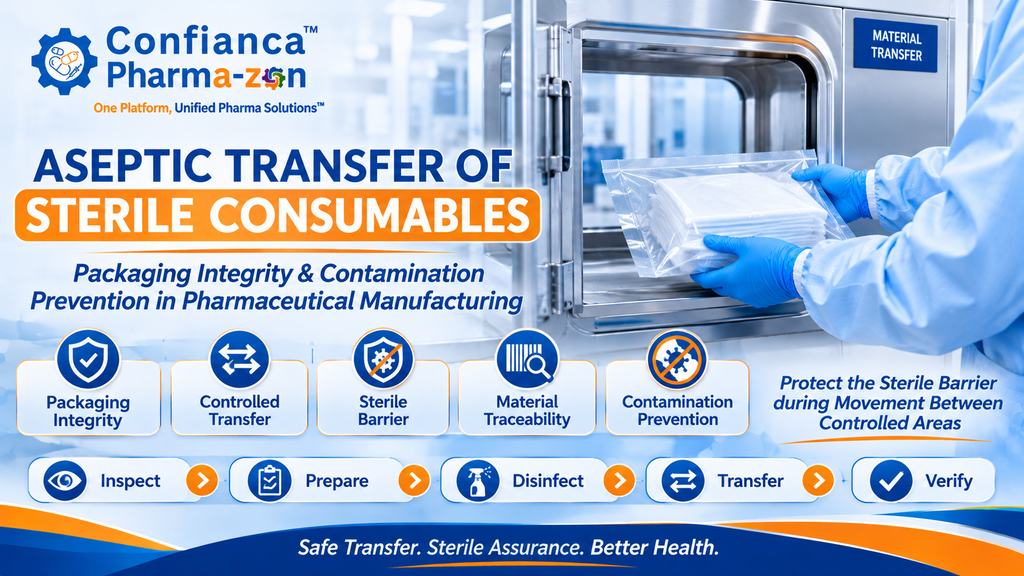
6. Developing an Effective Sterile Consumable Transfer Procedure
A controlled transfer procedure should define the movement of consumables from receipt to point of use.
Step 1: Material Receipt
At goods receipt, verify:
- Product name.
- Supplier.
- Batch or lot number.
- Quantity.
- Packaging condition.
- Sterilization information.
- Expiry or retest information, where applicable.
- Purchase specifications.
Any damaged or questionable packaging should be handled according to the receiving procedure.
Step 2: Quarantine and Quality Review
Materials should be placed in the designated storage or quarantine status until the required checks and release activities are completed.
Quality documentation may include:
- Certificate of Analysis, where applicable.
- Certificate of Irradiation or sterilization documentation, as relevant.
- Product specification.
- Technical data sheet.
- Declaration of conformity, where applicable.
- Supplier qualification records.
The exact documentation depends on the product and intended application.
Step 3: Controlled Storage
Sterile consumables should be stored according to the manufacturer’s specified conditions.
Storage requirements may include:
- Temperature limits.
- Humidity limits.
- Protection from direct sunlight.
- Packaging protection.
- Defined shelf-life conditions.
- Segregation of released and rejected materials.
Storage arrangements should prevent unnecessary damage to sterile packaging.
Step 4: Material Preparation
Before transfer, the required quantity of consumables should be identified and prepared.
Preparation activities should follow approved procedures.
For example, operators may need to inspect outer packaging, verify material identity, and prepare the required items for transfer.
Step 5: Outer Packaging Removal
Where applicable, outer packaging should be removed in the designated preparation area.
Operators should follow a defined sequence to prevent the outer packaging from contacting the inner packaging or exposed sterile product.
The procedure should specify:
- Which packaging layer can be removed.
- Where removal is permitted.
- How the inner package is protected.
- How waste packaging is discarded.
- Which surfaces may contact the inner package.
Step 6: Disinfection and Transfer
The exposed packaging surface may require an approved disinfection process before entry into the next controlled area.
The disinfectant, concentration, contact time, application method, and compatibility should be established through approved procedures.
Operators should avoid transferring wet packaging or using incompatible disinfectants.
Step 7: Entry Into the Target Area
The final transfer should follow the site’s approved material transfer procedure.
Depending on the facility design, this may involve:
- Material airlocks.
- Pass boxes.
- Dynamic pass-through systems.
- Interlocked transfer arrangements.
- Other qualified transfer systems.
The transfer procedure should reflect the cleanroom classification and contamination control strategy.
Step 8: Point-of-Use Verification
Before opening the final package, the operator should confirm:
- Correct material identity.
- Package integrity.
- Expiry status.
- Required sterile status.
- Correct quantity.
- Suitability for the intended operation.
Only acceptable materials should be released for use.
7. Sterile Consumables Used in Different Pharmaceutical Applications
Different manufacturing operations require different consumables.
7.1 Sterile Gloves
Sterile gloves are important for aseptic operations where hand contact may influence contamination control.
Selection considerations include:
- Material composition.
- Size.
- Length.
- Dexterity.
- Chemical compatibility.
- Sterilization method.
- Packaging.
- Intended cleanroom application.
For isolators and restricted-access barrier systems, glove selection should also consider the equipment design and application.
7.2 Sterile Cleanroom Wipes
Sterile wipes are used for cleaning and disinfection activities in controlled manufacturing environments.
Important characteristics include:
- Low particle generation.
- Low linting.
- Suitable material composition.
- Appropriate absorbency.
- Chemical compatibility.
- Sterile status.
- Packaging integrity.
The wipe should be appropriate for the surface and cleaning agent.
7.3 Sterile Tubing and Connectors
Tubing and connectors may be used for fluid transfer, sampling, filtration, and other manufacturing activities.
Selection considerations include:
- Material compatibility.
- Internal diameter.
- Pressure rating.
- Flexibility.
- Extractables and leachables.
- Connection integrity.
- Sterilization compatibility.
The suitability of tubing should be assessed for the actual fluid, temperature, pressure, and process conditions.
7.4 Sterile Filters
Sterile filtration components are important in selected pharmaceutical manufacturing applications.
For sterilizing-grade filtration, filter selection and qualification should consider applicable requirements, including microbial retention, compatibility, integrity testing, and process-specific validation.
Relevant considerations include:
- Nominal or rated pore characteristics.
- Membrane material.
- Chemical compatibility.
- Flow characteristics.
- Extractables and leachables.
- Filter integrity.
- Product recovery.
A filter’s nominal pore size alone does not establish its suitability for sterilizing filtration.
7.5 Sterile Funnels and Sampling Accessories
Sterile funnels and sampling accessories can support laboratory testing, microbiological activities, and selected manufacturing operations.
Selection should consider:
- Material of construction.
- Sterilization status.
- Product compatibility.
- Packaging.
- Intended use.
- Handling requirements.
8. Contamination Risks During Sterile Consumable Handling
Contamination risks can arise at different points in the consumable lifecycle.
Personnel-Related Risks
Improper gowning, incorrect glove handling, and unnecessary contact with critical surfaces can introduce contamination.
Preventive measures include:
- Regular training.
- Approved gowning procedures.
- Proper hand hygiene.
- Controlled movements.
- Appropriate material handling.
Packaging-Related Risks
Damaged packaging, incorrect removal sequences, and inappropriate handling may compromise protection.
Preventive measures include:
- Visual package inspection.
- Defined transfer procedures.
- Packaging integrity verification.
- Controlled waste disposal.
Environmental Risks
Uncontrolled material movement may increase contamination risks.
Preventive measures include:
- Appropriate cleanroom classification.
- Material flow controls.
- Qualified transfer arrangements.
- Environmental monitoring.
- Contamination control procedures.
Material-Related Risks
Some materials may shed particles or release chemical substances under particular operating conditions.
Preventive measures include:
- Supplier evaluation.
- Material compatibility assessment.
- Appropriate technical documentation.
- Product-contact suitability assessment.
9. Extractables and Leachables: An Important Consideration
Extractables and leachables are important considerations when selecting polymeric consumables and product-contact materials.
Extractables are chemical substances that may be released from a material under controlled, often exaggerated extraction conditions.
Leachables are substances that migrate from a material into the actual product or process environment under relevant conditions.
Potential sources include:
- Tubing.
- Plastic bags.
- Connectors.
- Filters.
- Elastomeric components.
- Product-contact containers.
The significance of extractables and leachables depends on the material, product formulation, contact time, temperature, and manufacturing conditions.
Manufacturers should assess available supplier studies and determine whether additional evaluation is needed for their specific application.
10. Supplier Qualification and Documentation
Reliable sterile consumable management requires appropriate supplier evaluation.
The supplier assessment should consider:
- Manufacturing capabilities.
- Quality management system.
- Product specifications.
- Sterilization controls.
- Packaging configuration.
- Traceability.
- Change notification.
- Complaint handling.
- Product consistency.
- Technical support.
Depending on the product, manufacturers may request:
- Certificate of Analysis.
- Sterilization certificate or relevant batch documentation.
- Product technical data sheet.
- Material composition information.
- Packaging specifications.
- Shelf-life information.
- Extractables and leachables data, where relevant.
- Applicable compliance declarations.
Supplier documentation should be reviewed for relevance and completeness rather than accepted without evaluation.
11. Establishing a Sterile Consumable Inventory Management System
Effective inventory management helps prevent the use of unsuitable, expired, or incorrectly stored consumables.
A controlled inventory system should include:
- Unique material identification.
- Supplier information.
- Batch traceability.
- Receipt date.
- Expiry date.
- Storage location.
- Release status.
- Quantity management.
- Usage records, where required.
First-expiry-first-out (FEFO) principles can help manage materials with defined expiry dates.
Regular inventory reviews should identify expired, damaged, or incorrectly stored materials.
Digital inventory systems can further improve traceability and reduce manual documentation errors.
12. Regulatory and Quality Considerations
Sterile consumable management should be integrated into the pharmaceutical site’s contamination control strategy and quality management system.
Relevant references may include:
- EU GMP Annex 1: Manufacture of Sterile Medicinal Products.
- Applicable national GMP requirements.
- ISO 14644 series for cleanrooms and associated controlled environments.
- ISO 11135 for ethylene oxide sterilization of health care products.
- ISO 11137 series for radiation sterilization.
- ISO 17665 for moist heat sterilization.
- Applicable material-specific and product-specific standards.
The relevance of each standard depends on the consumable and its intended application.
Pharmaceutical manufacturers should also consider the supplier’s validated sterilization process and the specific product’s documentation.
A sterile consumable should not be considered suitable merely because it meets a general cleanroom requirement. Its suitability must be assessed against the intended pharmaceutical application.
13. Common Mistakes in Sterile Consumable Management
Mistake 1: Assuming all sterile products can be used in every cleanroom
Different areas have different contamination control requirements.
Mistake 2: Ignoring packaging integrity
A damaged sterile barrier can compromise the suitability of the consumable.
Mistake 3: Removing packaging too early
Unnecessary exposure may increase contamination risks.
Mistake 4: Ignoring sterilization compatibility
Different materials respond differently to sterilization technologies.
Mistake 5: Incomplete supplier documentation
Missing traceability or sterilization information may create difficulties during quality review.
Mistake 6: Improper storage
Storage outside specified conditions may affect packaging and material suitability.
Mistake 7: Inadequate personnel training
Even a high-quality sterile consumable can be mishandled if operators are not trained in the applicable transfer procedure.
14. How Confianca Pharmazon Supports Sterile Manufacturing Requirements
Confianca Pharmazon provides pharmaceutical products and consumable solutions to support pharmaceutical manufacturing, quality control, and microbiology operations.
Our product portfolio includes relevant categories such as:
- Sterile and non-sterile QC and microbiology supplies.
- Centrifuge tubes.
- Cell spreaders.
- Sterile M-Funnels.
- Disposable gloves.
- Piercan gloves for isolators and barrier systems.
- Dry wipes.
- Filtration-related consumables.
- Pharmaceutical packaging and process accessories.
- Other specialized pharmaceutical consumables.
The selection of consumables should always consider application requirements, material specifications, documentation, and compatibility.
Our objective is to support pharmaceutical manufacturers in identifying suitable products for their operational requirements.
15. Future Trends in Sterile Consumable Management
The pharmaceutical industry is increasingly focusing on improved contamination control, single-use technologies, material traceability, and digital quality management.
Some important developments include:
Advanced single-use systems: More integrated single-use assemblies are being adopted for selected pharmaceutical manufacturing processes.
Improved packaging technologies: Better packaging designs can support product protection and controlled material transfer.
Digital traceability: Electronic inventory and material tracking systems can improve batch traceability.
Material compatibility assessment: Greater attention is being given to extractables, leachables, and product-contact suitability.
Risk-based contamination control: Facilities are increasingly integrating material transfer risks into their overall contamination control strategy.
Automation: Automated transfer and material management systems may reduce unnecessary manual handling in suitable applications.
Frequently Asked Questions (FAQs)
1. What are sterile consumables in pharmaceutical manufacturing?
Sterile consumables are products supplied with an appropriately established sterile status for use in pharmaceutical manufacturing, laboratory, and cleanroom applications.
2. What is aseptic transfer of sterile consumables?
Aseptic transfer is the controlled movement of materials into cleanroom or critical processing areas while minimizing contamination risks.
3. Why is packaging integrity important for sterile consumables?
Packaging protects the product from external contamination. Damage to the sterile barrier may compromise the product’s suitability for use.
4. Which sterilization methods are commonly used for sterile consumables?
Common methods include gamma irradiation, electron beam irradiation, ethylene oxide, and moist heat sterilization, depending on product and material suitability.
5. What is the difference between primary and secondary packaging?
Primary packaging provides the product’s immediate protective packaging, while secondary packaging provides an additional protective layer.
6. Can sterile consumables be transferred directly into an aseptic area?
They should be transferred through an approved material transfer procedure appropriate to the facility design, cleanroom classification, and contamination control strategy.
7. What documentation should be reviewed before using sterile consumables?
Relevant documentation may include product specifications, sterilization records, certificates, technical data sheets, batch information, and shelf-life details.
8. What are extractables and leachables?
Extractables are substances released under defined extraction conditions, while leachables migrate into the actual product or process environment under relevant conditions.
9. How should sterile consumables be stored?
They should be stored according to the manufacturer’s specified conditions, with protection from packaging damage, moisture, and unsuitable environmental exposure.
10. Why is supplier qualification important for sterile consumables?
Supplier qualification helps verify product consistency, manufacturing controls, sterilization documentation, traceability, and suitability for the intended application.
Conclusion
Sterile consumables are essential to pharmaceutical manufacturing, but their suitability depends on more than their initial sterile status.
Packaging integrity, sterilization compatibility, storage, material handling, supplier documentation, and controlled aseptic transfer all contribute to maintaining product suitability throughout the material lifecycle.
A well-designed sterile consumable management programme helps pharmaceutical manufacturers reduce contamination risks, improve material traceability, and support reliable cleanroom operations.
By integrating controlled material transfer procedures with appropriate supplier qualification and contamination control practices, organizations can strengthen their sterile manufacturing systems.
Confianca Pharmazon supports pharmaceutical manufacturers with a range of QC, microbiology, sterile consumable, and specialized pharmaceutical product solutions to help meet their manufacturing and operational requirements.