No products in the cart.
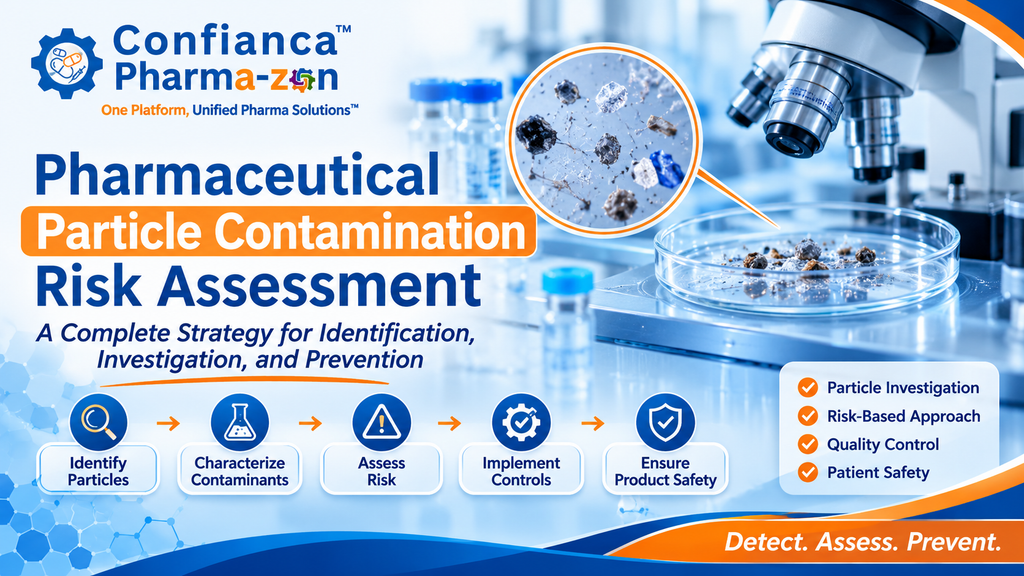
Pharmaceutical Particle Contamination Risk Assessment: A Complete Strategy for Identification, Investigation, and Prevention
Introduction
Particulate contamination is one of the important quality concerns in pharmaceutical manufacturing, particularly in products administered through parenteral routes. The presence of unintended particles in pharmaceutical formulations can indicate potential contamination, material degradation, manufacturing deficiencies, packaging-related issues, or environmental influences.
For pharmaceutical manufacturers, identifying a particle is only one part of an effective investigation. Understanding its potential origin, assessing its risk, evaluating its impact on product quality, and implementing preventive measures are equally important.
A comprehensive pharmaceutical particle contamination risk assessment helps manufacturers move beyond simple particle detection and establish a systematic approach to contamination investigation and prevention.
Particle characterization in pharmaceuticals provides valuable analytical information about the physical and chemical properties of foreign particles. When combined with manufacturing knowledge, process investigation, microscopy, and elemental analysis, it can support more reliable root-cause investigations.
This article explains how pharmaceutical companies can develop a structured particle contamination risk assessment strategy, evaluate contamination sources, select suitable analytical techniques, and establish effective preventive controls.
1. Understanding Pharmaceutical Particle Contamination
Pharmaceutical particle contamination refers to the presence of unintended particulate matter in a drug product, raw material, process intermediate, packaging component, or manufacturing environment.
Particles may originate from several sources, including:
- Raw materials and excipients.
- Glass containers, ampoules, and vials.
- Elastomeric closures and rubber components.
- Stainless steel manufacturing equipment.
- Polymer tubing and single-use assemblies.
- Filters and filtration systems.
- Personnel-related contamination.
- Environmental dust and airborne particles.
- Packaging and transportation activities.
The nature of the contamination depends on the manufacturing process, product formulation, equipment configuration, and materials used.
For example, a metallic particle identified in an injectable product may indicate possible equipment wear, whereas a glass particle may require an investigation of container integrity, handling, or manufacturing operations.
Similarly, polymeric particles may be associated with tubing, seals, plastic components, or single-use systems.
Understanding the possible sources is essential because different particle types require different investigation strategies.
2. Why Particle Contamination Risk Assessment Is Important
Particle contamination assessment should not be limited to determining whether a particle is present. Manufacturers must evaluate the potential consequences of contamination.
A structured assessment supports:
Patient safety: Foreign particulate matter in injectable products may create potential patient risks. The significance depends on particle characteristics, exposure, route of administration, and applicable product requirements.
Product quality: Unexpected particles may indicate deviations in manufacturing or packaging processes.
Regulatory compliance: Pharmaceutical manufacturers are expected to investigate quality defects, document findings, and establish appropriate corrective and preventive actions.
Process improvement: Particle investigations can identify recurring contamination sources and opportunities to strengthen manufacturing controls.
Supplier quality: Identifying the material composition of particles can help determine whether raw materials, components, or supplied consumables require further investigation.
A strong assessment connects analytical findings with the manufacturing process and quality management system.
3. Establishing a Risk-Based Particle Investigation Framework
An effective particle contamination risk assessment should follow a structured framework.
Step 1: Define the Contamination Event
The investigation should begin with a clear description of the observed contamination.
Relevant information includes:
- Product name and batch number.
- Manufacturing date.
- Container type and size.
- Stage at which the particle was detected.
- Number of affected units.
- Particle appearance.
- Approximate particle dimensions.
- Location of observation.
- Relevant manufacturing deviations.
Photographs and microscopy images should be collected wherever possible.
The initial description must distinguish between observed facts and assumptions.
Step 2: Determine the Potential Impact
The next step is to evaluate the possible impact of the contamination.
Important considerations include:
- Product administration route.
- Product formulation.
- Particle dimensions.
- Particle morphology.
- Chemical composition, when known.
- Potential number of particles per unit.
- Possibility of recurrence.
- Batch distribution and affected population.
A risk assessment should be scientifically justified and aligned with the company’s approved quality risk management procedure.
Step 3: Identify Potential Contamination Sources
The investigation team should review the complete manufacturing pathway.
Potential sources can be grouped into five major categories:
- Material-related sources.
- Equipment-related sources.
- Process-related sources.
- Environmental sources.
- Packaging-related sources.
A process flow diagram can help identify the points where particles may enter the product.
Step 4: Select Appropriate Analytical Techniques
The analytical strategy should be selected according to the particle’s characteristics and the investigation objective.
Different techniques provide different types of information. Therefore, combining complementary techniques may be more useful than depending on a single analytical method.
Step 5: Evaluate Findings and Establish CAPA
The final investigation should connect analytical evidence with potential sources, assess the associated risk, and recommend corrective and preventive actions.
The effectiveness of CAPA should subsequently be evaluated using appropriate monitoring and verification activities.
4. Analytical Techniques Used in Pharmaceutical Particle Characterization
Particle characterization provides scientific evidence that supports contamination investigations.
4.1 Optical Microscopy
Optical microscopy is commonly used for preliminary examination of particulate matter.
It helps assess:
- Particle shape.
- Surface appearance.
- Colour.
- Approximate dimensions.
- Transparency and opacity.
- Agglomeration.
- Surface irregularities.
Optical microscopy is particularly useful during initial investigations because it provides visual information that can guide the selection of further analytical techniques.
However, visual appearance alone cannot establish the chemical identity of an unknown particle.
4.2 Scanning Electron Microscopy (SEM)
Scanning Electron Microscopy provides detailed information about particle surface morphology.
SEM can help identify:
- Surface texture.
- Fracture patterns.
- Structural irregularities.
- Particle agglomeration.
- Distinctive physical characteristics.
It is especially useful when particles are too small or structurally complex for adequate examination using conventional optical microscopy.
4.3 Energy Dispersive X-Ray Spectroscopy (EDS)
Energy Dispersive X-Ray Spectroscopy is used alongside SEM to obtain elemental information.
EDS can help identify elements such as:
- Iron.
- Chromium.
- Nickel.
- Silicon.
- Aluminium.
- Calcium.
- Copper.
- Zinc.
- Sulphur.
For example, the presence of iron, chromium, and nickel may support an investigation into possible stainless-steel-related contamination.
However, elemental composition should not automatically be treated as proof of a specific source. Different materials may contain similar elements.
The findings must be compared with reference materials, equipment specifications, manufacturing records, and other relevant evidence.
4.4 Fourier Transform Infrared Spectroscopy (FTIR)
FTIR is useful for identifying many organic materials.
It can support the investigation of:
- Polymeric particles.
- Rubber-related materials.
- Fibres.
- Organic residues.
- Certain packaging-related contaminants.
The technique provides molecular information based on infrared absorption characteristics.
4.5 Raman Spectroscopy
Raman spectroscopy can provide molecular fingerprint information for suitable materials.
It may be useful for investigating:
- Certain polymeric contaminants.
- Pigments.
- Organic particles.
- Some inorganic compounds.
- Crystalline materials.
The suitability of Raman analysis depends on particle size, fluorescence, material properties, and sample condition.
4.6 Complementary Analytical Methods
Depending on the contamination event, additional methods may include:
- X-ray diffraction for crystalline material identification.
- Thermal analysis for selected polymeric materials.
- Ion chromatography for relevant ionic species.
- Elemental analysis for specific investigation objectives.
- Particle counting and sizing techniques.
The analytical plan should be justified according to the nature of the sample and the question being investigated.
5. Developing a Particle Source Identification Matrix
A particle source identification matrix can help investigation teams organize possible contamination origins.
| Particle characteristics | Possible sources to investigate |
|---|---|
| Metallic appearance | Equipment, tools, metallic components |
| Glass-like appearance | Vials, ampoules, glass equipment |
| Transparent polymeric appearance | Tubing, seals, plastic components |
| Fibrous appearance | Garments, wipes, filters, packaging |
| Rubber-like appearance | Elastomeric closures, gloves, seals |
| Mineral-like appearance | Raw materials, environmental dust |
| Coated or layered appearance | Packaging, equipment surfaces, material degradation |
This matrix is an investigation aid, not a definitive identification guide.
A final conclusion should be supported by analytical results and process-related evidence.
6. Risk Evaluation: Assessing the Significance of Identified Particles
Not every particle presents the same level of risk.
A scientific evaluation should consider several factors.
Particle size: Particle dimensions can influence detection, characterization, and potential product impact. Size should be evaluated using a suitable measurement method.
Particle shape: Fibres, flakes, angular fragments, and spherical particles may behave differently.
Chemical composition: Material identity can help determine whether the particle is associated with product ingredients, packaging, equipment, or another source.
Exposure route: The product’s intended route of administration is an important consideration.
Frequency of occurrence: Repeated findings may indicate a systematic problem rather than an isolated event.
Distribution: Contamination observed in one unit may require a different investigation scope from contamination detected across multiple batches.
Risk evaluation should follow an approved and documented methodology rather than relying on assumptions.
7. Connecting Particle Characterization With Pharmaceutical Manufacturing Operations
Analytical results become more valuable when linked to manufacturing operations.
For example:
Filling operations: Investigate product-contact components, filling needles, transfer lines, pumps, and equipment wear.
Filtration operations: Examine filter integrity, assembly conditions, compatibility, and possible material shedding.
Container washing: Review washing conditions, container handling, and possible glass-related contamination.
Sterilization operations: Investigate equipment, packaging, material compatibility, and potential degradation.
Aseptic processing: Review personnel practices, environmental monitoring trends, transfer operations, and contamination control measures.
A multidisciplinary investigation involving Quality Assurance, Quality Control, Engineering, Production, and Microbiology can improve the quality of conclusions.
8. Building a Pharmaceutical Particle Contamination Control Strategy
An effective contamination control strategy should include preventive controls at different stages.
Raw Material Controls
- Establish appropriate material specifications.
- Evaluate suppliers.
- Review incoming material quality.
- Investigate unexpected particulate findings.
- Maintain appropriate storage conditions.
Equipment Controls
- Establish preventive maintenance programmes.
- Inspect product-contact surfaces.
- Evaluate equipment wear.
- Review cleaning procedures.
- Assess component compatibility.
Process Controls
- Evaluate filtration operations.
- Control material transfer.
- Establish appropriate handling practices.
- Review process deviations.
- Monitor recurring contamination events.
Personnel and Environmental Controls
- Establish gowning procedures.
- Train personnel.
- Maintain cleanroom discipline.
- Monitor environmental conditions.
- Investigate unusual contamination trends.
Packaging Controls
- Evaluate container and closure components.
- Review packaging integrity.
- Investigate glass-related defects.
- Assess the suitability of product-contact materials.
9. Documentation Requirements for Particle Contamination Investigations
A technically sound investigation must also be properly documented.
Recommended documentation includes:
- Initial contamination observation.
- Sample identification and traceability.
- Sample receipt and condition.
- Analytical methodology.
- Instrument details.
- Microscopy photographs.
- SEM images, where applicable.
- EDS spectra and elemental results.
- Relevant analytical limitations.
- Potential source assessment.
- Risk evaluation.
- Root-cause investigation.
- CAPA recommendations.
- Final scientific conclusion.
The report should distinguish between confirmed findings, possible sources, and unresolved uncertainties.
This is especially important when analytical evidence supports a probable source but cannot establish the exact origin.
10. Common Mistakes in Pharmaceutical Particle Investigations
Several mistakes can reduce the reliability of particle contamination investigations.
Mistake 1: Depending only on visual appearance
A particle that looks metallic may not necessarily be metallic. Further analysis may be required.
Mistake 2: Assuming elemental composition confirms the source
EDS identifies elements but does not automatically identify the exact equipment or component from which a particle originated.
Mistake 3: Ignoring manufacturing history
Analytical results should be evaluated alongside batch records, maintenance records, deviations, and process information.
Mistake 4: Using unsuitable analytical methods
The method must be appropriate for the particle’s size, material, and condition.
Mistake 5: Closing investigations without effectiveness checks
CAPA implementation does not automatically demonstrate that the original contamination source has been eliminated.
11. How Confianca Pharmazon Supports Particle Characterization Requirements
Confianca Pharmazon supports pharmaceutical manufacturers with specialized particle characterization solutions and analytical services.
Particle characterization can help pharmaceutical organizations obtain meaningful information about unknown particles and support their technical investigations.
Relevant areas of support include:
- Particle characterization services.
- Microscopic examination.
- SEM-EDS-based elemental investigation.
- Particle morphology assessment.
- Technical analytical documentation.
- Pharmaceutical contamination investigation support.
By combining appropriate analytical approaches with scientific interpretation, pharmaceutical manufacturers can strengthen their understanding of particulate contamination and support more informed quality decisions.
12. Future of Pharmaceutical Particle Contamination Investigation
The future of particle contamination investigation is expected to involve greater integration of analytical technologies, digital documentation, image-based analysis, and data-driven quality management.
Potential developments include:
- Digital microscopy and image management.
- Automated particle classification.
- Advanced elemental mapping.
- Improved analytical data integration.
- Trend analysis across manufacturing batches.
- Digital investigation workflows.
Artificial intelligence may assist with image classification and pattern recognition, but analytical verification and qualified scientific interpretation remain essential.
The objective should be to improve investigation efficiency without compromising scientific reliability.
Frequently Asked Questions (FAQs)
1. What is pharmaceutical particle contamination risk assessment?
It is a systematic evaluation of particulate contamination, including its potential origin, characteristics, product impact, and associated risks.
2. Why is particle characterization important in pharmaceutical manufacturing?
Particle characterization provides information about particle morphology, dimensions, and chemical or elemental composition, supporting contamination investigations and quality decisions.
3. Which analytical techniques are used for particle identification?
Commonly used methods include optical microscopy, SEM, EDS, FTIR, and Raman spectroscopy. The selection depends on the sample and investigation objective.
4. What is the difference between SEM and EDS?
SEM provides detailed surface imaging, while EDS provides elemental information. Both techniques can be used together for particle characterization.
5. Can EDS identify the exact source of contamination?
No. EDS identifies elements present in the analysed region. Source identification requires comparison with reference materials and manufacturing evidence.
6. What are common sources of particles in injectable products?
Potential sources include glass containers, elastomeric closures, equipment, tubing, filters, environmental contamination, and raw materials.
7. How should pharmaceutical companies investigate unknown particles?
They should document the finding, preserve sample traceability, select appropriate analytical methods, evaluate potential sources, assess product risk, and establish justified CAPA.
8. Is particle size sufficient to determine contamination risk?
No. Risk assessment should also consider particle composition, morphology, exposure route, frequency, and product-specific factors.
9. What is the role of SEM-EDS in contamination investigations?
SEM-EDS combines detailed particle imaging with elemental analysis, helping investigators compare unknown particles with potential source materials.
10. How can particle contamination be prevented?
Prevention requires appropriate material controls, equipment maintenance, process controls, environmental practices, personnel training, and an effective contamination control strategy.
Conclusion
Pharmaceutical particle contamination risk assessment is an important element of product quality management, particularly for injectable pharmaceutical products.
Identifying an unexpected particle is only the beginning of a successful investigation. Understanding its physical and chemical characteristics, evaluating possible sources, assessing product impact, and establishing effective preventive measures are essential for building a reliable contamination control programme.
By integrating particle characterization techniques such as microscopy, SEM-EDS, FTIR, and other suitable analytical methods, pharmaceutical manufacturers can develop stronger scientific evidence for contamination investigations.
A structured, risk-based approach helps organizations improve investigation quality, strengthen manufacturing controls, and support patient safety.
Confianca Pharmazon supports pharmaceutical manufacturers with particle characterization solutions and technical services designed to strengthen analytical understanding and pharmaceutical quality management.