No products in the cart.
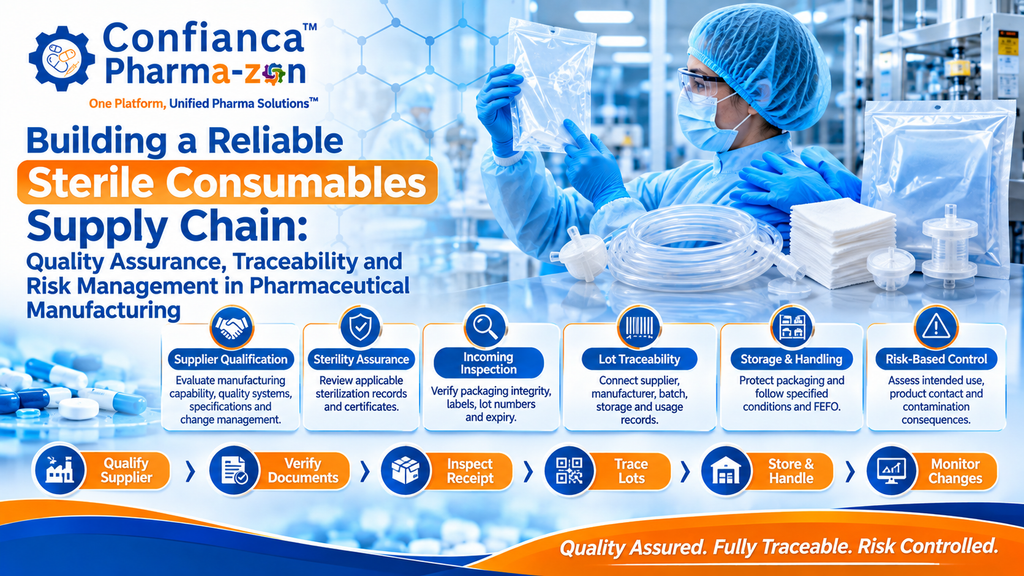
Building a Reliable Sterile Consumables Supply Chain: Quality Assurance, Traceability and Risk Management in Pharmaceutical Manufacturing
1. Introduction: Why Sterile Consumables Supply Chain Quality Matters
Sterile pharmaceutical manufacturing depends on a controlled combination of facilities, equipment, processes, trained personnel and qualified materials.
Although significant attention is generally given to manufacturing equipment, sterilization systems and environmental monitoring, the quality of consumables used throughout sterile operations is equally important.
Sterile gloves, sterile wipes, sterile tubing, filtration components, sampling accessories, sterile bags, transfer materials and other consumables may be used in different stages of pharmaceutical manufacturing.
These products can influence manufacturing operations, contamination control and the reliability of aseptic processes.
However, ensuring that the right consumables are available at the right time is only one part of the challenge.
Pharmaceutical manufacturers must also establish confidence in their suppliers, verify product documentation, maintain traceability, control incoming materials and ensure that supplied products meet their intended requirements.
A sterile consumable should not be accepted merely because its packaging carries the word “sterile”.
Its suitability depends on several factors, including the manufacturing process, material characteristics, sterilization information, packaging integrity, documentation and intended application.
An unreliable sterile consumables supply chain can create operational interruptions, additional qualification activities, material rejection and potential quality risks.
Therefore, a structured supplier quality and material management programme is essential.
This article explains how pharmaceutical organizations can strengthen sterile consumables supply chain management through supplier evaluation, documentation control, traceability, incoming inspection and quality risk management.
2. Understanding Sterile Consumables in Pharmaceutical Manufacturing
Sterile consumables are products intended for use in controlled pharmaceutical operations where sterility is required for the intended application.
They may be used in manufacturing, sampling, product transfer, filling, laboratory activities and other controlled processes.
Examples include:
2.1 Sterile Gloves
Sterile gloves are used by personnel performing activities where hand contamination control is essential.
Depending on the application, materials may include nitrile, latex or other suitable glove materials.
Selection should consider:
- Sterility status.
- Material composition.
- Size availability.
- Physical integrity.
- Chemical compatibility.
- Intended cleanroom application.
- Packaging configuration.
- Relevant product documentation.
2.2 Sterile Wipes
Sterile wipes are used for cleaning and controlled wiping activities in suitable pharmaceutical environments.
Important selection considerations include:
- Fibre shedding characteristics.
- Absorbency.
- Material composition.
- Sterility status.
- Packaging.
- Chemical resistance.
- Cleanroom suitability.
2.3 Sterile Tubing
Sterile tubing may be used in product transfer, sampling and process connections.
Selection depends on:
- Material composition.
- Internal diameter.
- External diameter.
- Pressure requirements.
- Temperature conditions.
- Chemical compatibility.
- Connection configuration.
- Sterilization method.
- Intended product-contact application.
2.4 Sterile Filtration Components
Sterile filtration-related consumables may include suitable filter assemblies, capsules, cartridges and associated accessories.
Important considerations include the intended filtration purpose, membrane characteristics, product compatibility, integrity-testing requirements and supplier documentation.
2.5 Sterile Bags and Transfer Accessories
Sterile bags and transfer accessories may be used in material handling and controlled transfer operations.
Their suitability depends on material properties, intended use, packaging, sterilization information and the specific manufacturing process.
2.6 Other Pharmaceutical Consumables
Depending on the operation, pharmaceutical facilities may also require:
- Sterile sampling accessories.
- Sterile connectors.
- Sterile funnels.
- Sterile bottles and containers.
- Cleanroom garments.
- Sterile protective accessories.
- Suitable product-contact components.
- Specialized laboratory consumables.
Not every consumable used in a cleanroom is necessarily sterile. The required status must be defined according to its intended use.
3. Why Supplier Qualification Is the Foundation of Sterile Consumables Quality
A pharmaceutical manufacturer may receive materials from several suppliers, distributors and manufacturers.
However, the quality of the final supplied product depends on the controls applied throughout the supply chain.
Supplier qualification is therefore a critical component of material management.
The objective is to establish whether a supplier can consistently provide products meeting predefined technical, quality and documentation requirements.
3.1 Supplier Evaluation Criteria
A supplier evaluation programme may include:
Manufacturing capability: Evaluate whether the manufacturer has appropriate facilities, production controls and quality systems.
Quality management system: Review relevant quality certifications, procedures and quality assurance practices.
Product specifications: Verify that the supplier can consistently meet the required specifications.
Sterilization controls: Review the applicable sterilization process and supporting documentation where relevant.
Documentation capability: Confirm the availability of required certificates, declarations and technical information.
Traceability: Evaluate the supplier’s ability to identify manufacturing lots and maintain distribution records.
Change management: Determine how product, material, manufacturing and sterilization changes are communicated.
Complaint management: Review the supplier’s system for investigating quality complaints and implementing corrective actions.
3.2 Importance of Manufacturer Identification
A distributor and a manufacturer may be different organizations.
Pharmaceutical procurement teams should establish the identity of the actual manufacturer and understand the responsibilities of each supply chain participant.
This is particularly important when evaluating product specifications, sterilization information, material declarations and manufacturing changes.
4. Sterility Assurance and Documentation Requirements
Sterility assurance is an important consideration when purchasing consumables intended for sterile manufacturing operations.
A product’s sterile status should be supported by appropriate manufacturing and sterilization controls and relevant documentation.
Depending on the product, process and applicable requirements, documentation may include:
- Certificate of Analysis (CoA), where applicable.
- Certificate of Conformance (CoC).
- Sterility certificate or sterilization release documentation.
- Sterilization method information.
- Lot or batch identification.
- Product specification.
- Material declaration.
- Technical data sheet.
- Packaging information.
- Relevant validation or qualification information.
- Applicable regulatory or quality declarations.
The required documentation should be established during supplier qualification and purchasing approval.
4.1 Understanding Different Sterilization Methods
Sterile consumables may be sterilized using different methods, depending on the material and product design.
Common approaches include:
Gamma irradiation: Uses ionizing radiation to achieve the intended sterilization outcome.
Electron beam sterilization: Uses high-energy electrons for microbial inactivation.
Ethylene oxide sterilization: Uses ethylene oxide gas under controlled processing conditions.
Moist heat sterilization: Uses saturated steam under defined conditions where suitable for the material and product.
The selected method must be appropriate for the specific consumable.
Not every material is compatible with every sterilization method.
For example, certain polymers may undergo changes in mechanical, chemical or physical properties following sterilization.
Therefore, manufacturers should evaluate the suitability of the sterilization process for the product and its intended application.
4.2 Why a Sterility Certificate Is Not the Entire Quality Assessment
A sterility certificate provides relevant evidence about the supplied product’s sterilization status, according to the scope of the document.
However, it does not independently establish every aspect of product suitability.
The manufacturer should also consider:
- Packaging integrity.
- Product identification.
- Material specifications.
- Lot traceability.
- Storage requirements.
- Transport conditions.
- Intended application.
- Remaining shelf life.
A complete material acceptance decision should consider all applicable quality requirements.
5. Incoming Inspection and Material Acceptance
Incoming inspection is an important control point in the sterile consumables supply chain.
Even when products are sourced from approved suppliers, pharmaceutical organizations should establish appropriate receipt and verification procedures.
5.1 Packaging Inspection
Packaging protects sterile products during storage and distribution.
Incoming inspection may include checking:
- Packaging integrity.
- Seal condition.
- Visible damage.
- Moisture exposure.
- Contamination indicators.
- Label readability.
- Product identification.
- Lot number.
- Expiry or use-by date.
Damaged packaging should be evaluated according to approved procedures before material release.
5.2 Documentation Verification
Incoming documentation should be compared against the purchase order and approved specifications.
For example, the receiving team may verify that:
- Product descriptions match the order.
- Lot numbers match the supplied documents.
- Required certificates are available.
- Sterility information is applicable.
- Product dimensions meet requirements.
- Storage conditions are specified.
- Expiry dates meet acceptance criteria.
5.3 Material Quarantine and Release
Materials should follow the manufacturer’s approved receiving and release procedure.
Where required, newly received consumables should remain in a controlled status until documentation and inspection requirements are completed.
The material management system should clearly identify whether a product is:
- Received.
- Under inspection.
- Quarantined.
- Approved.
- Rejected.
This reduces the risk of unintended use before acceptance.
6. Lot Traceability and Supply Chain Transparency
Traceability is essential for maintaining control over pharmaceutical manufacturing materials.
In the event of a supplier complaint, packaging defect or product-quality investigation, the manufacturer should be able to identify the affected material lots.
A traceability system may record:
- Supplier name.
- Actual manufacturer.
- Product code.
- Description.
- Purchase order.
- Received quantity.
- Lot number.
- Manufacturing date.
- Expiry date.
- Sterilization batch information, where applicable.
- Certificate references.
- Storage location.
- Issued quantity.
- Department or production batch where used.
6.1 Why Lot-Level Traceability Matters
Consider a situation in which a supplier communicates a quality concern affecting a particular manufacturing lot of sterile gloves.
If the pharmaceutical manufacturer maintains appropriate lot-level records, it can identify the received quantity, remaining inventory and relevant internal usage information.
Without reliable traceability, identifying affected materials may become difficult and time-consuming.
Traceability therefore supports effective investigation, material control and supplier communication.
7. Storage and Handling of Sterile Consumables
Sterile consumables should be stored and handled according to the manufacturer’s instructions and approved internal procedures.
Incorrect storage or unnecessary handling may compromise packaging integrity or affect product suitability.
Important controls include:
Storage environment: Maintain specified temperature, humidity and other storage conditions where applicable.
Packaging protection: Prevent unnecessary exposure to moisture, dust and physical damage.
Inventory management: Apply appropriate stock rotation principles.
Expiry control: Monitor product expiry and shelf-life requirements.
Segregation: Separate rejected, expired or damaged materials from approved inventory.
Handling procedures: Train personnel to handle sterile packaging without damaging seals or protective layers.
7.1 First Expiry First Out (FEFO)
FEFO is a useful inventory management approach in which materials with the earliest expiry date are issued first, subject to their approved status and suitability.
It can help reduce unnecessary material expiry and improve inventory utilization.
However, stock rotation should never override material acceptance or storage requirements.
8. Managing Changes in Sterile Consumables
Changes to sterile consumables can affect pharmaceutical manufacturing operations.
A supplier may introduce a new material formulation, modify a manufacturing location, change a sterilization provider or revise a packaging configuration.
Such changes should be evaluated through the manufacturer’s approved change-control process.
Examples of changes requiring assessment include:
- Change in raw material.
- Change in polymer formulation.
- Change in product dimensions.
- Change in manufacturing facility.
- Change in sterilization method.
- Change in sterilization location.
- Change in packaging material.
- Change in supplier or manufacturer.
- Change in product specification.
The assessment should determine whether additional technical evaluation, compatibility testing, qualification or process assessment is necessary.
A supplier’s notification should not automatically be interpreted as proof that the change is acceptable for every pharmaceutical application.
9. Risk-Based Management of Sterile Consumables
Not every consumable presents the same level of quality risk.
A sterile product-contact component may require more extensive evaluation than a general-purpose item used outside a critical manufacturing area.
Risk assessment should consider:
- Intended use.
- Direct or indirect product contact.
- Potential contamination consequences.
- Sterility requirements.
- Material characteristics.
- Manufacturing process.
- Supplier reliability.
- Packaging protection.
- Storage conditions.
- Traceability requirements.
9.1 Example of Risk-Based Classification
| Consumable category | Potential quality concern | Evaluation focus |
|---|---|---|
| Sterile product-contact tubing | Product contamination or material-related concerns | Material suitability and supporting technical documentation |
| Sterile gloves | Loss of protective barrier or contamination control | Integrity, sterility and intended-use suitability |
| Sterile wipes | Particle or fibre shedding | Material characteristics and cleanroom suitability |
| Sterile filters | Filtration performance concerns | Application-specific specifications and qualification |
| Sterile transfer bags | Packaging or material-related concerns | Integrity, traceability and suitability |
The table provides illustrative considerations. Actual risk classification should be established by the pharmaceutical manufacturer’s quality system.
10. Common Problems in Sterile Consumables Procurement
Pharmaceutical procurement teams may face several recurring challenges.
10.1 Incomplete Documentation
A supplier may provide the product without all required technical or quality documents.
This can delay material acceptance and create additional communication requirements.
Recommended approach: Define documentation requirements before issuing purchase orders.
10.2 Incorrect Product Specifications
A product may appear similar to the approved item but differ in dimensions, material or configuration.
Recommended approach: Maintain controlled product specifications and verify the actual supplied item against them.
10.3 Inadequate Lot Identification
Missing or unclear lot information can affect traceability.
Recommended approach: Include lot identification and relevant documentation checks in the incoming inspection process.
10.4 Packaging Damage
Damaged packaging may compromise the protective barrier.
Recommended approach: Establish clear inspection and disposition procedures for damaged shipments.
10.5 Uncontrolled Supplier Changes
Undocumented changes can affect the suitability of previously approved products.
Recommended approach: Establish formal supplier change-notification requirements.
10.6 Supply Chain Interruptions
Unplanned shortages may disrupt production schedules.
Recommended approach: Develop appropriate procurement planning and evaluate qualified alternative sources where justified.
11. Role of Procurement, Quality Assurance and Production Teams
Effective sterile consumables management requires coordination across multiple departments.
Procurement team
- Sources products from approved suppliers.
- Maintains purchasing specifications.
- Confirms commercial and delivery requirements.
- Coordinates supplier communication.
Quality assurance team
- Approves supplier qualification activities.
- Reviews quality documentation.
- Evaluates deviations and complaints.
- Controls material approval and change management.
Quality control team
- Performs applicable material testing or verification.
- Reviews analytical requirements.
- Supports technical investigations.
Production team
- Defines operational requirements.
- Reports material-related concerns.
- Maintains controlled material usage.
- Follows approved handling procedures.
Warehouse team
- Maintains storage conditions.
- Controls inventory status.
- Monitors expiry dates.
- Supports lot-level traceability.
Clear responsibilities help reduce gaps in material management.
12. Regulatory and GMP Considerations
Sterile consumables management should form part of the pharmaceutical manufacturer’s overall contamination control and quality management strategy.
Relevant frameworks and references may include:
- EU GMP Annex 1: Manufacture of Sterile Medicinal Products.
- Applicable national GMP requirements.
- WHO GMP guidance for sterile pharmaceutical products.
- ISO 13485, where relevant to the supplier’s quality management system and product scope.
- ISO 11135 for ethylene oxide sterilization, where applicable.
- ISO 11137 for radiation sterilization, where applicable.
- ISO 17665 for moist heat sterilization, where applicable.
- Applicable product-specific standards and pharmacopoeial requirements.
The applicability of each standard depends on the product, intended use, manufacturer and regulatory framework.
Supplier certification alone does not replace the pharmaceutical manufacturer’s responsibility to assess material suitability.
13. Building a Strong Sterile Consumables Supplier Qualification Programme
An effective supplier qualification programme should be systematic and documented.
A practical approach may include the following stages.
Stage 1: Requirement identification
Define product specifications, sterility requirements, intended use and documentation expectations.
Stage 2: Supplier identification
Identify suitable manufacturers and distributors.
Stage 3: Technical evaluation
Review product specifications, material details and intended-use suitability.
Stage 4: Quality assessment
Evaluate the supplier’s quality system and relevant manufacturing or sterilization controls.
Stage 5: Documentation review
Verify the availability and relevance of required technical and quality documents.
Stage 6: Sample evaluation
Where necessary, evaluate representative samples against approved requirements.
Stage 7: Supplier approval
Complete the applicable internal approval process.
Stage 8: Ongoing monitoring
Review supplier performance, complaints, delivery reliability and changes.
This structured process helps organizations develop a more reliable and transparent sterile consumables supply chain.
14. How Confianca Pharmazon Supports Pharmaceutical Consumables Requirements
Confianca Pharmazon supports pharmaceutical organizations with pharmaceutical products, consumables and specialized solutions for manufacturing and quality operations.
Our product portfolio and sourcing activities support different requirements across pharmaceutical manufacturing environments.
Depending on the application and availability, product categories may include:
- Sterile and pharmaceutical-grade consumables.
- QC and microbiology supplies.
- Centrifuge tubes.
- Cell spreaders.
- Sterile M-Funnels.
- Disposable gloves.
- Piercan gloves for isolator applications.
- Filtration-related consumables.
- Pharmaceutical sampling accessories.
- Specialized manufacturing and cleanroom supplies.
We understand that pharmaceutical organizations require more than product availability.
Technical specifications, appropriate documentation, product identification and application requirements are important considerations in procurement.
Our objective is to support customers in identifying suitable pharmaceutical products and consumables according to their operational and technical requirements.
15. Practical Checklist for Sterile Consumables Procurement
Before approving a sterile consumable for pharmaceutical use, consider the following checklist:
- Confirm the intended application.
- Verify the actual manufacturer.
- Review the product specification.
- Confirm required sterility status.
- Review applicable sterilization documentation.
- Check product material information.
- Verify packaging integrity.
- Confirm lot identification.
- Review expiry and shelf-life information.
- Check storage requirements.
- Evaluate supplier qualification status.
- Review required certificates.
- Confirm traceability arrangements.
- Assess supplier change-control practices.
- Complete internal material approval.
16. Frequently Asked Questions (FAQs)
Q1. What are sterile consumables in pharmaceutical manufacturing?
Sterile consumables are products intended for use in pharmaceutical operations where sterile materials are required, including suitable gloves, wipes, tubing, filters, bags and transfer accessories.
Q2. Why are sterile consumables important in aseptic manufacturing?
They help support contamination control and the controlled execution of manufacturing activities.
Q3. What documents should be checked when purchasing sterile consumables?
Depending on the product, documents may include a Certificate of Analysis, Certificate of Conformance, sterility or sterilization documentation, product specifications and material declarations.
Q4. Does a sterile certificate guarantee product suitability?
No. Sterility is only one consideration. Packaging integrity, material characteristics, traceability and intended-use suitability must also be evaluated.
Q5. What is supplier qualification for sterile consumables?
It is a documented process for assessing whether a supplier can consistently meet predefined product, quality and documentation requirements.
Q6. Why is lot traceability important?
It enables pharmaceutical manufacturers to identify affected materials during quality investigations, supplier complaints and product-related assessments.
Q7. What is FEFO in pharmaceutical inventory management?
FEFO means First Expiry First Out. It prioritizes issuing approved materials with the earliest expiry date first.
Q8. What are the common sterilization methods for pharmaceutical consumables?
Common methods include gamma irradiation, electron beam, ethylene oxide and moist heat sterilization, depending on material suitability.
Q9. Why should suppliers notify manufacturers about product changes?
Changes in materials, manufacturing processes, sterilization or packaging may affect product suitability and should be assessed through change control.
Q10. How should sterile consumables be stored?
They should be stored according to the manufacturer’s specified conditions, with appropriate protection of packaging and control of expiry dates.
Q11. Are all cleanroom consumables required to be sterile?
No. Sterility requirements depend on the intended use, manufacturing area and applicable contamination control strategy.
Q12. What is the role of procurement in sterile consumables quality?
Procurement supports supplier selection, specification control, purchasing accuracy and coordination with quality and production departments.
Conclusion
Sterile consumables are an important part of pharmaceutical manufacturing operations, and their quality management should extend beyond purchasing and stock availability.
A reliable sterile consumables supply chain requires qualified suppliers, suitable technical specifications, appropriate documentation, incoming inspection, lot traceability, controlled storage and effective change management.
By adopting a risk-based approach and coordinating procurement, quality assurance, quality control, production and warehouse activities, pharmaceutical manufacturers can strengthen their material management systems.
The objective is to ensure that every consumable entering a controlled manufacturing operation is appropriately evaluated for its intended purpose.
Confianca Pharmazon – Your Partner for Pharmaceutical Products, Consumables and Specialized Manufacturing Solutions.