
No products in the cart.
Improving Pharmaceutical Visual Inspection Performance Through Defect Challenge Design and Evaluation
1. Introduction: Why Visual Inspection Performance Needs Scientific Evaluation
Visual inspection is an essential quality control activity in pharmaceutical manufacturing, particularly for injectable products supplied in ampoules, vials, prefilled syringes and other primary packaging formats.
The objective of visual inspection is to identify visible defects and foreign particulate matter that may affect product quality, container integrity or patient safety.
However, visual inspection is influenced by several variables, including lighting conditions, inspection duration, container characteristics, particle properties, operator experience and inspection system performance.
A pharmaceutical manufacturing facility may have qualified inspection equipment and trained personnel, but this does not automatically guarantee consistent defect detection under every operating condition.
One important way to evaluate inspection performance is through structured defect challenge studies using appropriately designed pharmaceutical Knapp Kits.
A Knapp Kit provides a controlled collection of reference containers representing different defect categories. These reference samples can be used to assess inspection capability, support inspector training and evaluate the performance of manual or automated visual inspection systems.
Nevertheless, the effectiveness of a Knapp Kit depends on more than the number of defect samples included.
The selection of representative defects, consistency of challenge conditions, traceability of reference samples and scientific interpretation of inspection results are equally important.
This article explores how pharmaceutical manufacturers can design effective visual inspection challenges, evaluate defect detection performance and use Knapp Kits as part of a structured quality assurance strategy.
2. Understanding Pharmaceutical Knapp Kits
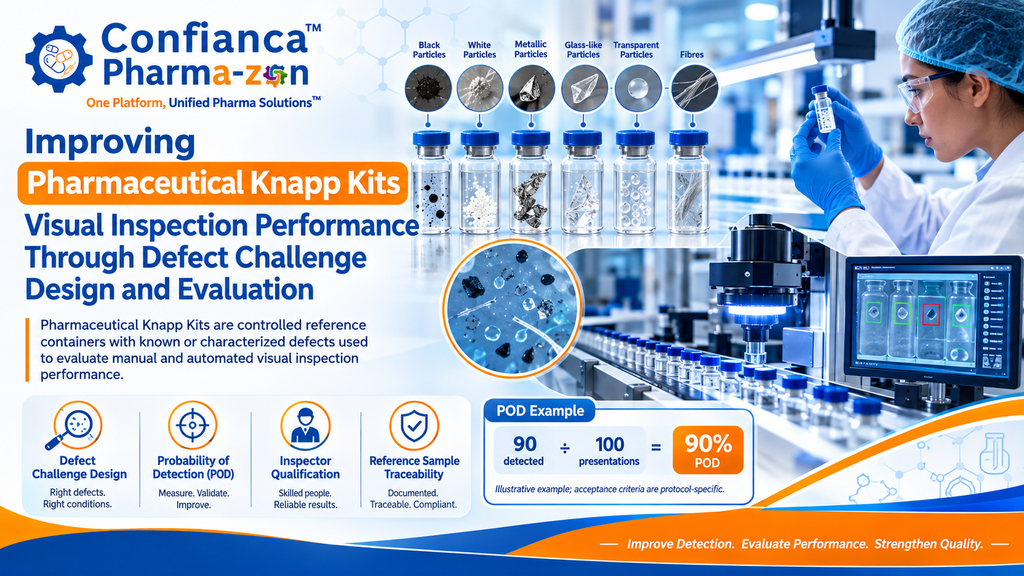
A pharmaceutical Knapp Kit is a reference set of containers containing known or characterized defects and particulate challenges used for pharmaceutical visual inspection studies.
The kit may include clear, coloured or other suitable container formats depending on the product and inspection application.
Typical challenge categories may include:
- Black particles.
- White particles.
- Metallic particles.
- Glass-related particles.
- Fibres.
- Transparent particles.
- Other representative foreign particulate matter.
- Product or container-related defects, where included in the study design.
The exact composition depends on the intended use, product characteristics, applicable requirements and approved protocol.
Knapp Kits are used to evaluate whether an inspector or inspection system can identify specified challenge conditions under defined inspection parameters.
They can also support training and ongoing performance monitoring.
2.1 Purpose of a Knapp Kit
The main purposes include:
- Evaluating manual inspection capability.
- Assessing automated visual inspection systems.
- Supporting inspector qualification.
- Conducting periodic performance evaluations.
- Establishing inspection consistency.
- Supporting defect recognition training.
- Evaluating the impact of inspection conditions.
- Maintaining documented reference standards.
A Knapp Kit should be treated as a controlled evaluation tool rather than simply a collection of defective containers.
3. Why Defect Challenge Design Is Important
A visual inspection challenge is only meaningful when the selected samples represent the inspection risks and objectives of the manufacturing process.
For example, an inspection system may consistently identify large black particles but perform differently when presented with smaller transparent or low-contrast particles.
Therefore, challenge design should consider more than the presence or absence of particles.
Important design parameters include:
- Defect category.
- Particle material.
- Particle size.
- Particle colour.
- Particle shape.
- Particle position.
- Container type.
- Product appearance.
- Inspection conditions.
- Intended evaluation purpose.
3.1 Selecting Representative Particle Categories
Particle categories should be selected according to the pharmaceutical product and its manufacturing risks.
For example, an injectable product manufactured in glass containers may require consideration of glass-related and metallic particle challenges.
A product manufactured using elastomeric components may require consideration of appropriate rubber-related or other relevant material challenges.
The objective is to establish a challenge set that provides meaningful coverage of the defects relevant to the intended inspection process.
3.2 Selecting Particle Sizes
Particle size is an important variable in visual inspection performance.
Generally, smaller particles may be more difficult to detect than larger particles, but detection is not determined by size alone.
Colour contrast, particle shape, orientation, container geometry, background and movement can all influence visibility.
A well-designed challenge set should therefore consider different particle characteristics instead of assuming that size alone determines detection difficulty.
3.3 Considering Particle Contrast
A dark particle against a light background may be easier to detect than a transparent particle with limited visual contrast.
Similarly, a white particle in a light-coloured formulation may present a different detection challenge from a black particle in a clear solution.
Inspection challenges should reflect these differences where relevant.
4. Defect Detection Evaluation: Beyond Pass or Fail
One of the important applications of a Knapp Kit is evaluating the performance of a visual inspection process.
A simple pass-or-fail result may not always provide sufficient information about inspection capability.
A structured evaluation should examine detection patterns across defect categories and challenge conditions.
For example:
| Challenge category | Inspection observation |
|---|---|
| Black particles | Record detected and missed samples |
| White particles | Evaluate contrast-related detection |
| Metallic particles | Assess detection of relevant metallic challenges |
| Transparent particles | Evaluate low-contrast detection |
| Fibres | Evaluate elongated particle recognition |
| Glass-related particles | Assess relevant particulate challenges |
Results should be recorded according to the approved study protocol.
The evaluation should also consider the number of samples tested, the number of repeated trials, the inspection conditions and the statistical approach used.
5. Understanding Probability of Detection (POD)
Probability of Detection (POD) is an important concept in visual inspection performance evaluation.
It describes the likelihood that a specified defect or challenge condition will be detected under defined conditions.
A simplified expression is:
[
POD = \frac{\text{Number of correctly detected challenge samples}}{\text{Total number of challenge presentations}} \times 100
]
For example, if an inspector correctly identifies 90 out of 100 challenge presentations:
[
POD = \frac{90}{100}\times100 = 90%
]
This example illustrates the calculation only. It does not establish an acceptable qualification limit.
A meaningful POD study should account for the study design, sample independence, repeated observations, defect characteristics and uncertainty in the estimate.
A high overall detection percentage can also conceal poor performance for a particular defect category.
For example, an inspection system might perform well for black particles but poorly for transparent particles.
Therefore, category-wise analysis is often more informative than relying exclusively on one combined percentage.
6. Evaluating Manual Visual Inspection Performance
Manual visual inspection relies on the ability of trained personnel to identify relevant defects under controlled inspection conditions.
Performance may be influenced by:
- Inspector experience.
- Visual acuity.
- Training quality.
- Inspection duration.
- Lighting intensity and arrangement.
- Background conditions.
- Container rotation and handling.
- Fatigue.
- Workstation ergonomics.
A Knapp Kit can help organizations assess inspector performance using controlled challenge samples.
6.1 Inspector Training
Training should include defect recognition, correct inspection technique, container handling and the identification of common inspection errors.
Training using reference samples helps inspectors understand how different particles appear under actual or representative inspection conditions.
6.2 Inspector Qualification
Qualification should follow an approved procedure with clearly defined acceptance criteria.
The procedure should specify:
- Reference sample identification.
- Challenge sequence.
- Inspection environment.
- Permitted inspection time.
- Recording methodology.
- Evaluation criteria.
- Retraining requirements.
- Approval and documentation responsibilities.
6.3 Periodic Performance Assessment
Initial qualification is not sufficient to demonstrate consistent performance over an inspector’s entire working period.
Periodic assessments can help identify training gaps and changes in detection performance.
The frequency should be determined through applicable requirements, the approved quality system and risk-based considerations.
7. Evaluating Automated Visual Inspection Systems
Automated visual inspection systems use cameras, lighting arrangements, image-processing technologies and software algorithms to inspect pharmaceutical containers.
A Knapp Kit may support system performance evaluation by presenting controlled reference challenges.
Automated inspection systems may be evaluated for:
- Particle detection.
- Defect classification.
- False rejection.
- False acceptance.
- Repeatability.
- Detection consistency.
- Performance across different container presentations.
7.1 Importance of Representative Challenge Samples
Automated inspection performance depends on the relationship between particle characteristics, optical conditions and image-processing algorithms.
A challenge sample that does not represent the actual inspection application may provide limited evidence of system capability.
Therefore, challenge selection should consider the intended product, container and inspection configuration.
7.2 False Acceptance and False Rejection
Two important performance outcomes should be considered.
False acceptance: A defective or challenge container is incorrectly classified as acceptable.
False rejection: An acceptable container is incorrectly classified as defective.
Both outcomes can have operational and quality implications.
The evaluation should distinguish between the two rather than reporting only the overall detection rate.
8. Importance of Reference Sample Traceability
A Knapp Kit must have a reliable identification and documentation system.
Without traceability, it may become difficult to establish whether the same reference sample was used across different qualification or performance studies.
Important traceability information may include:
- Unique sample identification number.
- Defect category.
- Particle description.
- Container identification.
- Reference images.
- Initial characterization information.
- Preparation or manufacturing details.
- Inspection history.
- Storage location.
- Current status.
- Review or replacement history.
Traceability also helps prevent confusion between reference challenge samples and routine production samples.
9. Maintaining Consistent Inspection Challenge Conditions
Inspection performance can change when testing conditions are inconsistent.
For example, changing the illumination arrangement or inspection duration between assessments may affect the comparability of results.
A controlled study should define relevant parameters before the challenge begins.
| Parameter | What should be controlled |
|---|---|
| Lighting | Approved lighting arrangement |
| Background | Defined inspection background |
| Inspection duration | Specified challenge time |
| Container presentation | Consistent handling procedure |
| Sample identification | Unique reference numbers |
| Test sequence | Approved challenge sequence |
| Data recording | Standardized result format |
| Acceptance criteria | Predefined evaluation rules |
Where an inspection system has product-specific settings, these should be appropriately documented.
10. Statistical Considerations in Visual Inspection Studies
A scientifically designed inspection study should use a suitable evaluation approach.
Important considerations include:
Sample size: The number of challenge presentations should be sufficient for the intended evaluation.
Repeatability: Repeated testing may help identify variation in inspection outcomes.
Defect-specific performance: Different defect categories should be assessed separately where appropriate.
Confidence intervals: Statistical uncertainty should be considered when interpreting detection estimates.
Study limitations: The report should explain any factors that limit the interpretation of results.
A result of 100% detection in a small sample does not prove that an inspection process will detect every similar defect in future production.
Study conclusions should remain within the limits of the evidence generated.
11. GMP and Regulatory Considerations
Pharmaceutical visual inspection activities should be designed and documented in accordance with applicable regulatory expectations and the manufacturer’s quality management system.
Relevant references may include:
- USP General Chapter <1790>, Visual Inspection of Injections.
- USP General Chapter <790>, Visible Particulates in Injections.
- Applicable GMP requirements.
- Applicable national regulatory guidance.
- Approved company procedures and qualification protocols.
The applicable edition and current requirements should always be verified before designing or approving a study.
A Knapp Kit does not independently establish regulatory compliance.
It is one component of a broader visual inspection control strategy that may include equipment qualification, process validation, personnel qualification, routine inspection monitoring and defect management.
12. Common Mistakes During Knapp Kit Evaluation
Several mistakes can reduce the value of a visual inspection study.
Mistake 1: Using poorly characterized samples
Unknown or insufficiently documented samples can weaken the reliability of the evaluation.
Mistake 2: Ignoring defect-specific performance
A combined detection percentage may conceal weak performance for specific particle categories.
Mistake 3: Changing inspection conditions
Uncontrolled differences between studies can make results difficult to compare.
Mistake 4: Using reference samples without adequate identification
Missing identification can create traceability problems.
Mistake 5: Treating training as equivalent to qualification
Training supports competence, but qualification requires an approved assessment and documented evaluation.
Mistake 6: Ignoring false rejection
An inspection system should be evaluated for both detection performance and unnecessary rejection.
Mistake 7: Overstating study conclusions
A limited challenge study should not be presented as proof of universal detection capability.
13. How Confianca Pharmazon Supports Visual Inspection Activities
Confianca Pharmazon supports pharmaceutical manufacturers through specialized visual inspection solutions, including pharmaceutical Knapp Kits and related technical support.
Our solutions are intended to help organizations strengthen their visual inspection activities through suitable reference challenges and structured evaluation approaches.
Depending on the application, support may include:
- Pharmaceutical visual inspection Knapp Kits.
- Black, white and metallic particle reference challenges.
- Particle size-based challenge configurations.
- Reference defect identification.
- Visual inspection performance evaluation support.
- Documentation and technical information.
- Support for manual and automated inspection applications.
Each requirement should be evaluated according to the product, container format, inspection process and intended qualification or assessment objective.
14. Practical Checklist for an Effective Knapp Kit Study
Before conducting a visual inspection challenge study, consider the following:
- Define the purpose of the study.
- Identify the inspection system or personnel being evaluated.
- Select representative challenge categories.
- Establish sample identification and traceability.
- Verify reference sample condition.
- Define inspection lighting and background.
- Establish the inspection duration.
- Approve the challenge sequence.
- Define data recording requirements.
- Establish acceptance criteria before testing.
- Evaluate false acceptance and false rejection.
- Review category-wise detection performance.
- Document study limitations.
- Approve and retain the final report.
15. Frequently Asked Questions (FAQs)
Q1. What is a pharmaceutical Knapp Kit?
A pharmaceutical Knapp Kit is a reference collection of containers with characterized defects or particulate challenges used to evaluate pharmaceutical visual inspection performance.
Q2. Why are Knapp Kits used in pharmaceutical manufacturing?
They support visual inspection evaluation, inspector training, automated inspection assessment and performance monitoring.
Q3. Can a Knapp Kit be used for manual visual inspection?
Yes. Appropriately designed reference challenge samples can be used to assess manual inspector performance under defined conditions.
Q4. Can Knapp Kits be used for automated inspection systems?
Yes. They can support the evaluation of automated inspection performance using suitable challenge samples and approved protocols.
Q5. What types of particles can be included in a Knapp Kit?
Depending on the application, challenge categories may include black, white, metallic, glass-related, transparent and fibre-like particles.
Q6. What is Probability of Detection?
POD is a measure of the likelihood that a specified defect will be detected under defined inspection conditions.
Q7. Does a Knapp Kit guarantee regulatory compliance?
No. It supports inspection performance evaluation but does not replace the manufacturer’s GMP responsibilities or complete qualification programme.
Q8. How often should visual inspection performance be evaluated?
The frequency should be established through applicable requirements, risk assessment and approved company procedures.
Q9. Why is particle size important in Knapp Kit design?
Particle size can influence visibility, but colour, contrast, shape and inspection conditions also affect detection performance.
Q10. What is the difference between inspector training and qualification?
Training develops knowledge and practical skills. Qualification is a documented assessment demonstrating that an individual meets predefined performance requirements.
Q11. What documentation should accompany a Knapp Kit?
Suitable documentation may include sample identification, defect descriptions, reference information, traceability details and applicable technical documentation.
Q12. What is the role of Knapp Kits in automated inspection qualification?
They can provide controlled challenge samples for evaluating system detection, classification and inspection performance under defined conditions.
Conclusion
Effective pharmaceutical visual inspection requires more than trained operators and sophisticated inspection equipment. It requires a structured approach to challenge design, performance evaluation, reference sample traceability and result interpretation.
Pharmaceutical Knapp Kits provide a valuable tool for assessing visual inspection performance when they are designed and used appropriately.
By selecting representative defects, controlling inspection conditions, analysing defect-specific results and maintaining complete documentation, pharmaceutical manufacturers can develop a more reliable and scientifically supported visual inspection programme.
Confianca Pharmazon – Supporting Pharmaceutical Manufacturers with Visual Inspection Solutions and Specialized Knapp Kits.