No products in the cart.
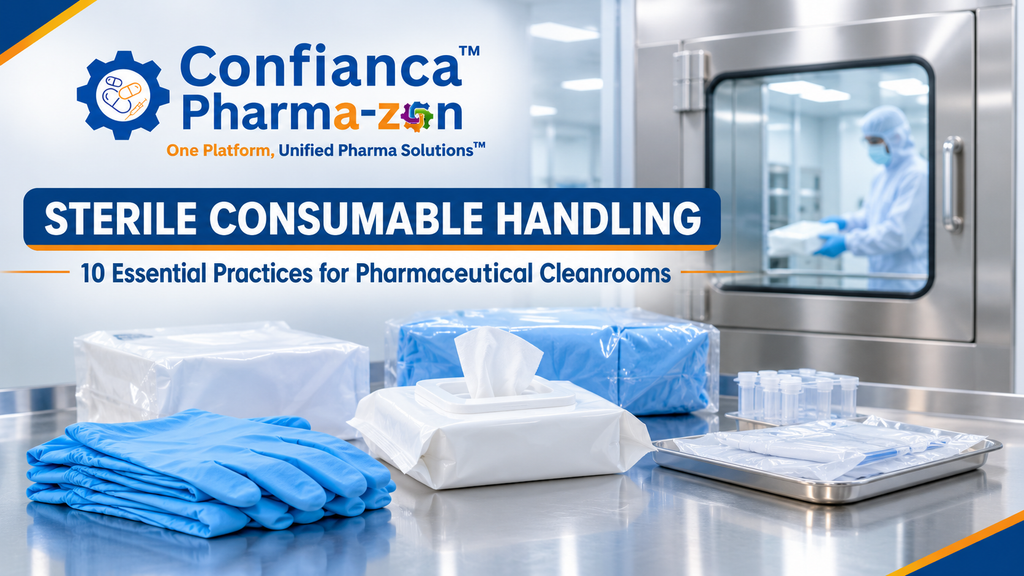
Sterile Consumable Handling in Pharmaceutical Cleanrooms: 10 Essential Practices for Contamination Control and Aseptic Manufacturing
1. Introduction
Pharmaceutical cleanrooms are designed to control contamination during the manufacturing of products that require specific environmental conditions.
In sterile pharmaceutical manufacturing, maintaining the required environmental and microbiological controls is particularly important because contamination may compromise product quality and patient safety.
Manufacturers invest in cleanroom infrastructure, HVAC systems, environmental monitoring, personnel qualification, cleaning procedures and aseptic processing controls.
However, one area that also requires significant attention is the handling of cleanroom consumables.
Sterile gloves, wipes, garments, cleaning accessories, transfer materials and other consumables enter controlled manufacturing areas regularly.
Although these materials may appear routine, inappropriate selection or handling can introduce contamination risks.
For example, a sterile wipe with damaged packaging, a glove handled incorrectly during gowning or a consumable transferred through an uncontrolled material pathway may compromise the intended contamination control measures.
Therefore, sterile consumable handling in cleanrooms should be treated as an important part of pharmaceutical contamination control rather than simply a warehouse or procurement activity.
Manufacturers should establish clear procedures for product selection, incoming inspection, storage, material transfer, opening, handling, use and disposal.
This article explains the major considerations involved in cleanroom consumable management and how pharmaceutical manufacturers can develop a more structured approach to maintaining material quality throughout aseptic manufacturing operations.
2. Understanding Sterile Consumables in Pharmaceutical Cleanrooms
Sterile consumables are products intended for use in controlled applications where microbiological contamination must be prevented or appropriately controlled.
Their application depends on the manufacturing process, cleanroom classification, contamination control strategy and intended contact with personnel, equipment or product-contact surfaces.
Common cleanroom consumable categories include:
| Consumable category | Examples | Typical application |
|---|---|---|
| Hand protection | Sterile gloves | Personnel protection and controlled handling |
| Cleaning materials | Sterile wipes | Cleaning and surface disinfection activities |
| Garments | Sterile coveralls, hoods and shoe covers | Personnel gowning |
| Fluid handling | Sterile funnels and transfer components | Suitable controlled transfer operations |
| Filtration | Sterile filters | Applicable filtration processes |
| Sampling | Sterile sampling accessories | Controlled sample collection |
| Packaging | Sterile bags and wraps | Material protection and transfer |
| Specialized accessories | Isolator and ORABS gloves | Barrier system operations |
The selection of these products should be based on their intended use rather than the assumption that every sterile consumable is suitable for every cleanroom activity.
2.1 Sterile Does Not Automatically Mean Suitable for Every Cleanroom
A product may have a documented sterilization status but still be unsuitable for a particular application.
For example, a sterile glove may have the required microbiological status but may not have the appropriate chemical resistance, mechanical strength or compatibility with a specific process.
Similarly, a sterile wipe may be suitable for one cleaning application but unsuitable for another surface or chemical disinfectant.
Therefore, manufacturers should evaluate both the sterile status and technical suitability of each consumable.
2.2 Understanding Product Contact and Non-Product Contact Applications
Consumables may be classified according to their relationship with the manufacturing process.
Direct product-contact applications: Materials may come into direct contact with the pharmaceutical product or product-contact surfaces.
Indirect product-contact applications: Materials may contact equipment or components that subsequently interact with the product.
Non-product-contact applications: Materials may be used for personnel protection, environmental cleaning or other controlled activities without direct product contact.
The risk assessment and documentation requirements may differ for each application.
3. Why Consumable Handling Is a Critical Contamination Control Activity
Cleanroom contamination may arise through several routes.
These can include:
- Personnel
- Raw materials
- Packaging
- Equipment
- Cleaning activities
- Environmental sources
- Manufacturing operations
- Transfer of materials between areas
Consumables can contribute to contamination risk if their packaging, handling or application is not adequately controlled.
3.1 Microbiological Contamination
A consumable may introduce microorganisms if it is not appropriately manufactured, sterilized, stored or handled.
The manufacturer’s sterilization documentation and packaging integrity should be evaluated according to the intended application.
3.2 Particulate Contamination
Materials such as gloves, wipes, garments and polymeric components may generate or release particles under certain conditions.
Potential sources include:
- Material abrasion
- Surface damage
- Poor-quality packaging
- Mechanical friction
- Improper handling
- Deteriorated consumables
This is especially important in areas where particulate contamination must be carefully controlled.
3.3 Chemical Contamination
Certain consumables may contain chemical residues, processing additives or substances that can be transferred to surfaces.
Depending on the application, manufacturers may need to consider:
- Material composition
- Residual chemicals
- Extractables and leachables
- Cleaning agent compatibility
- Surface residues
3.4 Cross-Contamination
Consumables used in different production areas or product campaigns may create cross-contamination concerns if they are not adequately segregated and controlled.
Clear identification, storage and usage procedures help reduce this risk.
4. Ten Essential Practices for Sterile Consumable Handling
Practice 1: Select Consumables According to Cleanroom Requirements
Consumable selection should begin with the intended cleanroom application.
Consider:
- Cleanroom classification
- Intended use
- Sterility requirements
- Particle generation characteristics
- Material compatibility
- Chemical resistance
- Mechanical properties
- Packaging configuration
For example, a sterile wipe intended for a controlled pharmaceutical environment should be evaluated for its suitability in the specific cleaning application.
A general-purpose industrial wipe should not automatically be substituted.
Practice 2: Establish Incoming Material Inspection
Incoming inspection is the first opportunity to identify consumables that may not meet the intended requirements.
The receiving process should verify:
- Product name
- Manufacturer
- Product code
- Batch or lot number
- Quantity
- Expiry date, where applicable
- Sterilization identification
- Packaging condition
- Required documentation
Damaged packaging should be evaluated according to an approved quality procedure.
Materials with compromised sterile barriers should not be introduced into sterile operations without an approved disposition.
Practice 3: Maintain Packaging Integrity
Packaging is an important part of sterile consumable control.
Personnel should inspect packaging before use.
Look for:
- Tears
- Punctures
- Open seals
- Damaged corners
- Moisture
- Deformation
- Unusual contamination
- Missing identification
Double or multiple packaging layers may be used to support controlled transfer into higher-grade areas.
The packaging configuration and transfer procedure should follow the manufacturer’s instructions and site-specific contamination control strategy.
Practice 4: Follow Controlled Material Transfer Procedures
Materials entering cleanroom areas should follow approved transfer procedures.
Depending on the facility design, these procedures may involve:
- Material airlocks
- Pass boxes
- Interlocked transfer systems
- Disinfection of external packaging
- Removal of outer packaging
- Staged transfer between areas
Personnel should understand which packaging layer may be removed at each stage.
The objective is to avoid introducing contamination from external packaging into controlled manufacturing environments.
Practice 5: Use Proper Gowning and Glove Handling Techniques
Personnel protection is an important element of aseptic processing.
Sterile gloves should be handled according to approved gowning procedures.
Important considerations include:
- Hand hygiene before gowning
- Correct glove size
- Proper opening of sterile packaging
- Avoiding contact with non-sterile surfaces
- Correct donning technique
- Inspection for visible damage
- Appropriate glove replacement
Gloves should be replaced when damaged, contaminated or when required by the relevant procedure.
Practice 6: Use Sterile Wipes According to Their Intended Application
Sterile wipes may be used for cleaning and disinfection activities in controlled environments.
However, the selection should consider:
- Wipe material
- Particle generation
- Absorbency
- Chemical compatibility
- Surface compatibility
- Sterility
- Packaging configuration
- Intended cleaning method
A wipe that performs well on one surface may not be suitable for another.
The cleaning procedure should define the appropriate wiping technique, chemical agent, contact time and required frequency.
Practice 7: Maintain Suitable Storage Conditions
Consumables should be stored according to manufacturer specifications.
Storage management should consider:
- Temperature
- Humidity, where specified
- Packaging protection
- Shelf life
- Stock rotation
- Segregation
- Identification
- Environmental cleanliness
The FIFO or FEFO inventory approach may be applied according to the material’s expiry and site inventory procedures.
FEFO (First Expiry, First Out) is particularly useful when materials have defined expiry dates.
Practice 8: Control Consumable Usage at Point of Use
The handling procedure should continue after the material enters the cleanroom.
Personnel should:
- Verify material identity.
- Check packaging condition.
- Confirm suitability for the activity.
- Open packaging according to the SOP.
- Avoid unnecessary exposure.
- Use materials only for their approved purpose.
- Dispose of used materials appropriately.
Uncontrolled movement of consumables between different production areas should be avoided.
Practice 9: Establish Clear Disposal Procedures
Used consumables may contain biological, chemical or particulate residues.
Disposal procedures should consider the material’s intended use and contamination status.
Relevant controls may include:
- Segregated waste containers
- Defined disposal pathways
- Controlled removal from cleanrooms
- Appropriate waste identification
- Procedures for contaminated materials
Waste movement should be integrated into the facility’s contamination control strategy.
Practice 10: Train Personnel and Monitor Compliance
Even a well-designed procedure will not be effective if personnel do not understand how to apply it.
Training should cover:
- Consumable identification
- Packaging inspection
- Material transfer
- Gowning and glove handling
- Wipe selection
- Storage requirements
- Disposal procedures
- Deviation reporting
Training effectiveness should be evaluated through appropriate assessment and workplace observation.
5. Handling Sterile Gloves and Protective Accessories
Sterile gloves are particularly important in aseptic manufacturing because they form part of personnel protection and contamination control.
Different manufacturing applications may require different glove materials and configurations.
Common glove-related considerations include:
5.1 Glove Material
Depending on the application, gloves may be manufactured from nitrile, latex or other suitable materials.
Material selection should consider:
- Chemical compatibility
- Mechanical strength
- Flexibility
- Fit
- Comfort
- Particle generation
- Intended sterility status
5.2 Glove Integrity
Gloves should be inspected according to the approved procedure.
Visible damage, punctures or other abnormalities should be addressed before use.
For isolator and barrier system applications, glove integrity testing may be an important part of the equipment and contamination control programme.
5.3 Specialized Piercan Gloves
Isolator and ORABS applications may require specialized glove assemblies designed for specific equipment interfaces.
Important considerations include:
- Glove dimensions
- Material
- Thickness
- Length
- Cuff configuration
- Port compatibility
- Mechanical performance
- Chemical compatibility
The correct glove should be selected according to the isolator or barrier system specification.
A standard cleanroom glove should not automatically be considered a replacement for a specialized barrier-system glove.
6. Proper Use of Sterile Wipes and Cleaning Materials
Cleaning and disinfection are important parts of cleanroom contamination control.
Sterile wipes may be used for equipment surfaces, controlled work areas and other suitable applications.
6.1 Selecting the Right Wipe
Different wipes may have different characteristics.
Examples include:
- Polyester wipes
- Polyester-cellulose wipes
- Other low-linting wipe materials
- Sterile pre-saturated wipes
Selection should consider the intended surface and cleaning method.
6.2 Lint Generation
Wipe-related particle generation can create concerns in controlled environments.
Manufacturers may evaluate relevant wipe characteristics, including particle release and suitability for the required cleaning application.
6.3 Chemical Compatibility
Wipes should be compatible with the cleaning or disinfecting agent.
The selected combination should not introduce unacceptable residues or damage the surface.
6.4 Wiping Technique
The cleaning SOP should define:
- Wiping direction
- Overlapping strokes
- Surface coverage
- Wipe replacement frequency
- Contact time
- Cleaning sequence
Personnel should avoid reusing a contaminated wipe in a manner that spreads contamination to already cleaned areas.
7. Material Transfer into Cleanroom Areas
Material transfer is an important interface between external areas and controlled manufacturing environments.
A material may arrive in a clean outer carton but still require additional preparation before entry into a higher-grade area.
An example transfer sequence may include:
Stage 1: Receipt
Receive the consumable and verify identification, packaging and supporting documentation.
Stage 2: Quarantine or Controlled Storage
Store the material in the designated area pending required checks or release.
Stage 3: Outer Packaging Inspection
Check the external packaging for damage and visible contamination.
Stage 4: Packaging Removal
Remove the outer packaging according to the approved transfer procedure.
Stage 5: External Surface Disinfection
Where required, disinfect the appropriate packaging surfaces using an approved method.
Stage 6: Controlled Transfer
Move the consumable through the designated material transfer system.
Stage 7: Point-of-Use Verification
Verify product identification, packaging condition and suitability before opening.
The exact sequence will vary depending on facility design and the applicable cleanroom procedures.
8. Sterile Consumables in Isolators and ORABS
Isolators and Open Restricted Access Barrier Systems (ORABS) are used to support contamination control in sterile manufacturing.
Consumable selection and handling must be compatible with the barrier system.
8.1 Isolator Applications
Isolators may use specialized glove assemblies, transfer containers and other components.
Consumables should be evaluated according to:
- Material compatibility
- Port configuration
- Transfer method
- Sterility requirements
- Mechanical integrity
- Decontamination compatibility
8.2 ORABS Applications
ORABS systems use physical barriers and controlled access to support contamination control.
The handling of consumables should consider how personnel access the working area and how materials are introduced or removed.
8.3 Importance of Specialized Gloves
Specialized Piercan gloves and other suitable isolator glove assemblies may be required depending on the system design.
Correct sizing, installation, compatibility and integrity control are essential considerations.
8.4 Consumable Transfer Risks
Improper transfer may introduce contamination into a controlled barrier environment.
Manufacturers should establish validated or otherwise appropriately qualified transfer procedures according to the system and risk assessment.
9. Storage, Inventory and Traceability
Effective inventory management helps prevent the use of unsuitable consumables.
A structured system should track:
- Product description
- Manufacturer
- Supplier
- Product code
- Lot number
- Expiry date
- Sterilization status
- Storage location
- Receipt date
- Release status
- Usage records, where required
9.1 FIFO and FEFO
FIFO means First In, First Out.
FEFO means First Expiry, First Out.
Where expiry dates are applicable, FEFO can help reduce the risk of using expired materials.
9.2 Batch Traceability
Traceability is important when a supplier quality issue, packaging defect or material-related deviation occurs.
Manufacturers should be able to identify the relevant consumable lots and determine where they were used, according to the site’s traceability requirements.
9.3 Supplier Change Management
Changes in consumable material, manufacturer, sterilization method or packaging configuration may affect suitability.
Such changes should be evaluated through the approved supplier and change-control processes.
10. Common Handling Mistakes in Pharmaceutical Cleanrooms
Mistake 1: Assuming Every Sterile Consumable Is Suitable for Every Area
Different cleanroom applications may have different material and sterility requirements.
Mistake 2: Ignoring Packaging Damage
A damaged sterile barrier should never be treated as an ordinary packaging issue.
Mistake 3: Improper Transfer of External Packaging
Introducing external packaging into controlled areas without following transfer procedures may increase contamination risk.
Mistake 4: Incorrect Glove Donning
Touching non-sterile surfaces during glove donning may compromise the intended sterile condition.
Mistake 5: Using the Wrong Wipe
A wipe may be incompatible with the surface, chemical agent or intended cleaning application.
Mistake 6: Poor Inventory Management
Expired, damaged or incorrectly identified consumables may enter production if inventory controls are inadequate.
Mistake 7: Uncontrolled Material Substitution
Substituting a product without technical and quality assessment may introduce new contamination risks.
Mistake 8: Inadequate Personnel Training
Personnel may follow inconsistent practices when handling procedures are unclear or training is insufficient.
11. Developing a Cleanroom Consumable Management SOP
A well-defined SOP should cover the entire lifecycle of a consumable.
A recommended structure includes:
| SOP section | Key requirements |
|---|---|
| Purpose | Define the objective of consumable management |
| Scope | Identify applicable cleanrooms and materials |
| Responsibilities | Define QA, warehouse, production and microbiology responsibilities |
| Material receipt | Establish incoming verification requirements |
| Inspection | Define packaging and product checks |
| Storage | Specify storage and stock control |
| Transfer | Describe movement between controlled areas |
| Handling | Define opening and point-of-use procedures |
| Usage | Establish approved applications |
| Disposal | Define disposal pathways |
| Deviations | Explain reporting and investigation |
| Records | Identify traceability and documentation requirements |
The SOP should be aligned with the facility’s contamination control strategy and applicable GMP requirements.
12. Regulatory and GMP Considerations
Sterile consumable management should be considered within the wider pharmaceutical quality system.
Relevant frameworks may include:
EU GMP Annex 1: Provides requirements and principles for sterile medicinal product manufacturing, including contamination control strategy, personnel, materials and environmental controls.
ISO 14644 series: Provides standards relevant to cleanroom classification and related cleanroom considerations.
USP General Chapters: Relevant chapters may apply depending on the consumable, product-contact application and testing requirements.
ICH Q9: Provides a framework for quality risk management.
Manufacturers should identify the specific requirements applicable to their operations and avoid treating the use of a particular consumable as proof of GMP compliance.
A sterile consumable does not replace the need for qualified facilities, trained personnel, appropriate environmental controls and validated or otherwise qualified processes.
13. How Confianca Pharmazon Supports Pharmaceutical Consumable Requirements
Confianca Pharmazon supports pharmaceutical manufacturers with products and consumables for QC, microbiology, sterile manufacturing and controlled production environments.
Our relevant product categories include:
Sterile and Microbiology Consumables
- Centrifuge tubes
- Cell spreaders
- Sterile M-Funnels
- Other laboratory consumables
Cleanroom and Personnel Protection Products
- Disposable gloves
- Piercan gloves
- Isolator and ORABS-related glove solutions
- Dry wipes
- Other suitable cleanroom accessories
Pharmaceutical Manufacturing Consumables
- Filtration-related consumables
- Pharmaceutical thermal paper rolls
- Sterile printer paper
- Other specialized pharmaceutical consumables
Product selection should be based on the intended application, required specifications and applicable documentation.
Confianca Pharmazon aims to support pharmaceutical manufacturers with appropriate product information and procurement assistance.
Frequently Asked Questions
1. What are sterile consumables in a pharmaceutical cleanroom?
They are materials and accessories intended for use in controlled manufacturing environments where microbiological contamination must be controlled.
Examples include sterile gloves, wipes, transfer components, sampling accessories and other suitable materials.
2. Why is sterile consumable handling important?
Improper handling may compromise packaging integrity, introduce particles or microorganisms, or result in unsuitable materials being used in manufacturing.
3. What is the difference between sterile and cleanroom-compatible consumables?
Sterile refers to a defined microbiological status supported by appropriate processing and documentation. Cleanroom compatibility relates to suitability for a controlled environment, including relevant particle and material characteristics. One does not automatically establish the other.
4. How should sterile gloves be handled?
Gloves should be stored, transferred, opened and donned according to the manufacturer’s instructions and the approved gowning SOP.
5. Why are sterile wipes important?
Suitable sterile wipes support controlled cleaning and disinfection activities while helping manage particulate and microbiological contamination risks.
6. What are Piercan gloves used for?
Specialized Piercan glove assemblies are used in suitable isolator and barrier-system applications, depending on the equipment configuration and technical specifications.
7. How should consumables be transferred into cleanrooms?
Transfer should follow the approved material movement procedure, which may include packaging inspection, controlled removal of outer packaging, surface disinfection and staged transfer.
8. What is FEFO in pharmaceutical inventory management?
FEFO means First Expiry, First Out. It prioritizes the use of materials with the earliest expiry dates, where applicable.
9. Can sterile consumables be reused?
This depends on the product design, intended use and approved procedure. Single-use products should not be reused unless the manufacturer and applicable validated procedures specifically permit it.
10. What documents should be checked before using sterile consumables?
Depending on the product, checks may include product specifications, lot identification, sterilization information, expiry details, certificates and packaging integrity.
Conclusion
Sterile consumable handling is an important part of pharmaceutical cleanroom management and aseptic manufacturing.
Although consumables may represent a relatively small part of the manufacturing process, their selection, storage, transfer and use can influence the effectiveness of contamination control measures.
A structured approach should address the complete material lifecycle, beginning with supplier and product selection and continuing through incoming inspection, controlled storage, cleanroom transfer, point-of-use handling and disposal.
By developing clear procedures, maintaining traceability, training personnel and evaluating consumable suitability, pharmaceutical manufacturers can strengthen their contamination control strategy.
Confianca Pharmazon – Your Partner for Pharmaceutical Sterile Consumables, QC and Microbiology Supplies, Cleanroom Products and Specialized Manufacturing Solutions.
Contact Confianca Pharmazon for product specifications, technical information and pharmaceutical consumable requirements.