
No products in the cart.
Knapp Kit Qualification Strategy for Pharmaceutical Manufacturing: 10 Essential Steps to Build a Reliable Visual Inspection Programme
1. Introduction
Visual inspection is a critical quality control activity in pharmaceutical manufacturing, especially for sterile injectable products.
Before injectable products are released for distribution, manufacturers must have appropriate procedures for identifying visible particulate matter and other relevant container or product defects.
The inspection process may involve trained personnel, automated visual inspection machines or a combination of both.
However, having an inspection procedure does not automatically demonstrate that the inspection process is capable of detecting the defects relevant to the product.
A pharmaceutical manufacturer must establish how inspectors are trained, how their performance is evaluated, how inspection equipment is challenged and how qualification results are documented.
This is where a well-designed Knapp Kit qualification strategy becomes important.
A Knapp Kit provides known challenge samples that can be used to evaluate visual inspection performance under defined conditions.
However, the value of a Knapp Kit depends on how it is incorporated into the overall inspection qualification programme.
Simply purchasing a defect kit and asking an inspector to identify particles is not a complete qualification strategy.
A meaningful programme should consider product characteristics, container type, defect categories, inspection conditions, acceptance criteria, test methodology, data evaluation and periodic reassessment.
This article explains how pharmaceutical manufacturers can develop a structured Knapp Kit qualification strategy that supports consistent inspection performance, technical documentation and quality system expectations.
2. Understanding the Role of Knapp Kits in Qualification
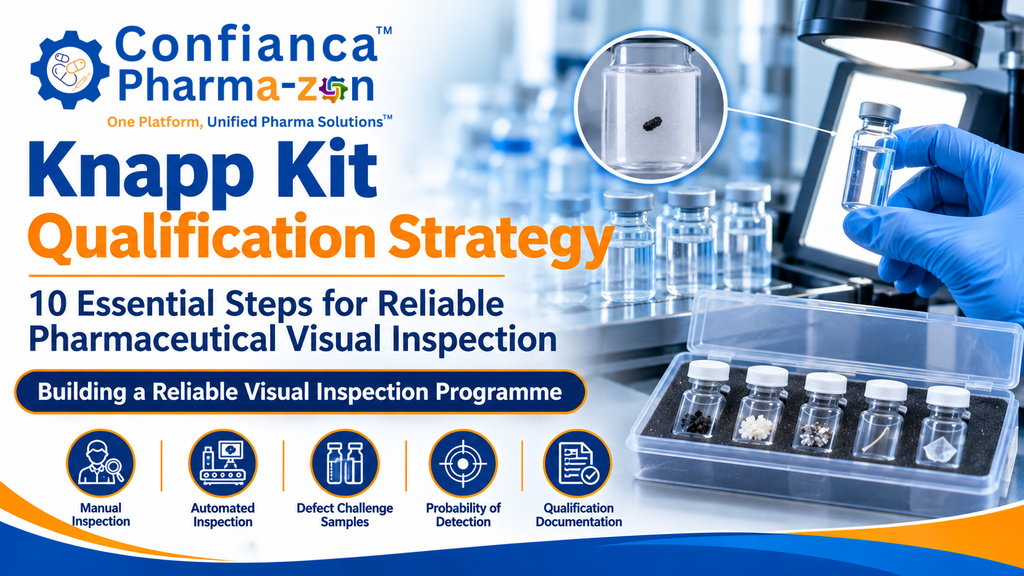
A pharmaceutical Knapp Kit is a collection of containers containing defined defects or reference samples designed to challenge visual inspection activities.
Depending on the kit configuration, samples may include:
- Black particles
- White particles
- Metallic particles
- Glass fragments
- Fibres
- Rubber or elastomeric particles
- Container cracks
- Cosmetic defects
- Closure-related abnormalities
- Good or defect-free reference samples
These samples can be designed for different container formats, including:
- Clear glass vials
- Amber glass vials
- Ampoules
- Pre-filled syringes
- Cartridges
The actual configuration should be based on the manufacturer’s application and agreed challenge requirements.
2.1 Knapp Kit as a Qualification Tool
The kit provides physical samples for controlled evaluation.
It can help determine whether an inspector or inspection system can identify specified defects under defined conditions.
2.2 Knapp Kit as a Training Tool
The same general category of defect samples may also support inspector training.
Training activities can help personnel understand differences between particle types, container defects and cosmetic abnormalities.
Training and formal qualification should nevertheless be distinguished.
Training develops capability, while qualification evaluates performance against predefined criteria.
2.3 Knapp Kit for Performance Evaluation
A controlled defect set can help evaluate inspection performance over time.
Results may be reviewed to identify missed defects, recurring weaknesses and opportunities for improvement.
3. Why a Structured Qualification Strategy Is Necessary
Pharmaceutical visual inspection involves multiple variables.
Even when the same particle is used, its detectability may change according to:
- Particle size
- Particle colour
- Particle shape
- Particle density
- Particle movement
- Product formulation
- Container transparency
- Container geometry
- Background contrast
- Lighting conditions
- Inspection speed
- Operator technique
An automated inspection system introduces additional factors, such as camera resolution, image processing parameters, container positioning and machine settings.
A structured qualification strategy helps ensure that these factors are considered before the inspection evaluation begins.
It also creates a documented connection between the intended inspection challenge and the results obtained.
4. Ten Essential Steps for Developing a Knapp Kit Qualification Programme
Step 1: Define the Qualification Objective
The first step is to identify exactly what the qualification programme is intended to evaluate.
Different objectives require different approaches.
For example:
| Qualification objective | Main purpose |
|---|---|
| Initial inspector qualification | Evaluate a new inspector’s ability to detect defined defects |
| Periodic requalification | Assess continued inspection capability |
| Additional training | Improve recognition of difficult defect categories |
| Automated machine qualification | Evaluate machine detection performance |
| Machine performance verification | Confirm performance under specified operating conditions |
| Investigation support | Examine a suspected weakness in the inspection process |
The objective should be documented before the challenge samples are selected.
A qualification exercise should not be designed retrospectively around the results.
Step 2: Identify Product and Container Requirements
The inspection programme should represent the products and container configurations relevant to the manufacturing facility.
Important details include:
- Product formulation
- Liquid or lyophilized presentation
- Container material
- Container colour
- Container dimensions
- Fill volume
- Headspace
- Closure configuration
For example, a clear liquid vial may present different inspection conditions from a lyophilized product or an amber vial.
Similarly, a pre-filled syringe has different geometry from a conventional vial.
A qualification programme should account for these differences using a justified grouping or bracketing strategy where appropriate.
Step 3: Develop a Defect Classification System
The next step is to define the defect categories required for the qualification programme.
A practical classification may include:
Particulate defects
- Black particles
- White particles
- Metallic particles
- Glass particles
- Fibres
- Elastomeric particles
Container defects
- Cracks
- Chips
- Breakage
- Surface damage
- Other relevant abnormalities
Closure-related defects
- Stopper defects
- Seal-related abnormalities
- Closure damage
- Incorrect component presentation
Cosmetic defects
- Relevant visible surface imperfections
- Cap-related abnormalities
- Other product-specific appearance defects
Not every category must be included in every kit.
The selection should be based on product risk, historical observations, process knowledge and inspection requirements.
Step 4: Establish Defect Characterization Requirements
Defect identification should be supported by appropriate documentation.
For particulate samples, useful information may include:
- Material category
- Particle dimensions
- Shape
- Colour
- Microscopic images
- Unique sample identification
Where relevant, analytical methods may be used to support material characterization.
For example, microscopy may be used to document particle dimensions, while SEM-EDS or FTIR may provide complementary material information.
A known particle should not automatically be considered a suitable challenge simply because its size is documented.
Its visibility and relevance to the intended inspection application also matter.
Step 5: Define Inspection Conditions
Inspection conditions should be established before qualification.
Relevant factors include:
- Lighting arrangement
- Background
- Container rotation
- Inspection duration
- Viewing angle
- Inspection speed
- Operator positioning
- Eye-rest arrangements
The protocol should describe the intended inspection method sufficiently clearly for the evaluation to be repeatable.
For manual inspection, the procedure should explain the required handling and viewing sequence.
For automated inspection, machine configuration and operating parameters should be controlled.
Step 6: Prepare the Qualification Protocol
A written protocol should define the complete evaluation methodology.
A typical protocol may include:
- Purpose and scope
- Responsibilities
- Reference to applicable SOPs
- Description of challenge samples
- Sample identification
- Inspection environment
- Inspection methodology
- Number of evaluation cycles
- Recording procedure
- Acceptance criteria
- Deviation handling
- Reporting and approval requirements
The protocol should be approved through the applicable quality system before execution.
Step 7: Establish Scientifically Justified Acceptance Criteria
Acceptance criteria should be defined before testing.
The criteria may depend on:
- Defect classification
- Intended qualification purpose
- Inspection methodology
- Historical performance
- Risk assessment
- Applicable internal procedures
A single universal acceptance percentage should not be applied automatically to every defect category and qualification programme.
Critical defects and less challenging samples may have different evaluation expectations.
The organization should justify its criteria and document the basis for their approval.
Step 8: Conduct the Qualification Exercise
The actual inspection evaluation should follow the approved protocol.
For manual inspection:
- Confirm inspector identity and qualification status.
- Verify the inspection environment.
- Provide the defined challenge set.
- Conduct the inspection according to the SOP.
- Record each identification result.
- Document missed defects.
- Review unexpected observations.
For automated inspection:
- Verify machine configuration.
- Confirm challenge sample identification.
- Run the samples under defined conditions.
- Record accepted and rejected units.
- Identify false accepts and false rejects.
- Review machine alarms and abnormal events.
- Document the operating parameters.
The execution should be controlled and traceable.
Step 9: Evaluate Results and Investigate Failures
Results should be evaluated against the predefined acceptance criteria.
A missed defect should not simply be removed from the record or ignored.
The investigation should consider:
- Defect characteristics
- Sample condition
- Inspection conditions
- Operator performance
- Equipment settings
- Training effectiveness
- Protocol compliance
For example, if a particular white particle is repeatedly missed, the team should evaluate whether the issue is related to contrast, lighting, particle characteristics or inspection technique.
The investigation should identify the likely reason and determine whether corrective action is required.
Step 10: Establish Requalification and Ongoing Monitoring
Initial qualification is not the end of the programme.
Inspection capability may change due to personnel, equipment, process and environmental factors.
A pharmaceutical manufacturer should establish a documented requalification approach based on risk and internal requirements.
Relevant triggers may include:
- Scheduled periodic reassessment
- Extended absence from inspection duties
- Significant inspection procedure changes
- Equipment modification
- Repeated inspection failures
- Relevant deviations
- Changes in product or container configuration
The frequency should be justified by the manufacturer’s quality system rather than assumed to be identical for every facility.
5. Manual Inspector Qualification Using Knapp Kits
Manual visual inspection depends on human perception and the ability to consistently recognize relevant defects.
A structured Knapp Kit programme can provide controlled samples for evaluating inspector performance.
5.1 Initial Training
New inspectors should receive training on:
- Particulate defect recognition
- Container defect recognition
- Inspection procedure
- Lighting and background
- Container handling
- Particle movement
- Rejection criteria
- Documentation requirements
Training should include practical exposure to suitable challenge samples.
5.2 Qualification Evaluation
After training, inspectors can be evaluated using a controlled sample set.
The qualification procedure should specify the test conditions, number of samples, evaluation method and acceptance criteria.
The results should be retained as controlled records.
5.3 Periodic Requalification
Periodic reassessment helps determine whether inspection performance remains acceptable.
Historical results can be reviewed to identify recurring weaknesses or changes in performance.
5.4 Managing Human Performance Factors
Inspector performance may be affected by:
- Visual fatigue
- Long inspection periods
- Poor ergonomics
- Inadequate lighting
- Inconsistent viewing techniques
- Distractions
- Insufficient training
These factors should be considered when designing and maintaining the inspection programme.
6. Automated Visual Inspection Machine Qualification
Automated inspection systems introduce different qualification requirements.
A machine may use multiple cameras, lighting arrangements, image processing algorithms and rejection mechanisms.
A Knapp Kit designed for automated inspection should be appropriate for the equipment configuration and challenge objective.
6.1 Machine Challenge Requirements
The qualification programme may evaluate:
- Detection of specified particles
- Detection of container cracks
- Identification of closure defects
- Correct rejection of defective units
- Handling of good reference units
- Repeatability under defined operating conditions
6.2 Machine Parameter Evaluation
Relevant parameters may include:
- Conveyor speed
- Container rotation
- Camera position
- Image acquisition
- Lighting settings
- Detection sensitivity
- Rejection timing
Changing machine settings may affect detection performance.
Therefore, results should be linked to the specific operating configuration.
6.3 False Accepts and False Rejects
A false accept occurs when a defective challenge unit is accepted by the inspection system.
A false reject occurs when a suitable good reference unit is rejected.
Both outcomes should be evaluated.
False accepts may indicate a detection weakness, while excessive false rejects may indicate inappropriate sensitivity or machine settings.
The investigation should consider the defect type and the operating conditions rather than treating every event as identical.
7. Understanding Probability of Detection
Probability of Detection (POD) is an important concept in visual inspection performance evaluation.
It describes the likelihood that a specified defect will be detected under defined evaluation conditions.
A simple empirical detection rate can be calculated as:
Detection Rate (%) = (Number of successful detections / Total inspection opportunities) × 100
For example, if a defined defect is detected in 18 out of 20 inspection opportunities:
Detection Rate = (18 / 20) × 100 = 90%
However, this simple calculation should not automatically be treated as a statistically validated POD model.
A formal POD study may require an appropriate experimental design, controlled challenge samples, sufficient observations and statistical analysis.
The number of repetitions, sample independence and inspection conditions should be considered.
Why POD Matters
POD evaluation can help manufacturers:
- Understand defect detectability
- Compare inspection performance
- Evaluate inspection method changes
- Identify difficult challenge categories
- Support qualification decisions
- Improve training programmes
Why Particle Size Alone Is Not Enough
Two particles with the same nominal size may have different detectability.
For example:
- A black particle may contrast strongly against a clear liquid.
- A white particle may be difficult to distinguish against a bright background.
- A thin fiber may be difficult to observe depending on its orientation.
- A dense metallic particle may move differently from a lightweight polymer fragment.
Therefore, particle size should be evaluated together with other physical and inspection-related characteristics.
8. Developing a Defect Challenge Matrix
A defect challenge matrix helps connect the kit configuration with the qualification objective.
An illustrative matrix is shown below.
| Defect category | Example challenge | Important evaluation factor |
|---|---|---|
| Black particle | Dark particulate matter | Contrast and particle dimensions |
| White particle | Light-coloured particulate matter | Background and lighting |
| Metallic particle | Stainless-steel-related fragment | Reflectivity and orientation |
| Glass particle | Glass fragment | Transparency and shape |
| Fiber | Elongated material | Length, thickness and orientation |
| Rubber particle | Elastomeric fragment | Colour and physical structure |
| Container crack | Visible container damage | Crack location and geometry |
| Closure defect | Stopper or seal abnormality | Defect visibility and presentation |
This matrix should be customized according to the actual manufacturing application.
A challenge matrix should also distinguish between samples used for training and samples used for formal qualification when the methodology requires separation.
9. Managing Qualification Failures
A qualification failure should initiate a structured assessment.
The response may differ depending on whether the failure involves a human inspector or an automated inspection system.
For Manual Inspection
The investigation may review:
- Training records
- Inspector experience
- Inspection environment
- Lighting
- Defect characteristics
- Procedure compliance
- Human performance factors
For Automated Inspection
The investigation may review:
- Camera configuration
- Lighting
- Detection settings
- Machine speed
- Container positioning
- Sample integrity
- Rejection mechanism
- Software or parameter changes
Corrective and Preventive Actions
Depending on the findings, CAPA may involve retraining, revised procedures, machine optimization, maintenance, additional qualification or other appropriate actions.
The effectiveness of CAPA should be verified using predefined criteria.
10. Documentation and Audit Readiness
An effective Knapp Kit qualification programme should have a clear documentation structure.
Important records may include:
- Approved qualification protocol
- Kit master identification
- Defect list
- Sample identification records
- Particle characterization information
- Microscopic images
- Relevant certificates
- Inspection results
- POD evaluation records, where applicable
- Deviation investigations
- CAPA records
- Qualification and requalification history
A strong documentation system should connect each individual challenge sample with its supporting records.
For example:
Kit identification → Sample identification → Defect category → Characterization record → Inspection result → Evaluation → Approval
This traceability chain helps reviewers understand exactly which challenge samples were used and how their performance was assessed.
11. Common Mistakes in Knapp Kit Qualification
1. Selecting a kit without defining the qualification objective.
The challenge set should be selected only after the intended application is understood.
2. Using inappropriate defect samples.
Samples should represent the relevant product and inspection conditions.
3. Ignoring particle characterization.
A sample should have appropriate identification and supporting documentation.
4. Changing acceptance criteria after testing.
Criteria should be established and approved before the qualification exercise.
5. Treating all missed defects equally.
Different defect categories may have different characteristics and risk implications.
6. Ignoring machine settings.
Automated inspection results are meaningful only when linked to controlled equipment conditions.
7. Failing to investigate repeated misses.
Recurring failures may indicate weaknesses in the inspection system or training programme.
8. Incomplete documentation.
Unidentified samples and disconnected reports can weaken traceability.
12. How Confianca Pharmazon Supports Visual Inspection Programmes
Confianca Pharmazon provides Visual Inspection Knapp Kits and defect challenge solutions for pharmaceutical manufacturers.
Depending on the agreed requirements, kit configurations can support:
- Manual visual inspection qualification
- Automatic visual inspection machine qualification
- Particulate defect challenges
- Container and cosmetic defect challenges
- Vial inspection
- Ampoule inspection
- Pre-filled syringe inspection
- Cartridge inspection
- Liquid and lyophilized product presentations
Supporting documentation may include sample identification, particle measurement information, microscopic images and relevant technical records, according to the project scope.
Confianca Pharmazon also supports pharmaceutical organizations with visual inspection training and related technical solutions.
The objective is to help manufacturers establish a more structured and traceable approach to visual inspection performance evaluation.
Frequently Asked Questions
1. What is a Knapp Kit qualification strategy?
It is a planned approach for selecting, using and documenting known defect samples to evaluate manual or automated pharmaceutical visual inspection performance.
2. Can a Knapp Kit be used for both manual and automatic inspection?
Yes, provided the kit configuration and challenge methodology are suitable for the intended inspection application.
3. What defects should be included in a Knapp Kit?
Depending on the product and qualification objective, defects may include black, white, metallic, glass, rubber and fibrous particles, along with relevant container or closure defects.
4. What is the difference between Knapp Kit qualification and inspector training?
Training develops recognition skills. Qualification evaluates whether an individual or system meets predefined performance requirements.
5. What is Probability of Detection?
POD describes the likelihood of detecting a specified defect under defined inspection conditions.
6. Does a larger particle always have a higher probability of detection?
Not necessarily. Colour, shape, orientation, density, product formulation and inspection conditions can all affect visibility.
7. How often should visual inspectors be requalified?
The frequency should be established by the manufacturer’s approved procedures and risk-based quality strategy. It should not be assumed to be identical for every organization.
8. What documentation is important for a Knapp Kit?
Sample identification, defect characterization, relevant measurements, microscopic images, certificates and qualification records may be required depending on the agreed scope.
9. Can a Knapp Kit support automated machine optimization?
Suitable challenge samples can help evaluate detection performance under defined machine configurations and support justified optimization activities.
10. Is a Knapp Kit alone sufficient to demonstrate regulatory compliance?
No. It is one tool within a wider visual inspection programme that includes procedures, trained personnel, equipment controls, qualification, investigations and quality documentation.
Conclusion
A reliable pharmaceutical visual inspection programme requires more than defect detection during routine production.
Manufacturers need a structured approach for training personnel, evaluating inspection systems, investigating missed defects and maintaining inspection capability over time.
A well-designed Knapp Kit qualification strategy can provide controlled challenge samples that support these activities.
By defining the qualification objective, selecting relevant defects, establishing suitable inspection conditions, documenting results and evaluating performance systematically, pharmaceutical manufacturers can strengthen the consistency and traceability of their visual inspection programmes.
Confianca Pharmazon – Specialized Pharmaceutical Visual Inspection Knapp Kits, Defect Challenge Solutions and Technical Training Support.
Contact Confianca Pharmazon to discuss customized Knapp Kit requirements for your manufacturing facility.