
No products in the cart.
Choosing the Right Particle Characterization Techniques for Pharmaceutical Quality Investigations
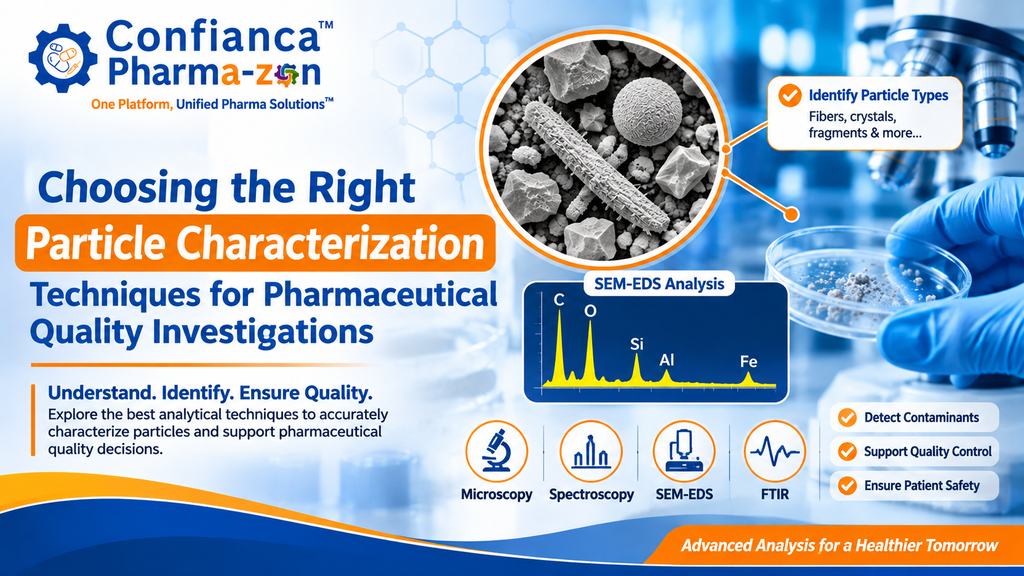
1. Introduction: Why Selecting the Right Particle Characterization Technique Matters
The presence of visible or sub-visible particles in pharmaceutical products is an important quality concern, particularly for injectable preparations, ophthalmic products, biologics and other sensitive pharmaceutical formulations. Even when a particle is detected during routine inspection, determining its actual identity, origin and potential impact requires a systematic scientific investigation.
Pharmaceutical particle characterization is not simply the process of observing particles under a microscope. It involves selecting suitable analytical techniques, understanding the physical and chemical properties of particles, evaluating analytical limitations and interpreting results in the context of pharmaceutical manufacturing and product quality.
One of the most common challenges faced by pharmaceutical quality control and quality assurance teams is deciding which analytical technique should be used for a particular particle investigation.
For example, a black particle observed in an injectable product may originate from rubber components, manufacturing equipment, packaging materials, environmental contamination or metallic sources. Visual appearance alone cannot reliably establish its composition.
Similarly, a transparent particle may be glass, polymer, cellulose, silicone-related material or another foreign substance.
Using an unsuitable analytical method can result in incomplete identification, misleading conclusions or unnecessary investigation delays.
Therefore, selecting the appropriate pharmaceutical particle characterization technique is essential for obtaining scientifically defensible results.
This article explains how pharmaceutical manufacturers can select appropriate analytical methods, combine complementary characterization techniques and use analytical findings to support contamination investigations and quality decisions.
2. Understanding Pharmaceutical Particle Characterization
Pharmaceutical particle characterization refers to the systematic evaluation of particles based on their physical, morphological, dimensional and chemical properties.
The objective is to understand what a particle is, what it may be made of and whether its characteristics provide evidence of a potential contamination source.
A complete particle characterization investigation may consider the following parameters:
- Particle size and size distribution.
- Shape and morphology.
- Surface characteristics.
- Colour and optical appearance.
- Elemental composition.
- Chemical composition.
- Physical structure.
- Potential material origin.
- Distribution and occurrence within the sample.
Different analytical techniques provide different types of information. No single method is necessarily sufficient for every pharmaceutical particle investigation.
2.1 Physical Characterization
Physical characterization evaluates the observable characteristics of a particle.
These include its dimensions, shape, colour, transparency, surface texture and structural features.
Physical characteristics can help investigators distinguish between fibres, fragments, flakes, crystalline particles, metallic particles and other particulate forms.
2.2 Chemical Characterization
Chemical characterization aims to determine the chemical composition or material identity of the particle.
Depending on the particle and investigation requirements, techniques such as FTIR, Raman spectroscopy and SEM-EDS may provide useful information.
2.3 Morphological Characterization
Morphological characterization focuses on particle shape and structural appearance.
It can help distinguish irregular fragments from fibres, spherical particles, flakes, crystalline structures and other particle types.
2.4 Elemental Characterization
Elemental characterization identifies the elements present in a particle.
Scanning Electron Microscopy coupled with Energy Dispersive X-ray Spectroscopy (SEM-EDS) is commonly used when elemental information is important to an investigation.
However, elemental composition alone does not always establish the complete chemical identity of a material.
3. Major Particle Characterization Techniques Used in Pharmaceutical Investigations
Selecting the appropriate analytical method begins with understanding what each technique can and cannot establish.
3.1 Optical Microscopy
Optical microscopy is frequently used as an initial examination technique for pharmaceutical particulate investigations.
It allows analysts to observe particles under magnification and assess their visible characteristics.
Information obtained:
- General particle shape.
- Approximate dimensions.
- Colour and transparency.
- Surface appearance.
- Fibre-like or fragment-like structures.
- Presence of multiple particle types.
Applications:
Optical microscopy is useful for initial screening, particle documentation, preliminary classification and selecting particles for further investigation.
For example, when multiple particles are recovered from an injectable product, microscopy can help classify them into different morphological groups before advanced analysis.
Limitation:
Optical microscopy generally cannot independently establish the chemical or elemental composition of an unknown particle.
3.2 Scanning Electron Microscopy (SEM)
Scanning Electron Microscopy provides high-resolution images of particle surfaces and structural characteristics.
SEM is particularly valuable when detailed morphological examination is required.
Information obtained:
- Surface morphology.
- Particle structure.
- Surface irregularities.
- Fracture characteristics.
- Fine structural details.
- High-magnification particle images.
SEM can help differentiate particles that appear similar under conventional optical microscopy.
For example, two black particles may have similar visible colours but significantly different surface structures.
SEM examination may reveal differences that support further investigation.
3.3 SEM-EDS Elemental Analysis
SEM-EDS combines electron microscopy with Energy Dispersive X-ray Spectroscopy.
This combination allows analysts to examine particle morphology and obtain elemental information from selected areas.
SEM-EDS is particularly useful for investigating suspected inorganic, metallic and mineral-based particles.
Typical elemental information may include:
- Iron (Fe).
- Silicon (Si).
- Aluminium (Al).
- Calcium (Ca).
- Magnesium (Mg).
- Chromium (Cr).
- Nickel (Ni).
- Copper (Cu).
- Zinc (Zn).
- Sulfur (S).
The actual elements detected depend on the sample, particle composition, instrument conditions and analytical limitations.
Pharmaceutical applications:
- Investigation of suspected metallic contamination.
- Characterization of inorganic particles.
- Evaluation of suspected glass-related particles.
- Investigation of equipment wear particles.
- Comparison of unknown particles with suspected source materials.
Important analytical consideration:
SEM-EDS provides elemental composition rather than complete molecular identification.
For example, detecting iron, chromium and nickel may support the possibility of a stainless-steel-related particle, but it does not automatically prove a particular equipment source or stainless-steel grade.
The analyst must evaluate the elemental profile alongside morphology, reference materials, process information and other analytical evidence.
3.4 Fourier Transform Infrared Spectroscopy (FTIR)
FTIR spectroscopy is used to identify chemical functional groups and support material identification.
It is particularly useful for many organic materials and polymers.
Potential applications include:
- Plastic fragments.
- Polymer-related contamination.
- Organic fibres.
- Rubber-related materials.
- Packaging-related materials.
- Certain coating and adhesive residues.
FTIR spectra can be compared with reference libraries or known material spectra.
The quality of identification depends on sample size, purity, spectral quality, material properties and reference availability.
3.5 Raman Spectroscopy
Raman spectroscopy provides molecular information based on the interaction of light with molecular vibrations.
It can complement FTIR analysis, especially when different molecular structures need to be distinguished.
Applications may include:
- Identification of certain organic and inorganic materials.
- Crystalline particle investigation.
- Pigment characterization.
- Polymer identification.
- Comparison of unknown particles with reference materials.
Some samples may exhibit fluorescence or other interferences that affect the quality of Raman measurements.
3.6 Particle Size Analysis
Particle size analysis provides quantitative information about particle dimensions and size distribution.
The appropriate technique depends on the nature of the sample and the measurement objective.
Possible approaches include image-based measurement, laser diffraction and other suitable particle-sizing methods.
A critical distinction must be maintained between the size of individual recovered foreign particles and the particle-size distribution of a bulk sample.
These are different analytical objectives and may require different methods.
4. How to Select the Right Analytical Technique
The most appropriate analytical method depends on the scientific question being investigated.
Before selecting a technique, the laboratory should define what information is needed.
For example:
- Is the objective to measure particle dimensions?
- Is detailed morphology required?
- Is elemental composition required?
- Is molecular identification required?
- Is comparison with a suspected contamination source necessary?
The answers help determine whether one technique or a combination of methods is appropriate.
4.1 Technique Selection Matrix
| Investigation objective | Suitable technique |
|---|---|
| Initial particle observation | Optical microscopy |
| Detailed surface morphology | SEM |
| Elemental composition | SEM-EDS |
| Organic material identification | FTIR |
| Molecular and crystalline characterization | Raman spectroscopy |
| Individual particle dimensions | Microscopic image analysis |
| Bulk particle-size distribution | Suitable particle-size analyser |
| Comparison with suspected source | Combination of appropriate techniques |
This matrix is a starting point rather than a universal method-selection rule. Actual selection should consider the sample, particle characteristics and required analytical evidence.
5. Importance of an Integrated Analytical Approach
In many pharmaceutical investigations, combining analytical techniques produces a more complete understanding than relying on a single method.
Consider an investigation involving a dark particle recovered from an injectable product.
The initial microscopic examination may indicate an irregular fragment.
SEM may reveal a rough and fractured surface.
EDS may identify iron, chromium and nickel as major detected elements.
The combined information may support a metallic-material hypothesis.
However, additional comparison with suspected equipment or manufacturing materials may be needed before identifying a likely source.
An integrated investigation can follow this sequence:
Step 1: Initial observation
Document the particle’s colour, shape, transparency and visible features.
Step 2: Microscopic examination
Record its morphology and dimensions.
Step 3: Advanced imaging
Use SEM when greater structural detail is required.
Step 4: Chemical or elemental analysis
Select EDS, FTIR or Raman according to the suspected material and investigation objective.
Step 5: Reference comparison
Compare analytical findings with suitable known materials.
Step 6: Scientific interpretation
Evaluate all observations and identify the level of confidence supported by the available evidence.
Step 7: Quality investigation
Use the results to support further manufacturing, packaging or environmental investigations where appropriate.
6. Pharmaceutical Applications of Particle Characterization
6.1 Injectable Pharmaceutical Products
Injectable products require careful particulate control because unintended particulate matter can present a product-quality concern.
Characterization may help investigate particles associated with:
- Glass containers.
- Elastomeric closures.
- Manufacturing equipment.
- Processing materials.
- Filtration systems.
- Environmental sources.
- Packaging components.
The analytical findings should be evaluated alongside applicable compendial requirements and the product-specific quality risk assessment.
6.2 Biopharmaceutical Manufacturing
Biopharmaceutical products may involve complex processing systems, single-use components and sensitive product-contact materials.
Particle investigations can help assess suspected material-related contamination and distinguish between different potential sources.
6.3 Glass Particle Investigations
Glass-related particles may require careful morphological and elemental evaluation.
SEM-EDS can provide elemental information that supports comparison with potential glass sources.
Nevertheless, composition and appearance should be interpreted together, and the investigation should not assume that every silicon-containing particle is glass.
6.4 Metal Particle Investigations
Metallic particles may arise from equipment contact, mechanical wear, maintenance activities or other manufacturing-related sources.
SEM-EDS can help characterize elemental profiles and support source-comparison investigations.
6.5 Packaging Material Investigations
Packaging materials may be potential sources of polymer, rubber, coating or other particulate contamination.
FTIR, Raman and microscopic examination may provide complementary information depending on the suspected material.
7. Analytical Challenges in Pharmaceutical Particle Identification
Even when sophisticated instruments are available, particle identification can involve several challenges.
Very small particle dimensions: Small particles may provide insufficient material for some analytical methods.
Mixed composition: A particle may contain more than one material, making interpretation complex.
Sample contamination: Handling, preparation and transfer may introduce foreign material.
Background interference: Membranes, mounting materials and substrates may contribute signals to analytical results.
Reference material limitations: A reference library may not contain the exact material being investigated.
Overinterpretation: A detected element or spectral feature may be insufficient to establish a unique material identity.
A scientifically sound report should acknowledge these limitations.
8. Quality Assurance and GMP Considerations
Particle characterization should be conducted under an appropriate laboratory quality system.
Important elements include:
- Approved analytical procedures.
- Instrument calibration and maintenance.
- Analyst training and competency.
- Sample identification and traceability.
- Controlled sample handling.
- Appropriate analytical controls.
- Raw data retention.
- Image and spectrum documentation.
- Scientific review of analytical conclusions.
- Deviation and investigation management where applicable.
For regulated pharmaceutical operations, analytical procedures and records should align with applicable GMP requirements and relevant pharmacopoeial expectations.
The investigation should distinguish between an analytical observation, a probable material identification and a confirmed source attribution.
These are not interchangeable conclusions.
9. Documentation of Particle Characterization Results
A useful particle characterization report should communicate findings clearly enough for quality teams to evaluate the investigation.
A comprehensive report may include:
- Sample identification and description.
- Investigation objective.
- Sample receipt and condition.
- Analytical methodology.
- Instrument information.
- Particle identification and numbering.
- Microscopic images.
- Particle size or measurement information.
- SEM micrographs where applicable.
- EDS spectra and elemental results where applicable.
- FTIR or Raman spectra where applicable.
- Analytical limitations.
- Results and interpretation.
- Conclusion and recommendations.
Where elemental percentages are reported, the analytical basis, quantification approach and relevant limitations should be clearly stated.
For example, the presence of sulfur in a blank membrane or sample-support material should be considered before attributing sulfur detected in a particle analysis to the foreign particle itself.
10. From Analytical Results to Effective Quality Decisions
The purpose of pharmaceutical particle characterization extends beyond producing images and analytical tables.
The results should help quality teams decide what additional investigation is necessary.
A practical investigation may include:
- Reviewing manufacturing batch records.
- Examining equipment maintenance history.
- Inspecting product-contact components.
- Reviewing filtration and transfer operations.
- Evaluating packaging components.
- Comparing suspected source materials.
- Assessing other affected batches.
- Evaluating potential product-quality impact.
- Establishing suitable CAPA actions.
Analytical evidence should support the investigation rather than replace process knowledge and quality risk assessment.
11. How Confianca Pharmazon Supports Pharmaceutical Particle Characterization
Confianca Pharmazon supports pharmaceutical organizations with specialized particle characterization and analytical investigation services.
Our approach focuses on helping pharmaceutical manufacturers obtain meaningful information about unknown particles through suitable analytical examination and scientific reporting.
Depending on the sample and investigation requirements, particle characterization may involve:
- Microscopic particle examination.
- Particle morphology documentation.
- Particle measurement.
- SEM imaging.
- SEM-EDS elemental characterization.
- Analytical comparison and interpretation.
- Technical reporting for quality investigations.
Our objective is to support informed decisions through structured analytical observations and clear technical documentation.
Every investigation should be designed around the actual sample characteristics and the questions that need to be answered.
12. Practical Checklist Before Starting a Particle Characterization Investigation
Before sending samples for analysis, pharmaceutical quality teams should consider the following checklist.
- Clearly define the investigation objective.
- Record the sample source and identification.
- Document the number of observed particles.
- Record particle colour and appearance.
- Preserve recovered particles appropriately.
- Avoid unnecessary handling.
- Identify possible analytical interferences.
- Share suspected contamination sources where available.
- Select methods according to the analytical objective.
- Define reporting requirements.
- Ensure sample traceability.
- Review analytical limitations before accepting conclusions.
13. Frequently Asked Questions (FAQs)
Q1. What is pharmaceutical particle characterization?
Pharmaceutical particle characterization is the scientific examination of particles to understand their size, morphology, physical structure and chemical or elemental composition.
Q2. Why is particle characterization important in pharmaceutical manufacturing?
It helps investigate foreign particulate matter, assess potential contamination sources and support pharmaceutical quality investigations.
Q3. Which techniques are commonly used for particle characterization?
Common techniques include optical microscopy, SEM, SEM-EDS, FTIR, Raman spectroscopy and suitable particle-sizing methods.
Q4. What is the difference between SEM and SEM-EDS?
SEM provides high-resolution images of particle surfaces and morphology. SEM-EDS adds elemental analysis to the microscopic examination.
Q5. Can SEM-EDS identify the exact chemical identity of a particle?
Not in every case. SEM-EDS primarily provides elemental information. Additional analytical techniques may be required for molecular identification.
Q6. When should FTIR analysis be considered?
FTIR is particularly useful when investigating many organic materials, polymers and certain other materials with identifiable infrared spectral characteristics.
Q7. Can particle characterization identify contamination sources?
It can support source identification by comparing particle characteristics with potential source materials. However, analytical similarity alone may not establish definitive source attribution.
Q8. Is optical microscopy sufficient for every particle investigation?
No. It is useful for initial examination, but advanced analytical methods may be necessary when chemical or elemental identification is required.
Q9. Why is sample preparation important?
Improper handling or preparation can introduce contamination, alter particle characteristics or interfere with analytical measurements.
Q10. What should a particle characterization report contain?
It should include sample details, methods, images, analytical findings, relevant spectra, limitations, interpretation and conclusions.
Q11. Can multiple analytical methods be used on one particle?
Yes. Combining complementary techniques can provide more comprehensive information when the sample and method requirements permit it.
Q12. Who needs pharmaceutical particle characterization services?
Pharmaceutical manufacturers, injectable product manufacturers, biotechnology organizations, quality control laboratories and organizations investigating particulate contamination may require these services.
Conclusion
Selecting the right pharmaceutical particle characterization technique is essential for obtaining reliable and meaningful analytical information.
Optical microscopy, SEM, SEM-EDS, FTIR and Raman spectroscopy each provide different types of evidence. Understanding their capabilities and limitations helps pharmaceutical organizations design investigations that are scientifically appropriate and aligned with quality objectives.
A structured approach combining suitable analytical methods, controlled sample handling, reference comparison and clear technical documentation can significantly improve the quality of particle investigations.
For pharmaceutical manufacturers, the objective should not simply be to identify a particle visually, but to understand its characteristics and use the available evidence to support appropriate quality decisions.
Confianca Pharmazon – Supporting Pharmaceutical Quality Through Specialized Analytical Services and Technical Expertise.