No products in the cart.
Pharmaceutical Particle Characterization: Techniques for Injectable Products and Contamination Investigation
Introduction
Unexpected particles in pharmaceutical products can raise important questions about product quality, manufacturing processes, packaging materials, and contamination control. Identifying the nature of these particles requires a systematic analytical approach supported by appropriate laboratory techniques.
Pharmaceutical particle characterization helps evaluate the physical and chemical properties of particles found in pharmaceutical materials and products. Depending on the investigation, the analysis may include microscopy, elemental analysis, molecular spectroscopy, and thermal analysis.
For injectable products, investigating visible or subvisible particulate matter is particularly important because particles may require further assessment under applicable product quality requirements. The analytical approach should be selected according to the sample characteristics, the investigation objective, and the information needed to support a scientific conclusion.
This article explains the major particle characterization techniques, their applications in pharmaceutical investigations, and how laboratories can use analytical evidence to assess unknown particles.
What Is Pharmaceutical Particle Characterization?
Pharmaceutical particle characterization is the systematic examination of particles to understand their physical appearance, morphology, composition, and other relevant properties.
The investigation may evaluate:
- Particle size and shape
- Colour and surface morphology
- Elemental composition
- Molecular or chemical characteristics
- Thermal behaviour
- Similarities with relevant reference materials
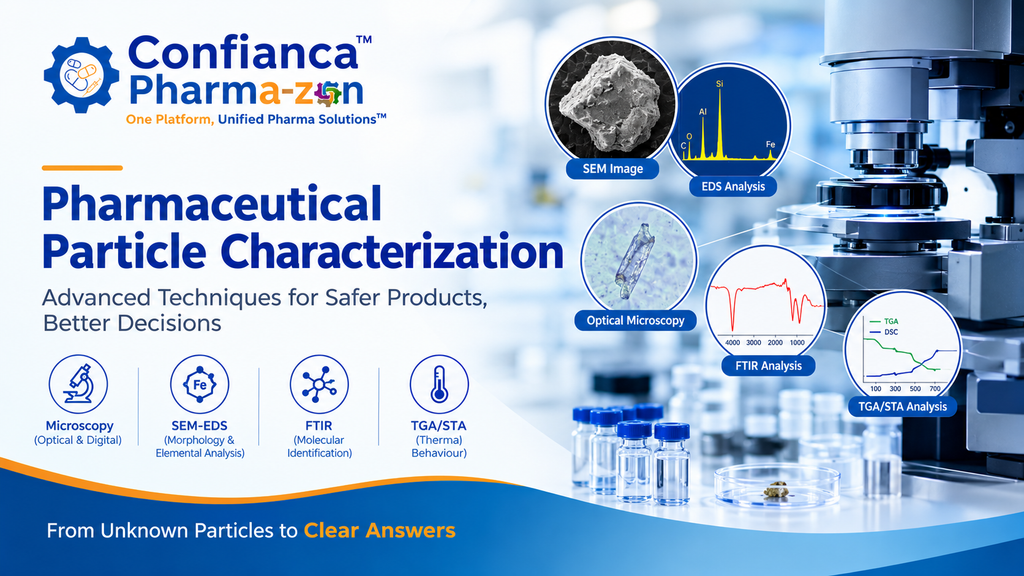
Different analytical methods provide different types of information. Optical microscopy can help assess particle appearance, while scanning electron microscopy with energy-dispersive spectroscopy (SEM-EDS) can provide detailed morphological and elemental information.
Fourier transform infrared spectroscopy (FTIR) may help investigate suitable organic materials, including certain polymers and fibres. Thermogravimetric analysis (TGA) and simultaneous thermal analysis (STA) can provide additional information about thermal behaviour.
The purpose is to build an evidence-based understanding of the particle rather than relying only on its visual appearance.
Why Is Injectable Particle Characterization Important?
Injectable particle characterization is relevant when unexpected particulate matter is observed in injectable pharmaceutical products or identified during a related quality investigation.
The source and nature of a particle cannot always be established through visual examination alone. Particles with similar appearances may have different compositions, while particles originating from similar materials may exhibit different physical characteristics.
A structured investigation can help teams:
- Examine the morphology and appearance of particles.
- Obtain additional information about their elemental or molecular composition.
- Compare findings with appropriate reference materials.
- Evaluate potential contamination sources.
- Document analytical observations to support quality investigations.
The appropriate testing strategy depends on the product, the particle, the available sample quantity, and the applicable requirements. Particle characterization complements, rather than replaces, relevant particulate-matter testing and pharmaceutical quality assessments.
Key Techniques Used in Pharmaceutical Particle Characterization
1. Optical Microscopy
Optical microscopy is commonly used as an initial examination technique for recovered particles.
It can provide information about colour, shape, transparency, visible surface features, and general morphology. These observations can help determine which additional analytical techniques may be suitable.
However, optical microscopy alone may not establish the chemical identity or source of an unknown particle.
2. SEM-EDS Pharmaceutical Particle Analysis
SEM EDS pharmaceutical particle analysis combines scanning electron microscopy (SEM) with energy-dispersive X-ray spectroscopy (EDS).
SEM provides detailed images of particle morphology and surface features. EDS provides information about the elements detected in the analysed region.
This combination may be useful for examining metallic fragments, inorganic particles, glass-like materials, and other samples for which elemental information is relevant.
SEM-EDS findings should be interpreted carefully. Elemental composition can help narrow potential material categories, but it does not always establish a unique material identity. Results may also be influenced by particle size, morphology, surface contamination, sample heterogeneity, and analytical conditions.
When elemental information is insufficient to answer the investigation question, complementary techniques such as FTIR or thermal analysis may be considered.
3. Fourier Transform Infrared Spectroscopy (FTIR)
FTIR is used to obtain infrared spectra associated with molecular vibrations.
For suitable samples, FTIR can help investigate polymers, fibres, elastomers, and other organic materials. The resulting spectrum may be compared with appropriate reference spectra to support material identification.
Sample quantity, particle dimensions, contamination, and spectral quality can influence the results. FTIR should therefore be selected according to the characteristics of the material and the objectives of the investigation.
4. Thermogravimetric Analysis and Simultaneous Thermal Analysis (TGA/STA)
Thermal analysis provides information about how a material behaves under controlled temperature conditions.
TGA measures changes in sample mass during a temperature programme. Depending on the instrument configuration, STA can combine measurements such as mass change and heat-flow information.
These methods may help evaluate thermal stability, decomposition behaviour, and differences between materials. Their suitability depends on the sample quantity, composition, and analytical question.
Pharmaceutical Particle Identification: From Observation to Evidence
Pharmaceutical particle identification involves assessing analytical evidence to determine what an unknown particle may be.
The process often begins with visual examination and progresses to more specialised testing when necessary. No single technique is suitable for every particle, so the analytical plan should reflect the information required.
A typical approach includes:
- Initial examination: Record the particle’s appearance, colour, shape, and visible features.
- Morphological assessment: Use suitable microscopy to examine the particle in greater detail.
- Compositional analysis: Select SEM-EDS, FTIR, or another appropriate technique based on the material and investigation objective.
- Reference comparison: Compare analytical results with suitable reference materials or established reference data.
- Interpretation: Assess the findings, including the limitations and uncertainties associated with each method.
- Reporting: Document the analytical methods, observations, results, and conclusions.
A proposed material identification should be supported by the available evidence. Where results are inconclusive, additional testing or further investigation may be required.
Unknown Particle Investigation Pharma: A Structured Approach
An unknown particle investigation pharma workflow should be designed to answer specific questions about the sample while preserving the integrity of the analytical evidence.
Step 1: Define the Investigation Objective
Determine what information is needed. The objective may involve understanding particle morphology, evaluating composition, comparing potential materials, or supporting a broader manufacturing investigation.
Step 2: Review the Sample and Available Information
Assess the sample’s condition, quantity, collection method, storage history, and any relevant product or manufacturing information.
These details help determine which analytical methods may be appropriate.
Step 3: Select Suitable Analytical Techniques
Choose the techniques based on the particle characteristics and the information required. Optical microscopy may provide an initial assessment, while SEM-EDS, FTIR, or TGA/STA may be appropriate for further investigation.
Step 4: Compare Results with Reference Materials
Where relevant reference materials are available, compare their analytical characteristics with those of the unknown particle.
Comparisons should consider the limitations of the techniques and the representativeness of the reference samples.
Step 5: Interpret and Document the Findings
Record the results and distinguish between confirmed observations, possible explanations, and conclusions that cannot yet be established.
A structured report helps quality teams understand the evidence and determine whether further investigation is necessary.
Foreign Particle Investigation Pharmaceutical: Evaluating Potential Sources
A foreign particle investigation pharmaceutical assessment may involve examining particles potentially associated with raw materials, manufacturing equipment, product-contact components, packaging, or other relevant sources.
The source should not be assumed based on appearance alone. Instead, investigators can use analytical findings and suitable reference comparisons to evaluate potential explanations.
For example, if a particle has an elemental profile resembling a material used in a manufacturing component, that similarity may support further investigation of the component. Additional evidence is still needed before concluding that the component was the source.
Similarly, a polymeric particle may require molecular analysis and comparison with relevant packaging or equipment materials.
A reliable investigation considers multiple evidence sources, including analytical results, manufacturing records, sample-handling information, and the circumstances in which the particle was discovered.
The Role of Reference Library Preparation
Reference library preparation can support pharmaceutical particle investigations by creating organised analytical information for selected materials used in manufacturing and packaging.
Depending on the project, representative coupons may be collected from relevant product-contact and non-contact materials. These samples can be analysed using suitable techniques to establish reference information for future comparison.
When an unknown particle is subsequently investigated, the reference data may help narrow potential material sources and guide further testing.
The usefulness of a reference library depends on the quality of the samples, the suitability of the analytical methods, and the completeness of the documented information.
Learn more about Library Preparation for Particle Characterization Analysis.
Common Challenges in Pharmaceutical Particle Analysis
Several factors can affect the reliability and interpretation of particle characterization results.
Limited sample quantity: Very small particles may restrict the number of analytical techniques that can be performed.
Sample contamination: Collection, handling, storage, or preparation may introduce additional material.
Sample heterogeneity: Different regions of a particle may have different characteristics, so a single measurement may not represent the entire sample.
Technique limitations: Each method provides specific information and has limitations. Elemental data, for example, may not establish a material’s molecular identity.
Incomplete reference data: Suitable reference materials may not be available for every potential source.
Overinterpretation of findings: A similarity between an unknown particle and a reference material does not automatically prove that they have the same source.
Recognising these limitations helps ensure that conclusions remain scientifically appropriate and that further testing is considered when necessary.
How Confianca Pharmazon Supports Particle Characterization
Confianca Pharmazon provides particle characterization-related analytical services to support pharmaceutical material evaluation and contamination investigations.
Depending on the sample and project requirements, the analytical approach may involve microscopy, SEM-EDS, FTIR, and TGA/STA. The objective is to select suitable methods that generate relevant information about the particle under investigation.
Reference library preparation can also help establish analytical information for selected manufacturing and packaging materials, supporting subsequent comparison with unknown particles.
For pharmaceutical teams evaluating unexpected particles, the choice of method should be guided by the sample, the investigation question, and the evidence required.
Explore Confianca Pharmazon’s Particle Characterization Analysis Services to learn more about the available service offering.
Frequently Asked Questions
What is pharmaceutical particle characterization?
Pharmaceutical particle characterization is the examination of particle properties, such as morphology, size, elemental composition, molecular characteristics, and thermal behaviour, using suitable analytical methods.
Which techniques are used for injectable particle characterization?
Depending on the investigation, techniques may include optical microscopy, SEM-EDS, FTIR, and thermal analysis. The appropriate combination depends on the sample and the information required.
What is SEM-EDS pharmaceutical particle analysis used for?
SEM-EDS can provide detailed particle images and information about the elements detected in the analysed region. It is useful when morphology and elemental composition are relevant to the investigation.
How is pharmaceutical particle identification different from characterization?
Characterization describes the properties of a particle. Identification uses those properties and other available evidence to assess the material’s identity. Establishing the source may require additional comparisons and investigation.
How is an unknown particle investigated in pharmaceutical manufacturing?
A structured investigation typically involves defining the objective, examining the sample, selecting suitable analytical techniques, comparing results with relevant reference materials, and documenting the findings and limitations.
Can particle characterization establish the exact source of contamination?
Not always. Analytical results may help evaluate potential sources, but source attribution generally requires appropriate reference comparisons and supporting manufacturing or investigation evidence.
Conclusion
Pharmaceutical particle characterization provides a systematic approach to understanding unexpected particles encountered in pharmaceutical products, materials, and manufacturing environments.
By combining suitable techniques such as optical microscopy, SEM-EDS, FTIR, and TGA/STA, laboratories can obtain complementary information to support pharmaceutical particle identification and contamination investigations.
For injectable products and other pharmaceutical applications, the key is to select appropriate methods, interpret results within their limitations, and use relevant reference information wherever available.
A structured analytical approach can help pharmaceutical teams evaluate unknown particles, investigate potential foreign materials, and make better-informed quality decisions.
Looking for particle characterization support? Contact Confianca Pharmazon to discuss your sample and analytical requirements.