
No products in the cart.
Knapp Kit for Pharmaceutical Visual Inspection: A Complete Guide to Defect Kits and Qualification
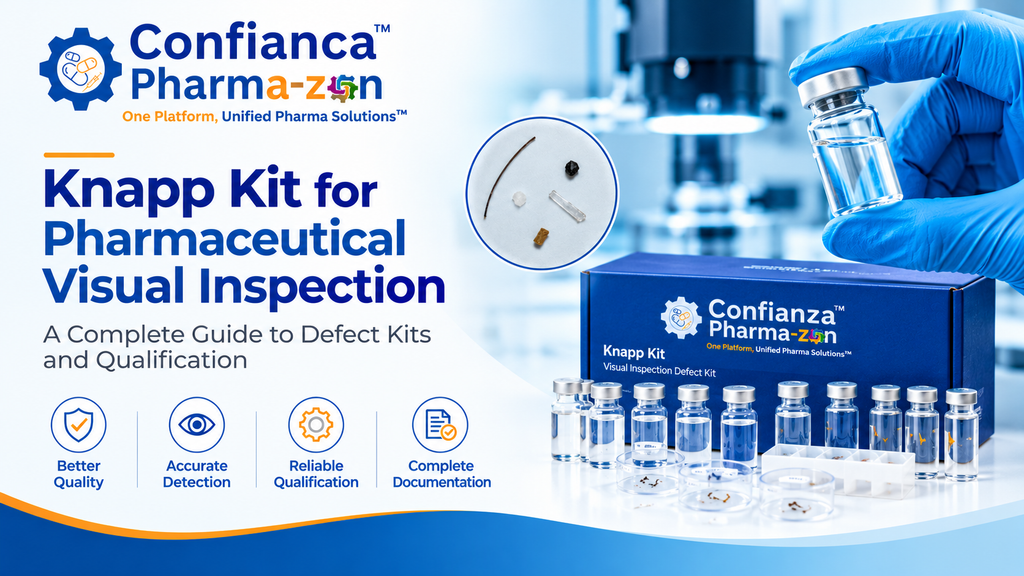
In pharmaceutical manufacturing, visual inspection is an important quality control activity used to identify visible particulate matter and container defects in injectable products. But how can pharmaceutical manufacturers evaluate whether their inspection process can identify the defects relevant to their products?
A structured visual inspection program requires suitable challenge samples, defined inspection conditions, documented results, and appropriate qualification procedures.
This is where a Knapp Kit for pharmaceutical visual inspection becomes useful.
Also known as a visual inspection defect kit or particulate matter challenge kit, a Knapp Kit can contain identified defect samples and, depending on its configuration, acceptable reference containers. These samples help pharmaceutical manufacturers evaluate inspector performance or challenge automatic visual inspection machines under defined conditions.
For pharmaceutical companies in India, selecting an appropriate Knapp Kit is important when establishing a new inspection program, training visual inspectors, evaluating defect detection performance, or reviewing an existing qualification process.
Confianca Pharmazon offers Knapp Kits and manual visual inspection defect kits for pharmaceutical applications, with configurations that can be discussed according to the required container format, defect categories, and supporting documentation.
This guide explains what a Knapp Kit is, how it is used, which defects may be included, and what pharmaceutical QA/QC teams should consider when selecting a suitable kit.
What Is a Knapp Kit?
A Knapp Kit is a set of identified challenge samples used to support pharmaceutical visual inspection training and qualification activities.
Depending on the intended application, the kit may contain containers with defined particulate or cosmetic defects, along with suitable reference containers. Each sample should be identifiable and traceable to its corresponding documentation.
A Knapp Kit may be used to support:
- Manual visual inspector training and qualification
- Automatic visual inspection machine qualification
- Defect recognition and assessment
- Probability of Detection (PoD) evaluation, where appropriate
- Investigation and review of inspection performance
The exact contents depend on the kit specification, container type, product characteristics, and intended qualification objective.
A Knapp Kit supports a controlled qualification program but does not, by itself, establish that an inspector or machine can detect every possible defect.
Why Is a Knapp Kit Important in Pharmaceutical Manufacturing?
Visible particulate matter in injectable products requires careful evaluation because the nature and characteristics of a defect can influence its detectability and potential significance.
A structured visual inspection program helps manufacturers assess performance under defined conditions and maintain appropriate quality records.
1. Supporting Inspector Qualification
Challenge samples help inspectors learn to recognize specified defects and demonstrate their performance against an approved assessment method.
2. Evaluating Automatic Inspection Machines
A suitable kit can help challenge automated inspection systems using identified defect samples under predefined operating conditions.
3. Improving Defect Recognition
Different particles and fibers can have different colours, sizes, shapes, and contrast characteristics. A suitable sample set can help evaluate recognition of the selected defect categories.
4. Supporting Quality Documentation
Identified samples, supplier documentation, approved protocols, and recorded results help establish traceability throughout the qualification process.
5. Identifying Inspection Limitations
Testing may reveal missed detections, unexpected rejections, or conditions requiring further investigation.
The final qualification approach should be based on the manufacturer’s quality system, risk assessment, intended application, and applicable requirements.
Types of Knapp Kits for Visual Inspection
Knapp Kits can be selected according to the inspection method and intended use.
1. Manual Visual Inspection Knapp Kit
Manual visual inspection kits support training and assessment of human inspectors.
The inspector examines the challenge samples under defined lighting, background, viewing, and handling conditions. Results are recorded and evaluated against the approved qualification criteria.
These kits may be suitable for applications involving vials, cartridges, prefilled syringes, and other agreed container formats.
2. Automatic Visual Inspection Machine Knapp Kit
Automatic visual inspection machine qualification kits are used to challenge automated inspection systems with selected defects.
Testing may evaluate whether the machine detects or rejects the specified challenge units under defined conditions. The test protocol should also address acceptable reference units and false rejects when these are within scope.
3. Particulate Matter Defect Kit
Particulate matter kits contain identified particle samples intended to represent selected contamination challenges.
Depending on the supplier’s configuration, examples may include glass particles, metal particles, black particles, and white particles.
4. Fiber Defect Kit
Fiber challenge samples can support the evaluation of inspection performance for specified fiber-related defects.
Examples may include black and white fibers, subject to the kit specification and customer requirements.
5. Container and Cosmetic Defect Kit
Where included in the scope, cosmetic defect samples can help assess recognition of relevant container or component defects.
The actual defect classification and acceptance criteria should be defined by the manufacturer’s approved procedures.
Common Defects Included in a Knapp Kit
The appropriate defect selection depends on the product, container, inspection system, and qualification objective.
Examples of defect categories that may be available include:
- Glass particles
- Metal particles
- Black particles
- White particles
- Black fibers
- White fibers
- Other specified particulate matter
- Selected container or cosmetic defects
Particle size can be an important characteristic, but size alone does not determine whether a defect will be detected. Colour, shape, orientation, movement, contrast, product appearance, and inspection conditions may also influence detectability.
Before ordering, confirm the exact defect categories, sample quantities, container formats, sizing information, and documentation included in the proposed kit.
How to Use a Knapp Kit for Visual Inspection Qualification
A reliable qualification exercise should begin with an approved protocol and a clearly defined testing objective.
Step 1: Define the Qualification Objective
Determine whether the kit will be used for inspector training, initial qualification, periodic reassessment, automatic machine qualification, or another defined purpose.
Document the product, container format, inspection method, and relevant defect categories.
Step 2: Select Suitable Defect Samples
Select samples that represent the intended inspection challenges.
Consider the product formulation, container characteristics, defect types, and inspection system. Do not assume that a kit selected for one container format is automatically suitable for every other format.
Step 3: Verify Sample Identification
Review the sample identification list and confirm that each challenge unit can be matched to its corresponding record.
Unidentified or damaged samples should be evaluated before use according to the site’s approved procedures.
Step 4: Establish Inspection Conditions
Define the applicable lighting, background, viewing distance, inspection duration, handling method, and equipment settings.
For automatic systems, document relevant machine configuration, recipe, operating speed, and inspection parameters.
Maintain conditions consistent with the approved protocol.
Step 5: Perform the Challenge Test
Present the challenge samples according to the approved procedure.
Record the sample identification, intended defect category, inspection result, and any unexpected observation. Preserve traceability between each sample and its recorded outcome.
Step 6: Evaluate the Results
Compare the recorded results with the predefined acceptance criteria.
Where appropriate, evaluate Probability of Detection (PoD) using the approved method and study design. Investigate missed defects, false rejects, and other unexpected results rather than changing acceptance criteria after testing.
Step 7: Prepare the Qualification Report
Document the qualification objective, sample identification, inspection conditions, results, deviations, investigations, and final assessment.
The report should be reviewed and approved according to the site’s quality management procedures.
A Knapp Kit is one component of the qualification process; it does not replace the manufacturer’s own protocol, assessment, or quality approval.
How to Choose the Right Knapp Kit
Selecting a suitable kit requires more than checking the number of samples supplied.
1. Container Format
Confirm whether the kit is intended for vials, cartridges, prefilled syringes, or another container format.
2. Product Formulation
The appearance of the product can influence visibility. Consider the relevant formulation and container characteristics when defining the inspection challenge.
3. Defect Categories
Identify the particles, fibers, and other defects required by the approved qualification scope.
4. Particle and Fiber Size
Review the available sizing information and confirm whether it meets the agreed technical requirements.
5. Documentation and Traceability
Confirm which sample lists, certificates, images, sizing records, and handling instructions are supplied.
6. Technical Support
Consider whether the supplier can support kit configuration, training, documentation queries, and customer-specific requirements.
A suitable Knapp Kit should be selected according to the intended inspection application and documented qualification requirements.
Documentation and Certificates for a Knapp Kit
Documentation helps ensure that the supplied samples can be identified and that their relevant characteristics can be reviewed.
Depending on the supplier and kit configuration, supporting documents may include:
- Master certificate or defect identification list
- Unique sample identification numbers
- Particle or fiber sizing information
- Microscopic images and measurement records
- Applicable instrument calibration records
- Relevant environmental or preparation records
- Probability of Detection evaluation documentation, where included
Confianca Pharmazon’s product information describes supporting documentation and services for its visual inspection kits. The exact records supplied should be confirmed for the selected configuration.
Supplier documentation supports the qualification process but should not be treated as a replacement for the manufacturer’s approved qualification protocol or final report.
Common Mistakes to Avoid When Selecting a Knapp Kit
Even when a suitable kit is available, poor preparation can weaken the usefulness of a qualification exercise.
Avoid these common mistakes:
- Selecting samples without confirming the intended container format.
- Assuming every Knapp Kit contains identical defects.
- Using samples without clear identification and traceability.
- Overlooking the importance of inspection conditions.
- Using unclear or unapproved acceptance criteria.
- Ignoring missed detections or false rejects.
- Treating a supplier certificate as proof of complete qualification.
- Failing to investigate unexpected results.
- Assuming that one successful test demonstrates performance for every product or inspection condition.
A controlled, risk-based approach helps ensure that the kit is appropriate for its intended purpose.
How Confianca Pharmazon Supports Pharmaceutical Visual Inspection
Confianca Pharmazon provides visual inspection Knapp Kits and defect kits for pharmaceutical applications.
According to its product information, the offering includes manual and automatic visual inspection kits, particulate matter samples, particle and fiber sizing services, supporting documentation, and visual inspection training-related services.
Available configurations and documentation should be confirmed according to the customer’s application and requirements.
For pharmaceutical manufacturers looking for a Knapp Kit in India, the appropriate solution depends on the required container format, defect categories, sample characteristics, qualification objective, and documentation needs.
Explore the Knapp Kit – Visual Inspection Kits, Particles and Particulate Matters to review the product information and discuss your requirements with Confianca Pharmazon.
Frequently Asked Questions
What is a Knapp Kit in pharmaceutical manufacturing?
A Knapp Kit is a set of identified challenge samples used to support visual inspection training and qualification activities. The actual sample types depend on the kit configuration and intended application.
What defects can be included in a Knapp Kit?
Depending on the supplier and configuration, examples may include glass, metal, black and white particles, fibers, and selected container defects. Confirm the available defect list before ordering.
Can a Knapp Kit be used for manual and automatic visual inspection?
Some kits are designed for manual inspection, others for automatic systems, and certain configurations may support both. Suitability must be confirmed for the intended inspection method and test protocol.
What is Probability of Detection in visual inspection?
Probability of Detection describes the likelihood that a defined inspection method detects a specified defect under stated conditions. Its evaluation should use an appropriate study design and predefined criteria.
Does a Knapp Kit certificate qualify an inspection machine?
No. Supplier documentation supports sample identification and traceability. Machine qualification requires an approved protocol, appropriate test conditions, recorded results, acceptance criteria, and documented quality review.
What documentation should be checked before ordering?
Review the defect identification list, available certificates, sizing information, sample traceability, handling instructions, and any additional records required by the qualification protocol.
Where can I get a Knapp Kit in India?
Confianca Pharmazon offers Knapp Kit and visual inspection-related products and services. Contact the company to discuss the appropriate configuration and documentation for your application.
Conclusion: Choose the Right Knapp Kit for Reliable Visual Inspection
A Knapp Kit can support pharmaceutical visual inspection training and qualification by providing identified challenge samples for a defined inspection task.
Selecting the right kit requires careful consideration of the inspection method, product formulation, container format, defect categories, sample traceability, and supporting documentation.
A structured qualification program combines suitable challenge samples with approved procedures, predefined acceptance criteria, recorded results, and appropriate investigation of unexpected outcomes.
For pharmaceutical manufacturers in India, choosing a suitable Knapp Kit can help support a more organized and traceable approach to visual inspection qualification.
If your team is planning inspector qualification, evaluating an automatic visual inspection machine, or reviewing its existing challenge samples, explore Confianca Pharmazon’s visual inspection Knapp Kits and discuss your specific requirements with the technical team.
Your trusted partner for pharma skills, systems, and solutions.
Disclaimer: This article is for general educational purposes only. Product specifications, qualification requirements, and applicable regulatory expectations should be confirmed with the supplier and the responsible quality and regulatory teams.