
No products in the cart.
10 Key Steps to Mastering Visual Inspection Qualification, Saudi Arabia: A Proven Audit Preparation Guide for Flawless Pharma Compliance
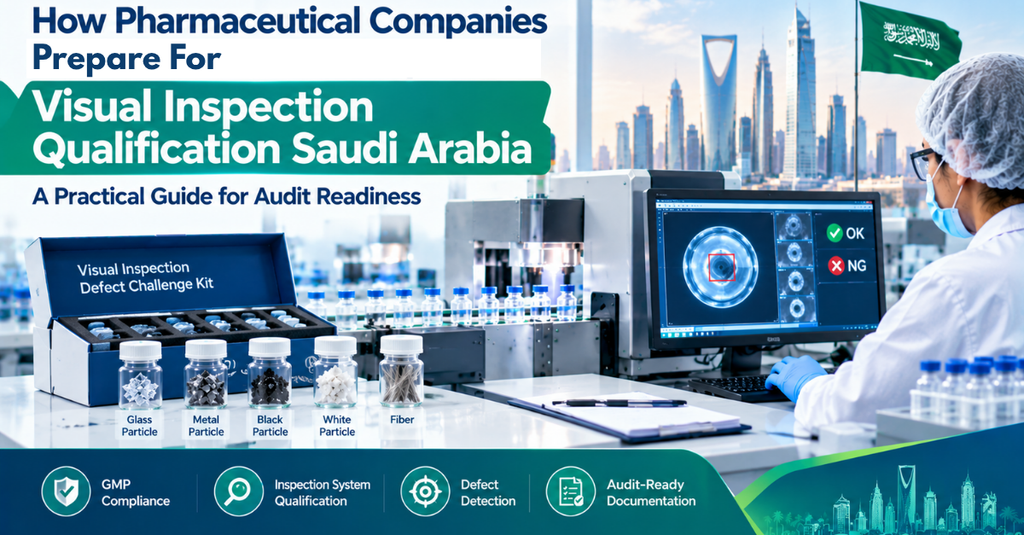
Visual inspection qualification Saudi Arabia: This process plays a critical role in pharmaceutical quality assurance, particularly when manufacturers produce injectable medicines, sterile solutions, and other products where visible contamination or container defects may create patient-safety risks. For pharmaceutical companies in the Kingdom, preparing for a visual inspection qualification audit involves more than checking equipment or reviewing a few inspection records. It requires a fully documented, risk-based system that clearly demonstrates how defects are identified, classified, detected, investigated, and controlled.
A well-prepared facility should be able to explain how its inspection process works, demonstrate that inspectors and automated systems perform as intended, and produce reliable evidence when requested by auditors. Knapp kits and visual inspection defect challenge kits can support this process by providing defined defect samples for qualification, training, and performance assessment.
This guide explains how pharmaceutical manufacturers in Saudi Arabia can prepare for visual inspection qualification audits, organize their documentation, assess inspection performance, and use defect challenge kits effectively.
Why Visual Inspection Qualification Matters in Saudi Arabia
Visual inspection is an important quality-control activity for pharmaceutical products, especially injectable preparations. Visible particles, damaged containers, defective closures, and other abnormalities may indicate a product-quality concern that requires assessment.
The Saudi Food and Drug Authority (SFDA) publishes Good Manufacturing Practice (GMP) guidance for pharmaceutical manufacturers. Its GMP guidance for sterile products addresses individual inspection of filled parenteral containers, risk-based defect classification, defect libraries, batch-performance analysis, and investigation of unusual defect trends. SFDA GMP guidance also provides a relevant reference point for manufacturers preparing their quality systems for inspection. SFDA GMP Guide
For companies operating in Saudi Arabia, audit preparation should therefore focus on demonstrating that visual inspection is a controlled, repeatable, and documented process—not simply a routine production step.
What auditors may want to understand
Depending on the scope of the audit, product type, and inspection system, auditors may ask:
- How are defects identified and categorized?
- How were the manual inspection process or automatic inspection machine qualified?
- How are representative defect samples selected and controlled?
- Are inspection parameters defined and justified?
- How are inspectors trained and qualified?
- How are false accepts, false rejects, and unexpected defect trends investigated?
- Can the company trace qualification activities to approved protocols and reports?
- How are changes to products, containers, equipment, and inspection settings assessed?
These questions should be addressed through approved procedures, actual qualification evidence, and consistent practices on the manufacturing floor.
1. Review the Applicable GMP and Internal Requirements
The first step in visual inspection audit preparation in Saudi Arabia is to establish which requirements apply to the facility, products, and inspection process.
Begin with the current applicable SFDA GMP requirements, relevant marketing authorization commitments, approved site procedures, and any other standards adopted by the company. USP General Chapter <790>, Visible Particulates in Injections, addresses visible particulate inspection, while USP General Chapter <1790>, Visual Inspection of Injections, provides additional guidance on the inspection process. https://doi.org/10.31003/USPNF_M7197_01_01 https://doi.org/10.31003/USPNF_M7198_06_01
These USP chapters should be applied according to their relevance and the company’s approved quality framework; do not assume that every informational recommendation automatically becomes a standalone Saudi regulatory requirement.
Conduct a requirements gap assessment
Create a simple assessment table that connects each applicable requirement to objective evidence.
| Review area | Questions to ask | Example evidence |
|---|---|---|
| Procedures | Are inspection steps and acceptance decisions defined? | Approved SOPs |
| Qualification | Is the inspection method or machine qualification documented? | Approved protocol and report |
| Defect library | Are known defect categories represented and maintained? | Defect library register |
| Personnel | Are training and qualification current? | Training and assessment records |
| Equipment | Are relevant settings and checks controlled? | Equipment records and parameter logs |
| Investigations | Are unexpected findings assessed and resolved? | Deviations, CAPAs, and trend reports |
Record each gap, assign an owner, set a target completion date, and verify closure before the audit. Avoid treating a document as compliant merely because it exists; its content and implementation must also be appropriate.
2. Establish a Complete Visual Inspection Documentation Package
Documentation is often where an otherwise effective inspection process becomes difficult to demonstrate. A machine may be functioning correctly, but missing protocols, incomplete records, or unclear acceptance criteria can make its performance difficult to verify.
For visual inspection qualification Saudi Arabia, companies should organize their records so that an auditor can follow the process from requirements and risk assessment through testing, approval, and routine monitoring.
Documents to prepare before the audit
Your document package should include, as applicable:
- Current visual inspection SOPs for manual and automated processes.
- Product- and container-specific inspection requirements.
- Risk assessments and defect classification rationale.
- Defect library inventory and identification records.
- Knapp kit or defect challenge kit specifications and certificates.
- Qualification protocols, predefined acceptance criteria, and approved reports.
- Automated inspection machine configuration and relevant parameter records.
- Inspector training, qualification, and requalification records.
- Inspection results, rejects, investigations, and trend reviews.
- Equipment maintenance, calibration, and change-control records, where applicable.
- Deviations, corrective and preventive actions (CAPA), and effectiveness checks.
- Procedures for handling, storage, expiry, and periodic review of challenge samples.
Not every document will apply to every inspection system. The package should reflect the site’s actual process and approved procedures.
Make records easy to retrieve
Use a document index that identifies the record title, document number, current revision, responsible department, and storage location. Check that records are legible, approved, and consistent with the equipment and process currently in use.
A useful preparation exercise is to ask a colleague who was not involved in qualification to retrieve the evidence for a selected defect or test. If the colleague cannot find the relevant protocol, raw data, and approval quickly, improve the indexing before the audit.
3. Build and Maintain a Representative Defect Library
A defect library provides a controlled reference for the types of abnormalities that personnel or inspection equipment may need to detect. It helps connect defect identification, training, qualification, and routine inspection decisions.
The SFDA GMP guidance for sterile products states that a defect library should be generated and maintained to capture known defect classes and used for training production and quality assurance personnel. It also highlights the importance of defect criticality, batch performance, and investigation of unusual defect trends. SFDA GMP Guide
Include relevant defect categories
Depending on the product, container, process, and risk assessment, the defect library may cover:
- Particulate defects: glass, metal, black particles, white particles, and fibers.
- Container defects: cracks, chips, damaged vials, and other container abnormalities.
- Closure defects: damaged stoppers, closure problems, or compromised seals.
- Product-related defects: crystallization, abnormal appearance, or incorrect solution characteristics.
- Cosmetic and packaging defects: cap-related abnormalities, label issues, and other defined presentation defects.
The categories above are examples, not a universal list of required challenge samples. The library should be based on the facility’s product and process risks, known defect history, packaging materials, and approved inspection strategy.
Define critical, major, and minor defects carefully
Defect classification should have a documented rationale. A defect’s significance depends on factors such as its potential impact on the patient, the dosage form, route of administration, and product-specific context.
For example, a visible foreign particle in an injectable product may warrant a different assessment from a cosmetic packaging issue. The classification should be supported by a risk-based rationale rather than informal judgement.
Practical tip: Maintain a defect matrix that records the defect name, category, potential source, criticality, applicable products, method of detection, reference sample identification, and required inspection or qualification use.
Review the matrix when new products are introduced, investigations reveal previously unrecognized defects, or process changes affect the types of defects that may occur.
4. Use Knapp Kits and Defect Challenge Kits Effectively
Knapp kits are designed to support visual inspection qualification by providing defined defect samples that can be used in structured testing. They are particularly useful when a company needs to demonstrate that its inspection process can identify representative defect types under specified conditions.
Confianca Pharmazon’s visual inspection offering includes Knapp kits for manual and automatic inspection systems, defect and training kits, and particulate samples such as glass, metal, black and white particles, and fibers. Its brochure also describes defect certificates, a probability-of-detection (PoD) evaluation sheet, technical support, and training options. The exact contents, documentation, sample types, and expiry conditions should be confirmed for the kit being purchased. <FileCite ref_id=”turn10file0″ />
What to verify when selecting a kit
Before purchase or use, confirm that the kit:
- Includes defect types relevant to the products and inspection process.
- Has clear sample identification and appropriate documentation.
- Provides traceability for the supplied defects and containers.
- Is suitable for the intended manual or automatic inspection application.
- Has defined handling, storage, and expiry information.
- Can be used in a protocol with predefined test conditions and acceptance criteria.
- Has a process for reporting damaged, missing, or non-viable samples.
Do not assume that a supplier certificate alone proves that the complete inspection system is qualified. The kit is a test tool; qualification depends on the approved protocol, execution, results, assessment, and final approval.
Keep challenge samples controlled
Assign each sample or container a unique identifier and maintain a register. Record receipt, inspection on arrival, storage location, use history where required, condition checks, expiry or review date, and disposition.
If a sample is damaged or its defect is no longer clearly identifiable, remove it from qualification use according to the approved procedure. Do not quietly substitute another sample without recording the change.
5. Prepare an Evidence-Based Qualification Protocol
An audit-ready qualification protocol should describe what will be tested, why the test is appropriate, how it will be performed, and how results will be evaluated.
For an automatic visual inspection machine, the protocol should reflect the actual machine configuration and its intended use. For manual inspection, it should define the controlled inspection conditions and personnel qualification approach.
Key protocol elements
A well-structured protocol generally includes:
- Objective and scope.
- Responsibilities and approvals.
- Equipment identification and configuration.
- Product, container, and defect types included.
- Risk assessment and rationale for challenge sample selection.
- Defined test conditions and operating parameters.
- Test sequence and sample identification method.
- Pre-approved acceptance criteria.
- Data recording and review requirements.
- Deviation handling and retest rules.
- Final report and approval requirements.
Define acceptance criteria before testing
Avoid deciding whether a result is acceptable only after seeing the outcome. Establish the criteria in advance and document the rationale.
For automated systems, consider the relevant detection performance for defined defect types, false-reject performance, repeatability, and the ability to handle the intended range of product and container presentations. For manual inspection, consider inspector performance under the specified conditions and the requirements of the site’s qualification program.
The appropriate sample size, number of test repetitions, and acceptance thresholds depend on risk, intended use, the inspection method, and the approved protocol. There is no single sample count or detection threshold that should be applied indiscriminately to every product and machine.
6. Assess Probability of Detection and Inspection Performance
Visual inspection is not perfectly deterministic. USP <1790> explains that the probability of detecting visible particles varies with the product, particle characteristics—including size, shape, colour, and density—and container design. USP <1790>
This is why qualification should evaluate performance under defined and relevant conditions instead of relying solely on a successful demonstration using a few obvious defects.
How to approach PoD testing
A structured probability-of-detection assessment should:
- Define the purpose of the assessment and the system being evaluated.
- Select defect samples representative of relevant product and process risks.
- Establish the number of test runs and sequence in the approved protocol.
- Record each sample’s identification and expected status.
- Capture detections, missed defects, and other required outcomes.
- Evaluate results against the pre-approved criteria.
- Investigate failures and document conclusions and approvals.
A PoD evaluation sheet can help organize test records, but the sheet alone is not a complete statistical analysis or proof of qualification. Interpret results using the protocol’s defined method and appropriate statistical rationale.
Track false rejects as well as missed defects
A machine that rejects too many acceptable units may create avoidable reinspection, waste, and production delays. Conversely, a system that accepts units containing challenge defects may have a detection-performance concern.
The audit evidence should show how both types of outcomes are measured and evaluated, what actions follow a failure, and how the company prevents unauthorized adjustment of machine settings to achieve a desired result.
7. Verify Machine Settings and Inspection Conditions
For automated inspection, ensure the machine’s configuration matches the approved qualification state. Review the relevant recipes, camera and lighting settings, detection parameters, software versions, rejection mechanisms, and other controls applicable to the equipment.
The specific controls will vary by machine design and inspection technology.
Pre-audit equipment checklist
- Confirm equipment identification and current status.
- Verify that the approved recipe or configuration is in use.
- Check relevant calibration, maintenance, and functional-test records.
- Confirm that reject mechanisms and associated alarms operate as intended.
- Review access controls and changes to critical parameters.
- Check whether software or hardware changes require requalification.
- Confirm that test results can be traced to the machine, configuration, date, and operator.
For manual inspection, verify that lighting, background, inspection rate, viewing conditions, and rest periods are controlled as defined in the approved procedure.
Document any differences between the current equipment configuration and the one used during qualification. Assess the impact through the site’s change-control process rather than assuming that a minor adjustment has no effect.
8. Confirm Personnel Training and Qualification
Equipment qualification does not remove the need for competent personnel. Operators, quality reviewers, and maintenance or validation staff should understand their responsibilities and the controls relevant to their roles.
Training should cover the site’s SOPs, defect classification, sample handling, inspection procedure, data recording, escalation of unexpected results, and the importance of following approved acceptance criteria.
For manual inspectors, qualification and requalification should follow the applicable GMP requirements and the site’s approved program. The SFDA GMP guidance for sterile products specifically addresses periodic qualification of manual visual inspectors. SFDA GMP Guide
Training records should demonstrate competence
Maintain records of:
- Training material and SOP revision.
- Date of training and trainer.
- Assessment or practical exercise completed.
- Qualification outcome and approval.
- Retraining or requalification where required.
For automatic systems, ensure that operators understand normal operation, alarm responses, reject handling, approved recipe selection, and when to stop the process and notify QA or engineering.
9. Prepare for Deviations, CAPA, and Trend Review
Auditors may look beyond a successful qualification report to understand how the company responds when performance is unexpected.
Examples include a challenge defect being missed, an unacceptable false-reject rate, a damaged reference sample, a change in defect patterns, or a machine configuration that differs from the approved state.
A practical investigation workflow
- Contain: Take immediate action according to the approved procedure, including stopping or holding the process when warranted.
- Document: Record the event, sample identification, equipment state, test conditions, and observed outcome.
- Assess risk: Determine the potential impact on product quality and previously inspected batches, as applicable.
- Investigate: Evaluate likely causes, such as sample condition, machine settings, operator technique, lighting, or procedural issues.
- Correct: Implement approved corrective and preventive actions.
- Verify: Conduct the necessary retesting or effectiveness checks.
- Approve: Ensure that authorized personnel review and close the investigation.
Do not repeat failed tests until a passing result is obtained without documenting the failure and following the approved retest rules. Repeated failures may indicate a deeper problem that needs investigation.
Trend analysis can also help identify recurring defect types, shifts in machine performance, unusual rejection rates, or repeated operator qualification issues.
10. Conduct a Mock Audit Before the Actual Visit
A mock audit is an effective way to test whether the documentation and shop-floor practices tell the same story.
Ask a cross-functional team from QA, production, engineering, and validation to review a representative product or machine. Where possible, involve someone who did not prepare the original qualification package.
Mock-audit checklist
- Current visual inspection SOPs are approved and available.
- Applicable SFDA GMP and internal requirements have been reviewed.
- The defect library reflects relevant known defect types.
- Defect classification is justified and documented.
- Knapp kit documentation and sample status are verified.
- Qualification protocols and acceptance criteria were approved before execution.
- Raw data, calculations, and final reports are traceable.
- Machine settings match the approved configuration.
- Personnel training and qualification records are current.
- Deviations, CAPA, and trend reviews are available.
- Open gaps have assigned owners and documented actions.
After the exercise, classify findings by risk, assign responsibilities, and verify that corrective actions are completed or managed under the site’s approved quality system before the audit.
Common Mistakes to Avoid During Audit Preparation
Even mature pharmaceutical sites can experience preventable audit difficulties. Watch for these common issues:
- Using generic defect samples: Samples that do not represent the facility’s product or process risks may provide weak qualification evidence.
- Relying only on supplier certificates: Supplier documentation supports traceability but does not replace site qualification.
- Changing acceptance criteria after testing: This undermines the credibility of the assessment.
- Ignoring false rejects: Excessive rejection can affect process efficiency and may indicate a need for investigation.
- Allowing expired or damaged samples into testing: Challenge samples must remain suitable for their intended use.
- Failing to assess changes: New containers, product presentations, software, or inspection settings may affect performance.
- Keeping records in disconnected locations: Poor retrieval can make valid evidence difficult to demonstrate.
- Closing CAPA without effectiveness checks: Corrective actions should address the cause and be evaluated for effectiveness.
A simple, well-maintained qualification system is generally easier to explain and defend than a large collection of disconnected documents.
How Confianca Pharmazon Can Support Visual Inspection Qualification
Pharmaceutical manufacturers preparing for visual inspection qualification audits may need defined challenge samples, defect documentation, training, and technical guidance.
Confianca Pharmazon offers Knapp kits for manual and automatic visual inspection, along with defect and training kits and particulate samples. Its brochure describes master certificates for defect kits, PoD evaluation sheets, support for kit-related regulatory queries, and visual inspection training options. Confirm the exact scope and deliverables for your required kit before ordering. <FileCite ref_id=”turn10file0″ />
Explore the Knapp Kit – Visual Inspection Kits, Particles & Particulate Matters page to review the offering. For broader inspection-system support, see Visual Inspection Booth Automation.
When evaluating a supplier, discuss the intended inspection application, defect categories, container type, documentation package, handling requirements, delivery schedule, and technical support needs. The final qualification strategy and acceptance criteria should remain under the pharmaceutical manufacturer’s approved quality system.
Frequently Asked Questions (FAQs)
1. What is visual inspection qualification?
Visual inspection qualification is the documented evaluation of whether a defined inspection process, inspector, or automated system can perform as intended under specified conditions. Its scope and acceptance criteria should be established through the applicable quality procedures and risk assessment.
2. Why are Knapp kits useful for pharmaceutical audits in Saudi Arabia?
Knapp kits can provide defined defect challenge samples for structured qualification and training. When used with suitable documentation and an approved protocol, they help demonstrate how inspection performance is assessed. The kit alone does not establish that a machine or process is qualified.
3. Which documents should be ready for a visual inspection audit?
Common records include SOPs, risk assessments, defect library registers, kit documentation, qualification protocols and reports, equipment records, training records, deviation and CAPA files, and performance trends. The exact package depends on the inspection process and applicable requirements.
4. Are USP <790> and <1790> relevant to Saudi pharmaceutical manufacturers?
They can be useful references for visible particulate inspection and the broader visual inspection process. Companies should assess their applicability within current SFDA requirements, approved product commitments, and internal procedures rather than assuming that every USP recommendation is automatically a separate local requirement.
5. How often should visual inspection qualification be repeated?
The frequency depends on the applicable requirements and the site’s approved procedures. Reassessment may also be needed after significant changes to equipment, software, product or container presentation, inspection parameters, or following an adverse performance trend or investigation.
6. Can a supplier’s certificate replace machine qualification?
No. A supplier’s certificate can support sample identification and traceability, but the pharmaceutical company must evaluate its inspection system through an appropriate, approved qualification process and document the results.
7. What should a company do if a challenge defect is missed?
Follow the approved failure and deviation procedure. Record the result, assess potential product impact, investigate the cause, implement corrective actions, and perform justified retesting or requalification as appropriate. Do not disregard the result simply because a later test passes.
Conclusion: Make Audit Readiness Part of Routine Quality Management
Preparing for visual inspection qualification audits is most effective when it is treated as an ongoing quality activity rather than a last-minute documentation exercise. Pharmaceutical companies in Saudi Arabia should maintain a representative defect library, use controlled challenge samples, establish clear acceptance criteria, qualify equipment and personnel appropriately, and retain traceable records of every relevant test and investigation.
A structured approach to visual inspection qualification Saudi Arabia helps teams demonstrate how defects are controlled, how inspection performance is assessed, and how unexpected results are addressed. Knapp kits and visual inspection defect challenge kits can contribute valuable evidence when they are selected according to risk and used within a documented qualification strategy.
Start by reviewing your current procedures, identifying gaps in your defect library and qualification records, and assigning clear actions to close those gaps. If your team needs defined challenge samples or technical support, discuss your requirements with a suitable supplier and ensure that the final approach aligns with your approved quality system and applicable regulatory expectations.
Contact Confianca Pharmazon to discuss Knapp kits, visual inspection defect challenge kits, and training options for your pharmaceutical quality team.
Your trusted partner for pharma skills, systems, and solutions.