No products in the cart.
Particle characterization analysis: Ultimate guide to how library preparation helps identify product contamination
In pharmaceutical manufacturing, finding an unexpected particle in a product is rarely the end of the problem. In many cases, it is the beginning of a much more important investigation.
A visible particle, fiber, fragment or other foreign material in a pharmaceutical product can raise several questions:
Where did it come from? Was it generated during manufacturing? Did it originate from a product-contact component? Could it be related to packaging? Is it process-related? And most importantly, how can the source be prevented from appearing again?
Answering these questions requires more than simply looking at the particle under a microscope.
This is where particle characterization analysis becomes valuable.
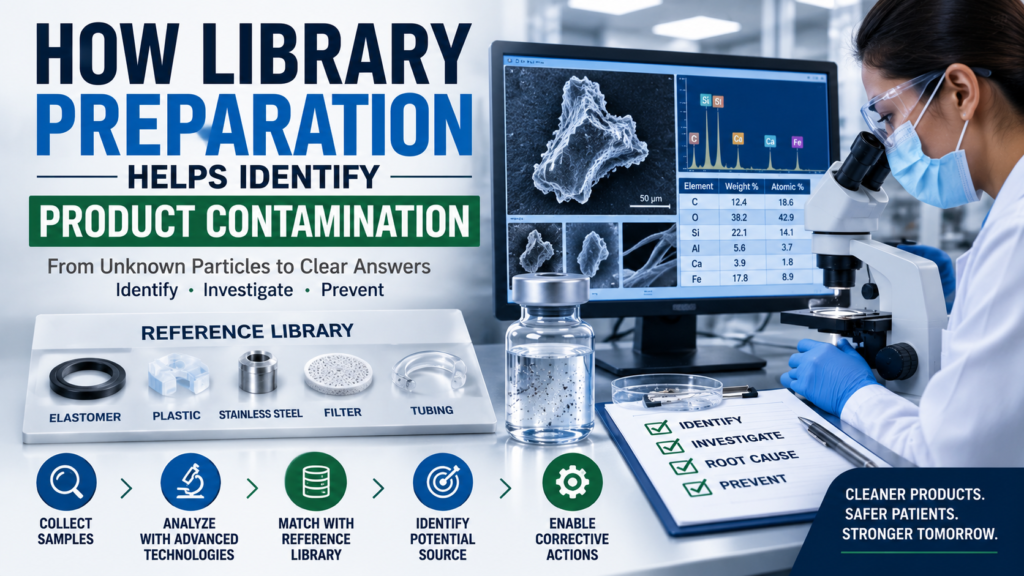
A structured library preparation approach can establish a reference database for the materials used throughout a manufacturing process. Once the characteristics of product-contact and non-product-contact components are understood, an unknown particle recovered from a pharmaceutical product can be compared against those reference materials.
For pharmaceutical manufacturers in India, this approach can strengthen contamination investigations, deviation assessments, root cause analysis and CAPA activities.
The key idea is simple:
You can identify an unknown particle much more effectively when you already understand the materials that could have generated it.
This article explains how library preparation works, why it matters, which analytical technologies can be used, and how pharmaceutical companies can build a practical particle identification strategy.
What Is Library Preparation in Pharmaceutical Particle Analysis?
Library preparation is a structured process used to create reference information about materials that may potentially contribute to contamination.
In a pharmaceutical manufacturing environment, many different components come into contact with the product or operate close to the manufacturing process.
These may include:
- Manufacturing equipment
- Product-contact components
- Filters
- Tubing
- Gaskets
- Seals
- Elastomeric components
- Plastics
- Packaging-related materials
- Stainless-steel components
- Processing accessories
- Non-product-contact materials
The first step is understanding which materials are relevant.
A practical library preparation exercise can involve a Gemba activity with the client, where manufacturing personnel and analytical specialists review the process and identify product-contact and non-product-contact parts.
Gemba, in this context, means going to the actual manufacturing environment to understand what is physically present in the process rather than relying exclusively on documents or drawings.
The Gemba activity may be optional depending on the investigation or project requirements.
After the relevant components have been identified, representative coupons can be collected.
These coupons become the reference materials for laboratory analysis.
Why Build a Particle Reference Library?
Imagine that an unknown particle is discovered in an injectable product.
A microscopic examination may reveal that it is:
- Fibrous
- Irregular
- Transparent
- Dark
- Metallic-looking
- Polymer-like
- Glass-like
But visual appearance alone may not provide enough evidence to establish its source.
Now imagine that the manufacturer already has reference information for its major product-contact components.
The investigation team can compare the unknown particle’s characteristics against the established reference library.
This can provide a much stronger basis for source identification.
The library can help answer questions such as:
- Does the unknown particle resemble a manufacturing component?
- Does its elemental composition correspond to a metal component?
- Does its chemical structure resemble a polymer or elastomer?
- Does its thermal behavior match a known material?
- Is its morphology consistent with a particular source?
This is one of the key benefits of combining library preparation with particle characterization analysis.
How Library Preparation Works: A Step-by-Step Approach
A well-designed library preparation program can be organized into several stages.
Step 1: Understand the Manufacturing Process
Before collecting samples, understand the process flow.
Review:
- Manufacturing stages
- Product-contact surfaces
- Equipment configuration
- Component materials
- Single-use assemblies
- Filters
- Tubing
- Seals and gaskets
- Transfer systems
- Filling equipment
- Packaging interfaces
The objective is to identify materials that could realistically contribute to a particle.
Step 2: Identify Product-Contact and Non-Contact Components
Not every material in a manufacturing facility has the same contamination risk.
A product-contact component has a direct pathway to the pharmaceutical product.
A non-product-contact component may have a more indirect contamination pathway.
Both categories can be relevant depending on the investigation.
This is why process mapping is important.
The investigation team should document:
- What the component is
- Where it is located
- What material it is made from
- Whether it contacts the product
- Whether it can generate particles
- Whether particles from that component could reach the product
This information creates the foundation of the reference library.
Step 3: Collect Representative Coupons
Once relevant components have been identified, representative samples or coupons can be collected.
A coupon is essentially a representative piece of the material that can be submitted for laboratory analysis.
Examples might include portions of:
- Elastomeric components
- Polymer tubing
- Plastic components
- Gaskets
- Seals
- Filters
- Metallic components
- Other process-contact materials
Sample collection should be carefully documented and controlled.
Important information can include:
- Component identification
- Supplier or manufacturer
- Material description
- Equipment location
- Sampling date
- Manufacturing line
- Contact status
- Sample identification number
Good sample traceability is critical because the library will later serve as a reference during contamination investigations.
Step 4: Analyze the Reference Materials
This is where laboratory testing becomes central.
A comprehensive library can use multiple analytical technologies because different techniques provide different types of information.
Four particularly useful technologies are:
1. SEM with EDS
2. FTIR
3. TGA/STA
4. Microscopic Analysis
Using complementary techniques can provide a more complete material profile.
SEM With EDS for Particle Characterization
Scanning Electron Microscopy (SEM) provides detailed information about the morphology and surface characteristics of a sample.
This can help investigators understand:
- Particle shape
- Surface structure
- Morphology
- Physical appearance
- Fracture characteristics
When SEM is combined with Energy Dispersive X-ray Spectroscopy (EDS), elemental information can also be obtained.
For example, an unknown particle may demonstrate an elemental composition associated with a particular metallic or inorganic material.
This can help narrow down possible sources.
SEM with EDS is particularly valuable when an investigation involves an unknown particle recovered from a pharmaceutical product and the objective is to determine its potential source.
FTIR for Chemical and Material Identification
Fourier Transform Infrared Spectroscopy (FTIR) provides information about chemical bonding and molecular characteristics.
This makes FTIR particularly useful for materials such as:
- Polymers
- Elastomers
- Organic materials
- Fibers
- Certain coatings
- Other chemically identifiable materials
While SEM/EDS can provide morphological and elemental information, FTIR can provide complementary information about chemical structure.
This distinction is important.
Two materials can potentially have similar visual appearances but different chemical structures.
FTIR helps provide another layer of evidence.
TGA/STA for Thermal Characterization
Thermogravimetric Analysis (TGA) and Simultaneous Thermal Analysis (STA) examine how a material behaves as temperature changes.
Thermal analysis can provide information about:
- Weight loss
- Decomposition
- Thermal stability
- Material composition
- Changes associated with heating
This can be useful when distinguishing between materials that may appear similar using visual or microscopic examination.
When incorporated into a reference library, thermal behavior can become another characteristic against which an unknown material may be evaluated.
Microscopic Analysis: The First Layer of Information
Microscopic analysis remains an important part of the overall investigation.
It can provide information about:
- Shape
- Size
- Color
- Morphology
- Surface appearance
- Fiber characteristics
- General particle structure
Microscopy can be particularly useful as an initial screening technique.
However, microscopy alone may not always establish the identity or source of an unknown particle.
That is why complementary analytical technologies are valuable.
From Library Preparation to Unknown Particle Identification
Once the reference library has been established, the process can be applied to an actual contamination investigation.
Suppose an unknown particle is discovered during inspection of an injectable product.
The investigation can follow a structured pathway.
Stage 1: Recover the Particle
The particle first needs to be recovered from the product using an appropriate procedure.
Particle recovery is an important step because poor recovery can compromise subsequent analysis.
The objective is to obtain a representative particle while minimizing the risk of introducing additional contamination.
Stage 2: Examine the Particle
The recovered particle can then undergo appropriate examination.
Initial observations may include:
- Approximate size
- Shape
- Color
- Morphology
- Fiber or fragment characteristics
This creates an initial profile.
Stage 3: Perform SEM With EDS
The unknown particle can then be examined using SEM with EDS.
The morphology can be compared with reference materials in the established library.
The elemental profile can provide additional evidence about potential source materials.
Stage 4: Compare With the Reference Library
This is where the library becomes particularly powerful.
Instead of asking:
“What is this particle?”
the investigation can ask:
“Which known material in our manufacturing environment has characteristics consistent with this particle?”
That is a much more focused question.
Example: Investigating an Unknown Particle in an Injectable Product
Consider a hypothetical example.
A pharmaceutical company manufacturing sterile injectable vials discovers a small foreign particle during visual inspection.
The particle is recovered and submitted for laboratory examination.
Microscopic analysis shows an irregular fragment.
SEM provides detailed morphological information, while EDS indicates an elemental composition associated with a particular class of material.
The investigation team then compares these findings against the established library.
One of the process-contact components shows similar characteristics.
The team can then investigate that component further.
Potential next steps may include:
- Inspecting the component condition
- Reviewing equipment history
- Checking maintenance records
- Reviewing component installation
- Evaluating cleaning procedures
- Checking supplier information
- Examining previous deviations
- Reviewing particle trends
- Evaluating whether similar particles were previously observed
The analytical result does not automatically prove causation.
Instead, it provides scientific evidence that can guide the broader root cause investigation.
This distinction is extremely important in pharmaceutical quality investigations.
Why Multiple Analytical Technologies Are Better Than One
A common mistake is expecting one analytical technique to answer every contamination question.
In reality, each technique has strengths and limitations.
| Technology | Primary Information |
|---|---|
| Microscopy | Visual appearance and morphology |
| SEM | High-resolution morphology |
| EDS | Elemental composition |
| FTIR | Chemical/bonding information |
| TGA/STA | Thermal behavior and composition |
Using complementary information can create a more robust material fingerprint.
For example:
Microscopy + SEM + EDS + FTIR + TGA/STA
can provide a broader understanding than relying on a single observation.
This is especially valuable when investigating unknown particles where the potential source is uncertain.
How Particle Characterization Analysis Supports Root Cause Investigation
The ultimate objective is not merely to name a particle.
The real objective is to understand why it was present.
This makes particle characterization analysis an important investigative tool.
It can support several stages of a pharmaceutical quality investigation:
Deviation investigation
Analytical evidence can help determine whether a particle is consistent with a known process material.
Root cause analysis
Material characteristics can help narrow down potential sources.
CAPA
If a process-related source is identified, corrective and preventive actions can be developed around that source.
Trend analysis
Repeated particle findings can be compared to identify patterns.
Process improvement
Information about contamination sources can help manufacturing teams reduce recurrence.
7 Practical Tips for Building a Useful Particle Library
1. Start With Process Risk
Do not collect samples randomly.
Prioritize materials based on their likelihood and potential impact.
2. Include Product-Contact Components
These should receive particular attention because of their direct pathway to the product.
3. Consider Non-Contact Sources
Indirect contamination pathways can also matter.
4. Maintain Strong Traceability
Every library sample should be clearly identifiable.
5. Use Complementary Techniques
Do not rely solely on appearance when additional characterization can provide stronger evidence.
6. Keep the Library Current
Manufacturing processes change.
Equipment, suppliers, components and materials can change over time.
Review the library following relevant process changes.
7. Connect the Library to Your Quality System
The library should support deviation investigations, contamination assessments and CAPA rather than exist as an isolated analytical database.
Common Mistakes in Pharmaceutical Particle Investigations
Several problems can reduce the effectiveness of contamination investigations.
Mistake 1: Investigating the particle without understanding the process
A particle’s identity means more when you understand where it could have originated.
Mistake 2: Depending only on visual appearance
Two materials may look similar but have completely different compositions.
Mistake 3: Not building a reference library
Without reference materials, investigators may have difficulty connecting an unknown particle to a manufacturing source.
Mistake 4: Ignoring process changes
A library can become outdated when new components, suppliers or equipment are introduced.
Mistake 5: Treating analytical results as the entire root cause
Laboratory identification provides evidence. A complete root cause investigation should also examine manufacturing records, equipment, personnel practices, maintenance, cleaning and other relevant factors.
Why This Approach Is Relevant for Indian Pharmaceutical Manufacturers
India has a large and diverse pharmaceutical manufacturing sector, including manufacturers of sterile products, injectables, biologics and complex formulations.
For these manufacturers, particulate contamination can become a significant quality concern because unexpected particles may trigger:
- Deviations
- Batch investigations
- Rejections
- Customer complaints
- Regulatory questions
- CAPA
- Process improvement activities
A structured library preparation strategy gives the investigation team a proactive advantage.
Instead of starting from zero whenever an unknown particle is found, the company can already have reference information about relevant manufacturing materials.
That can make investigations more structured and evidence-driven.
FAQ: Library Preparation and Particle Characterization
What is library preparation in particle analysis?
Library preparation is the process of identifying relevant manufacturing materials, collecting representative samples and characterizing those materials to create a reference database for future particle identification and contamination investigations.
Why is library preparation important?
It establishes reference information about materials that could potentially contribute to contamination. This can make subsequent unknown particle investigations more targeted.
What technologies can be used?
A comprehensive approach can use microscopic analysis, SEM with EDS, FTIR and TGA/STA. Each technology provides different information about morphology, elemental composition, chemical structure or thermal behavior.
Can library preparation identify the exact source of a particle?
It can provide strong evidence about whether an unknown particle is consistent with a known material. However, analytical similarity alone does not necessarily establish definitive causation. The result should be evaluated alongside the broader manufacturing investigation.
What is SEM with EDS used for?
SEM provides high-resolution morphological information, while EDS provides elemental information. Together, they can help characterize unknown particles and compare them with reference materials.
Is particle characterization analysis only useful after contamination occurs?
No. Building a reference library is a proactive approach. It creates baseline information that can be used if an unknown particle is discovered later.
How often should a particle library be updated?
There is no universal frequency that applies to every facility. The library should be reviewed when relevant changes occur, such as changes to product-contact components, suppliers, equipment or manufacturing processes.
Conclusion: Turn Unknown Particles Into Actionable Evidence
Finding an unknown particle in a pharmaceutical product can be challenging.
But the investigation becomes much more structured when the manufacturer already understands the materials present throughout its manufacturing process.
Library preparation creates that foundation.
By identifying relevant product-contact and non-product-contact components, collecting representative coupons and analyzing them using complementary technologies such as microscopy, SEM with EDS, FTIR and TGA/STA, pharmaceutical companies can establish a useful reference library.
When an unknown particle is subsequently recovered from a product, particle characterization analysis can then help compare the unknown material against that established library.
The result is more than a description of a particle.
It can provide valuable evidence for:
- Contamination investigations
- Root cause analysis
- Deviation assessments
- CAPA
- Process improvement
- Contamination prevention
- Quality risk management
For pharmaceutical manufacturers in India, building this capability proactively can be particularly valuable. Instead of waiting until a contamination event occurs and then trying to determine what materials could be involved, organizations can establish a scientific reference framework in advance.
If your pharmaceutical facility is dealing with unknown particles, recurring contamination, injectable product investigations or the need to establish a material reference library, professional particle characterization analysis can help provide the analytical evidence needed to move from “What is this particle?” toward the more important question: “Where could it have come from, and how can we prevent it from happening again?”
Explore Particle Characterization Analysis Services:
Your trusted partner for pharma skills, systems, and solutions.