No products in the cart.


Particle Characterization Analysis Services
1. Inverted Fluorescence Microscopy
2. UV Fluorescence Imaging
3. EDXRF (Energy Dispersive X-ray Fluorescence)
4. Stereo Microscopy (Extended Analysis)
5. Scanning Electron Microscopy (SEM)
Catalog:
Particle Characterization Analysis_Confianca Pharmazon
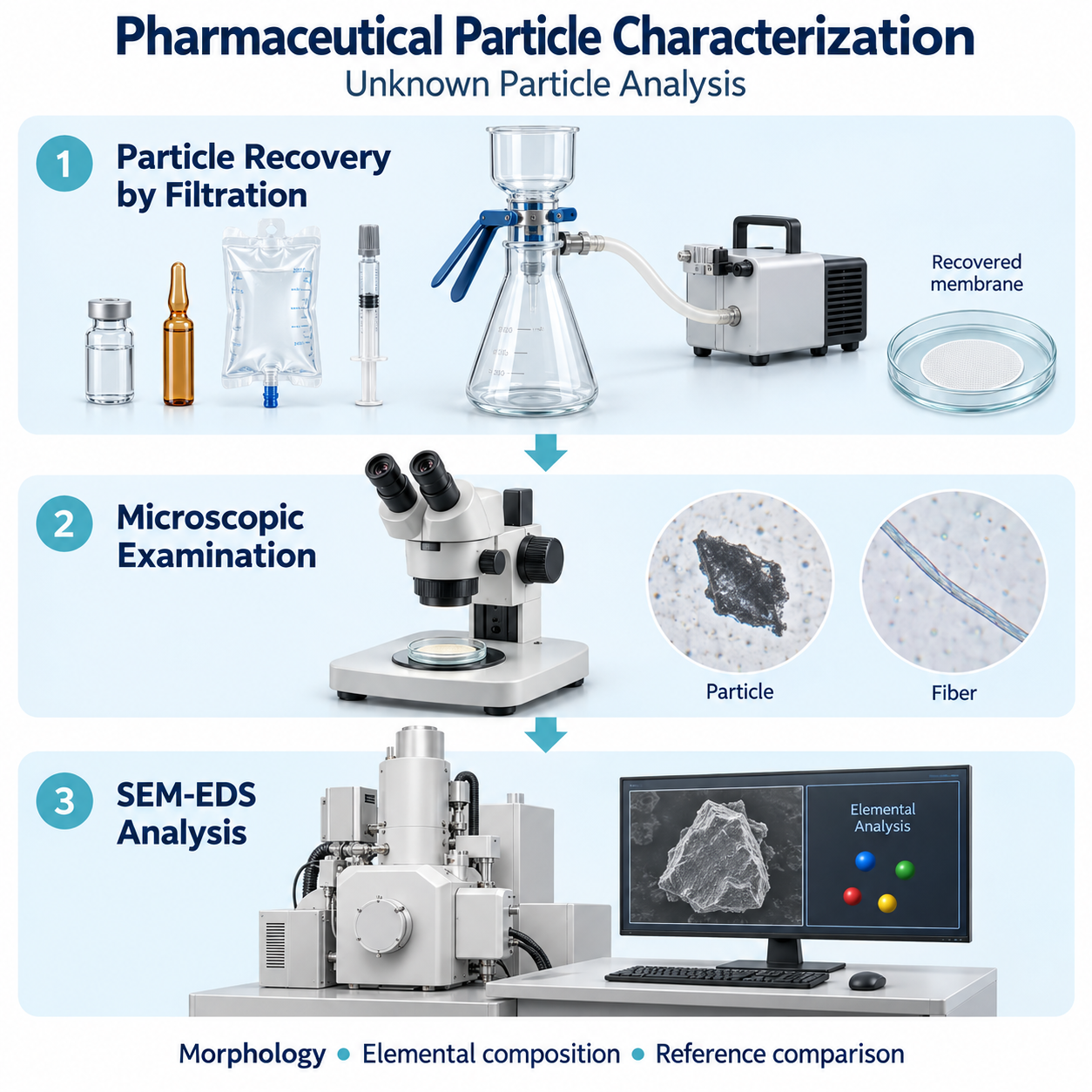
Pharmaceutical Particle Characterization and Unknown Particle AnalysisParticle Recovery by Filtration | Microscopic Examination | SEM-EDS Analysis |
| Confianca Pharmazon (Confianca Technologies LLP) provides pharmaceutical particle characterization services in Ahmedabad, India, supporting the investigation of unknown particles and fibers detected in pharmaceutical products. Our service follows a structured approach: particle recovery through filtration, microscopic examination and characterization using scanning electron microscopy with energy-dispersive X-ray spectroscopy (SEM-EDS). Where suitable reference data are available, analytical findings are compared with known manufacturing materials to help identify potential contamination sources. We work with samples supplied in vials, bags, ampoules, prefilled syringes (PFS) and other pharmaceutical containers, with sample suitability and recovery requirements assessed before analysis. |
Understanding Unknown Particles in Pharmaceutical Products |
| An unknown particle may originate from a manufacturing component, packaging material, process environment or another source. Its visible appearance alone may not provide sufficient information to determine its nature or origin. A structured analytical investigation helps address key questions:
Our particle characterization service provides analytical evidence to support these assessments and help pharmaceutical quality, laboratory, production and engineering teams plan their next investigation steps. |
Our Particle Characterization Process |
1. Sample Review and Investigation PlanningWe begin by reviewing the submitted sample information and the background of the investigation. This helps establish an appropriate recovery approach and analytical scope. Relevant information may include:
The recovery and analysis approach is selected according to the product matrix, particle characteristics and investigation objective. |
2. Particle Recovery Through Filtration |
| Particle recovery is the first laboratory stage of the investigation. The submitted product is processed using a suitable filtration method to retain particles or fibers for examination. The filtration membrane and handling approach are selected with consideration of the sample and subsequent analytical requirements. Our recovery process addresses:
Where the product cannot be filtered directly, any necessary sample preparation is assessed before proceeding. Recovery feasibility depends on the product matrix and the nature and quantity of particulate matter present. |
3. Microscopic Examination of Recovered Particles |
| Following filtration, the retained material is examined under a microscope. Microscopic examination provides an initial assessment of visible characteristics, including:
This stage helps locate the material of interest and select suitable particles for further characterization. Images and observations also provide a visual record for the investigation. |
4. SEM-EDS Particle Characterization |
| Selected particles are prepared for analysis using scanning electron microscopy with energy-dispersive X-ray spectroscopy. SEM: Detailed Examination of Particle Morphology SEM provides detailed images of the recovered particle, allowing assessment of its shape, surface texture and structural features. These observations support comparison with suspected source materials. EDS: Elemental Characterization EDS identifies detectable elements within the analysed region of the particle. The resulting elemental profile provides additional evidence for assessing the material’s nature and comparing it with reference samples. SEM images and EDS findings are interpreted together, with consideration of sample preparation and possible contributions from the mounting substrate or coating. |
5. Comparison with Known Materials and Reference Libraries |
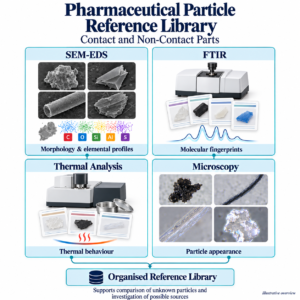
| Where a pharmaceutical material reference library is available, the unknown particle’s morphological features and elemental profile are compared with relevant library entries. Potential reference materials may include:
This comparison helps narrow down possible sources and identify components that warrant further assessment. If suitable reference information is unavailable, client-supplied suspected materials may be considered for comparative analysis. |
6. Analytical Reporting and Investigation Support |
| Findings are compiled into a report based on the agreed scope of work. The report may include:
The objective is to provide a clear connection between the submitted sample, recovered particle, analytical findings and potential source materials. |
Sample and Container Types |
We assess particle recovery and characterization requirements for products supplied in:
The analysis scope is agreed after reviewing the product matrix, available sample quantity and suspected contamination. |
How This Service Supports Your Quality Team |
| Evidence for Contamination Investigations Microscopic observations and SEM-EDS findings provide analytical evidence to supplement visual inspection and manufacturing records. Focused Assessment of Potential Sources Comparisons with relevant reference materials help your team prioritise suspected components and determine where further investigation is needed. Connection Between Products and Manufacturing Materials Recovered particles can be assessed alongside known product-contact and non-contact materials to investigate possible relationships. Documented Findings for Technical Review A structured report enables quality, laboratory, production and engineering personnel to review the analytical findings together. Support for Corrective and Preventive Action Decisions Particle characterization can inform root-cause assessment and CAPA planning when considered alongside process evidence and the wider investigation. |
The Role of a Pharmaceutical Particle Reference Library |
| A facility-specific reference library contains analytical information about known materials used in the manufacturing environment. Once prepared, it provides a resource for comparing particles recovered during future investigations. For SEM-EDS analysis, the relevant reference information includes particle morphology and elemental composition. A library does not automatically identify every unknown particle. Its usefulness depends on the materials included, the quality of the reference data and the suitability of the analytical techniques for the material being investigated. Confianca Pharmazon also provides library preparation for product-contact and non-contact parts, helping pharmaceutical teams establish reference information before an unknown particle investigation arises. |
Interpreting Results CorrectlyA probable material match is not, by itself, confirmation of the exact contamination source. |
| Different components may contain similar materials and produce similar elemental profiles. SEM-EDS also does not directly determine molecular bonding structure, so some polymers, elastomers and fibers may require complementary testing for further differentiation. Analytical findings should therefore be evaluated alongside:
This combined assessment supports a more defensible conclusion about the source of contamination. |
Why Work with Confianca Pharmazon? |
| A Structured Analysis Sequence Our approach connects particle recovery, microscopy and SEM-EDS characterization within a defined investigation scope.Focus on Pharmaceutical Manufacturing Materials We consider recovered particles in relation to relevant product-contact and non-contact components.Reference Library Comparison Available library data and suspected source materials can support comparative assessment.Sample-Specific Planning Filtration and analytical requirements are assessed according to the submitted product and investigation needs.Clear Reporting Findings are presented with relevant observations and limitations to support informed technical review. |
Information to Share When Requesting a Quotation |
To help us assess your requirements, please provide:
Please discuss sample submission requirements with our team before dispatch. |
1. What is pharmaceutical particle characterization?
Pharmaceutical particle characterization examines the physical and elemental characteristics of unknown particles or fibers detected in a product. The findings help assess the nature of the material and support investigation of possible contamination sources.
2. How does Confianca Pharmazon analyse unknown particles?
Our process begins with particle recovery through suitable filtration, followed by microscopic examination. Selected particles are then characterised using SEM-EDS. Where relevant reference materials or library data are available, the findings are compared to help narrow down potential sources.
3. Which pharmaceutical containers can you recover particles from?
We assess samples supplied in vials, ampoules, pharmaceutical bags, prefilled syringes (PFS) and other containers. Recovery feasibility depends on the product matrix, available sample quantity and particle characteristics.
4. Why is filtration performed before particle analysis?
Filtration helps separate and retain particles from the submitted product so they can be located and examined. The membrane and recovery approach are selected according to the sample and subsequent analytical requirements.
5. Can every pharmaceutical product be filtered directly?
No. Some products require an assessment of viscosity, solubility or compatibility with the filtration membrane before processing. Any necessary sample preparation is considered with care to minimise changes to the particles being investigated.
6. What happens after particle recovery?
Recovered material is examined under a microscope to document characteristics such as colour, shape, surface appearance and dimensions, where suitable measurement is possible. This examination helps select particles for further SEM-EDS characterization.
7. What information does SEM-EDS provide?
Scanning electron microscopy (SEM) provides detailed images of particle morphology and surface features. Energy-dispersive X-ray spectroscopy (EDS) identifies detectable elements within the analysed region. Together, these findings support material characterization and reference comparison.
8. Can SEM-EDS identify all types of particles and fibers?
SEM-EDS provides useful morphological and elemental information, but it cannot uniquely identify every material. Some polymers, elastomers and fibers have similar elemental profiles and may require complementary techniques, such as FTIR, for further differentiation.
9. Can the analysis confirm the exact contamination source?
The analysis can identify characteristics consistent with a suspected material and help establish a probable source. Confirmation of the exact source also requires manufacturing-process evidence, such as equipment condition, maintenance history and component usage.
10. Is a particle reference library required before submitting a sample?
No. Unknown particles can be characterised without an existing library. However, relevant reference data or suspected source samples improve the basis for comparison and can help focus the investigation.
11. Can you compare an unknown particle with our equipment or packaging materials?
Yes. Depending on the agreed scope, recovered particles can be compared with suitable client-supplied reference materials, including gaskets, tubing, filters, rubber stoppers, glass, metal components and packaging materials.
12. How do you minimise contamination during particle recovery?
The recovery approach considers sample handling, filtration materials and preparation requirements to minimise additional contamination. Potential contributions from the filtration membrane, mounting substrate or coating are considered when interpreting analytical findings.
13. What does the particle characterization report include?
Depending on the agreed scope, the report may include sample details, recovery and filtration information, microscopic observations, SEM images, EDS spectra, elemental results and reference comparisons. Relevant limitations and interpretation are included to support technical review.
14. How much sample is required, and how long does the analysis take?
Sample requirements and turnaround time depend on the product, particle availability, number of samples, recovery complexity and analytical scope. Please contact our team before dispatch so these requirements can be agreed.
15. What information should we provide when requesting a quotation?
Please share the product description, container type, sample quantity, approximate volume and available particle photographs. A brief investigation background, suspected source materials and required timeline will help us assess the scope.
16. How can we request unknown particle analysis?
Contact Confianca Pharmazon to discuss particle recovery by filtration, microscopic examination, SEM-EDS characterization and reference material comparison.
Have you detected an unknown particle or fiber in a pharmaceutical product?
Share your sample details and investigation requirements so we can assess the scope and provide a quotation.
Confianca Pharmazon — Confianca Technologies LLP
Location: Ahmedabad, Gujarat, India
Phone: +91 9173319482
Email: support@confiancapharmazon.com
Request a Quotation | Discuss Sample Submission





Reviews
There are no reviews yet.