
No products in the cart.
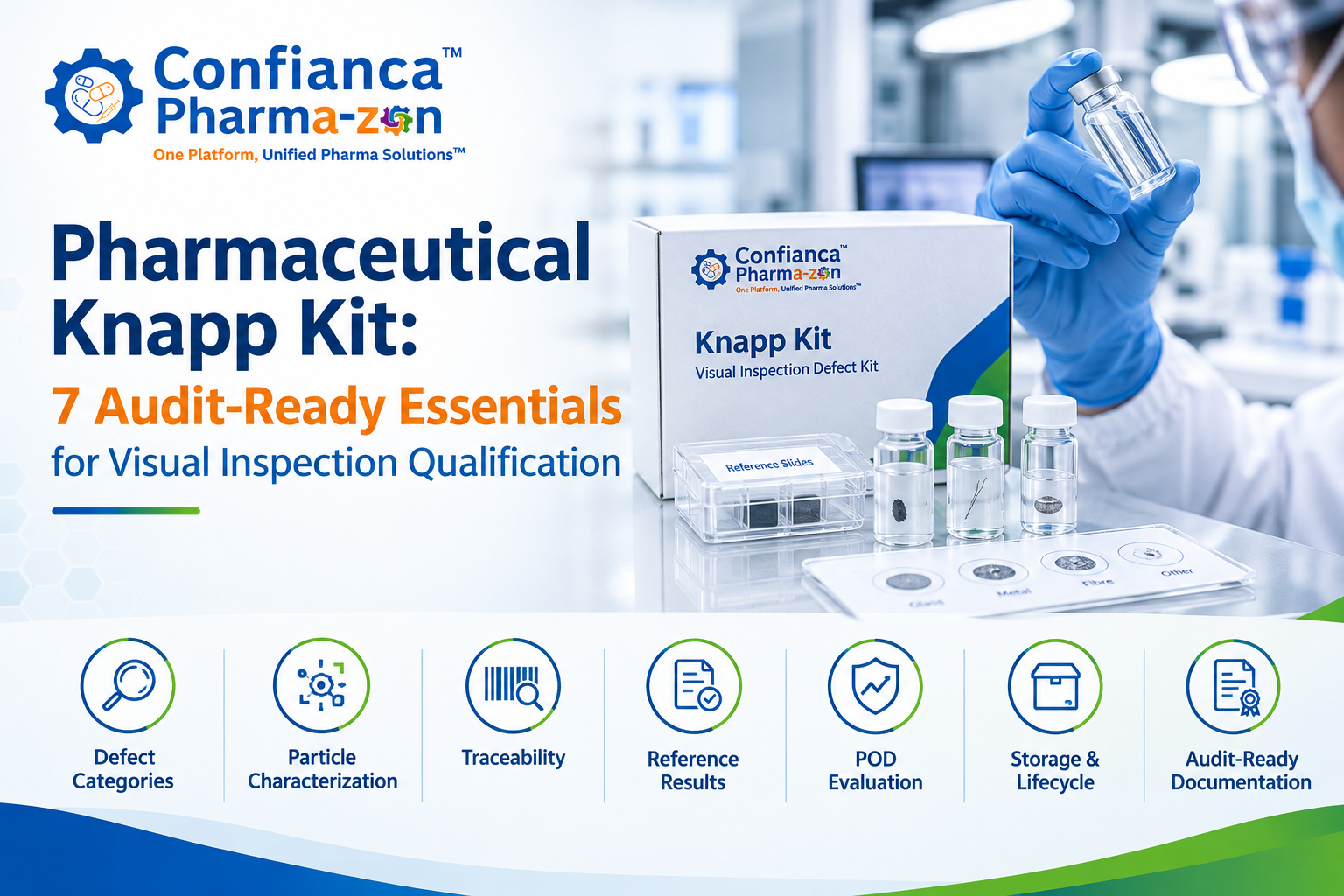
Pharmaceutical Knapp Kit: 7 Audit-Ready Essentials for Visual Inspection Qualification
Introduction: Why a Pharmaceutical Knapp Kit Matters
In pharmaceutical manufacturing, a single visible particle inside an injectable product can trigger a significant quality investigation. Glass fragments, metal particles, fibres, and other foreign matter may indicate potential contamination risks that require careful assessment. For manufacturers of sterile injectable medicines, reliable visual inspection is therefore an essential component of pharmaceutical quality assurance.
However, how can pharmaceutical companies demonstrate that their visual inspectors can recognize relevant defects consistently? How can they evaluate inspection performance, document training results, and establish confidence in their qualification programs?
A pharmaceutical Knapp kit can support these activities by providing structured defect samples or representative test units for visual inspection training and assessment. When appropriately designed, documented, and maintained, a Knapp kit can help pharmaceutical manufacturers evaluate inspector performance under defined conditions.
Nevertheless, purchasing a visual inspection defect kit alone does not establish regulatory compliance or prove that an inspector is qualified. The kit must be suitable for its intended purpose and integrated into a documented, risk-based qualification program.
For pharmaceutical manufacturers, the real value lies in combining representative defects, reliable reference information, suitable inspection conditions, documented assessment criteria, and effective quality-system controls.
In this guide, we explore seven essential considerations when selecting and managing a pharmaceutical Knapp kit, explain its role in inspector qualification, and discuss how defect characterization, traceability, and Probability of Detection (POD) can contribute to a more systematic visual inspection program.
What Is a Pharmaceutical Knapp Kit?
A pharmaceutical Knapp kit, commonly referred to as a Knapp study kit or visual inspection defect kit, is a training and assessment aid used to support the evaluation of personnel performing manual visual inspection.
Depending on its configuration and intended application, a kit may contain test containers with representative particulate matter, identified defects, acceptable units, or other inspection challenges.
These materials allow inspectors to practice identifying and classifying defects using a defined inspection procedure. Trainers can compare the results against established reference information to evaluate performance.
A pharmaceutical Knapp kit may be used to support activities such as:
- Initial visual inspector training.
- Practical defect-recognition exercises.
- Inspector qualification and reassessment.
- Refresher training for specific defect categories.
- Evaluation of inspection consistency.
- Documentation of training and assessment outcomes.
- Support for visual inspection process improvement.
The contents and capabilities of different kits can vary. Therefore, pharmaceutical manufacturers should assess whether a particular kit adequately represents the products, containers, defect categories, and inspection conditions relevant to their operations.
A kit designed for glass vials, for example, should not automatically be considered suitable for qualifying inspectors working with every type of prefilled syringe, cartridge, suspension, or lyophilized product.
Why Is a Knapp Kit Important in Pharmaceutical Manufacturing?
Visual inspection is influenced by several variables, including particle characteristics, product formulation, container design, lighting, inspection technique, and the inspector’s experience.
The United States Pharmacopeia’s General Chapter USP <1790>, Visual Inspection of Injections, discusses the development and evaluation of visual inspection programs. USP <790>, Visible Particulates in Injections, addresses visible particulate requirements for injections.
These chapters have distinct purposes, and manufacturers should consult the applicable official texts when designing their inspection programs.
A pharmaceutical Knapp kit can support practical training by allowing personnel to encounter defined inspection challenges rather than relying exclusively on classroom explanations or photographs.
1. Improving defect recognition
Inspectors need to recognize differences between visible particles and other product or container defects. Training with representative samples can help reinforce the visual characteristics of different defect categories.
2. Supporting consistent assessment
A controlled test set with established reference results allows trainers to compare inspection outcomes against predefined expectations.
3. Identifying training gaps
Assessment results can reveal whether an inspector has difficulty detecting particular particle types, recognizing certain defects, or following the inspection procedure.
4. Strengthening documentation
When test-set identification, reference results, assessment criteria, and inspector performance are documented, the resulting records can support internal quality reviews and audits.
5. Supporting continuous improvement
Aggregated training and inspection data can help quality teams identify recurring performance issues and determine whether additional training, procedural review, or further investigation is warranted.
The kit is therefore best understood as one element of a broader visual inspection qualification strategy.
7 Audit-Ready Essentials of a Pharmaceutical Knapp Kit
Not every visual inspection defect kit offers the same level of documentation, defect representation, or assessment support. Before selecting a pharmaceutical Knapp kit, manufacturers should evaluate its suitability against their intended use.
The following seven essentials provide a practical evaluation framework.
Essential 1: Representative Defect Categories
The first consideration is whether the kit contains defects relevant to the manufacturer’s products and inspection responsibilities.
For injectable products, representative particulate categories may include:
- Glass particles.
- Metallic particles, including stainless steel where relevant.
- Fibres.
- Other suitable foreign particulate matter.
- Product-specific visible defects, where included in the kit’s intended scope.
The visual appearance of a particle can vary considerably. Size, colour, shape, contrast, transparency, and movement within the liquid can influence detection.
A dark particle against a light background may present a different inspection challenge from a translucent fibre or a reflective metallic particle.
The selection of defect samples should therefore be based on product-specific risks and the intended purpose of the qualification exercise.
What to verify: Request a documented inventory of the kit’s contents, the defect categories represented, and an explanation of the kit’s intended application and limitations.
Essential 2: Documented Particle Sizing and Characterization
Particle size can influence visual detectability, but size alone does not determine whether a particle will be detected during manual inspection.
Particle characteristics, container geometry, product clarity, lighting, and inspection technique also contribute to the outcome.
For this reason, particle sizing for a Knapp kit should be supported by an appropriate characterization method and clearly defined reporting conventions.
Depending on the kit and its purpose, supporting documentation may include:
- Particle identification.
- Measurement results or size ranges.
- Measurement methodology.
- Relevant microscopy images.
- Characterization records.
- Sample identification and corresponding reference data.
Digital microscopy and other suitable analytical techniques may help characterize particles when the method is appropriate for the material and the intended measurement.
It is also important to distinguish a particle’s measured dimensions from its visual detectability. A particle measurement certificate does not, by itself, establish the probability that an inspector will detect that particle.
What to verify: Confirm how particle dimensions are determined, what the reported measurements represent, and whether the characterization records can be linked unambiguously to the corresponding test units.
Essential 3: Traceability and Controlled Identification
Knapp kit traceability is important because qualification results must be associated with the correct test set and its established reference information.
Without reliable identification, it may become difficult to establish which units were used during an assessment, whether the expected results were correct, or whether a test set remained suitable for continued use.
An appropriately controlled kit may use unique sample identifiers, container labels, inventory records, and documented reference information.
The exact traceability system will depend on the kit’s design and the manufacturer’s quality procedures.
A robust documentation approach should address:
- Unique kit or test-set identification.
- Identification of individual test units, where applicable.
- Reference defect classification.
- Associated characterization records.
- Assessment history, where maintained.
- Storage and handling history, where relevant.
- Changes, repairs, replacement, or requalification decisions.
These records help establish a clear relationship between the physical samples and the assessment results.
What to verify: Determine whether the supplier’s identification and documentation system supports the traceability needed by your quality management system.
Essential 4: Defined Reference Results and Assessment Criteria
A visual inspection qualification exercise requires a reliable basis for evaluating performance.
Inspectors should not be assessed against assumptions or undocumented expectations. The test set’s reference information should be established and controlled using a suitable process.
An assessment protocol should define the relevant defect categories, inspection conditions, acceptance criteria, recording method, and handling of discrepancies.
Depending on the intended assessment, the protocol may evaluate:
- Correct detection of defined defects.
- Correct classification of detected defects.
- Missed defects.
- Incorrect rejection of acceptable units.
- Compliance with the prescribed inspection sequence.
- Accuracy of recorded results.
A single overall pass percentage may conceal important weaknesses. For example, an inspector may achieve a high total score while repeatedly missing one defect category considered important for the product.
For this reason, acceptance criteria should be scientifically justified, risk-based, and approved by the responsible quality unit.
A supplier’s certificate or test-set documentation can support this evaluation, but the pharmaceutical manufacturer remains responsible for establishing and approving its own qualification requirements.
What to verify: Check whether the reference results are controlled, whether assessment criteria can be applied consistently, and whether the kit supports the intended qualification protocol.
Essential 5: Support for Probability of Detection (POD) Evaluation
Probability of Detection, commonly abbreviated as POD, describes the likelihood that a particular inspection process will detect a defect under specified conditions.
POD is relevant because manual visual inspection is not an absolute method of detecting every possible visible particle. Detection performance can vary with the defect and the conditions under which inspection is performed.
Factors influencing detection may include:
- Particle size and material.
- Particle shape and colour.
- Contrast against the product and container.
- Product formulation and clarity.
- Container geometry.
- Lighting conditions.
- Inspection technique and duration.
- Inspector experience and fatigue.
A pharmaceutical Knapp kit may contribute test units to a structured assessment intended to investigate detection performance. However, possession of a Knapp kit does not automatically establish a validated POD value.
A meaningful POD evaluation requires a suitable study design, clearly defined test conditions, appropriate sample selection, reliable reference results, and a justified method of analysing the findings.
Manufacturers should also distinguish between an individual inspector qualification exercise and a formal study intended to estimate inspection-process detection performance.
These activities can have different objectives, sample requirements, and statistical considerations.
What to verify: If POD evaluation is part of your program, confirm whether the kit’s design and documentation support the planned study. Do not assume that a generic defect kit is sufficient for every POD assessment.
Essential 6: Storage, Handling, Shelf Life, and Requalification
A Knapp kit should remain suitable for its intended purpose throughout its use.
Storage and handling requirements depend on the materials, container configuration, defect samples, and design of the specific kit. Physical damage, changes to a test unit, loss of identification, or deterioration of relevant components may affect its suitability.
A lifecycle management procedure should define how the kit is stored, issued, handled, inspected, and returned to storage.
Where appropriate, it should also address:
- Protection against breakage or damage.
- Prevention of sample mix-ups.
- Maintenance of sample identification.
- Periodic condition checks.
- Defined storage conditions.
- Supplier-specified shelf life, if applicable.
- Criteria for removing damaged or unsuitable units from use.
- Review or requalification following relevant changes.
Not every kit has the same shelf life or requalification requirements. These should be established from the supplier’s documentation, the kit’s design, and the manufacturer’s approved procedures.
A kit should not be assumed suitable indefinitely merely because it remains physically present in the laboratory or training area.
What to verify: Request the applicable storage and handling instructions, any defined shelf life, and recommendations for checking continued suitability.
Essential 7: Audit-Ready Documentation and Supplier Support
An audit-ready Knapp kit is not simply a kit supplied with a certificate. Its documentation should be appropriate for the intended use and capable of supporting the manufacturer’s qualification and quality-system activities.
Depending on the kit’s configuration, useful documentation may include:
- Product specification and intended-use statement.
- Kit inventory and identification records.
- Defect descriptions and reference information.
- Particle characterization records, where applicable.
- Instructions for use.
- Storage and handling requirements.
- Limitations of the kit.
- Supplier contact and technical support information.
- Applicable maintenance or lifecycle recommendations.
The manufacturer should determine which documents are necessary under its own quality procedures.
The term audit-ready should describe the quality and completeness of the available evidence for the intended application, not a guarantee that a kit automatically satisfies every regulatory requirement.
Similarly, terms such as certified Knapp kit or Knapp kit certification should be evaluated carefully. Buyers should establish exactly what has been certified, characterized, tested, or reviewed, by whom, and against which documented criteria.
What to verify: Review the actual documentation package rather than relying on product descriptions or general claims of certification.
How to Qualify Pharmaceutical Visual Inspectors Using a Knapp Kit
Selecting a suitable pharmaceutical Knapp kit is only one part of the process. A qualification program should explain how inspectors are trained, assessed, approved, and reassessed.
Step 1: Define the Qualification Scope
Identify the products, container formats, inspection tasks, and defect categories covered by the inspector’s responsibilities.
For example, inspection of clear glass ampoules may involve different challenges from inspection of prefilled polymer syringes or lyophilized products.
The qualification scope should be defined in the applicable procedures.
Step 2: Provide Theoretical Training
Explain the purpose of visual inspection, relevant defect categories, acceptance and rejection criteria, documentation requirements, and procedures for handling suspect units.
Personnel should understand the difference between detecting a defect and investigating its underlying cause.
Step 3: Establish Controlled Inspection Conditions
Define the inspection environment and procedure, including applicable lighting, background, handling technique, inspection sequence, and inspection duration.
Conditions should be consistent with the approved procedure and intended inspection process.
Step 4: Conduct Practical Assessment
Use a suitable test set containing known reference units appropriate to the qualification objective.
The inspector should examine the units and record the findings according to the approved protocol.
Step 5: Evaluate Performance Against Approved Criteria
Compare the recorded results with the established reference results. Assess the relevant defect categories and investigate missed defects or inappropriate rejections.
The quality unit should approve the acceptance criteria and qualification decisions.
Step 6: Document Qualification and Approval
Record the inspector’s identity, training date, test-set identification, inspection conditions, assessment results, acceptance criteria, evaluator, and approval status as required by the procedure.
Qualification should apply to the defined scope rather than being assumed to cover every product or container type.
Step 7: Maintain Competency
Define requalification and refresher training requirements based on applicable obligations, product risks, and performance.
A documented reassessment may be appropriate after a significant performance issue, relevant process change, or extended absence from inspection duties.
The exact requirements should be established by the manufacturer’s approved quality procedures.
Pharmaceutical Knapp Kit and Regulatory Considerations
Pharmaceutical manufacturers should evaluate Knapp kit selection and use in the context of applicable regulations, pharmacopoeial requirements, product-specific obligations, and internal quality procedures.
USP <1790>: Visual Inspection of Injections
USP <1790> addresses considerations involved in developing and evaluating visual inspection programs for injections. It provides relevant context for understanding inspection variables, performance evaluation, and inspector qualification.
Manufacturers should consult the current official chapter when designing their programs and determine which recommendations are applicable to their products and markets.
USP <790>: Visible Particulates in Injections
USP <790> addresses visible particulate requirements for injections. It should not be treated as interchangeable with USP <1790>, which focuses on visual inspection program considerations.
A Knapp kit may support training and assessment, but it does not replace applicable product examination requirements or the manufacturer’s responsibility to control visible particulates.
Indian GMP and Schedule M
Indian pharmaceutical manufacturers should review the applicable requirements under the Drugs Rules, including Schedule M, alongside their established pharmaceutical quality systems.
Training records, defined responsibilities, approved procedures, and appropriate documentation contribute to effective quality-system management.
The specific approach to inspector qualification should be determined using the current applicable requirements and the company’s product and process risks.
FDA Guidance and Export Markets
Manufacturers supplying injectable products to the United States or other international markets should review the relevant regulatory requirements for those markets.
FDA guidance on inspection of injectable products for visible particulates can provide additional context for understanding the broader control strategy, including inspection, investigation, and corrective action.
The applicability and status of individual guidance documents should be verified before they are used to establish compliance expectations.
Important: Purchasing a pharmaceutical Knapp kit does not, by itself, establish compliance with USP chapters, Indian GMP, FDA expectations, or any other regulatory requirement. Compliance depends on the overall system, the intended use, the evidence available, and the applicable obligations.
Common Mistakes to Avoid When Selecting a Knapp Kit
Choosing a Kit Based Only on Price
A low purchase price does not establish that a kit is suitable for the intended application. Compare defect representation, documentation, traceability, and lifecycle support.
Assuming Particle Size Determines Detectability
Particle dimensions are important, but size alone does not determine whether a defect will be detected. Material, shape, contrast, product characteristics, and inspection conditions also matter.
Ignoring Reference Data
Without reliable reference information, assessment outcomes may be difficult to interpret or compare. Establish how reference results are controlled before using the kit for qualification.
Treating Every Kit as Universally Applicable
Different products and container designs create different inspection challenges. Confirm the kit’s intended scope and identify any gaps that require additional assessment materials.
Confusing Supplier Certification With Regulatory Compliance
A certificate may support traceability or characterization, depending on what it documents. It should not automatically be interpreted as proof of regulatory compliance or inspector qualification.
Neglecting Storage and Lifecycle Management
Damaged, incorrectly identified, or poorly maintained test units can undermine the reliability of an assessment. Define appropriate handling and suitability checks.
Treating Qualification as a One-Time Activity
Inspector competency should be maintained through the manufacturer’s approved training, performance monitoring, and reassessment program.
How to Choose the Right Pharmaceutical Knapp Kit for Your Facility
Before purchasing a pharmaceutical Knapp kit, QA, QC, training, and procurement teams should evaluate the product against their specific requirements.
Consider the following questions:
- Which product types and container formats will the kit support?
- Which defect categories must be represented?
- Is particle characterization or dimensional measurement required?
- Are sample identities and reference results adequately controlled?
- Does the documentation support the intended assessment?
- Will the kit be used for initial training, routine qualification, refresher training, or a formal POD study?
- What storage, handling, and maintenance controls are required?
- Is a defined shelf life or periodic suitability review applicable?
- What technical documentation and supplier support are available?
- Can the kit be incorporated into the facility’s approved procedures?
A documented evaluation helps the manufacturer select a kit based on its intended purpose rather than relying solely on sample count, price, or general product claims.
The final decision should consider technical suitability, documentation, usability, lifecycle requirements, and the facility’s quality-system needs.
Frequently Asked Questions (FAQs)
1. What is a pharmaceutical Knapp kit?
A pharmaceutical Knapp kit is a visual inspection training and assessment aid used to help pharmaceutical personnel practice identifying defined defects. Its configuration and suitability depend on the intended application, test units, reference information, and supporting documentation.
2. What is a Knapp kit used for in pharmaceutical manufacturing?
A Knapp kit may support initial inspector training, practical defect recognition, competency assessment, refresher training, and inspection performance evaluation. Its use should be defined in an approved procedure.
3. What defects should a pharmaceutical Knapp kit include?
Depending on the intended application, a kit may include representative glass, metallic, fibre, or other particulate defects. The appropriate categories should be selected based on product-specific risks and the qualification objective.
4. What is the difference between a Knapp kit and a visual inspection defect kit?
The terms may be used to describe overlapping types of visual inspection training materials. However, kit contents and capabilities vary. Buyers should review the actual configuration, intended use, and documentation instead of assuming the terms guarantee identical contents.
5. What is particle sizing for a Knapp kit?
Particle sizing involves determining and reporting particle dimensions using an appropriate measurement method. The measurement method and reported dimensions should be clearly defined. Particle size alone does not establish visual detectability.
6. Does a pharmaceutical Knapp kit establish regulatory compliance?
No. A kit can support training and assessment, but compliance depends on the manufacturer’s overall quality system, approved procedures, suitable inspection controls, documentation, and applicable regulatory requirements.
7. What is the role of Probability of Detection (POD) in visual inspection?
POD describes the likelihood that a defined inspection process will detect a defect under specified conditions. A formal POD study requires a suitable study design and appropriate analysis; simply using a Knapp kit does not establish a POD value.
8. How often should a Knapp kit be requalified?
There is no single interval that can be assumed to apply to every kit. Review requirements should be established using the kit’s documentation, condition, intended use, and the manufacturer’s approved procedures.
9. What documentation should accompany a Knapp kit?
Depending on its configuration, useful documentation may include an inventory, sample identification, defect reference information, characterization records, instructions for use, and storage and handling requirements. The manufacturer should determine the required documentation for its intended application.
10. Can one Knapp kit qualify inspectors for all injectable products?
Not necessarily. Product formulations, container designs, defect characteristics, and inspection conditions can differ. Manufacturers should establish whether the kit adequately represents the intended qualification scope.
Conclusion: Build a More Reliable Visual Inspection Qualification Program
Reliable visual inspection depends on trained personnel, suitable test materials, controlled inspection conditions, documented assessment criteria, and a well-maintained pharmaceutical quality system.
A properly selected pharmaceutical Knapp kit can support defect-recognition training, structured competency assessment, and inspection program improvement. However, its value depends on its suitability for the intended application and the quality of its supporting documentation.
The seven essentials discussed in this guide—representative defect categories, particle characterization, traceability, controlled reference results, POD study suitability, lifecycle management, and audit-ready documentation—provide a practical framework for evaluating a visual inspection defect kit.
For pharmaceutical manufacturers, the objective should not simply be to purchase a kit. It should be to establish a documented and risk-based approach to visual inspection qualification that supports consistent decisions and continuous improvement.
When selecting a kit, review the intended use, defect representation, characterization methods, traceability arrangements, documentation package, and supplier support. Integrate the selected materials into approved procedures and evaluate performance against scientifically justified acceptance criteria.
Strengthen Your Pharmaceutical Visual Inspection Program With Confianca Pharmazon
Confianca Pharmazon supports pharmaceutical and biopharmaceutical professionals with solutions for visual inspection training and pharmaceutical consumables.
If your facility is evaluating a pharmaceutical Knapp kit, visual inspection defect kit, or related particulate characterization requirements, explore our Knapp Kit and Visual Inspection Kits.
Contact our team to discuss your intended application, defect categories, documentation needs, and visual inspection qualification objectives.
Confianca Pharmazon — supporting a more systematic approach to pharmaceutical quality assurance.