No products in the cart.
How Visual Inspection Booth Automation Supports EU GMP Annex 1 Compliance in Sterile Manufacturing
Introduction
The pharmaceutical industry is entering a new era of contamination control, digital compliance, and smart manufacturing. One of the most significant regulatory developments driving this transformation is the revised EU GMP Annex 1 guidance for sterile medicinal product manufacturing.
EU GMP Annex 1 places strong emphasis on:
- Contamination control strategy (CCS)
- Sterility assurance
- Human intervention minimization
- Environmental monitoring
- Data integrity
- Automated systems
- Risk-based manufacturing approaches
As pharmaceutical manufacturers adapt to these stricter expectations, many are upgrading their inspection environments using advanced Visual Inspection Booth Automation systems.
Traditional manual visual inspection methods often struggle to meet modern regulatory expectations due to:
- Human variability
- Fatigue
- Inconsistent inspection conditions
- Limited traceability
- Reduced scalability
Modern automated inspection booths now combine:
- Smart lighting systems
- AI-assisted inspection
- Ergonomic design
- Digital audit trails
- Real-time monitoring
- Machine vision technology
to create highly controlled and GMP-compliant inspection environments.
In this comprehensive guide, we’ll explore how Visual Inspection Booth Automation supports EU GMP Annex 1 compliance, improves contamination control, strengthens audit readiness, and enhances pharmaceutical quality assurance.
Understanding EU GMP Annex 1
EU GMP Annex 1 is one of the most important regulatory guidelines governing sterile pharmaceutical manufacturing.
It applies to:
- Injectable products
- Sterile biologics
- Ophthalmic products
- Vaccines
- Aseptic processing environments
The revised Annex 1 focuses heavily on proactive contamination prevention instead of reactive quality control.
Key Areas Covered Under EU GMP Annex 1
Contamination Control Strategy (CCS)
Manufacturers must establish a comprehensive contamination prevention system.
Human Intervention Minimization
Reducing manual interactions is strongly encouraged.
Environmental Monitoring
Continuous monitoring and trending are expected.
Risk Management
Risk-based approaches must guide manufacturing processes.
Data Integrity
Electronic systems and audit trails are essential.
Lifecycle Management
Inspection systems require ongoing qualification and performance monitoring.
These requirements directly impact pharmaceutical visual inspection operations.
Why Visual Inspection Matters in Sterile Manufacturing
Visual inspection acts as the final product quality checkpoint before sterile products reach patients.
It helps detect:
- Glass particles
- Metal fragments
- Fibers
- Rubber particles
- Cracks
- Cosmetic defects
- Fill defects
- Container closure issues
According to USP <790>, injectable products should be:
“Essentially free from visible particulate matter.”
Any failure in defect detection can lead to:
- Product recalls
- Regulatory observations
- Patient safety risks
- Warning letters
- Import alerts
This makes Visual Inspection Booth Automation a critical component of sterile manufacturing compliance.
Challenges with Traditional Manual Inspection Systems
Traditional inspection systems face several limitations.
Human Fatigue
Inspectors performing repetitive inspections for long durations experience reduced concentration.
Inconsistent Inspection Conditions
Lighting, positioning, and inspection speed may vary between operators.
Limited Data Traceability
Manual systems often lack digital records and audit trails.
High False Reject Rates
Human variability increases inspection inconsistency.
Reduced Scalability
Manual inspection struggles to support large-scale production.
These challenges create compliance risks under EU GMP Annex 1.
What Is Visual Inspection Booth Automation?
Visual Inspection Booth Automation refers to advanced pharmaceutical inspection environments designed to improve:
- Defect detection accuracy
- Compliance consistency
- Data traceability
- Operator performance
- Inspection repeatability
Modern automated booths include:
- Controlled lighting systems
- Smart lux monitoring
- Digital timers
- AI-assisted inspection
- Ergonomic operator design
- Electronic audit trails
- Automated inspection support
These systems help pharmaceutical manufacturers establish highly controlled inspection environments aligned with GMP expectations.
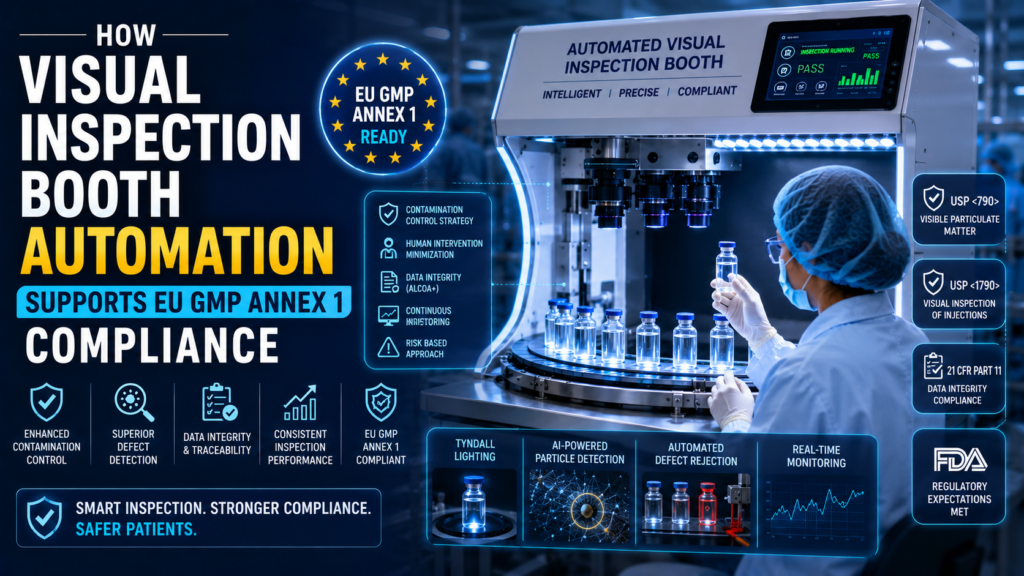
How Visual Inspection Booth Automation Supports EU GMP Annex 1 Compliance
1. Supports Contamination Control Strategy (CCS)
One of the biggest requirements under EU GMP Annex 1 is the implementation of a formal contamination control strategy.
Automated inspection booths help reduce contamination risks through:
- Controlled inspection environments
- Reduced operator handling
- Improved particulate visibility
- Standardized inspection workflows
Key CCS Benefits
- Lower contamination risk
- Improved environmental consistency
- Reduced human intervention
- Better inspection reproducibility
This strengthens overall sterile manufacturing quality systems.
2. Reduces Human Error and Variability
Human factors remain one of the biggest contamination risks in sterile manufacturing.
Automated systems help minimize:
- Fatigue-related errors
- Inconsistent inspection speed
- Subjective defect interpretation
- Missed defects
Advanced Visual Inspection Booth Automation systems standardize:
- Lighting intensity
- Product handling
- Viewing angles
- Inspection timing
- Background contrast
This improves inspection consistency significantly.
3. Improves Particulate Matter Detection
Advanced lighting technologies improve visibility of:
- Transparent particles
- Fibers
- Glass fragments
- Metallic contamination
Importance of Tyndall Lighting
Tyndall lighting enhances particle visibility through light scattering.
This helps inspectors identify:
- Fine particulate matter
- Floating particles
- Transparent contaminants
Modern automated booths optimize:
- Black background visibility
- White background contrast
- Lux intensity
- Reflection control
This improves compliance with:
- USP <790>
- USP <1790>
- EU GMP Annex 1
4. Enhances Data Integrity and Audit Readiness
EU GMP Annex 1 strongly emphasizes:
- Electronic records
- Audit trails
- Data integrity
- Traceability
Modern automated inspection booths include:
- Electronic monitoring systems
- User authentication
- Audit logs
- Timestamped records
- Performance analytics
This helps manufacturers comply with:
- 21 CFR Part 11
- EU Annex 11
- GMP documentation requirements
5. Supports Lifecycle Management
EU GMP Annex 1 expects lifecycle-based system qualification.
Automated inspection systems support:
- IQ/OQ/PQ documentation
- Periodic qualification
- Performance monitoring
- Preventive maintenance
- Trend analysis
This ensures continuous inspection reliability.
Role of AI and Machine Learning in Inspection Automation
Artificial intelligence is transforming pharmaceutical inspection systems.
AI-powered inspection systems can:
- Detect microscopic defects
- Reduce false rejects
- Analyze historical trends
- Improve detection sensitivity
- Predict inspection risks
Machine learning systems continuously improve inspection accuracy using historical defect data.
This supports proactive contamination prevention.
Importance of USP <790> and USP <1790>
USP <790>
Focuses on visible particulate matter in injectable products.
Requires products to be:
“Essentially free from visible particulate matter.”
USP <1790>
Provides guidance on:
- Inspection lifecycle management
- Qualification systems
- Probability of Detection (POD)
- Inspection environment controls
Automated booths help improve compliance with both standards.
Probability of Detection (POD) Improvement
POD measures how effectively inspectors identify defects.
Automated inspection environments improve POD through:
- Controlled lighting
- Reduced fatigue
- Standardized workflows
- AI-assisted inspection support
Better POD directly improves:
- Product quality
- Inspection reliability
- Regulatory confidence
Ergonomics and Operator Performance
Operator fatigue significantly impacts inspection accuracy.
Modern automated booths improve ergonomics through:
- Adjustable seating
- Proper viewing angles
- Arm support systems
- Reduced repetitive strain
- Smart operator interfaces
This helps inspectors maintain focus during extended inspection cycles.
Common Defects Detected Using Automated Inspection Booths
Particulate Matter
- Glass particles
- Metal fragments
- Fibers
- Rubber particles
Cosmetic Defects
- Cracks
- Scratches
- Seal defects
- Label damage
Fill Defects
- Underfill
- Overfill
- Air bubbles
Container Closure Defects
- Improper sealing
- Stopper misalignment
- Cap defects
Benefits of Visual Inspection Booth Automation
Better Compliance
Supports EU GMP Annex 1 requirements.
Improved Detection Accuracy
Advanced lighting and AI improve visibility.
Reduced Human Dependency
Automation reduces variability.
Enhanced Data Integrity
Electronic records improve audit readiness.
Increased Productivity
Faster inspection with fewer false rejects.
Improved Patient Safety
Better defect detection prevents contaminated products from reaching patients.
Real-World Example
A sterile injectable manufacturer faced:
- High false reject rates
- Inconsistent manual inspection
- Regulatory observations regarding inspection documentation
After implementing Visual Inspection Booth Automation, the company achieved:
- 45% reduction in false rejects
- Improved POD scores
- Better audit outcomes
- Enhanced data integrity
- Faster batch release
This demonstrates the operational value of automated inspection environments.
Best Practices for Implementing Visual Inspection Booth Automation
1. Validate Lighting Systems
Perform lux mapping and qualification.
2. Conduct POD Studies
Measure inspection effectiveness regularly.
3. Train Operators
Focus on:
- Defect recognition
- Ergonomics
- Inspection consistency
- AI-assisted workflows
4. Maintain Audit Trails
Ensure electronic records are secure and traceable.
5. Monitor System Performance
Track:
- False reject trends
- Detection accuracy
- Environmental conditions
Integration with Pharma 4.0 and Smart Manufacturing
Pharmaceutical manufacturers are moving toward:
- AI-powered analytics
- Digital quality systems
- Smart factories
- Real-time monitoring
Automated inspection booths support:
- MES integration
- Electronic batch records
- Predictive maintenance
- Centralized analytics
This enables better decision-making and continuous improvement.
How Confianca Pharmazon Supports GMP-Compliant Inspection Systems
Confianca Pharmazon Visual Inspection Booth Automation Solutions offers advanced pharmaceutical inspection technologies designed for:
- Sterile manufacturing
- Injectable inspection
- GMP compliance
- EU GMP Annex 1 readiness
- USP <790> and USP <1790> compliance
Their solutions include:
- Smart visual inspection booths
- AI-enabled inspection support
- Digital monitoring systems
- Ergonomic inspection setups
- Qualification kits
- Training programs
- Audit readiness support
The company also supports pharmaceutical workforce upskilling through the Skillup to Scaleup mission led by Gaurav Dakshini.
Frequently Asked Questions (FAQs)
What is Visual Inspection Booth Automation?
Visual Inspection Booth Automation refers to advanced inspection systems that combine smart lighting, automation, AI, and digital monitoring to improve pharmaceutical inspection quality.
Why is EU GMP Annex 1 important?
EU GMP Annex 1 provides regulatory guidance for sterile pharmaceutical manufacturing and contamination control.
How does automation improve compliance?
Automation improves:
- Inspection consistency
- Data integrity
- Traceability
- Contamination control
- Audit readiness
What defects can automated inspection systems detect?
Automated systems can detect:
- Glass particles
- Fibers
- Cracks
- Rubber fragments
- Fill defects
- Cosmetic defects
Does automation replace human inspectors?
Automation reduces dependency on manual inspection but human expertise remains important for qualification, investigation, and decision-making.
Conclusion
As regulatory expectations continue to evolve, pharmaceutical manufacturers must modernize their inspection systems to meet the demands of EU GMP Annex 1 compliance.
Traditional inspection methods alone are no longer sufficient for ensuring:
- Inspection consistency
- Data integrity
- Contamination control
- Audit readiness
Modern Visual Inspection Booth Automation systems provide a smarter and more reliable approach by integrating:
- Controlled lighting
- AI-assisted inspection
- Digital monitoring
- Ergonomic design
- Electronic traceability
These technologies significantly improve defect detection accuracy while supporting proactive contamination prevention strategies.
Organizations investing in automated inspection systems today are building stronger foundations for:
- Regulatory compliance
- Patient safety
- Operational excellence
- Pharma 4.0 readiness
Explore advanced pharmaceutical inspection solutions here:
Confianca Pharmazon Visual Inspection Booth Automation Solutions
Your trusted partner for pharma skills, systems, and solutions.