
No products in the cart.
8 Key Factors to Choose the Right Tested Visual Inspection Qualification Kit India
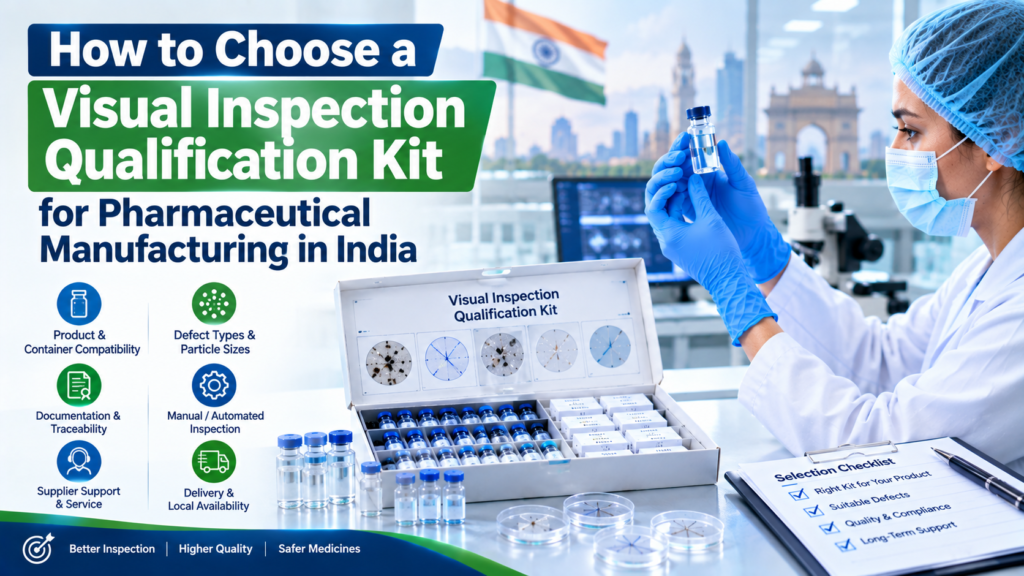
What makes a visual inspection qualification kit India solution suitable for a pharmaceutical manufacturing facility?
Is it the number of samples? The size of the particles? The type of container? The certificates supplied with the kit? Or whether it works with manual and automated inspection systems?
The answer is: all of these factors can matter, but the right choice starts with your qualification objective.
For pharmaceutical manufacturers, especially those handling injectable and parenteral products, visual inspection is an important quality-control activity. India’s Schedule M states that filled parenteral containers should be individually inspected for extraneous contamination or other defects. Where visual inspection is used, it should be performed under suitably controlled illumination and background, with appropriate operator controls and recorded results.
That means a visual inspection program needs more than an operator looking at vials on a production line.
Manufacturers need a structured approach to training, qualification, challenge testing, documentation, and ongoing performance evaluation.
This is where a visual inspection qualification kit or Knapp Kit can become a valuable tool.
But not every kit is necessarily suitable for every product, container, inspection method, or qualification objective.
This guide explains what Indian pharmaceutical manufacturers should consider before selecting a kit.
What Is a Visual Inspection Qualification Kit?
A visual inspection qualification kit is a controlled set of challenge samples used to evaluate the ability of an inspection process to identify defined defects.
Depending on the intended application, a kit may contain:
- Pharmaceutical vials
- Cartridges
- Prefilled syringes
- Liquid formulations
- Lyophilized formulations
- Known particulate defects
- Fibers
- Container defects
- Closure-related defects
- Other representative visual challenges
The basic concept is simple:
Known challenge → controlled inspection → recorded result → performance evaluation
This is different from simply collecting random rejected units from production.
A controlled qualification kit gives the manufacturer a defined challenge that can be incorporated into an approved training or qualification procedure.
Confianca Pharmazon’s current product information describes Knapp Kits for both manual and automatic visual inspection, including liquid and lyophilized formulations in vial, cartridge, and prefilled-syringe formats, as well as particulate matter in different micron-size ranges.
Why Choosing the Right Kit Matters
Visual inspection is influenced by many variables.
USP <1790> explains that visual inspection is a probabilistic process and that detection capability can vary based on factors such as particle size, shape, color, density, dosage form, and container design.
Consider two examples.
A large dark particle in a clear solution inside a transparent vial may be relatively easy to detect.
A smaller, lighter-colored particle with less contrast may present a substantially different inspection challenge.
Likewise, the same defect may behave differently in:
- A small vial
- A large vial
- A cartridge
- A prefilled syringe
- A clear solution
- A lyophilized product
This is why selecting a visual inspection qualification kit India solution should be based on the actual manufacturing and inspection environment rather than simply choosing a generic kit.
8 Key Factors to Consider When Choosing a Visual Inspection Qualification Kit India
1. Start With Your Qualification Objective
Before contacting suppliers, determine exactly what you are trying to qualify.
Your objective might be:
- New inspector training
- Initial visual inspector qualification
- Periodic requalification
- Defect recognition training
- Manual inspection performance evaluation
- Automated visual inspection machine qualification
- Investigation support
- Development of a defect reference library
These are related activities, but they are not necessarily identical.
Example
Suppose a pharmaceutical manufacturer is introducing a new injectable product in a glass vial.
The QA team may need a kit to train and qualify manual inspectors.
Another facility may already have experienced inspectors but is installing an automated visual inspection machine.
The second facility will have different qualification requirements.
Actionable tip: Write your qualification objective in one sentence before requesting a quotation. This helps the supplier recommend a configuration based on application rather than simply product availability.
2. Match the Kit to Your Container
Container compatibility is one of the most important considerations.
A qualification kit should reflect the physical characteristics of the product being inspected whenever practical.
Potential formats include:
Vials
Relevant considerations may include:
- Vial dimensions
- Fill volume
- Solution appearance
- Glass characteristics
- Stopper and seal configuration
Cartridges
Consider:
- Container geometry
- Product visibility
- Closure configuration
- Inspection orientation
Prefilled Syringes
Consider:
- Barrel geometry
- Product visibility
- Components and closures
- Inspection method
Confianca Pharmazon’s product information specifically lists visual inspection kits for liquid and lyophilized formulations in vial, cartridge, and PFS formats.
The important lesson is straightforward:
Do not choose the defect samples first and the container second.
The container itself is part of the inspection challenge.
3. Identify the Defects You Actually Need
A good visual inspection defect kit India solution should reflect the defects relevant to your manufacturing process.
Potential challenges can include:
Particulate defects
- Glass
- Metal
- Black particles
- White particles
- Fibers
- Other relevant particulate materials
Container defects
- Cracks
- Breakage
- Surface abnormalities
Closure defects
- Stopper abnormalities
- Seal-related defects
- Closure problems
Cosmetic defects
- Component imperfections
- Surface defects
- Other appearance-related issues
Not every facility needs every possible defect.
The objective is to establish a representative and scientifically justified challenge set.
Confianca Pharmazon’s published information describes Knapp Kits and related defect kits containing particulate challenges and other visual inspection defects for pharmaceutical applications.
4. Pay Attention to Particle Size
Particle size is a major consideration when selecting a kit for particulate inspection.
USP <1790> identifies particle size as one of the factors affecting visual detection. Shape, color, density, formulation, container characteristics, and inspection conditions can also affect detection capability.
So, instead of simply asking:
“Does the kit contain particles?”
ask more specific questions:
- What particle types are available?
- What size ranges are available?
- How are particles characterized?
- Is the size documented?
- Can particle characteristics be traced?
- Are the particles appropriate for the intended qualification?
- Can the supplier provide different challenge levels?
Confianca Pharmazon’s product page states that particulate matter is available in different micron-size ranges.
Practical tip
Ask for particle-size information before purchasing rather than assuming that “particle included” means the kit will meet your qualification requirements.
5. Consider Manual vs Automatic Visual Inspection
One of the biggest purchasing decisions is whether the kit will be used for manual visual inspection, automatic visual inspection, or both.
Manual Visual Inspection
Manual inspection relies on trained human inspectors.
A typical qualification process may involve:
- Training the inspector on the inspection procedure.
- Explaining the expected defect types.
- Providing controlled challenge samples.
- Recording detection results.
- Reviewing missed defects.
- Documenting qualification according to the approved SOP.
Human performance can vary due to experience, fatigue, attention, and inspection conditions.
A standardized challenge set can therefore help make training and evaluation more consistent.
Automatic Visual Inspection
Automated systems require a different approach.
The inspection machine may need to be challenged with known defects to evaluate whether the configured system can detect relevant abnormalities.
Potential challenges can include:
- Particles
- Fibers
- Cracks
- Container defects
- Closure defects
- Other defined inspection challenges
Confianca Pharmazon specifically describes its Knapp Kits as applicable to manual and automatic visual inspection machines.
Key point
Do not assume that a kit suitable for manual inspection is automatically sufficient for every automated inspection qualification.
The machine, camera system, lighting, product, container, inspection parameters, and defect profile should all be considered.
6. Review Documentation and Traceability
A qualification kit is more useful when the manufacturer can clearly identify what each challenge sample represents.
Before purchasing, ask the supplier about:
- Certificate or identification documentation
- Defect identification
- Particle-size information
- Traceability
- Kit identification
- Instructions for use
- Storage conditions
- Handling requirements
- Replacement policy
- Technical documentation
This is especially important when qualification records may later be reviewed by QA, auditors, or regulatory inspectors.
A documented challenge sample is easier to incorporate into a controlled qualification procedure than an unidentified sample.
7. Consider Inspection Conditions
A qualification kit should be used within a properly designed inspection process.
India’s Schedule M specifically states that visual inspection of parenteral products should be performed under suitably controlled illumination and background. It also addresses operator eyesight checks, rest periods, equipment validation where other inspection methods are used, and recording of results.
Therefore, buying a sophisticated kit will not compensate for poorly controlled inspection conditions.
Your qualification protocol should consider factors such as:
- Lighting
- Background
- Inspection angle
- Inspection duration
- Operator positioning
- Rest periods
- Product presentation
- Inspection environment
The kit is one component of the overall system.
8. Evaluate the Supplier, Not Just the Kit
Choosing a visual inspection qualification kit India supplier should involve more than comparing quotations.
Evaluate whether the supplier understands pharmaceutical visual inspection.
Ask:
- Can the supplier explain the intended application?
- Can the kit be configured for your container?
- Can the supplier provide relevant defect types?
- Is particle information available?
- Is documentation supplied?
- Can technical questions be answered?
- Is support available for manual inspection?
- Is support available for automated inspection?
- Are replacement arrangements clear?
- Can the supplier support future requirements?
This becomes particularly valuable when a facility is establishing or upgrading its visual inspection qualification program.
A Simple Supplier Evaluation Matrix
Instead of comparing suppliers only on price, create a technical scorecard.
| Selection Factor | Questions to Evaluate |
|---|---|
| Qualification objective | Does the kit match the intended use? |
| Container format | Vial, cartridge, PFS or other? |
| Formulation | Liquid or lyophilized? |
| Defect types | Are relevant challenges available? |
| Particle size | Are sizes characterized and documented? |
| Manual inspection | Is inspector qualification supported? |
| Automated inspection | Is machine qualification supported? |
| Documentation | Are certificates and records supplied? |
| Traceability | Can each challenge be identified? |
| Technical support | Can the supplier answer application questions? |
| Delivery | Can the kit be supplied when required? |
| Customization | Can the configuration match the process? |
This approach gives QA, QC, engineering, and procurement teams a common framework.
Example: Choosing a Kit for an Indian Injectable Manufacturer
Imagine an Indian pharmaceutical company manufacturing a liquid injectable in glass vials.
The facility wants to improve its manual visual inspector qualification program.
Instead of simply searching for the lowest-priced Knapp kit India option, the team defines its requirements:
- Liquid injectable
- Glass vial
- Manual visual inspection
- New and existing inspector qualification
- Particulate challenges
- Glass and metal particles
- Fiber challenges
- Defined particle-size requirements
- Traceability documentation
- Controlled inspection conditions
The procurement team can now send the same technical specification to several suppliers.
This makes supplier comparison more objective and reduces the risk of purchasing a kit that does not match the actual process.
How Knapp Kits Can Support Inspector Training
A visual inspection training kit can help transform training from a theoretical exercise into a practical challenge.
For example, an inspector may be shown:
- A vial containing a dark particle
- A vial containing a fiber
- A vial containing a glass particle
- A container with a visible defect
- A visually acceptable control sample
The operator can then inspect the samples under the defined inspection conditions and record the results.
This can help trainers identify where additional instruction may be needed.
A qualification kit should not, however, be viewed as a replacement for a complete training program.
Training should also cover:
- Inspection procedure
- Defect classification
- Inspection environment
- Product presentation
- Operator responsibilities
- Documentation
- Handling of rejected units
- Escalation and investigation procedures
How Qualification Kits Support Automated Inspection
Automated visual inspection systems can provide high-speed inspection, but they still need to be appropriately qualified and challenged.
A controlled defect kit can provide known challenges for evaluating system performance.
For example, a manufacturer may discover during qualification that:
- Large dark particles are consistently detected.
- Smaller particles require further parameter optimization.
- Certain fibers require specific camera or lighting settings.
- A particular container defect generates false rejects.
The results can help engineering and QA teams understand machine performance under defined conditions.
This is one reason a visual inspection qualification kit India solution should be selected with the actual machine and product configuration in mind.
Common Mistakes When Selecting a Visual Inspection Qualification Kit
Mistake 1: Choosing Only by Price
A low-cost kit may not match your product, container, defects, or documentation requirements.
Mistake 2: Assuming All Kits Are Equivalent
Different kits can have different sample configurations and intended applications.
Mistake 3: Ignoring Particle Characteristics
Particle size, shape, color, and density can affect detection.
Mistake 4: Forgetting the Container
The same defect can create a different inspection challenge in different container formats.
Mistake 5: Treating Training as Qualification
Training teaches the inspection process. Qualification evaluates performance against defined requirements.
Mistake 6: Assuming USP <790> Requires a Particular Commercial Kit
USP <790> establishes requirements for visual inspection of injectable products but does not mandate a particular commercial Knapp Kit brand.
The kit should therefore be treated as a tool supporting an appropriately designed qualification program.
What Should Indian Pharma Manufacturers Ask a Supplier?
Before issuing a purchase order, use this checklist:
Product and application
- What formulation is the kit designed for?
- Which container formats are available?
- Is it for manual or automated inspection?
Defects
- Which particulate types are included?
- Are fibers available?
- Are container and closure defects available?
- What particle-size ranges are available?
Documentation
- Is defect identification supplied?
- Is particle-size information available?
- What certificates are included?
- Is traceability provided?
Technical support
- Can the supplier help select the appropriate configuration?
- Can the supplier support qualification questions?
- Are customization options available?
Purchasing
- What is the lead time?
- What are the storage requirements?
- What is the replacement policy?
- What after-sales support is available?
A supplier who can answer these questions clearly can make the purchasing process significantly easier.
Why Confianca Pharmazon’s Knapp Kits May Be Relevant to Indian Manufacturers
Confianca Pharmazon’s current product information describes Knapp Kits and manual visual inspection kits for pharmaceutical applications, including liquid and lyophilized formulations in vial, cartridge, and prefilled-syringe formats. It also lists Knapp Kits for manual and automatic visual inspection machines and particulate matter in different micron-size ranges.
The company’s published educational material also discusses the use of Knapp Kits for inspector qualification, defect recognition, manual inspection, and automated inspection applications.
For an Indian pharmaceutical manufacturer, the most important step is still to match the kit configuration with the facility’s specific:
- Product
- Container
- Defect profile
- Inspection method
- Qualification protocol
- Documentation requirements
Suggested product page
Explore Knapp Kits – Manual & Automatic Visual Inspection Kits
Frequently Asked Questions
What is a visual inspection qualification kit?
It is a controlled set of challenge samples used to evaluate the performance of manual inspectors or visual inspection systems against defined defects and conditions.
Why is a visual inspection qualification kit important in India?
Indian GMP requirements include expectations around inspection of parenteral products. Schedule M states that filled parenteral products should be individually inspected for extraneous contamination or other defects and that visual inspection should be performed under suitably controlled conditions.
What is a Knapp Kit?
A Knapp Kit is a visual inspection challenge and qualification tool containing known defects or challenge samples. Confianca Pharmazon describes its kits for manual and automatic visual inspection applications.
Can Knapp Kits be used for manual inspection qualification?
Yes. They can be incorporated into a controlled manual inspector training and qualification program when appropriately configured and used according to the manufacturer’s approved procedure.
Can the same kit be used for automatic visual inspection?
It depends on the qualification objective, machine, container, formulation, and defect profile. An automated inspection system may require specific challenge configurations.
What types of defects should be included?
The appropriate defects depend on the product and risk assessment. Potential challenges include glass, metal, fibers, black or white particulate matter, container defects, closure defects, and other relevant visual abnormalities.
Does USP <790> require a Knapp Kit?
No. USP <790> addresses visual inspection of injectable products and visible particulate matter; it does not mandate a particular commercial qualification-kit brand.
What is USP <1790>?
USP <1790> provides guidance related to the visual inspection of injections and discusses factors affecting visual inspection, including inspection methods and the probabilistic nature of defect detection.
How should a pharmaceutical company choose between different suppliers?
Compare suppliers using technical criteria such as container compatibility, formulation, defect types, particle-size information, documentation, traceability, intended application, technical support, and delivery—not price alone.
Conclusion: Choose the Kit Around Your Inspection Process
Selecting a visual inspection qualification kit India solution should begin with one simple question:
What exactly are you trying to qualify?
From there, pharmaceutical manufacturers can work through the critical requirements:
- Product and formulation
- Container type
- Manual or automated inspection
- Relevant defect types
- Particle-size requirements
- Training versus qualification
- Inspection conditions
- Documentation and traceability
- Technical support
- Supplier capability
For injectable manufacturing, visual inspection is an important quality-control activity. India’s Schedule M specifically addresses individual inspection of filled parenteral products and controlled conditions for visual inspection.
At the same time, USP <1790> highlights why visual inspection cannot be treated as a simple binary activity: detection capability depends on multiple factors, including the characteristics of the defect and the product/container system.
That is why the right visual inspection qualification kit should be considered part of a broader qualification strategy—not an isolated purchase.
For Indian pharmaceutical manufacturers, a well-selected Knapp Kit can provide controlled challenge samples for training, qualification, and inspection-system evaluation. The key is to choose a configuration that reflects the actual manufacturing and inspection process.
If you are evaluating a visual inspection qualification kit India solution, define your technical requirements first and then discuss the appropriate kit configuration with an experienced supplier.
Looking for Knapp Kits and visual inspection defect kits for pharmaceutical manufacturing in India? Explore Confianca Pharmazon’s solutions and select the configuration suited to your product, container, and inspection method.
Explore Knapp Kits and Visual Inspection Defect Kits
Your trusted partner for pharma skills, systems, and solutions.