No products in the cart.
How to Build a Visual Inspection Defect Library Saudi Arabia: A Practical 10 Steps Guide to Knapp Kits
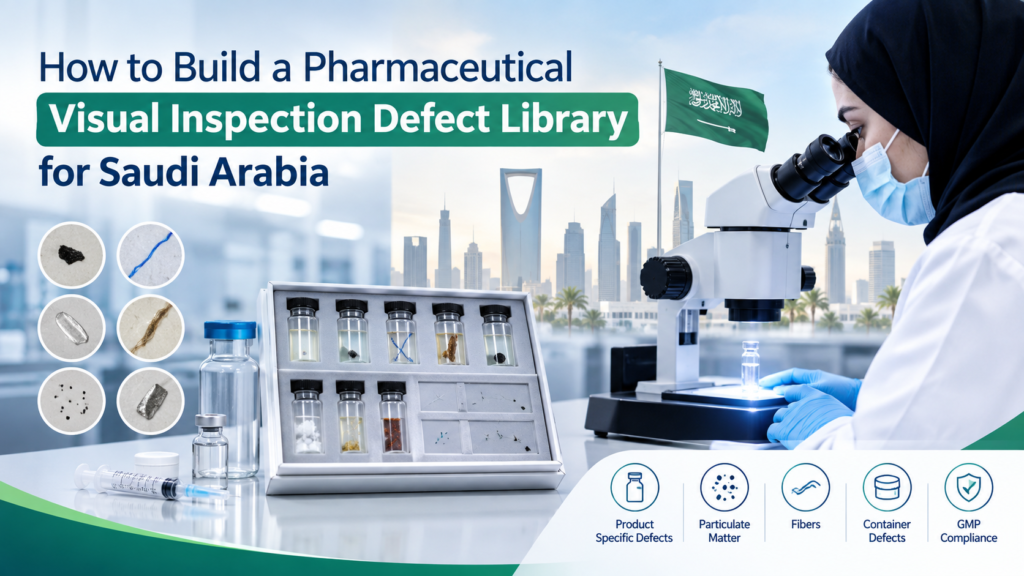
For pharmaceutical manufacturers, visual inspection is not simply a matter of looking at a vial and deciding whether it appears acceptable.
A reliable visual inspection program requires defined inspection conditions, trained personnel, representative defects, documented qualification procedures, and appropriate ongoing assessment.
This becomes particularly important for manufacturers of sterile and injectable products, where visible particulate matter, fibers, cracks, container defects, closure problems, and other abnormalities need to be detected consistently.
For companies developing a visual inspection defect library Saudi Arabia, one of the most important questions is:
What defects should be included, and how should the library be designed so that it reflects the actual manufacturing process?
A generic collection of defective containers may not be enough.
A useful defect library should be connected to the products, packaging components, inspection conditions, historical deviations, and risks associated with the individual pharmaceutical manufacturing operation.
The Saudi Food and Drug Authority (SFDA) GMP framework provides the regulatory foundation for pharmaceutical manufacturing in Saudi Arabia. Its GMP guide incorporates requirements for sterile manufacturing and emphasizes controls designed to prevent microbial, particulate, and endotoxin/pyrogen contamination.
This guide explains how pharmaceutical manufacturers can approach the development of a practical visual inspection defect library Saudi Arabia, how Knapp Kits can support the program, what defects to consider, and how to connect the library with inspector qualification and ongoing visual inspection improvement.
Why Pharmaceutical Manufacturers Need a Defect Library
A defect library provides a controlled collection of representative defects that can be used for training, qualification, challenge testing, and visual inspection performance assessment.
Without a structured library, training can become inconsistent.
For example, one trainer may use a black particle while another may use a large visible crack. A new operator may therefore receive very different practical exposure depending on who conducts the training.
A properly designed library provides a common reference.
It can help organizations:
- Standardize defect recognition
- Train new visual inspectors
- Support qualification exercises
- Evaluate inspector performance
- Conduct Probability of Detection studies
- Support recurring qualification
- Challenge automated inspection systems
- Investigate recurring visual inspection problems
- Create documented training evidence
Confianca Pharmazon’s Knapp Kit documentation describes defect libraries, training kits, qualification kits, manual and automatic visual inspection applications, and particulate defects in different size ranges.
Understanding the Saudi GMP Context
Before building a visual inspection defect library Saudi Arabia, the library should be considered as part of the manufacturer’s broader pharmaceutical quality system—not as a standalone product.
The SFDA publishes GMP guidelines for pharmaceutical manufacturers, and its GMP framework incorporates the principles applicable to sterile medicinal products. The sterile manufacturing guidance emphasizes prevention of particulate contamination through appropriate facility, equipment, system, procedure, qualification, validation, monitoring, and personnel controls.
For visual inspection specifically, the Saudi GMP guidance is particularly relevant because manual inspection is expected to be performed under suitable and controlled illumination and background conditions, with appropriately controlled inspection rates. The guidance also addresses operator qualification and use of appropriate defect samples.
Therefore, the defect library should be designed around the actual inspection process.
Step 1: Identify the Products Being Inspected
The first step is to understand exactly what your inspectors will be examining.
Consider:
- Liquid injections
- Lyophilized products
- Vaccines
- Biologics
- Ophthalmic products
- Parenteral solutions
- Prefilled syringes
- Cartridges
- Ampoules
- Vials
The container itself also matters.
A clear glass vial presents a different visual challenge from an amber vial. Similarly, a small-volume vial can create different inspection conditions compared with a larger container.
Confianca Pharmazon’s visual inspection kit offering includes liquid and lyophilized formulations and formats such as vials, cartridges, and prefilled syringes.
Create a Product-Inspection Matrix
A simple matrix can help:
| Product | Container | Formulation | Inspection Method | Key Defects |
|---|---|---|---|---|
| Injectable A | Clear vial | Liquid | Manual | Particles, fibers |
| Injectable B | Amber vial | Liquid | Manual | Particles, cracks |
| Product C | Vial | Lyophilized | Manual | Closure defects |
| Product D | PFS | Liquid | Automated | Particles, cosmetic defects |
This makes the library more relevant to your facility.
Step 2: Identify Realistic Defect Categories
The next step is to determine which defects inspectors actually need to recognize.
A comprehensive library can include several categories.
Particulate Defects
Examples include:
- Clear glass particles
- Amber glass particles
- Metal particles
- Black particles
- White particles
- Black fibers
- White fibers
- Hair fibers
- Other product-specific fibers or particles
Confianca Pharmazon’s Knapp Kit documentation specifically lists clear glass, amber glass, metal, white and black particles, black and white fibers, hair fibers, and customer-specified particle/fiber types.
Container Defects
Consider including:
- Cracks
- Broken containers
- Chips
- Scratches
- Deformation
- Other container abnormalities
These defects may have different levels of criticality depending on the product and manufacturer’s approved classification system.
Closure Defects
A library may also include:
- Damaged rubber stopper
- Incorrect closure
- Open seal
- Closure-related abnormalities
- Cap-related defects
The manufacturer’s own risk assessment should determine which closure defects are relevant.
Product-Related Defects
Depending on the formulation, the library may need examples of:
- Crystallization
- Precipitation
- Aggregates
- Incorrect solution
- Color abnormalities
These are especially important when the visual appearance of the formulation itself is part of the inspection process.
Step 3: Classify Defects by Criticality
Not every defect has the same significance.
A useful library should have a documented classification system appropriate to the manufacturer’s quality procedures.
For example:
Critical
Potentially serious defects such as:
- Certain particulate contamination
- Cracks
- Broken containers
- Significant closure failures
Major
Potentially significant defects such as:
- Certain container abnormalities
- Significant cosmetic defects
- Relevant closure problems
Minor
Less significant cosmetic or packaging abnormalities.
The exact classification should come from the pharmaceutical manufacturer’s approved SOPs, risk assessment, product requirements, and applicable regulatory/pharmacopeial expectations.
The purpose of classification is to help inspectors understand what they are looking for and how the organization expects each defect to be handled.
Step 4: Base the Library on Actual Manufacturing Risks
One of the biggest mistakes is creating a defect library simply by copying a generic supplier catalog.
Instead, start with your own data.
Review:
- Historical deviations
- Batch rejection records
- Customer complaints
- Visual inspection failures
- Previous investigations
- Container supplier issues
- Component defects
- Equipment-related contamination
- Environmental monitoring trends
- Previous CAPA investigations
Suppose your facility has repeatedly observed fibers during injectable inspection.
That should influence the composition of your defect library.
Similarly, if a filling machine has previously generated metallic contamination, metal particle challenges become particularly relevant.
Step 5: Identify Potential Sources of Particles
A good defect library should reflect realistic contamination sources.
Possible sources include:
Primary Packaging Material
- Glass
- Rubber
- Plastic
- Aluminum
Manufacturing Equipment
- Stainless steel
- Elastomers
- Polymers
- Lubricants
Filters
Filter-related materials may be relevant depending on the manufacturing process.
Cleanroom Garments
Textile fibers can become a potential contamination source.
Personnel
Human-origin contamination may include hair or fibers.
Confianca Pharmazon’s product documentation states that particle and fiber defects can be created using real sources of primary packaging materials, machine/product-contact materials, filters, and garments used in aseptic areas.
This approach makes the defect library more representative of actual manufacturing risks.
Step 6: Define Particle Size and Characteristics
Particle size is only one characteristic that affects visibility.
Other characteristics include:
- Color
- Shape
- Transparency
- Reflectivity
- Density
- Material
- Orientation
- Movement within the container
A small dark particle may be easier to see than a similarly sized transparent particle.
A fiber may be easier to detect when it moves through the solution than when it remains against the container wall.
This is one reason visual inspection is not simply a binary technical process.
The inspection environment and defect characteristics influence detection.
Confianca Pharmazon describes its particulate defects as available in different micron-size ranges and provides particle/fiber sizing with certificates as part of its visual inspection offering.
Step 7: Select the Right Knapp Kit
This is where Knapp Kits Saudi Arabia become relevant.
A Knapp Kit should be selected according to the purpose of the program.
For Manual Inspector Training
Consider:
- Relevant particle types
- Fibers
- Container defects
- Closure defects
- Product-related defects
For Inspector Qualification
Consider:
- Representative defects
- Appropriate defect difficulty
- Product/container configuration
- Criticality
- Qualification protocol
For Automated Inspection
Consider:
- Machine-compatible containers
- Relevant defect types
- Particle characteristics
- Known challenge samples
- Automated inspection qualification requirements
Confianca Pharmazon describes Knapp Kits for both manual and automatic visual inspection applications, along with training and qualification kits.
Step 8: Standardize the Defect Documentation
A defect library becomes significantly more useful when every sample has appropriate identification and documentation.
Consider recording:
- Defect identification number
- Defect category
- Defect type
- Container type
- Product/formulation
- Particle/fiber characteristics
- Size information where applicable
- Classification
- Preparation information
- Certificate/reference documentation
- Inspection result
- Qualification status
Confianca Pharmazon’s documentation describes master certificates, Probability of Detection evaluation sheets, particulate matter certificates, and defect identification support as part of its Knapp Kit offering.
Step 9: Connect the Library to Inspector Qualification
A defect library should not simply sit inside a QA cupboard.
It should become part of the training and qualification lifecycle.
A typical framework can include:
Stage 1 — Training
Explain:
- Defect categories
- Inspection technique
- Lighting
- Background
- Container handling
- Acceptance/rejection criteria
Stage 2 — Practical Training
The inspector works with representative physical defects.
Stage 3 — Qualification
The manufacturer conducts its approved qualification exercise.
Stage 4 — Documentation
Results are recorded and reviewed.
Stage 5 — Requalification
The organization follows its approved periodic qualification program and applicable regulatory expectations.
The SFDA GMP guidance describes continuing training, assessment of practical effectiveness, training records, and visual inspection qualification considerations for operators.
Step 10: Consider Probability of Detection
Probability of Detection, or POD, is an important concept when designing a visual inspection program.
Visual inspection is influenced by variables such as:
- Particle size
- Shape
- Color
- Density
- Product formulation
- Container characteristics
- Lighting
- Inspection duration
- Inspection speed
- Operator fatigue
Consequently, the defect library should contain challenges that are meaningful for the actual inspection process.
For example, qualifying an inspector using only large black particles may not adequately demonstrate their ability to detect smaller transparent or low-contrast particles.
A representative challenge set provides a more useful assessment.
Designing a Saudi-Specific Defect Library
A pharmaceutical manufacturer in Saudi Arabia should consider creating a library around its own manufacturing environment rather than purchasing a completely generic collection.
Recommended structure
Tier 1 – Common defects
- Black particles
- White particles
- Fibers
- Glass particles
Tier 2 – Manufacturing-specific defects
- Equipment-derived particles
- Packaging-derived particles
- Stopper-related defects
- Filter-related materials
Tier 3 – Product-specific defects
- Crystallization
- Aggregates
- Precipitation
- Formulation-specific abnormalities
Tier 4 – Container/closure defects
- Cracks
- Chips
- Scratches
- Seal defects
- Stopper defects
This creates a library that reflects both general pharmaceutical risks and facility-specific risks.
Common Mistakes to Avoid
1. Using Only Generic Samples
A generic kit may not represent your actual manufacturing risks.
2. Ignoring Container Differences
Clear and amber containers can present different visual challenges.
3. Focusing Only on Particles
Visual inspection may also involve container, closure, cosmetic, and product-related defects.
4. Not Updating the Library
New deviations and investigations should influence future training and qualification.
5. Poor Documentation
Without traceability, certificates, qualification records, and controlled procedures, the library becomes difficult to defend during quality reviews.
6. Treating Training as Qualification
Training teaches the skill.
Qualification demonstrates performance against a defined procedure.
These should not automatically be treated as the same activity.
How Confianca Pharmazon Can Support Your Defect Library
Confianca Pharmazon provides Knapp Kits, Manual Visual Inspection Defect Library Kits, Training Kits, Qualification Kits, and particulate matter solutions for manual and automated visual inspection applications. Its documentation also describes online and classroom training, visual inspection qualification guidance, particle/fiber sizing certificates, and support related to USP Chapters <790> and <1790>.
For a Saudi pharmaceutical manufacturer, the configuration can be discussed around:
- Product formulation
- Container format
- Inspection method
- Defect categories
- Particle types
- Particle size
- Training objectives
- Qualification objectives
- Documentation requirements
This allows the visual inspection defect library Saudi Arabia program to be developed around the manufacturer’s actual inspection risks rather than simply selecting an off-the-shelf collection.
Frequently Asked Questions
What is a pharmaceutical visual inspection defect library?
It is a controlled collection of representative defects used to support visual inspection training, qualification, assessment, and inspection process development.
What should a defect library contain?
Depending on the manufacturing process, it can contain particulate matter, fibers, glass, metal, container defects, closure defects, cosmetic defects, and product-related abnormalities.
What is a Knapp Kit?
A Knapp Kit is a specialized visual inspection challenge/qualification kit containing controlled defect samples used for visual inspection training and qualification activities.
Are Knapp Kits only used for manual inspection?
No. Confianca Pharmazon’s documentation describes kits for both manual and automatic visual inspection applications.
How often should visual inspectors be qualified?
The applicable Saudi GMP guidance addresses visual inspection qualification and states that operators should undergo visual inspection qualification at least annually for manual inspection, while the manufacturer’s quality system should define the applicable qualification and requalification program.
Should every pharmaceutical company use the same defect library?
Not necessarily. The library should reflect the products, containers, manufacturing processes, historical defects, contamination risks, inspection methods, and approved quality procedures of the individual facility.
Conclusion
Building a visual inspection defect library Saudi Arabia pharmaceutical manufacturers can rely on requires more than purchasing a box of defective samples.
The strongest approach starts with the actual manufacturing process.
Identify your products and containers. Review historical deviations and complaints. Determine the most relevant particulate, fiber, container, closure, cosmetic, and product-related defects. Define appropriate defect characteristics and documentation. Then integrate representative Knapp Kit samples into a controlled training and qualification program.
For Saudi manufacturers, this approach can help create a more structured visual inspection system aligned with the applicable SFDA GMP framework and the company’s own quality requirements.
Confianca Pharmazon’s Knapp Kits and Visual Inspection Defect Kits can support manual and automated inspection applications, with options covering different formulations, container formats, particulate defects, fibers, training, qualification, and related documentation.
Looking to build or upgrade your pharmaceutical defect library in Saudi Arabia?
Contact Confianca Pharmazon to discuss your vial, cartridge, prefilled syringe, formulation, defect categories, particle-size requirements, and manual or automated inspection objectives and determine the appropriate Knapp Kit configuration for your program.
Your trusted partner for pharma skills, systems, and solutions.