
No products in the cart.
Manual Visual Inspection Kit Saudi Arabia: The Ultimate Guide to Manual vs Automatic Visual Inspection Qualification
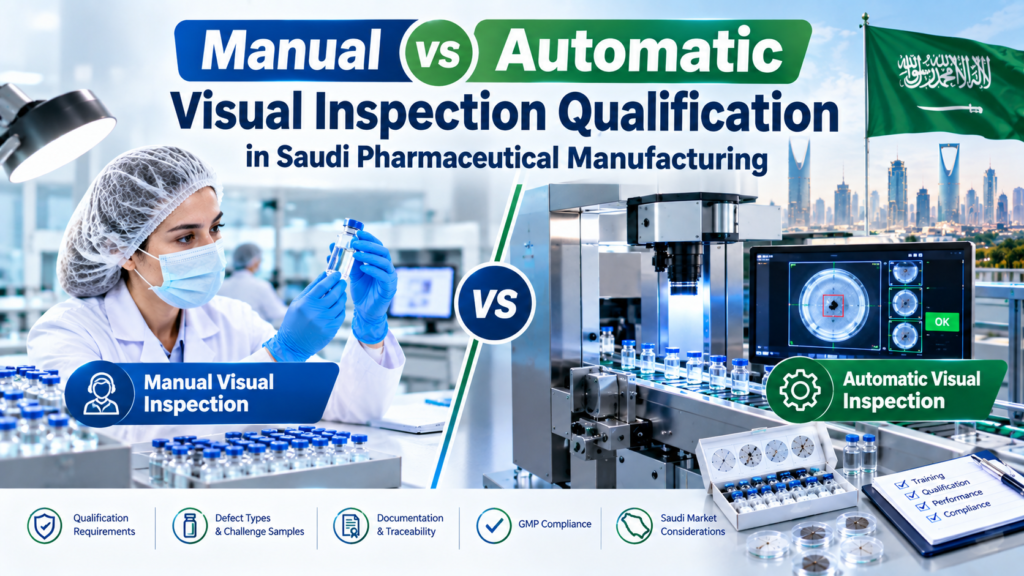
In pharmaceutical manufacturing, visual inspection is not simply about looking at a vial and deciding whether it appears acceptable. For injectable and parenteral products, manufacturers need a controlled process capable of detecting relevant particulate matter, container defects, closure defects and other abnormalities.
But an important question arises when designing the qualification program:
Should the facility focus on manual visual inspection, automatic inspection, or both?
The answer depends on the manufacturing process, inspection technology, product characteristics, container format and qualification objective.
For pharmaceutical manufacturers in Saudi Arabia, this distinction is particularly relevant because the Saudi Food and Drug Authority (SFDA) GMP guidance addresses both manual and automated inspection approaches. The guidance states that manual inspection should be performed under suitable, controlled illumination and background conditions, with appropriately controlled and qualified inspection rates. It also calls for visual inspection qualification of operators at least annually using appropriate samples from the manufacturer’s defect library and consideration of worst-case conditions.
For automated inspection, the SFDA guidance states that the process should be validated to detect known defects that may affect product quality or safety and that equipment should be challenged with representative defects before start-up and at regular intervals during the batch.
This is where a properly configured manual visual inspection kit Saudi Arabia solution or Knapp Kit can become useful as part of a broader qualification strategy.
Why Visual Inspection Qualification Matters in Saudi Pharma Manufacturing
Filled parenteral containers must be inspected for extraneous contamination and other defects. The SFDA GMP Guide states that all filled containers of parenteral products should be inspected individually for extraneous contamination or other defects. It also calls for defect classification and criticality to be established during qualification based on risk and historical knowledge.
This means visual inspection should be treated as a defined pharmaceutical quality process rather than an informal operator activity.
A structured qualification program can help manufacturers establish:
- Whether personnel can identify relevant defects
- Whether inspection conditions are appropriately controlled
- Whether inspection rates are qualified
- Whether known defects can be detected
- Whether automated inspection equipment performs as intended
- Whether inspection results are properly recorded
- Whether defect types and reject levels can be trended
The SFDA guidance also states that a defect library should be generated and maintained to capture known classes of defects and that it should be used for training production and quality assurance personnel.
Manual vs Automatic Visual Inspection: What Is the Difference?
The simplest distinction is the inspection decision-maker.
In manual inspection, a trained human operator examines each container under controlled conditions.
In automatic inspection, imaging systems and inspection algorithms examine containers and identify programmed or validated defect conditions.
Neither approach should be viewed simply as a replacement for the other. They involve different qualification considerations.
| Factor | Manual Visual Inspection | Automatic Visual Inspection |
|---|---|---|
| Primary decision-maker | Trained inspector | Inspection machine/system |
| Qualification focus | Personnel capability | Equipment/process capability |
| Main challenge | Human variability | Equipment sensitivity and validated detection |
| Training | Essential | Operator/system training still required |
| Defect challenge | Known representative samples | Known representative defects |
| Inspection conditions | Illumination, background, rate | Machine settings, cameras, lighting, algorithms |
| Performance monitoring | Inspector results | Machine challenge and performance data |
| Common tool | Manual defect/qualification kit | Knapp Kit or machine challenge set |
The appropriate qualification strategy should therefore be based on the actual inspection method used at the facility.
What Is a Manual Visual Inspection Kit?
A manual visual inspection kit is a collection of good and defective pharmaceutical containers designed to provide controlled examples for training, qualification and assessment.
Depending on the supplier and application, the kit may include:
- Vials
- Cartridges
- Prefilled syringes
- Liquid formulation samples
- Lyophilized formulation samples
- Particulate defects
- Fibers
- Container defects
- Closure-related defects
- Cosmetic defects
Confianca Pharmazon describes its visual inspection offering as including manual visual inspection kits for liquid and lyophilized formulations across vial, cartridge and prefilled-syringe formats, along with Knapp Kits for manual and automatic visual inspection applications.
A manual visual inspection kit Saudi Arabia facility selects should therefore be matched to the actual product and container configuration rather than selected solely because it is marketed as a general pharmaceutical defect kit.
What Is a Knapp Kit?
A Knapp Kit can be used as a controlled challenge set containing known defects or challenge units for visual inspection qualification and performance assessment.
Depending on the application, a Knapp Kit may support:
- Manual inspector qualification
- Visual inspection training
- Automatic inspection machine qualification
- Defect detection studies
- Probability of Detection evaluations
- Defect library development
- Performance assessment
Examples of defects described in Confianca Pharmazon’s visual inspection materials include glass particles, metal particles, black and white particles, fibers, cracks, stopper defects, seal defects and other container or cosmetic abnormalities.
The exact configuration should depend on the intended qualification application.
Importantly, a Knapp Kit should not be treated as a substitute for a complete GMP qualification program. It is a challenge and training resource that should be incorporated into an appropriately designed quality system.
Manual Visual Inspection Qualification in Saudi Arabia
The SFDA GMP guidance provides specific expectations for manual inspection.
According to the guidance:
- Manual inspection should be performed under suitable and controlled illumination and background.
- Inspection rates should be appropriately controlled and qualified.
- Operators should undergo visual inspection qualification at least annually.
- Appropriate samples from the manufacturer’s defect library should be used.
- Worst-case scenarios should be considered.
- Eyesight checks should be included.
- Operator distractions should be minimized.
- Frequent appropriate breaks should be provided.
This makes the design of the challenge samples important.
What Should Manual Qualification Samples Represent?
A qualification program may consider:
Particulate defects
Examples can include:
- Glass
- Metal
- Black particles
- White particles
- Other relevant particulate matter
Fibers
Fiber challenges may include:
- Black fibers
- White fibers
- Hair-like fibers
- Other relevant elongated foreign material
Container defects
Examples include:
- Cracks
- Broken or damaged containers
- Surface defects
Closure defects
Depending on the product, qualification may consider:
- Damaged stoppers
- Seal defects
- Closure abnormalities
- Cap-related defects
The actual defect categories should be based on the facility’s risk assessment, product, packaging system and manufacturing history.
Automatic Visual Inspection Qualification in Saudi Arabia
Automatic inspection introduces a different set of qualification questions.
Instead of asking:
“Can this inspector detect the defect?”
the manufacturer must ask:
“Can this validated inspection system reliably detect the known defects that it is intended to detect?”
The SFDA GMP guidance states that automated inspection processes should be validated to detect known defects that may impact product quality or safety and that representative defects should be used to challenge equipment before start-up and at regular intervals throughout the batch.
This means a qualification strategy for an automatic inspection machine should consider:
- Camera performance
- Lighting configuration
- Machine settings
- Container presentation
- Product characteristics
- Defect characteristics
- Detection algorithms
- Reject mechanism
- Challenge frequency
- Acceptance criteria
- Documentation and trending
A Knapp Kit designed for automatic inspection applications can provide known challenge units that allow the machine’s detection capability to be assessed under defined conditions.
Why the Same Kit May Not Work for Both Systems
It can be tempting to purchase one kit and use it for every inspection application.
However, manual and automatic systems do not interact with defects in exactly the same way.
A human inspector may rely on visual contrast, movement, particle characteristics and experience.
An automated system may depend on:
- Image resolution
- Camera configuration
- Lighting
- Image-processing parameters
- Container positioning
- Machine speed
- Detection algorithms
Therefore, a qualification kit should be selected according to the intended application.
For example, a Saudi manufacturer producing injectable products in vials may have:
Manual inspection:
Operators inspect vials under controlled lighting.
Automatic inspection:
A machine performs 100% inspection after filling.
In this situation, the company may need separate qualification strategies for the human inspection process and automated system.
How to Choose a Manual Visual Inspection Kit Saudi Arabia
Before purchasing a manual visual inspection kit Saudi Arabia, QA, QC, production, validation and engineering teams should define the qualification requirements.
1. Identify the Product
Start with the formulation.
Ask:
- Is it liquid?
- Is it lyophilized?
- Is it clear or visually challenging?
- What is the expected appearance?
- What types of defects are considered critical?
The challenge samples should be relevant to the product.
2. Confirm the Container Format
The container affects visual inspection.
Consider whether your facility uses:
- Vials
- Ampoules
- Cartridges
- Prefilled syringes
Also consider:
- Container size
- Glass color
- Closure configuration
- Fill volume
- Product movement characteristics
A kit that closely represents the production container can provide more meaningful qualification conditions.
3. Define the Defect Categories
Do not start procurement by asking only for a “Knapp Kit.”
Instead, create a defect requirement list.
For example:
| Requirement | Example |
|---|---|
| Particles | Glass, metal, black, white |
| Fibers | Black, white, hair-like |
| Container | Crack, damage |
| Closure | Stopper/seal defects |
| Product | Appearance abnormalities |
| Size | Defined particle/defect ranges |
This makes supplier discussions much more precise.
4. Consider Particle Size and Characteristics
Particle size alone does not determine visual detectability.
Shape, color, contrast, movement and product/container characteristics can influence detection.
Confianca Pharmazon describes particulate matter in different micron-size ranges within its visual inspection kit offering.
For qualification, define the particle characteristics relevant to your risk assessment and inspection process.
5. Check Documentation and Traceability
A professional qualification program requires more than physical samples.
Ask the supplier about available documentation, such as:
- Defect identification
- Master certificates
- Sample identification
- Traceability information
- Particle information where applicable
- Qualification documentation
- POD documentation, where applicable
- Handling and storage instructions
The documentation should support the organization’s internal qualification protocol and quality records.
6. Consider Worst-Case Conditions
This is particularly important because SFDA’s GMP guidance specifically calls for worst-case scenarios to be considered during manual visual inspection qualification. Examples given include inspection time, line speed, container size and fatigue.
A practical qualification exercise might therefore consider:
- Maximum inspection rate
- Smallest relevant container
- Relevant lighting conditions
- Appropriate inspection duration
- Operator fatigue
- Difficult-to-detect defects
The objective is to understand inspection capability under conditions that represent the actual process.
7. Consider Probability of Detection
Probability of Detection, or POD, can be useful when evaluating visual inspection performance.
A structured challenge study can help an organization understand whether known defects are consistently detected under defined inspection conditions.
However, POD methodology should be scientifically designed and statistically appropriate to the intended application.
It should not be reduced to simply counting how many defects one operator finds.
Example: Saudi Injectable Manufacturer
Imagine a Saudi pharmaceutical manufacturer producing a liquid injectable in glass vials.
The facility uses both manual and automated inspection.
Step 1: Risk assessment
The QA team identifies:
- Visible particulate matter
- Glass particles
- Metal particles
- Fibers
- Cracks
- Closure defects
Step 2: Manual qualification
Operators receive appropriate training and inspect known challenge samples under controlled conditions.
The company records:
- Inspector identification
- Defect type
- Detection result
- Qualification date
- Acceptance criteria
- Any missed defects
Step 3: Automatic qualification
The automated system is challenged using representative known defects.
The team records:
- Machine configuration
- Defect type
- Challenge result
- Reject response
- Equipment status
- Qualification evidence
Step 4: Ongoing monitoring
Results are recorded and defect trends reviewed.
This aligns with the SFDA GMP expectation that inspection results should be recorded and defect types and numbers trended.
This example illustrates why manual and automated inspection should be treated as related but distinct qualification activities.
Common Mistakes to Avoid
Mistake 1: Choosing the Cheapest Kit
Price should not be the only procurement criterion.
A low-cost kit that does not match your container, formulation or defect requirements may provide limited qualification value.
Mistake 2: Using Irrelevant Defects
A qualification sample should have a defined purpose.
Select representative defects based on product and process risk.
Mistake 3: Treating Training as Qualification
Training teaches an operator how to perform an activity.
Qualification provides documented evidence that the person can perform the required inspection under defined conditions.
These activities should be connected but clearly distinguished.
Mistake 4: Ignoring Automated Inspection Requirements
If a facility uses an automated inspection machine, simply qualifying operators does not establish automated-system performance.
The machine needs its own appropriate validation and challenge strategy.
Mistake 5: Forgetting Documentation
Physical samples without traceability or appropriate documentation can make qualification records difficult to defend during an audit.
Manual vs Automatic: Which Qualification Approach Does Your Facility Need?
The answer depends on the inspection process.
Choose a manual-focused qualification strategy when:
- Human inspectors perform the inspection
- Manual inspection is part of release operations
- Personnel qualification is required
- The facility is developing or maintaining a defect library
- Inspector competency needs periodic assessment
Consider automated qualification when:
- An automated visual inspection machine is used
- The machine performs product inspection
- Automated detection needs validation
- Representative defects are required for machine challenges
- Equipment performance must be checked periodically
Consider both when:
- The facility uses manual and automatic inspection
- Manual inspection is used as an alternative or backup
- Automated equipment is qualified but human intervention remains part of the process
- Different products use different inspection technologies
Practical Procurement Checklist for Saudi Pharmaceutical Manufacturers
Before selecting a manual visual inspection kit Saudi Arabia supplier, review this checklist:
Product compatibility
- Product formulation identified
- Liquid or lyophilized status confirmed
- Container type confirmed
- Container size documented
- Closure configuration identified
Defect requirements
- Particle categories defined
- Fiber categories defined
- Container defects defined
- Closure defects defined
- Relevant particle/defect sizes identified
Qualification requirements
- Manual qualification requirements defined
- Automatic qualification requirements defined
- Worst-case conditions considered
- POD requirements evaluated
- Acceptance criteria established
Documentation
- Defect identification available
- Traceability available
- Certificates reviewed
- Storage requirements understood
- Technical support confirmed
How Knapp Kits Can Support a Saudi Visual Inspection Program
A Knapp Kit or visual inspection defect kit should be viewed as one component of a larger quality system.
Confianca Pharmazon describes its Knapp Kit offering for both manual and automatic visual inspection applications, while its product information also covers particulate matter and manual inspection kits for liquid and lyophilized formulations across formats such as vials, cartridges and prefilled syringes.
For a Saudi pharmaceutical manufacturer, the practical value comes from matching the kit to:
- Product
- Container
- Defect profile
- Inspection technology
- Qualification objective
- Documentation requirements
- Internal GMP procedures
The goal is not simply to own a defect kit. The goal is to use controlled challenge samples within a documented, risk-based visual inspection program.
Frequently Asked Questions
1. What is a manual visual inspection kit?
A manual visual inspection kit contains representative good and defective pharmaceutical samples that can be used for visual inspection training, qualification and performance assessment.
2. What is the difference between a Knapp Kit and a manual visual inspection kit?
The terms can overlap, but they are not necessarily identical. A manual visual inspection kit may focus on inspector training and qualification, while a Knapp Kit can be configured as a controlled challenge set for manual or automated inspection applications. The exact configuration depends on the supplier and intended use.
3. Does SFDA require a specific commercial Knapp Kit?
The SFDA GMP guidance requires appropriate qualification and representative defect challenges, but it does not identify a particular commercial Knapp Kit brand as mandatory.
4. How often should manual visual inspectors be qualified?
The current SFDA GMP guidance states that operators performing manual inspection should undergo visual inspection qualification at least annually, with appropriate samples from the manufacturer’s defect library and consideration of worst-case scenarios.
5. Can the same Knapp Kit be used for manual and automatic inspection?
It depends on the kit configuration and qualification objective. A kit should be appropriate for the specific inspection system, container, product and defect types being evaluated.
6. What defects should a pharmaceutical visual inspection kit contain?
Potential categories include particulate matter, fibers, container defects, closure defects and other product-specific abnormalities. The actual defect set should be based on the facility’s risk assessment and inspection requirements.
7. Can Knapp Kits support automatic visual inspection machine qualification?
Yes. Confianca Pharmazon describes Knapp Kits for automatic visual inspection machine qualification as well as manual inspection applications.
8. Why is a defect library important?
SFDA’s GMP guidance states that a defect library should be generated and maintained to capture known classes of defects and used for training production and quality assurance personnel.
Conclusion: Building a Structured Visual Inspection Qualification Program
Manual and automatic visual inspection serve different operational purposes, and their qualification strategies should reflect those differences.
For manual inspection, the focus is on demonstrating that trained personnel can detect relevant defects under controlled conditions. For automated inspection, the focus shifts toward validating the inspection process and challenging the equipment with representative known defects.
For Saudi pharmaceutical manufacturers, the SFDA GMP framework provides clear expectations around controlled inspection conditions, personnel qualification, defect libraries, representative challenges, documentation and trending.
A properly selected manual visual inspection kit Saudi Arabia solution can support inspector training and qualification when it is matched to the product, container, defect profile and internal qualification protocol. Similarly, an appropriately configured Knapp Kit can support automated inspection-machine challenges.
The most practical approach is to begin with a risk-based assessment:
- Identify the products and containers being inspected.
- Define relevant defect categories.
- Determine whether inspection is manual, automated or both.
- Establish qualification and acceptance criteria.
- Select representative challenge samples.
- Maintain appropriate documentation and traceability.
- Record, trend and periodically review inspection performance.
For pharmaceutical manufacturers looking to strengthen their visual inspection program, Confianca Pharmazon’s Knapp Kits and visual inspection defect kits can be evaluated based on the required application, container format and defect profile.
Explore the Knapp Kit and Visual Inspection Defect Kit range and discuss the appropriate configuration for your pharmaceutical visual inspection requirements.
Your trusted partner for pharma skills, systems, and solutions.