
No products in the cart.
Understanding SEM-EDS Results in Pharmaceutical Particle Characterization: From Elemental Analysis to Reliable Investigation Decisions
Introduction
In pharmaceutical manufacturing, the discovery of an unknown particle can raise important questions about product quality, manufacturing conditions, equipment performance, and possible contamination sources. However, identifying a particle is not always straightforward. Two particles that appear similar under a microscope may have different material compositions, while particles originating from different sources may show comparable elemental characteristics.
This is why pharmaceutical particle characterization requires more than visual observation. Analytical techniques such as scanning electron microscopy (SEM) and energy-dispersive X-ray spectroscopy (EDS) provide additional information that can help laboratory and quality teams understand the physical structure and elemental composition of unknown particles.
SEM-EDS pharmaceutical particle analysis is particularly useful when investigating metallic fragments, glass-related particles, inorganic residues, and other materials that require detailed microscopic examination.
However, analytical results must be interpreted carefully. An elemental profile does not automatically establish the exact material identity or prove the source of contamination. Reliable conclusions require a combination of microscopy, elemental analysis, reference material comparison, manufacturing knowledge, and documented investigation evidence.
This article explains how SEM-EDS findings can be interpreted during pharmaceutical particle characterization and how analytical observations can be converted into useful information for contamination investigations.
1. Why SEM-EDS Analysis Is Important in Pharmaceutical Investigations
Pharmaceutical particles can originate from several possible sources, including:
- Manufacturing equipment and machine components.
- Stainless-steel product-contact and non-product-contact parts.
- Glass containers, ampoules, and vials.
- Rubber stoppers, gaskets, and elastomeric components.
- Filters, tubing, and transfer assemblies.
- Packaging materials and polymeric components.
- Fibres from garments, wipes, and other materials.
- Environmental and handling-related sources.
Visual inspection may help identify a particle’s colour, shape, approximate dimensions, and general appearance. However, these characteristics may not be sufficient to distinguish between materials.
For example, a small metallic-looking particle may require further analysis to understand which elements are present. Similarly, a transparent or dark particle may need additional examination before its material characteristics can be assessed.
SEM-EDS provides two complementary types of information:
Scanning Electron Microscopy (SEM): Provides high-magnification images that help examine particle morphology, surface characteristics, structure, and other visible features.
Energy-Dispersive X-ray Spectroscopy (EDS): Provides information about the detectable elemental composition of the analysed region.
When considered together, these techniques help build a more detailed analytical picture of an unknown particle.
2. Understanding the Difference Between SEM Images and EDS Results
One common mistake during particle investigations is treating SEM images and EDS spectra as if they provide the same information.
They serve different purposes.
SEM imaging helps answer questions such as:
- What is the general shape of the particle?
- Does the surface appear smooth, rough, fractured, or irregular?
- Are there visible layers, coatings, or attached materials?
- Does the particle appear fibrous, fragmented, or compact?
- Are there visible differences between different regions?
EDS analysis helps answer different questions:
- Which detectable elements are present?
- Which elements appear dominant in the analysed region?
- Are there characteristic elemental combinations?
- Do different regions show similar or different elemental profiles?
- Are the findings consistent with a suspected reference material?
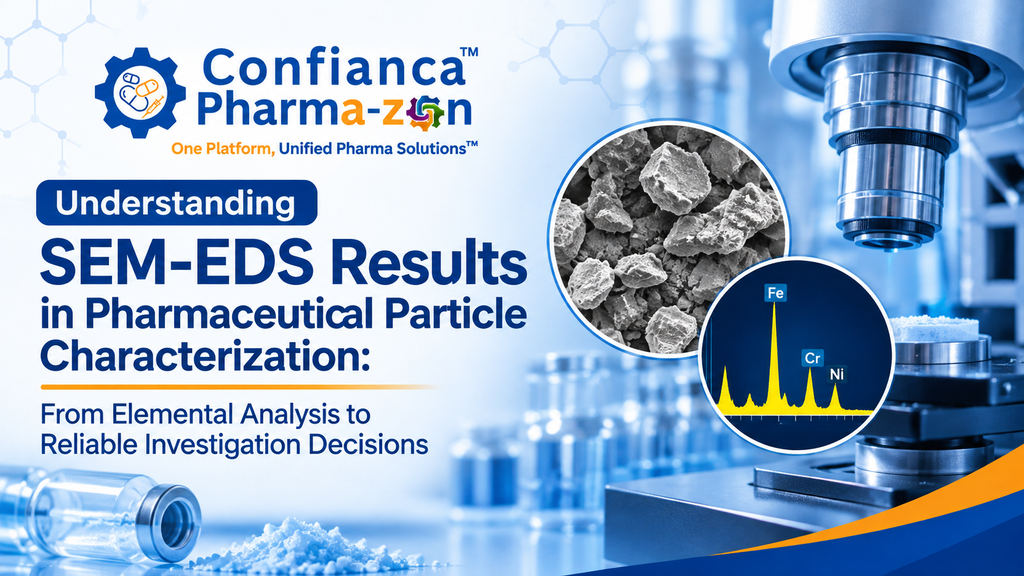
For example, SEM imaging may show an irregular fragment with a rough surface, while EDS may detect iron, chromium, and nickel.
Together, these observations may support an assessment that the particle is consistent with a stainless-steel-related material. However, this elemental combination alone does not prove that the particle originated from a particular machine, component, or manufacturing location.
The distinction between observation and conclusion is essential for reliable pharmaceutical particle identification.
3. How to Interpret Elemental Profiles Correctly
An elemental profile is an important part of SEM-EDS pharmaceutical particle analysis. However, the presence or absence of individual elements should not be interpreted in isolation.
A useful interpretation considers:
Major detected elements: Elements that represent a significant portion of the measured elemental profile.
Minor detected elements: Elements present at lower levels that may provide additional information about the analysed material.
Elemental combinations: Groups of elements that may be consistent with particular material families.
Regional differences: Variations between different analysed areas of the same particle.
Analytical conditions: Factors such as accelerating voltage, acquisition settings, particle geometry, surface condition, and sample preparation.
For example, detecting silicon and oxygen may be consistent with several silica-containing or silicate-related materials. Additional elements and morphological characteristics may help narrow the interpretation, but the profile alone may not distinguish every possible material.
Similarly, carbon and oxygen may be detected in a wide range of organic and polymeric materials. These elements should not be used as the sole basis for identifying a specific polymer.
A scientifically responsible report should clearly distinguish between detected elements, possible material interpretations, and confirmed source identification.
4. Why Different Regions of the Same Particle May Produce Different Results
Some pharmaceutical particles are not chemically or physically uniform.
A particle may contain:
- A main material with a surface coating.
- Multiple attached fragments.
- Surface contamination.
- Different material layers.
- Localized deposits.
- A heterogeneous composition.
As a result, analysing only one region may not represent the complete particle.
For suitable samples, multiple EDS analysis points can help assess regional variation.
For example, a particle may show a predominantly metallic profile in one region and a different elemental profile in another. This could indicate a coating, an attached contaminant, a heterogeneous structure, or another analytical consideration.
The investigator should therefore consider whether the selected analysis points adequately represent the particle.
Where necessary, additional regions may be examined to understand whether the observed elemental profile is consistent across the particle or varies significantly.
5. Factors That Can Influence SEM-EDS Results
SEM-EDS results are influenced by several analytical and sample-related factors.
Particle Size
Very small particles may be difficult to analyse independently if the interaction volume extends beyond the particle or includes the supporting substrate.
The particle’s dimensions should therefore be considered when selecting analytical conditions and interpreting the resulting spectrum.
Particle Shape and Orientation
Irregular surfaces and particle orientation can affect X-ray generation and detection. This may influence the apparent elemental profile.
Surface Contamination
Residues, handling contamination, mounting materials, and other surface deposits may contribute to the detected signal.
Sample Preparation
Filtration, drying, mounting, coating, and other preparation steps may influence the final analytical result.
For example, a conductive coating or mounting substrate may contribute signals that need to be considered during interpretation.
Elemental Detection Limitations
EDS has limitations in detecting and quantifying certain elements, particularly at low concentrations or under unsuitable analytical conditions.
Not every detected or undetected element should be treated as definitive proof of a material’s identity.
6. Comparing Unknown Particles with Known Reference Materials
One of the most useful steps in pharmaceutical particle investigation is comparing unknown particles with relevant manufacturing materials.
Potential reference materials may include:
- Stainless-steel components.
- Glass containers and glass-related materials.
- Rubber stoppers and elastomers.
- Gaskets and seals.
- Filters and tubing.
- Polymer-based components.
- Gloves and garment materials.
- Packaging and handling materials.
A comparison should consider more than one characteristic.
Important comparison parameters include:
- Morphological similarity.
- Elemental profile.
- Surface characteristics.
- Particle dimensions.
- Material composition.
- Differences between analysed regions.
- Suitability of the reference material.
A reference library can support this process by providing documented information about known materials.
However, a match or similarity should be interpreted according to the quality and completeness of the reference data. Similar elemental profiles do not necessarily establish an identical material or a common source.
Where appropriate, client-supplied reference materials may also be considered for comparative analysis.
7. When Additional Analytical Techniques May Be Necessary
SEM-EDS is useful for many inorganic and elemental investigations, but it does not provide a complete chemical identification for every particle type.
Some materials require complementary analytical techniques.
FTIR Spectroscopy
Fourier Transform Infrared Spectroscopy can provide information about molecular bonds and functional groups. It is particularly useful when investigating many organic materials and polymers.
Raman Spectroscopy
Raman spectroscopy provides molecular and structural information that may help differentiate certain materials, pigments, and compounds.
Optical and Stereo Microscopy
These techniques help examine colour, shape, transparency, surface appearance, and other physical characteristics before selecting particles for advanced analysis.
Other Suitable Analytical Methods
Depending on the material and investigation objective, additional techniques may be considered to distinguish similar materials or investigate specific chemical characteristics.
The appropriate analytical method should be selected according to the particle, sample condition, required identification level, and available reference information.
8. Connecting Analytical Findings with Manufacturing Evidence
Analytical results are only one part of a pharmaceutical contamination investigation.
A complete investigation should also consider manufacturing and process information.
Useful supporting information may include:
- Equipment maintenance history.
- Previous breakdowns or repairs.
- Product-contact material specifications.
- Filter and tubing replacement records.
- Cleaning and sanitization records.
- Batch manufacturing records.
- Environmental monitoring information.
- Packaging component history.
- Previous particle observations.
- Supplier and material change records.
For example, if an unknown particle has characteristics consistent with a particular gasket material, investigators may review the equipment configuration, gasket condition, maintenance records, and relevant replacement history.
This approach helps connect analytical observations with actual process conditions.
It also prevents an investigation from assigning a contamination source based only on an elemental match.
9. Preparing a Scientifically Useful Particle Characterization Report
A particle characterization report should present analytical findings in a clear and traceable manner.
Depending on the agreed analytical scope, the report may include:
Sample Information
- Sample identification.
- Product and container details.
- Sample quantity and relevant background information.
Particle Recovery Information
- Recovery method.
- Filtration information, where applicable.
- Sample preparation details.
Microscopic Examination
- Particle photographs.
- Morphological observations.
- Relevant dimensions.
- Selected microscopic images.
SEM-EDS Findings
- SEM images.
- EDS spectra.
- Elemental results.
- Analysed regions.
- Relevant analytical conditions.
Reference Comparison
- Known reference material information.
- Similarities and differences.
- Possible material interpretations.
Interpretation and Limitations
- What the results support.
- What cannot be concluded from the analysis alone.
- Additional investigation that may be appropriate.
A clear report allows quality, laboratory, production, and engineering teams to review the same evidence and make informed investigation decisions.
10. Common Interpretation Mistakes to Avoid
Treating an Elemental Match as Exact Source Confirmation
Similar elemental profiles may occur in different materials. Source confirmation requires supporting evidence.
Ignoring the Particle’s Morphology
An elemental spectrum without morphological context may provide an incomplete interpretation.
Overlooking Sample Preparation Effects
Mounting materials, coatings, and preparation residues may influence the spectrum.
Analysing Only One Region When the Particle Is Heterogeneous
A single point may not represent the complete particle.
Reporting Unsupported Material Identification
Reports should separate detected elements, possible material classification, and confirmed identification.
Ignoring the Manufacturing Process
Laboratory findings should be correlated with equipment, materials, process records, and other investigation evidence.
11. How Confianca Pharmazon Supports Pharmaceutical Particle Investigations
Confianca Pharmazon supports pharmaceutical professionals through particle characterization-related services and reference material comparison.
Its particle characterization service information describes a structured approach involving particle recovery through filtration, microscopic examination, SEM-EDS analysis, and comparison with relevant known materials where suitable reference information is available.
The service information also identifies sample types such as vials, ampoules, pharmaceutical bags, and prefilled syringes, with the analytical approach assessed according to sample suitability and investigation requirements.
This type of analytical support can help pharmaceutical quality and laboratory teams organize findings, assess possible material relationships, and plan further investigation.
Conclusion
SEM-EDS is a valuable analytical technique for pharmaceutical particle characterization, especially when an unknown particle requires detailed morphological and elemental examination.
However, reliable pharmaceutical particle identification depends on correct interpretation rather than simply listing detected elements.
By considering particle morphology, elemental profiles, regional variations, sample preparation, reference materials, and manufacturing evidence, investigators can develop a more scientifically supported understanding of unknown particles.
The objective of a successful investigation is not merely to identify which elements are present. It is to understand what the analytical evidence supports, recognize its limitations, and use the findings to guide appropriate quality and contamination-control decisions.
Need support with pharmaceutical particle characterization or unknown particle investigation?
Visit Confianca Pharmazon to explore particle characterization services and discuss your analytical requirements.