
No products in the cart.
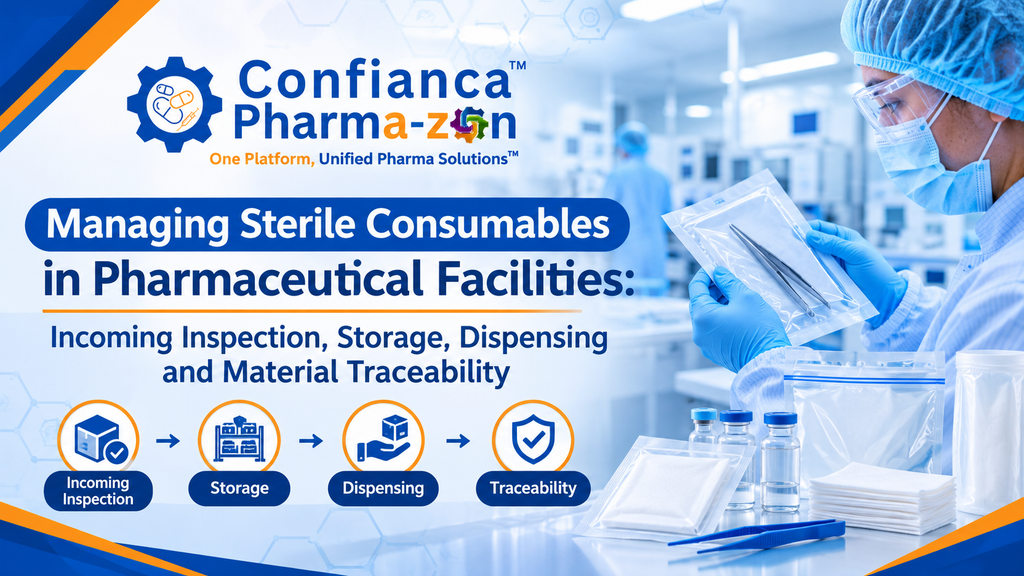
Managing Sterile Consumables in Pharmaceutical Facilities: Incoming Inspection, Storage, Dispensing and Material Traceability
Introduction
Pharmaceutical manufacturing environments depend on carefully controlled materials, equipment, personnel practices, and operating procedures. Among these supporting materials, sterile consumables play an important role in aseptic processing, microbiology laboratories, cleanroom operations, and other controlled pharmaceutical activities.
However, selecting an appropriate sterile consumable is only one part of material management.
The way a consumable is received, inspected, stored, transferred, issued, and tracked can also influence its suitability at the point of use.
Even a product supplied with appropriate documentation may become unsuitable if its packaging is damaged, its storage requirements are not followed, or its identity and lot information cannot be verified.
This makes sterile consumable management an important part of pharmaceutical material control.
A structured approach helps organizations maintain product identification, preserve packaging condition, reduce handling-related risks, and support traceability throughout the material lifecycle.
This article explains the important controls involved in managing sterile consumables from supplier receipt to final use in pharmaceutical manufacturing and laboratory environments.
1. Why Sterile Consumable Management Requires a Controlled Approach
Sterile consumables are used in applications where their sterility status and physical condition may be important to the manufacturing or laboratory process.
Depending on their intended application, they may include:
- Sterile disposable forceps.
- Sterile cleanroom wipes.
- Sterile gloves.
- Sterile bags.
- Sterile sampling accessories.
- Sterile microbiology consumables.
- Sterile funnels and filtration accessories.
- Other suitable disposable materials.
The requirements for each product may differ.
For example, a sterile wipe used for a particular cleanroom cleaning activity may have different requirements from a sterile accessory that directly contacts a pharmaceutical product.
Therefore, the material should be managed according to its intended application, product specifications, and site procedures.
The objective is to ensure that the correct material is available in the correct condition, with appropriate documentation, when it is required.
2. Step One: Establish Clear Material Specifications Before Purchasing
A strong material control process begins before a purchase order is issued.
The purchasing and quality teams should understand what the consumable is expected to do and what specifications are necessary for its intended use.
Important specification elements may include:
Product Identification
The product name, description, size, type, and catalogue or product identification should be clearly defined.
Intended Application
The specification should identify whether the product is intended for general cleanroom use, aseptic processing, microbiological testing, sampling, or product-contact applications.
Sterility Status
The required sterility status should be clearly stated and verified against the product documentation.
A product should not be considered sterile simply because it is disposable or described as a cleanroom consumable.
Material Composition
Material composition may be relevant to chemical compatibility, physical performance, particle release, and other application-specific requirements.
Packaging Configuration
The number of packaging layers, unit packaging, outer packaging, and transfer requirements should be understood.
Storage Conditions
Any temperature, humidity, light, or other storage restrictions should be identified from the manufacturer’s instructions.
Shelf Life
The expiry date or other applicable shelf-life information should be considered during purchasing and inventory planning.
Clear specifications reduce confusion between purchasing, warehouse, quality, and end-user teams.
3. Step Two: Supplier Qualification and Documentation Review
Supplier selection is an important part of pharmaceutical material management.
A supplier should be assessed according to the criticality of the consumable and its intended use.
Depending on the material and application, supplier evaluation may consider:
- Product specifications.
- Manufacturing information.
- Sterilization information, where applicable.
- Packaging configuration.
- Lot identification.
- Shelf-life information.
- Quality documentation.
- Change-notification arrangements.
- Supply consistency.
- Technical support.
Documentation requirements should be defined by the pharmaceutical organization’s quality system and risk assessment.
Relevant documents may include:
Certificate of Analysis (CoA): Where applicable, this may provide specified test results associated with a product or lot.
Certificate of Conformance (CoC): May provide confirmation that the supplied product meets specified requirements.
Sterilization Documentation: Relevant information may be required to support the supplied sterility status and applicable process documentation.
Technical Data Sheet: Provides product characteristics, material information, dimensions, and other specifications.
Product Specification: Defines the agreed requirements against which the material is assessed.
Not every consumable requires the same set of documents. The documentation package should be appropriate to the product’s intended use and risk classification.
4. Step Three: Incoming Material Inspection
When sterile consumables arrive at a pharmaceutical facility, the receiving process should verify that the delivered materials correspond to the approved purchase and material requirements.
Incoming inspection is an important opportunity to identify discrepancies before products enter controlled inventory.
The inspection may include:
Product Identity
Verify the product description, catalogue number, size, and quantity against the purchase order and approved specification.
Supplier and Manufacturer Details
Check that the supplied material comes from the expected supplier or approved source.
Lot or Batch Identification
Confirm that the lot or batch number is available and readable where applicable.
Expiry or Shelf-Life Information
Verify the expiry date or other applicable date information.
Packaging Condition
Inspect for visible damage, punctures, broken seals, moisture, contamination, or other signs of compromised packaging.
Documentation
Review the documents required by the purchasing specification and quality procedures.
Quantity Verification
Confirm that the delivered quantity matches the order and accompanying delivery documentation.
If discrepancies are observed, the material should be handled according to the facility’s approved procedure. Products with questionable packaging or identification should not be released for use without appropriate assessment.
5. Step Four: Packaging Integrity and Its Importance
Packaging plays an important role in maintaining the condition of sterile consumables.
The packaging configuration should be appropriate for the product and its intended application.
For sterile products, packaging integrity is particularly important because damage to a sterile barrier system may compromise the product’s suitability for use.
Potential packaging concerns include:
- Torn or punctured packaging.
- Broken seals.
- Open or partially opened packs.
- Moisture exposure.
- Incorrect labelling.
- Missing product identification.
- Visible damage during transport.
- Packaging that does not match the approved specification.
Outer packaging and sterile barrier packaging should be understood separately.
Damage to an outer shipping carton does not necessarily mean the sterile barrier is compromised, but the condition of the internal packaging must be assessed.
Similarly, an apparently clean outer package does not establish that the sterile barrier is intact.
Facilities should follow the manufacturer’s instructions and approved material acceptance procedures when evaluating packaging condition.
6. Step Five: Storage Conditions and Inventory Management
After acceptance, sterile consumables should be stored according to their specified conditions.
Storage management should consider:
Designated Storage Areas
Consumables should be stored in areas appropriate to their classification and intended use.
Environmental Conditions
Temperature, humidity, light exposure, and other environmental requirements should be followed where specified by the manufacturer.
Segregation
Different material categories, sterile and non-sterile products, and accepted and rejected materials should be segregated according to site procedures.
Shelf-Life Monitoring
Expiry dates should be monitored to prevent unsuitable materials from being issued.
Stock Rotation
Appropriate stock rotation methods help ensure that materials are issued in a controlled sequence.
Packaging Protection
Products should be protected from crushing, punctures, excessive handling, and other damage during storage.
A well-organized inventory system makes it easier to identify the material, verify its status, and locate the relevant lot information when required.
7. Step Six: Controlled Dispensing and Transfer into Cleanroom Areas
Material transfer into a controlled manufacturing area requires attention because packaging can carry contamination from one environment to another.
The transfer method should be defined by the facility’s cleanroom procedures and contamination control strategy.
Depending on the application, controls may include:
- Verification of material identity before dispensing.
- Confirmation of release status.
- Inspection of outer packaging.
- Removal of external packaging at designated locations.
- Appropriate disinfection of packaging surfaces where required.
- Controlled transfer through material airlocks or pass-through systems.
- Protection of inner packaging during movement.
- Use of approved gowning and handling procedures.
The transfer procedure should reflect the cleanroom classification, material characteristics, and intended use.
For example, a consumable entering an aseptic processing area may require a different transfer process from a product intended for a general controlled laboratory area.
The objective is to minimize contamination risks while maintaining the condition and identity of the consumable.
8. Step Seven: Proper Handling at the Point of Use
Correct handling remains important after the consumable reaches the work area.
Personnel should follow approved procedures for opening, handling, and using sterile products.
Important practices include:
Verify Before Opening
Check the product identity, lot number, expiry date, and packaging condition before use.
Open According to the Instructions
Use the approved opening technique to avoid unnecessary contact with critical surfaces.
Avoid Unnecessary Handling
Minimize unnecessary contact with the product and its sterile barrier.
Use the Correct Product for the Task
Do not substitute one consumable for another without appropriate evaluation and approval.
Follow Aseptic Practices
Personnel should follow the applicable gowning, handling, and aseptic procedures.
Report Abnormalities
Damaged packaging, unexpected particles, missing labels, and other discrepancies should be reported according to site procedures.
Correct handling helps maintain control over the material from receipt through actual use.
9. Step Eight: Lot Traceability and Material Records
Traceability is essential in pharmaceutical material management.
If a quality issue is identified, the organization should be able to determine which consumable lot was received, where it was stored, and where it was issued or used, as required by the applicable procedures.
A material traceability system may include:
- Product name and identification.
- Manufacturer and supplier.
- Lot or batch number.
- Receipt date.
- Quantity received.
- Inspection status.
- Documentation review status.
- Expiry date.
- Storage location.
- Issue date.
- Department or area receiving the material.
- Relevant usage records.
For critical applications, additional records may be required according to the site’s material control procedure.
Good traceability supports investigations, supplier communication, material recall activities, and quality review.
10. Step Nine: Managing Expired, Damaged, or Rejected Consumables
Materials that do not meet the required conditions should be controlled through the site’s approved quality procedures.
Examples include:
- Expired sterile consumables.
- Damaged sterile barrier packaging.
- Unidentified products.
- Materials with missing required documentation.
- Products stored outside specified conditions.
- Materials with visible contamination.
- Products with unexplained physical changes.
Such materials should not be issued for routine use without an appropriate documented assessment.
The facility should define how these materials are identified, segregated, investigated, and dispositioned.
This helps prevent accidental use of products that may no longer be suitable for their intended application.
11. The Importance of Change Control for Sterile Consumables
Changes in consumables can affect manufacturing operations.
A replacement product may have a different material composition, size, packaging configuration, surface characteristic, or sterilization method.
Even if two products appear similar, they should not automatically be considered interchangeable.
Before implementing a material change, the organization may need to assess:
- Material compatibility.
- Intended application.
- Product-contact suitability.
- Packaging configuration.
- Sterility status.
- Supplier documentation.
- Handling and transfer requirements.
- Potential impact on existing procedures.
- Training requirements.
- Qualification or validation needs, where applicable.
The assessment should be proportionate to the criticality of the consumable and the possible impact of the change.
12. Common Mistakes in Sterile Consumable Management
Assuming All Disposable Products Are Sterile
Sterility status must be verified from the product specification and supporting documentation.
Ignoring Packaging Damage
A damaged package should be assessed according to approved procedures before use.
Poor Inventory Control
Unclear stock status, missing lot information, and inadequate expiry monitoring can create unnecessary risks.
Using Materials Outside Their Intended Application
A product suitable for one task may not be suitable for another.
Inadequate Transfer Procedures
Uncontrolled movement of materials into cleanrooms can introduce contamination risks.
Missing Lot Traceability
Incomplete records may make investigations and material-impact assessments more difficult.
Changing Suppliers Without Proper Evaluation
A supplier or product change may introduce differences that require assessment and approval.
13. Building a Practical Sterile Consumable Control Checklist
A practical checklist can help receiving, warehouse, quality, and production teams follow a consistent process.
Before Purchase
- Confirm the intended application.
- Define product specifications.
- Identify required sterility status.
- Review material compatibility.
- Define documentation requirements.
At Receipt
- Verify product identity.
- Check lot and expiry details.
- Inspect packaging.
- Verify quantity.
- Review required documents.
During Storage
- Follow specified storage conditions.
- Maintain segregation.
- Protect packaging.
- Monitor expiry dates.
- Maintain inventory records.
During Transfer
- Follow approved material transfer procedures.
- Verify release status.
- Protect internal packaging.
- Follow area-specific requirements.
At Point of Use
- Verify identity and expiry.
- Inspect packaging.
- Open according to instructions.
- Follow approved handling procedures.
- Record lot information where required.
After Use or Discrepancy
- Follow disposal procedures.
- Report damaged or questionable materials.
- Maintain relevant records.
- Investigate deviations according to the quality system.
14. How Confianca Pharmazon Supports Pharmaceutical Consumable Requirements
Confianca Pharmazon offers products for pharmaceutical and controlled-environment applications, including a range of sterile consumables and microbiology laboratory consumables.
Its website features products such as sterile disposable forceps, sterile cleanroom wipes, sterile bags, sterile pens, cleanroom markers, and microbiology-related consumables.
The suitability of an individual product depends on its specification, sterility status, packaging, and intended application.
Pharmaceutical manufacturers and laboratory professionals should confirm the relevant product details and requirements before purchasing.
Conclusion
Sterile consumable management involves much more than purchasing products labelled as sterile.
A controlled lifecycle approach should cover specification, supplier assessment, incoming inspection, packaging integrity, storage, dispensing, cleanroom transfer, point-of-use handling, and material traceability.
Each stage contributes to ensuring that the correct product is available in an appropriate condition for its intended application.
By establishing clear procedures and maintaining appropriate documentation, pharmaceutical organizations can strengthen material control, support contamination prevention, and improve the reliability of their manufacturing and laboratory operations.
Sterile consumables should always be managed as part of the facility’s broader quality management system and contamination control strategy.
Looking for sterile consumables for pharmaceutical manufacturing or laboratory applications?
Visit Confianca Pharmazon to explore available products and discuss your specific requirements.