No products in the cart.
Pharmaceutical Contamination Investigation in India: How Revolutionary Advanced Particle Analysis Empowers Flawless Root Cause Investigation
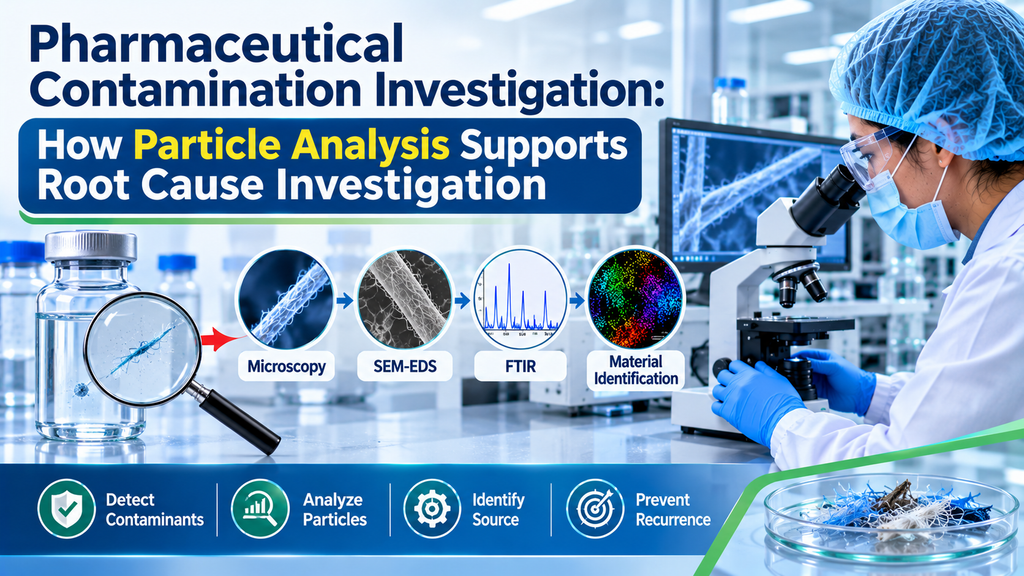
A visible particle in a pharmaceutical product can trigger a series of important questions. What is the particle made of? Where did it come from? Could it have entered during manufacturing, packaging, storage, or handling? Does it indicate a one-time event or a recurring process issue?
For pharmaceutical manufacturers, finding a particle is only the beginning. The real challenge is identifying its composition, tracing its possible source, assessing the potential impact, and deciding what corrective action will prevent recurrence.
This is where pharmaceutical contamination investigation becomes essential. A structured investigation combines careful sample handling, visual examination, analytical testing, manufacturing knowledge, and documented evidence. Particle characterization analysis can provide valuable information about the physical and chemical properties of an unknown particle, helping QA and QC teams move beyond assumptions.
In India’s competitive pharmaceutical manufacturing environment, a systematic approach to particulate contamination can support better quality decisions, stronger investigations, and more effective root cause analysis.
This guide explains how particle analysis supports a pharmaceutical contamination investigation, which analytical techniques may be useful, and how manufacturers can build a practical investigation workflow.
Why Is Pharmaceutical Contamination Investigation Important?
Pharmaceutical products are manufactured through multiple interconnected activities, including raw material dispensing, processing, filtration, filling, sealing, packaging, and storage. Particles may potentially enter at different stages through materials, equipment, components, personnel, utilities, or the surrounding environment.
A particle observed in a product does not automatically identify the source or establish the level of risk. Its significance depends on several factors, such as:
- The type and composition of the particle.
- Its size, shape, colour, and physical characteristics.
- The product and dosage form involved.
- The stage at which the particle may have entered.
- Whether similar particles have been observed previously.
- The potential impact on product quality and patient safety.
For example, a dark particle recovered from a product could be associated with a material fragment, equipment wear, packaging component, or an external source. Its colour alone cannot confirm its identity.
A documented pharmaceutical contamination investigation helps teams collect evidence before reaching conclusions. It also supports decisions about additional testing, batch assessment, equipment inspection, and corrective and preventive actions (CAPA).
Common sources to consider during an investigation
The investigation team may review possible sources across the manufacturing and packaging process:
- Raw materials: Fibres, fragments, or other foreign material associated with incoming materials or their handling.
- Equipment and machinery: Possible wear particles, damaged surfaces, seals, gaskets, or component fragments.
- Product-contact components: Materials that directly contact the product during processing, transfer, filtration, or filling.
- Packaging materials: Glass, metal, polymer, elastomer, or fibre fragments that may be associated with packaging operations.
- Personnel and handling: Fibres or other material introduced during handling, maintenance, or interventions.
- Facility and environment: Particles potentially associated with surfaces, cleaning activities, construction, or the manufacturing environment.
These are investigation possibilities, not conclusions. The actual source must be assessed using evidence from the sample, process, equipment, and relevant materials.
What Is Particle Characterization Analysis?
Particle characterization analysis is the examination of particles to understand their physical, morphological, elemental, or molecular properties. It can help distinguish between materials that may look similar during routine visual inspection.
A particle may be described initially as black, white, transparent, metallic, glass-like, or fibrous. These descriptions are useful for recording observations, but they do not necessarily establish material identity.
Depending on the sample and investigation objective, particle characterization may involve:
- Microscopy for visual examination and morphology.
- Scanning Electron Microscopy with Energy Dispersive X-ray Spectroscopy (SEM-EDS) for high-resolution imaging and elemental information.
- Fourier Transform Infrared Spectroscopy (FTIR) for molecular or material identification.
- Thermogravimetric Analysis (TGA) or Simultaneous Thermal Analysis (STA) for thermal behaviour and weight-change information, where appropriate.
No single technique answers every question. The analytical method should be selected according to the particle’s characteristics, the quantity available, and the information needed by the investigation team.
How Particle Analysis Supports Root Cause Investigation
A useful investigation connects analytical findings with manufacturing information. Laboratory results can narrow down possible material sources, but the investigation team must compare those results with the actual process and components used at the facility.
The following workflow can help organize the investigation.
1. Document and preserve the recovered particle
Before testing begins, the sample should be documented and handled carefully. Small particles can be lost, damaged, or contaminated during collection and transfer.
Record information such as:
- Product name, batch or lot reference, and dosage form.
- Date and location of observation.
- Stage of manufacturing or inspection where the particle was detected.
- Container or sample identification.
- Particle colour, approximate size, shape, and visible appearance.
- Recovery method and storage conditions.
- Photographs of the particle and its original context, where available.
Use clean, suitable tools and containers to reduce the possibility of introducing additional material. The laboratory and investigation team should agree on sample allocation before testing, particularly when only a small particle is available.
Practical tip: Retain a portion of the recovered material, if sample quantity permits. Some analytical techniques may consume, alter, or otherwise affect the sample. Planning the sequence of tests can help preserve material for further examination.
2. Begin with microscopy and visual examination
Microscopy is often a useful first step because it provides information about the particle’s appearance without immediately requiring a more complex analytical investigation.
A microscopic examination may help assess:
- Particle shape and surface features.
- Whether the material appears fibrous, granular, flake-like, or irregular.
- Colour variation and visible layering.
- Surface texture and possible structural features.
- Whether the sample contains one particle or multiple different particles.
For instance, a particle described as a black fibre may be examined to determine whether it has a continuous elongated structure, an irregular fragment shape, or visible surface characteristics that can guide further testing.
Microscopy can also help detect microscopic contaminants on transparent surfaces such as filters or slides. It may improve the visibility of certain organic or biological particles, depending on the sample and examination conditions.
However, visual appearance alone should not be treated as definitive chemical identification. If the investigation needs to determine the material composition, additional analytical techniques may be necessary.
3. Use SEM-EDS to examine morphology and elemental composition
Scanning Electron Microscopy (SEM) provides high-resolution images that can reveal detailed surface morphology. When combined with Energy Dispersive X-ray Spectroscopy (EDS), the technique can provide information about the elements present in the analysed area.
SEM-EDS may be useful when the investigation needs to examine:
- The surface structure and morphology of an unknown particle.
- Whether the particle has features consistent with a particular material type.
- The elemental composition of the analysed region.
- Differences between particles recovered from separate samples.
- Similarities between an unknown particle and a suspected component material.
For example, if a particle is suspected to be associated with a metallic equipment component, SEM imaging may provide information about its surface and structure, while EDS can help identify elements present in the analysed area.
The result should be interpreted carefully. Elemental information does not always identify a unique material or prove a particular source. Different materials may contain similar elements, and surface contamination or sample preparation can influence the result.
SEM-EDS is therefore most valuable when its findings are compared with suitable reference materials and process knowledge.
4. Apply FTIR for molecular and material identification
FTIR analysis examines how a material interacts with infrared radiation to provide information about its molecular structure. It can be useful when the investigation needs to assess whether an unknown particle may be polymeric, organic, or another material that produces an interpretable infrared spectrum.
Depending on sample suitability, FTIR may be applied to materials such as:
- Powders and solid particles.
- Thin films.
- Polymers.
- Ceramics.
- Liquids.
- Other suitable solid-state materials.
For example, a suspected polymer fragment recovered from a pharmaceutical product may be compared with spectra from relevant packaging or equipment materials. Similarities may help identify a material family or narrow the possible sources.
FTIR can support qualitative or quantitative molecular characterization, depending on the method and sample. It is not suitable for every particle, and the amount, size, condition, and composition of the sample can affect whether useful data can be obtained.
A good investigation does not select FTIR simply because it is available. It selects FTIR when molecular information is relevant to the question being investigated.
5. Consider TGA or STA when thermal information is needed
Some investigations may require additional information about how a material behaves when heated. Thermogravimetric Analysis (TGA) measures changes in sample weight as a function of temperature or time under defined conditions.
Simultaneous Thermal Analysis (STA) combines thermogravimetric measurement with differential thermal analysis. Depending on the instrument configuration, DSC-related evaluation may also be available.
These methods may be relevant for suitable polymers, composites, nanomaterials, metals, ceramics, and inorganic materials.
Thermal analysis can provide supporting information about:
- Weight-loss stages.
- Thermal events.
- Decomposition behaviour.
- Differences between candidate materials.
TGA or STA is not automatically required for every foreign particle. It should be considered when the investigation question cannot be adequately addressed through visual, elemental, or molecular characterization alone.
Building a Reference Library for More Effective Source Identification
One of the practical challenges in contamination investigations is the absence of reliable reference information for materials used in the manufacturing process.
A reference library can help address this gap. It may contain representative samples or analytical data from relevant product-contact and non-product-contact components, equipment materials, packaging materials, and other potential sources.
A structured library preparation exercise may include:
- Reviewing equipment and process information with the client.
- Identifying relevant product-contact and non-product-contact components.
- Selecting representative materials or coupons for examination.
- Recording component names, locations, and material details where available.
- Characterizing selected materials using suitable analytical techniques.
- Organizing the resulting images and analytical data for future comparison.
Where appropriate, a Gemba activity with the client can help the team understand the equipment and identify which components may be relevant to the investigation.
For example, if an unknown fibre is recovered from a product, its morphology and analytical characteristics can be compared with reference information from materials used around the process. If an unknown particle is recovered, SEM-EDS or another suitable technique may help assess whether it resembles a known component material.
A reference library does not prove that a particular component caused contamination. It provides comparison data that can make future investigations more focused and evidence-based.
A Practical Pharmaceutical Contamination Investigation Workflow
A consistent workflow helps QA, QC, engineering, production, and laboratory teams work from the same evidence.
Recommended step-by-step approach
- Open the investigation: Record the observation, product details, batch information, and initial assessment.
- Secure the sample: Recover and store the particle using suitable handling practices.
- Document its appearance: Capture photographs and record visible characteristics.
- Review the process: Identify relevant manufacturing, maintenance, cleaning, and packaging activities.
- Select analytical methods: Choose microscopy, SEM-EDS, FTIR, TGA/STA, or a combination based on the investigation question.
- Examine potential sources: Identify relevant materials and components for comparison.
- Interpret the evidence: Review laboratory results alongside process and equipment information.
- Assess product impact: Evaluate the finding through the site’s established quality and risk-management procedures.
- Determine corrective actions: Address the supported or most probable cause, and define how effectiveness will be assessed.
- Document the outcome: Record the evidence, limitations, rationale, decisions, and follow-up actions.
Example: Investigating an unknown particle in a pharmaceutical product
Imagine that a dark, irregular particle is observed during inspection of a pharmaceutical product.
The initial observation does not establish whether the particle is metallic, polymeric, carbonaceous, or another material. The investigation team first documents the particle and reviews the point at which it was detected.
Microscopy is used to examine its shape and surface. SEM-EDS is then considered to obtain higher-resolution morphological and elemental information. If the sample appears to be a material for which molecular characterization would be informative, FTIR may be considered as a further step.
The team then reviews relevant equipment, product-contact components, packaging materials, and process activities. If reference data are available, the particle’s characteristics can be compared with those materials.
The investigation conclusion should explain what the analytical evidence supports, what remains uncertain, and why the selected corrective actions are appropriate. It should not claim a confirmed source if the available evidence only indicates a possible match.
Common Challenges in Particle Analysis and How to Address Them
Even a well-planned investigation can face practical limitations.
Very small or limited sample quantity
A recovered particle may be too small for every planned technique. Some tests may require specific sample preparation or may alter the sample.
What to do: Consult the analytical laboratory before allocating the sample. Agree on the testing sequence and prioritize the information most important to the investigation.
Multiple particles with different compositions
A sample may contain more than one type of particle. Treating all recovered material as a single contaminant can lead to misleading conclusions.
What to do: Where feasible, separate and document distinct particles before analysis. Link each analytical result to the correct sample identification.
Similar materials from different sources
Two components may be made from similar polymers or metals. A material match alone may not identify the exact component that released the particle.
What to do: Combine analytical comparisons with equipment inspection, process history, maintenance records, and other relevant evidence.
Incomplete reference information
Without reference data, the team may have difficulty comparing an unknown particle with potential sources.
What to do: Consider building a reference library for relevant components and materials. Keep sample identity and component traceability clear.
Overinterpreting laboratory results
A spectrum, elemental profile, or microscopic image may support a material assessment without proving the source or the exact contamination event.
What to do: Separate confirmed observations from interpretations and hypotheses. Document analytical limitations and explain how each finding influences the investigation.
Choosing a Particle Characterization Laboratory in India
Selecting a laboratory is not simply a matter of choosing the facility with the largest number of instruments. The laboratory should understand the investigation objective and recommend suitable testing based on the available sample.
Before engaging a service provider, consider the following:
- Method suitability: Can the laboratory explain why a proposed technique is appropriate for the particle?
- Relevant capabilities: Does it offer access to microscopy, SEM-EDS, FTIR, or thermal analysis where required?
- Sample handling: Can it explain how samples should be collected, packaged, transported, and allocated?
- Interpretation: Will the findings be explained in the context of the investigation question?
- Reference comparison: Can the laboratory support characterization of relevant component materials?
- Reporting: Are observations, methods, results, and limitations clearly documented?
- Communication: Can the laboratory coordinate with QA, QC, engineering, and other investigation stakeholders?
Manufacturers should also confirm the scope of service, sample requirements, turnaround expectations, and any applicable quality or accreditation status directly with the provider. Do not assume that every analytical technique or accreditation applies to every sample or test.
How Confianca Pharmazon Supports Particle Characterization Analysis
Confianca Pharmazon supports pharmaceutical organizations through particle characterization analysis and related investigation services.
Its described analytical capabilities include microscopy, SEM-EDS, FTIR, and TGA/STA. These techniques can provide complementary information about particle appearance, morphology, elemental composition, molecular structure, and thermal behaviour, depending on sample suitability.
Confianca Pharmazon has also developed a laboratory in Ahmedabad for Library Preparation and Particle Characterization Testing. A library preparation activity may include an optional Gemba with the client to identify relevant product-contact and non-product-contact components and collect representative coupons for analysis.
This work can help create reference information for future unknown particle or fibre investigations. When a particle is recovered from a product, the resulting analytical data may be compared with available reference materials to help investigate possible sources.
The appropriate testing plan depends on the particle, the available sample quantity, and the specific investigation question.
Explore the Particle Characterization Analysis Services to learn more about the service offering.
For facilities looking to strengthen their broader visual inspection approach, explore Visual Inspection Booth Automation.
Frequently Asked Questions (FAQs)
1. What is pharmaceutical contamination investigation?
Pharmaceutical contamination investigation is a structured process used to examine suspected or confirmed contamination, identify possible sources, assess product impact, and determine appropriate corrective and preventive actions. It combines sample evidence with process, equipment, and quality information.
2. How does particle characterization analysis help pharmaceutical manufacturers?
Particle characterization analysis helps determine the physical and chemical characteristics of an unknown particle. Depending on the sample, techniques such as microscopy, SEM-EDS, and FTIR can provide information that helps narrow down potential material sources.
3. Which analytical technique is best for unknown particle identification?
There is no single best technique for every particle. Microscopy can provide initial visual and morphological information, SEM-EDS can provide high-resolution imaging and elemental data, and FTIR can provide molecular information for suitable samples. The choice depends on the investigation objective and sample properties.
4. Can SEM-EDS identify the exact source of a particle?
SEM-EDS can provide valuable morphological and elemental information. However, similar materials may share elemental characteristics. Identifying an exact source usually requires comparison with reference materials and review of manufacturing, equipment, and process evidence.
5. Why is FTIR used in pharmaceutical particle analysis?
FTIR is used to obtain information about molecular structure and help characterize suitable materials, including many polymers and organic materials. It can support comparison between an unknown particle and candidate materials, subject to sample suitability and data interpretation.
6. What is a particle reference library?
A particle reference library is an organized collection of representative material samples and/or analytical data from relevant components and materials. It can help investigators compare unknown particles with potential sources during future investigations.
7. When should a pharmaceutical company outsource particle analysis?
Outsourcing may be considered when specialized analytical equipment, expertise, or reference characterization is not available internally, or when an investigation requires additional independent analytical support. The company should define the investigation question and confirm the laboratory’s method suitability before sending samples.
8. Does particle analysis alone complete a root cause investigation?
No. Particle analysis provides evidence about the particle, but a complete root cause investigation also considers process history, equipment condition, materials, handling, maintenance, and other relevant information. Analytical findings should be interpreted as part of the overall investigation.
Make Particle Analysis Part of an Evidence-Based Investigation
An unknown particle should never be treated as identified simply because it looks familiar. Effective contamination investigations require a disciplined approach that connects sample evidence with manufacturing knowledge.
A well-planned pharmaceutical contamination investigation may begin with careful documentation and microscopy, progress to SEM-EDS or FTIR when appropriate, and include comparison with reference materials from relevant components. Thermal analysis may provide additional information in selected cases.
For pharmaceutical manufacturers in India, particle characterization analysis can strengthen the technical evidence available to QA and QC teams, help narrow down potential contamination sources, and support more informed root cause decisions. The most useful outcome is not just a laboratory result, but a clear understanding of what the evidence establishes, what remains uncertain, and what action should follow.
If your team needs support with unknown particle identification, component reference library preparation, or analytical characterization, explore Confianca Pharmazon’s Particle Characterization Analysis Services and discuss your investigation requirements with the team.
Your trusted partner for pharma skills, systems, and solutions.