No products in the cart.
How Visual Inspection Booth Automation Reduces Human Error in Pharma and Improves GMP Compliance
Introduction
The pharmaceutical industry is built on precision, consistency, and patient safety. Every vial, ampoule, cartridge, syringe, and sterile injectable product leaving a manufacturing facility must be carefully inspected before it reaches healthcare providers and patients. Even a tiny glass fragment, fiber, rubber particle, or cosmetic defect can compromise product quality and potentially put patient health at risk.
For decades, pharmaceutical manufacturers have relied on trained operators to perform manual visual inspection. Although skilled inspectors play a vital role in quality assurance, manual inspection is inherently affected by human limitations such as fatigue, distraction, subjective judgment, and inconsistent performance.
As manufacturing volumes continue to increase and regulatory expectations become more stringent, pharmaceutical companies are turning to Visual Inspection Booth Automation to improve inspection accuracy, minimize human error, and strengthen compliance with global quality standards.
Modern automated visual inspection booths combine controlled lighting, ergonomic design, digital monitoring, real-time lux measurement, electronic documentation, and audit-ready reporting to create a standardized inspection environment that supports operators while reducing variability.
In this comprehensive guide, we’ll explore how Visual Inspection Booth Automation helps pharmaceutical manufacturers reduce human error, improve operational efficiency, strengthen GMP compliance, and deliver safer medicines to patients.
Why Human Error is a Major Challenge in Pharmaceutical Visual Inspection
Visual inspection is often the final opportunity to detect defects before pharmaceutical products are released into the market.
Inspectors are responsible for identifying:
- Glass particles
- Metal particles
- Rubber fragments
- Fibers
- Cosmetic defects
- Cracks
- Container closure defects
- Fill volume abnormalities
- Foreign particulate matter
However, despite extensive training, human inspectors are naturally susceptible to errors.
Common causes include:
- Eye fatigue
- Repetitive tasks
- Loss of concentration
- Stress
- Poor ergonomics
- Inconsistent lighting
- Subjective decision-making
These factors increase the probability of missed defects or unnecessary product rejection.
Understanding Visual Inspection Booth Automation
Visual Inspection Booth Automation enhances the traditional visual inspection process by integrating digital technologies with ergonomic inspection workstations.
Modern systems include features such as:
- Controlled LED illumination
- Black and white inspection backgrounds
- Online lux measurement
- Magnifying lens
- Adjustable workstation height
- Electronic audit trails
- User authentication
- Inspection activity logs
- Automated reporting
- 21 CFR Part 11 compliant documentation
Rather than replacing inspectors, automation creates an optimized inspection environment that helps them perform more consistently and accurately. Confianca Pharmazon’s Visual Inspection Booth Automation solutions incorporate many of these features to support pharmaceutical inspection programs.
Common Human Errors During Manual Visual Inspection
1. Inspector Fatigue
Visual inspection requires continuous concentration over extended periods.
Fatigue can result in:
- Missed particles
- Slower reaction time
- Reduced attention
- Inconsistent inspection quality
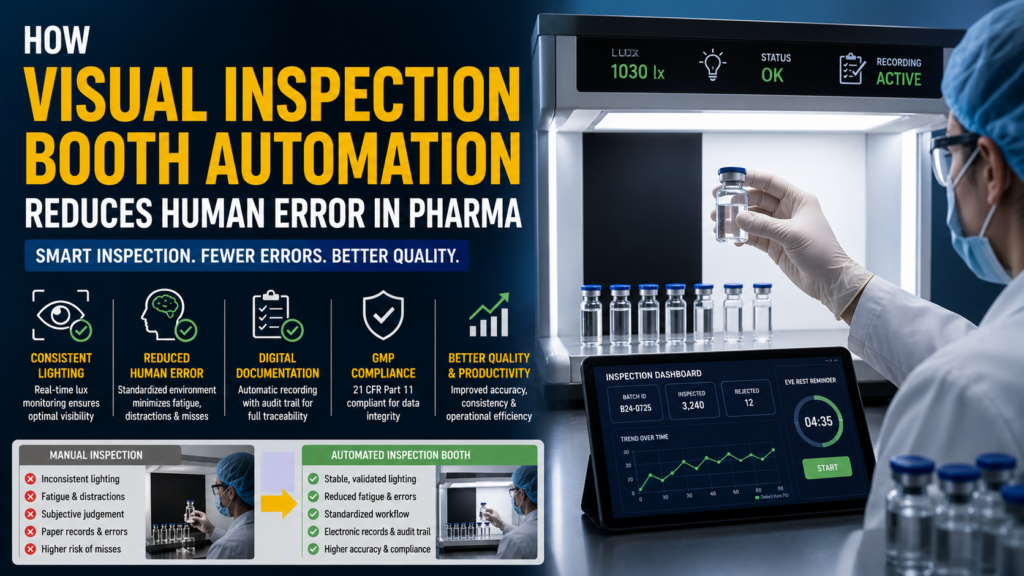
Automated booth features such as eye-rest reminders and standardized workflows help reduce fatigue-related performance decline.
2. Inconsistent Lighting
Lighting directly influences an inspector’s ability to detect defects.
Poor or inconsistent illumination can make it difficult to identify:
- Transparent particles
- Fine fibers
- Hairline cracks
- Small black particles
Modern automated booths continuously monitor and maintain proper lux levels, ensuring every inspection is performed under validated lighting conditions.
3. Subjective Decision-Making
Different inspectors may interpret the same defect differently based on:
- Experience
- Confidence
- Fatigue
- Training
Automation helps standardize inspection conditions and workflows, reducing variability between operators.
4. Documentation Errors
Manual recordkeeping can lead to:
- Missing entries
- Incorrect timestamps
- Illegible handwriting
- Lost records
Automated systems generate electronic records that improve traceability and support data integrity.
How Visual Inspection Booth Automation Reduces Human Error
Standardized Inspection Environment
Consistency is essential for accurate visual inspection.
Automation ensures:
- Uniform lighting
- Fixed inspection angles
- Consistent inspection backgrounds
- Ergonomic positioning
This minimizes environmental variability that can influence inspection outcomes.
Real-Time Lux Monitoring
Lighting intensity naturally changes over time due to equipment aging and environmental conditions.
Automated booths monitor lux levels continuously and alert users if illumination falls outside acceptable limits.
Benefits include:
- Improved defect visibility
- Compliance with inspection standards
- Reduced operator uncertainty
Operator Guidance
Modern systems guide inspectors through predefined workflows.
Examples include:
- Step-by-step inspection prompts
- Eye-rest reminders
- Inspection timing controls
- Digital checklists
These features help inspectors remain focused and follow standardized procedures.
Electronic Records and Audit Trails
One of the greatest advantages of Visual Inspection Booth Automation is automated documentation.
Systems capture:
- User identity
- Inspection timestamps
- Lux measurements
- Inspection outcomes
- Electronic signatures
- Audit trails
This eliminates many manual documentation errors while supporting regulatory compliance.
Improved Ergonomics
Poor workstation design contributes to fatigue and musculoskeletal strain.
Automated booths offer:
- Adjustable height
- Comfortable viewing angles
- Reduced repetitive motion
- Better posture support
Improved ergonomics enhance inspector comfort and sustain performance over long shifts.
Supporting GMP Compliance
Good Manufacturing Practices (GMP) require inspection processes to be controlled, documented, and reproducible.
Automation supports GMP by providing:
- Controlled inspection conditions
- Standardized procedures
- Electronic documentation
- Traceable records
- Environmental monitoring
These capabilities strengthen quality systems and reduce compliance risks.
21 CFR Part 11 and Data Integrity
Regulatory authorities increasingly focus on electronic data integrity.
Modern automated booths support:
- Secure user access
- Electronic signatures
- Audit trails
- Time-stamped records
- Controlled data storage
These features help manufacturers comply with 21 CFR Part 11 requirements while satisfying ALCOA principles:
- Attributable
- Legible
- Contemporaneous
- Original
- Accurate
Manual vs Automated Inspection Environment
| Feature | Manual Booth | Automated Booth |
|---|---|---|
| Lighting Verification | Manual | Automatic |
| Documentation | Paper-Based | Electronic |
| Audit Trail | Limited | Complete |
| Lux Monitoring | Periodic | Continuous |
| User Authentication | No | Yes |
| Data Integrity | Moderate | High |
| Eye-Rest Monitoring | Manual | Automated |
| Compliance Reporting | Manual | Automated |
Automation improves consistency without eliminating the need for trained inspectors.
The Role of Inspector Qualification
Automation complements—not replaces—human expertise.
Inspectors still require training in:
- Defect recognition
- Container handling
- Inspection techniques
- Regulatory expectations
Qualification programs should include:
- Classroom instruction
- Practical assessments
- Knapp Kit exercises
- Probability of Detection (POD) studies
- Periodic requalification
Confianca Pharmazon offers Knapp Kits and training programs to support inspector qualification and ongoing competency.
Probability of Detection (POD)
Probability of Detection (POD) measures how likely an inspector or system is to detect a defect under defined conditions.
Factors influencing POD include:
- Particle size
- Particle color
- Product formulation
- Lighting
- Container type
- Inspector experience
Automation helps improve POD by maintaining consistent inspection conditions and reducing variability.
Practical Example
Imagine a facility producing sterile injectable vials.
Before Automation
- Manual lux checks once per shift
- Paper inspection logs
- Variable workstation lighting
- Inconsistent documentation
After Implementing Visual Inspection Booth Automation
- Continuous lux monitoring
- Electronic audit trails
- Standardized workflows
- Automatic inspection records
- Operator reminders
Results may include:
- Fewer documentation errors
- Improved audit readiness
- Better inspection consistency
- Faster investigations
- Enhanced GMP compliance
Additional Benefits Beyond Human Error Reduction
Implementing Visual Inspection Booth Automation offers several operational advantages.
Increased Productivity
Standardized workflows improve inspection efficiency.
Better Traceability
Electronic records simplify audits and investigations.
Faster CAPA Investigations
Digital data helps identify root causes more quickly.
Enhanced Training
Performance data supports targeted coaching and requalification.
Reduced Compliance Risk
Automated monitoring reduces the likelihood of inspection deviations.
Best Practices for Successful Implementation
To maximize the benefits of automation:
- Validate the inspection booth (IQ, OQ, PQ).
- Train inspectors thoroughly.
- Maintain calibration schedules.
- Monitor lux levels routinely.
- Conduct regular POD studies.
- Use certified Knapp Kits for qualification.
- Integrate inspection records with the Quality Management System (QMS).
- Review inspection trends for continuous improvement.
Future of Visual Inspection Automation
The next generation of inspection systems will incorporate:
- Artificial Intelligence (AI)
- Machine Learning
- Predictive analytics
- Computer vision
- Cloud-based quality dashboards
- Industry 4.0 connectivity
- Real-time performance monitoring
These innovations will further reduce human error while improving inspection accuracy and manufacturing efficiency.
Frequently Asked Questions (FAQs)
What is Visual Inspection Booth Automation?
It is an advanced inspection solution that combines controlled lighting, ergonomic workstations, digital monitoring, electronic documentation, and compliance features to improve pharmaceutical visual inspection.
Can automation eliminate human error completely?
No. Automation significantly reduces human error by standardizing inspection conditions and documentation, but trained inspectors remain essential for judgment and decision-making.
How does automation improve GMP compliance?
It provides standardized inspection environments, electronic records, audit trails, continuous monitoring, and validated workflows that support regulatory expectations.
Why is lux monitoring important?
Consistent lighting improves defect visibility and ensures inspections are performed under validated conditions.
How do Knapp Kits support automated inspection?
Knapp Kits provide certified defect samples used for inspector qualification, machine validation, and Probability of Detection (POD) studies.
Conclusion
Reducing human error is one of the most significant challenges in pharmaceutical quality assurance. While experienced inspectors remain indispensable, modern Visual Inspection Booth Automation provides the standardized environment, digital tools, and compliance-focused features needed to enhance inspection accuracy and consistency.
By integrating automated lighting control, real-time lux monitoring, electronic documentation, audit trails, ergonomic design, and data integrity features, pharmaceutical manufacturers can strengthen GMP compliance, improve operational efficiency, and reduce the risk of defective products reaching patients.
As the pharmaceutical industry embraces digital transformation and Industry 4.0, automated visual inspection booths are becoming a strategic investment for organizations committed to delivering safer medicines and achieving regulatory excellence.
Call to Action
Upgrade your pharmaceutical inspection process with Confianca Pharmazon’s Visual Inspection Booth Automation solutions. Designed to support GMP compliance, 21 CFR Part 11 requirements, inspector productivity, and audit readiness, our advanced inspection booths help reduce human error while improving quality assurance across pharmaceutical manufacturing operations. Explore our solutions today to build a smarter, more reliable visual inspection program.
Your trusted partner for pharma skills, systems, and solutions.