No products in the cart.
Essential Foreign Particle Analysis Saudi Arabia: A Successful Guide for Pharma Companies
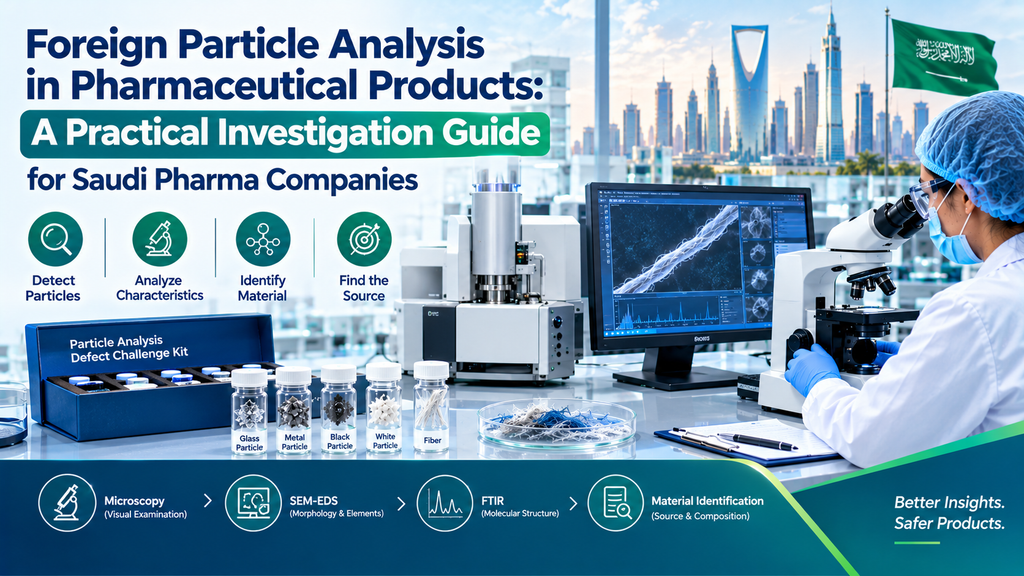
Discovering an unexpected particle in a pharmaceutical product can raise immediate questions about product quality, manufacturing controls, and patient safety. Is the particle a fragment from a product-contact component? Could it have originated from a filter, packaging material, equipment surface, or the surrounding manufacturing environment? Most importantly, what evidence can establish its identity and help prevent recurrence?
For pharmaceutical manufacturers in Saudi Arabia, foreign particle investigations should follow a structured, evidence-based approach. Visual examination may reveal the particle’s colour, shape, or size, but these observations rarely establish its material composition or original source. Advanced particle characterization analysis can provide additional information to help quality teams investigate contamination and develop scientifically supported conclusions.
This guide explains how foreign particle analysis Saudi Arabia pharmaceutical companies can use microscopy, scanning electron microscopy with energy-dispersive X-ray spectroscopy (SEM-EDS), Fourier-transform infrared spectroscopy (FTIR), and component reference libraries to investigate foreign particles, identify potential contamination sources, and support corrective and preventive actions.
Why Foreign Particle Analysis Matters in Pharmaceutical Manufacturing
Foreign particles are unexpected materials found in a product, container, process stream, or manufacturing-related sample. Depending on the product and circumstances, they may include fibers, glass fragments, metal particles, polymer pieces, mineral matter, or other extraneous materials.
The significance of a particle depends on several factors, including the dosage form, route of administration, particle characteristics, possible source, and likelihood of exposure.
For example, a foreign particle found in an injectable product requires careful evaluation because the product is intended for administration by injection. A particle discovered on a manufacturing filter may also warrant investigation to determine whether it reflects process contamination, component shedding, or another event.
Common sources of foreign particles
Potential sources vary between facilities, but may include:
- Product-contact components: Tubing, gaskets, seals, polymer parts, and other materials that contact the product.
- Primary packaging: Glass containers, stoppers, closures, and packaging-related components.
- Filtration systems: Filter materials, housings, and associated components.
- Manufacturing equipment: Worn or damaged parts, surface residues, and materials introduced during maintenance.
- Cleanroom operations: Fibers from garments, wipes, or other materials used in controlled environments.
- Handling and transfer: Particles introduced during sampling, transport, or laboratory preparation.
These are possible sources, not conclusions. An effective investigation should establish which explanations are supported by the evidence.
Why visual inspection alone may be insufficient
A dark particle might be metal, carbonaceous material, a polymer fragment, or another substance. A transparent fragment might resemble glass but require further examination to establish its characteristics.
Visual inspection is an important first step, but foreign particle analysis Saudi Arabia manufacturers undertake should progress to appropriate analytical testing when visual observations cannot resolve the source or material identity.
Step 1: Document the Particle and the Circumstances of Discovery
A reliable investigation starts with good sample documentation. Information about where and how the particle was found can be as valuable as the analytical results.
Record essential details
Document the following information wherever available:
- Product name, batch number, and dosage form.
- Date and location of particle detection.
- Stage of manufacturing at which the particle was discovered.
- Container, closure, filter, or equipment involved.
- Particle appearance, approximate dimensions, and photographs.
- Sampling and recovery method.
- Relevant deviations, maintenance activities, or component changes.
- Other units or batches in which similar findings have occurred.
This information helps investigators determine which materials and process steps deserve closer examination.
Preserve the sample carefully
Use an appropriate, documented recovery procedure and suitable sample containers. Avoid unnecessary handling that could damage the particle or introduce additional contamination.
If possible, retain the original container, filter, or suspected component for comparison. Preserve sufficient sample material for the planned analytical techniques, recognizing that very small particles may limit the available testing options.
Where appropriate, consider sampling controls to evaluate whether the recovery procedure or laboratory handling could have introduced foreign matter.
Practical tip: Before sending a sample to a laboratory, share photographs, the available particle quantity, the product type, and the main investigative question. This allows the laboratory to assess sample suitability and recommend a practical testing sequence.
Step 2: Begin with Microscopic Examination
Microscopy is often the first step in particle characterization because it provides a rapid way to examine physical characteristics and determine which additional techniques may be useful.
Depending on the sample, stereo microscopy or other suitable microscopic methods may help assess the particle’s shape, surface appearance, colour, and approximate size.
What microscopy can reveal
An initial examination can help determine:
- Whether the sample appears to be a fiber, fragment, flake, or irregular particle.
- Whether its surface is smooth, rough, fractured, or layered.
- Whether multiple particles are present.
- Whether attached residues or other materials are visible.
- Whether the particle resembles any known manufacturing component.
Microscopy can also help select an appropriate portion of the sample for further analysis.
Confianca Pharmazon’s particle characterization materials describe microscopic analysis for detecting contaminants on transparent surfaces, such as filters and slides, and improving the visibility of certain organic and biological particles.
Understand the limitations
Microscopic appearance does not necessarily establish chemical identity. Different materials can have similar colours and shapes, while particles from the same material may look different because of damage or manufacturing variation.
Use microscopy to develop and refine hypotheses rather than declaring a source based only on visual resemblance.
Step 3: Use SEM-EDS to Examine Morphology and Elemental Composition
Scanning electron microscopy with energy-dispersive X-ray spectroscopy, commonly called SEM-EDS, combines detailed surface imaging with elemental analysis.
It is particularly useful when a particle is small, has complex morphology, or requires more detailed characterization than conventional microscopy can provide.
How SEM supports particle analysis
SEM produces high-resolution images that help investigators examine:
- Surface texture and structural features.
- Fracture patterns and irregular edges.
- Fine particles attached to a larger fragment.
- Differences between the unknown sample and reference materials.
- Morphological similarities that may help narrow potential sources.
The useful magnification and image quality depend on the sample, instrument, preparation method, and operating conditions.
What EDS contributes
EDS detects characteristic X-rays emitted by elements in a sample during electron-beam analysis. The resulting spectrum can provide information about elemental composition.
For example, elemental findings may help distinguish a particle containing detectable metallic or inorganic constituents from another material with a different elemental profile.
However, EDS has limitations. Many organic materials contain predominantly carbon and oxygen, so their elemental profiles may not be sufficiently distinctive to identify a specific polymer. EDS also does not directly provide a complete molecular structure.
For this reason, SEM-EDS results should be interpreted alongside microscopy, reference samples, process history, and other analytical findings where appropriate.
When should SEM-EDS be considered?
SEM-EDS may be useful when:
- The particle is too small for detailed conventional examination.
- High-resolution morphology is required.
- Elemental composition may help distinguish candidate sources.
- The particle may contain inorganic material or attached residues.
- A comparison with known product-contact components is needed.
Confianca Pharmazon describes SEM imaging at magnifications of up to 300,000× and EDS-based elemental analysis as part of its particle characterization offering.
Step 4: Use FTIR When Molecular Identification Is Needed
Fourier-transform infrared spectroscopy (FTIR) can provide complementary information when investigators need to characterize suitable organic materials, polymers, and other substances.
FTIR measures infrared absorption associated with molecular vibrations. The resulting spectrum can be compared with reference spectra to evaluate the chemical characteristics of the sample.
Examples of FTIR applications
FTIR may help investigate whether an unknown particle is consistent with a particular polymer or organic material. For example, if a fragment resembles a polymeric gasket, the spectrum may help assess whether its molecular characteristics are consistent with a reference gasket sample.
FTIR may also be useful for selected fibers, films, powders, and other suitable materials, provided that the sample quantity and condition support the chosen method.
Questions to discuss with the laboratory
Before testing, clarify:
- Is the particle large enough for the available FTIR method?
- Can it be analyzed directly, or is preparation required?
- Could product residue or another contaminant affect the spectrum?
- Are known reference samples available for comparison?
- Will the result help distinguish between the leading source hypotheses?
A spectrum should not be considered conclusive solely because it resembles one library entry. The interpretation depends on spectral quality, sample condition, the specificity of the match, and the availability of suitable reference data.
FTIR can complement SEM-EDS: one technique provides elemental and morphological information, while the other can provide molecular information for suitable samples.
Step 5: Build a Reference Library of Manufacturing Components
A component reference library can make foreign particle investigations more systematic by recording the characteristics of materials used in the manufacturing process.
Rather than relying entirely on visual comparisons after an incident, the investigation team can compare the unknown particle with previously characterized materials.
How library preparation works
A structured library preparation exercise may include:
- Mapping the manufacturing process and identifying relevant material pathways.
- Identifying product-contact and selected non-contact components.
- Collecting representative coupons or samples from those components.
- Recording component names, locations, material information, and relevant supplier details.
- Characterizing suitable samples using microscopy, SEM-EDS, FTIR, and TGA/STA as appropriate.
- Organizing results so that future investigations can retrieve and compare reference data.
The scope should be based on the site’s process, contamination risks, and available materials.
Confianca Pharmazon describes an optional Gemba activity with clients to identify product-contact and non-contact parts. Samples collected from selected components can then be analyzed using microscopy, SEM-EDS, FTIR, and TGA/STA.
Why reference libraries improve investigations
A reference library can help teams narrow possible sources and prioritize follow-up testing. It may also help identify recurring material patterns across different contamination events.
Nevertheless, a match between a particle and a reference component does not automatically prove that the component caused the contamination. The team should assess the analytical similarity alongside process history, physical evidence, and other available information.
Review the library when components, suppliers, materials, or manufacturing processes change. This helps ensure that the reference data remain useful for future investigations.
Step 6: Consider Thermal Analysis When It Adds Value
Thermal analysis may provide additional information when the unknown particle and potential reference materials need further differentiation.
Thermogravimetric analysis (TGA) measures changes in sample mass as temperature or time changes. Differential thermal analysis (DTA) evaluates temperature differences associated with thermal events. Simultaneous thermal analysis (STA) combines techniques such as TGA and DTA in a single instrument.
When thermal analysis may be useful
Depending on the material and available sample quantity, thermal analysis may help evaluate:
- Thermal decomposition behaviour.
- Weight-loss patterns.
- Moisture- or volatile-related mass changes.
- Thermal events that distinguish between candidate materials.
It is not necessary for every foreign particle investigation. Very small samples may not provide enough material, and thermal analysis can consume or alter the sample.
Select this method when the expected information justifies the sample requirements and adds meaningful evidence to the investigation. Confianca Pharmazon describes TGA/STA applications for suitable polymers, composites, metals, ceramics, and inorganic materials.
Step 7: Determine the Root Cause and Assess Product Impact
Analytical characterization is one part of the investigation. The next step is to determine what the findings mean for the manufacturing process and product quality.
Follow a structured investigation process
1. Establish the problem. Document the particle, product, location, and circumstances of detection.
2. Characterize the sample. Use suitable microscopy and analytical techniques to determine its physical and material characteristics.
3. Identify candidate sources. Review relevant equipment, product-contact components, packaging, filters, garments, and other materials.
4. Compare reference materials. Evaluate analytical results against samples from potential sources.
5. Review manufacturing history. Examine relevant cleaning, maintenance, component replacement, deviations, and process records.
6. Assess product impact. Apply the site’s approved quality-risk assessment and batch-impact procedures.
7. Implement corrective actions. Address the supported root cause and determine how effectiveness will be verified.
Example: Investigating a particle in an injectable product
Suppose a manufacturer discovers a small dark fragment in an injectable product. Microscopy documents its morphology, and SEM-EDS provides information about its elemental composition. The results narrow the possible materials but do not establish a unique source.
The team compares the fragment with relevant component samples and reviews recent maintenance and production records. Additional analysis may be performed if it can distinguish between the remaining hypotheses.
The final investigation should clearly separate confirmed observations from interpretations and unresolved possibilities. If the evidence is insufficient to establish a definitive source, the report should state that limitation rather than presenting a hypothesis as a confirmed root cause.
Common Challenges in Foreign Particle Analysis
Even with advanced analytical instruments, investigations can be affected by practical limitations.
Insufficient sample quantity
A tiny particle may not support every desired analytical method. Plan the sequence carefully and consult the laboratory before allocating the sample.
Contamination during recovery
Sampling tools, containers, or handling procedures may introduce additional material. Use suitable controls and document the recovery process.
Overreliance on one analytical technique
Microscopy, SEM-EDS, and FTIR provide different types of information. Combining methods when justified can produce a stronger interpretation than relying on a single result.
Lack of reference materials
Without representative samples of relevant components, source attribution may remain uncertain. Consider building or expanding the reference library where appropriate.
Confusing material identity with source identification
Identifying a material does not necessarily reveal when, where, or how it entered the product. Source attribution requires consideration of the full body of evidence.
Choosing a Particle Characterization Laboratory for Saudi Arabia
When selecting a laboratory for particle characterization analysis, assess whether its capabilities match the investigation and the characteristics of the sample.
Ask the laboratory:
- Can it examine particles and fibers of the expected size?
- Is SEM-EDS available for the required morphology and elemental analysis?
- Can FTIR be used if molecular identification is needed?
- Can it compare unknown samples with reference components supplied by the manufacturer?
- Are sample recovery and handling requirements clearly communicated?
- Does the report distinguish results, interpretation, and limitations?
- Can the laboratory support follow-up technical questions?
Also clarify sample quantity, expected turnaround time, report contents, and any restrictions that could affect testing.
For pharmaceutical companies in Saudi Arabia, the chosen analytical approach should fit the product, the contamination concern, the company’s quality procedures, and applicable regulatory expectations. Analytical testing supports an investigation; it does not replace the manufacturer’s responsibility to assess product impact and approve quality decisions.
How Confianca Pharmazon Supports Particle Characterization Analysis
Confianca Pharmazon describes particle characterization and component reference-library preparation services through its Ahmedabad laboratory. Its published capabilities include microscopy, SEM-EDS, FTIR, and TGA/STA for suitable samples and investigative objectives.
The described workflow for unknown particles includes recovering the particle from the product and using SEM-EDS to investigate its characteristics and potential source, supported by reference information from product-contact components where available.
For pharmaceutical manufacturers evaluating foreign particle analysis Saudi Arabia requirements, it is useful to discuss the specific sample, likely material sources, available component information, and intended investigative outcome before selecting the testing plan.
Explore Particle Characterization Analysis Services to discuss an investigation or reference-library requirement.
When contacting a service provider, share the product type, particle location, available sample quantity, relevant process materials, and the questions the investigation needs to answer. This helps the laboratory recommend a suitable analytical approach rather than applying the same test sequence to every sample.
Frequently Asked Questions
1. What is foreign particle analysis in pharmaceuticals?
Foreign particle analysis is the examination of unexpected particulate material found in a pharmaceutical product or manufacturing-related sample. It can help determine the particle’s morphology, composition, and potential source.
2. Which techniques are used for foreign particle identification?
Depending on the sample, investigators may use microscopy, SEM-EDS, FTIR, and thermal analysis. The selection depends on the particle’s size, material, quantity, and the question that needs to be answered.
3. Can SEM-EDS identify every foreign particle?
No. SEM-EDS provides high-resolution imaging and elemental information, but it may not uniquely identify all organic materials or polymers. Additional techniques and reference comparisons may be necessary.
4. Why is a component reference library important?
A reference library provides analytical information about relevant manufacturing materials. Comparing an unknown particle with those materials can help narrow potential sources and support a more systematic investigation.
5. Does particle identification confirm the root cause?
Not automatically. Material identification is one part of source investigation. Root-cause conclusions should also consider manufacturing history, component comparisons, sampling information, and other relevant evidence.
6. When should a pharmaceutical company outsource particle characterization?
Outsourcing may be appropriate when the required analytical equipment or expertise is not available internally, when a more detailed investigation is needed, or when comparative analysis with reference components would benefit from specialized support.
7. How can pharmaceutical companies in Saudi Arabia prepare for a particle investigation?
Establish a documented recovery procedure, retain relevant samples and components, record the circumstances of detection, define the investigation questions, and consult a suitable laboratory about the analytical methods and sample requirements.
Turn Particle Findings into Actionable Evidence
An unexpected particle should prompt a structured investigation, not an assumption based on appearance. Effective foreign particle analysis Saudi Arabia pharmaceutical companies undertake begins with careful sample recovery and microscopic examination, followed by suitable analytical techniques to understand the particle’s morphology and composition.
SEM-EDS can provide detailed imaging and elemental information, FTIR can support molecular characterization of suitable materials, and thermal analysis may offer additional evidence when justified. A reference library of manufacturing components can help teams compare unknown particles with known materials and investigate possible contamination sources more systematically.
The goal is to connect analytical findings with manufacturing evidence, assess product impact, and implement corrective actions that address the supported root cause.
If your quality or manufacturing team is investigating an unknown particle or needs to develop a component reference library, contact Confianca Pharmazon to discuss particle characterization analysis and a suitable testing approach for your sample.
Your trusted partner for pharma skills, systems, and solutions.