No products in the cart.
Advanced Particle Characterization for Root Cause Analysis & CAPA Closure in Pharma
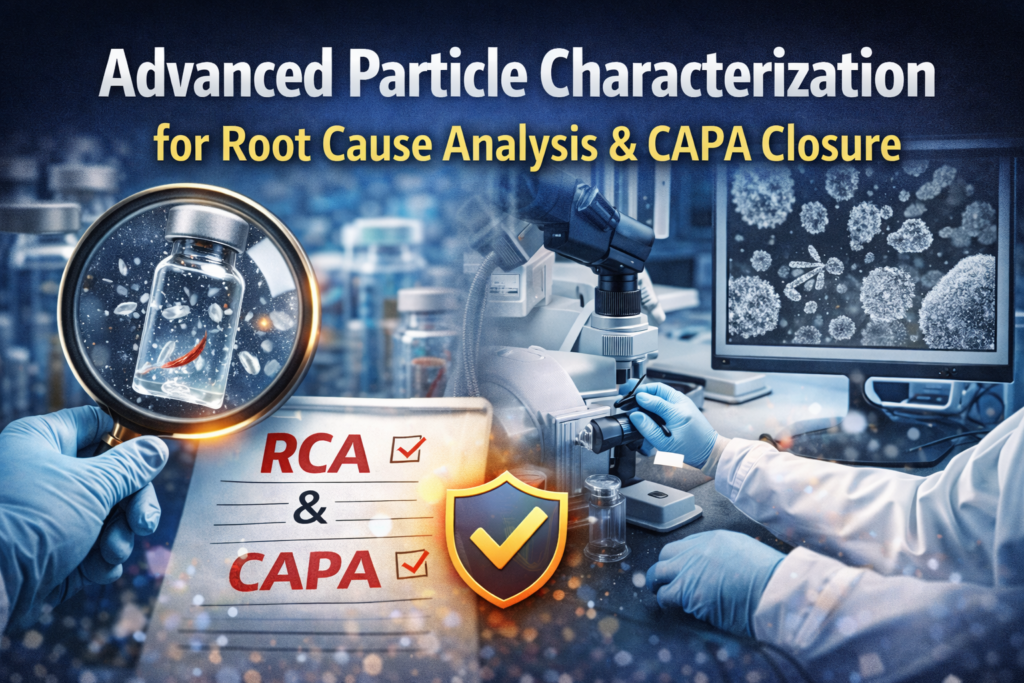
Introduction: Why Particle Contamination is a Critical Pharma Risk
In pharmaceutical manufacturing, even a microscopic particle can trigger massive consequences—product recalls, regulatory warnings, and serious patient safety risks. Whether it’s visible particulate matter in injectables or sub-visible contamination in sterile products, identifying the source quickly is non-negotiable.
This is where Advanced Particle Characterization becomes a game-changer.
Instead of guesswork, modern pharma companies rely on scientific, data-driven analysis to identify, classify, and trace particles back to their source. This not only strengthens Root Cause Analysis (RCA) but also ensures effective and sustainable CAPA closure.
If your CAPA investigations are taking too long or failing audits, this blog will show you exactly how Advanced Particle Characterization can transform your quality systems.
What is Advanced Particle Characterization?
Definition and Scope
Advanced Particle Characterization refers to a set of analytical techniques used to:
- Identify particle composition
- Determine size, shape, and morphology
- Trace origin (process, environment, packaging, etc.)
- Evaluate risk to product quality
It goes beyond basic visual inspection and uses scientific tools like spectroscopy, microscopy, and elemental analysis.
Why Basic Visual Inspection is Not Enough
Visual inspection is essential—but limited.
- It detects presence, not origin
- Cannot identify chemical composition
- Relies heavily on human judgment
- Not sufficient for regulatory justification
According to pharma best practices and USP guidelines, deeper analytical techniques are often required to support investigations.
The Role of Particle Characterization in Root Cause Analysis (RCA)
Why RCA Fails Without Proper Data
Many pharma companies struggle with RCA because:
- Lack of scientific evidence
- Over-reliance on assumptions
- Incomplete investigation reports
- Poor documentation
Without proper particle analysis, CAPAs often become “temporary fixes” rather than permanent solutions.
How Advanced Particle Characterization Strengthens RCA
1. Identifies Exact Particle Composition
Using techniques like FTIR or SEM-EDS:
- Glass particles
- Metal fragments
- Fibers (synthetic/natural)
- Rubber or elastomers
2. Links Contamination to Source
Example:
- Glass particle → vial breakage or delamination
- Fiber → gowning or cleanroom garments
- Metal → machine wear
3. Eliminates Guesswork
Instead of assumptions, decisions are based on scientific evidence.
Real-Life Example
A sterile injectable batch fails due to visible particles.
Without characterization:
- Assumption: contamination during filling
With Advanced Particle Characterization:
- Result: particle identified as stainless steel
- Root cause: worn-out pump component
Outcome:
- Accurate RCA
- Targeted CAPA
- Faster audit closure
Advanced Particle Characterization Techniques Used in Pharma
1. Microscopy (Optical & Digital)
- Visual identification
- Size and morphology analysis
- First-level screening
2. FTIR (Fourier Transform Infrared Spectroscopy)
- Identifies organic compounds
- Useful for polymers, fibers, rubber
3. SEM-EDS (Scanning Electron Microscopy with Energy Dispersive Spectroscopy)
- High-resolution imaging
- Elemental composition analysis
- Ideal for metals and inorganic particles
4. Raman Spectroscopy
- Molecular identification
- Works well with small particles
5. Particle Size Analysis
- Determines size distribution
- Critical for injectables and suspensions
Why Particle Characterization is Critical for CAPA Closure
Regulatory Expectations
Regulatory bodies expect:
- Scientific justification of root cause
- Evidence-based CAPA
- Data integrity and traceability
Failure can result in:
- Warning letters
- Product recalls
- Import alerts
How It Improves CAPA Effectiveness
1. Ensures Corrective Actions are Accurate
No more “trial-and-error” CAPAs.
2. Prevents Recurrence
By identifying true root cause, not symptoms.
3. Strengthens Audit Readiness
Clear documentation backed by data.
CAPA Lifecycle with Particle Characterization
- Detection of particle issue
- Sample collection
- Advanced Particle Characterization
- Root cause identification
- CAPA implementation
- Effectiveness check
When Should Pharma Companies Use Particle Characterization Services?
You should consider Particle Characterization Services in the following scenarios:
Critical Situations
- Visible particles in injectables
- OOS (Out of Specification) results
- Market complaints
- Regulatory observations
Routine Quality Improvement
- Process validation
- Vendor qualification
- Packaging studies
- Cleaning validation
Audit Preparation
- Pre-USFDA/EU audits
- Mock inspections
- Data verification
Outsourcing vs In-House Analysis: What’s Better?
Challenges of In-House Setup
- High equipment cost
- Skilled manpower requirement
- Maintenance and calibration
- Limited expertise
Benefits of Outsourcing Particle Characterization Services
- Access to advanced technology
- Faster turnaround time
- Expert interpretation
- Audit-ready reports
As highlighted in Confianca Pharmazon’s solutions, companies benefit from expert-driven analysis, regulatory-aligned documentation, and technical support for audit readiness.
How Confianca Pharmazon Supports Particle Analysis & CAPA
Confianca Pharmazon offers a comprehensive approach combining:
1. Particle Analysis Expertise
- Certified particle identification
- Advanced analytical techniques
2. Audit Support
- Documentation aligned with GMP
- Regulatory query handling
3. Training & Guidance
- Visual inspection training
- Particle handling best practices
4. End-to-End Support
- RCA assistance
- CAPA strategy
Their integrated model ensures pharma companies not only identify issues—but permanently solve them.
Best Practices for Effective Particle Investigation
1. Follow Structured Investigation Approach
- Define problem clearly
- Collect representative samples
- Avoid contamination during handling
2. Use Multiple Analytical Techniques
No single method gives complete answers.
3. Document Everything
- Sample details
- Methods used
- Results and conclusions
4. Train Your Team
Visual inspectors and QA teams must be trained to:
- Identify defects
- Handle samples properly
- Escalate issues
5. Integrate with CAPA System
Ensure findings are directly linked to CAPA actions.
Common Mistakes to Avoid
- Ignoring small particles
- Delaying investigation
- Using only visual inspection
- Poor documentation
- Weak CAPA implementation
Future Trends in Particle Characterization
1. AI-Based Particle Identification
Automated classification using machine learning.
2. Real-Time Monitoring
Inline particle detection systems.
3. Digital Integration
Linking analysis data with QMS systems.
FAQs
1. What is particle characterization in pharma?
It is the process of identifying and analyzing particles to determine their composition, size, and origin.
2. Why is Advanced Particle Characterization important?
It provides scientific evidence for root cause analysis and ensures effective CAPA closure.
3. Which industries need particle analysis the most?
Sterile injectables, biologics, and high-risk formulations.
4. Can particle characterization prevent product recalls?
Yes, by identifying contamination sources early and preventing recurrence.
5. Is outsourcing particle analysis better than in-house?
For most companies, yes—due to cost, expertise, and faster results.
Conclusion: Turn Investigations into Actionable Insights
Particle contamination is inevitable—but unresolved contamination is not.
With Advanced Particle Characterization, pharma companies can:
- Identify root causes faster
- Implement effective CAPAs
- Improve audit outcomes
- Enhance product quality
If your investigations are slow, unclear, or repeatedly failing audits, it’s time to upgrade your approach.
👉 Explore professional Particle Characterization Services to strengthen your RCA and CAPA systems today.
Your trusted partner for pharma skills, systems, and solutions.