
No products in the cart.
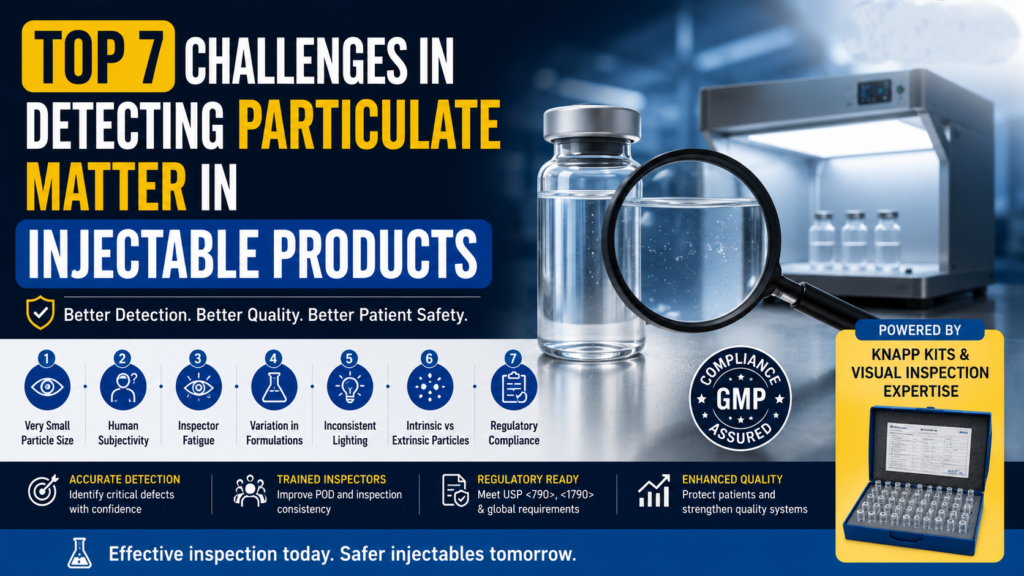
Top 7 Challenges in Detecting Particulate Matter in Injectable Products and How to Overcome Them
Introduction
Patient safety remains the highest priority in pharmaceutical manufacturing. Every injectable product that reaches a patient must be essentially free from visible particulate contamination. Even a tiny particle can lead to adverse reactions, product recalls, regulatory observations, and significant damage to a company’s reputation.
This is why detecting Particulate Matter in Injectable Products is one of the most critical quality control activities in sterile manufacturing. Regulatory authorities including the FDA, EMA, WHO, and USP require manufacturers to establish robust visual inspection programs to identify visible particulates before products reach the market.
However, detecting particulate contamination is far more challenging than it appears. Variables such as particle size, product formulation, lighting conditions, inspector fatigue, container type, and training effectiveness can significantly impact detection rates.
In this article, we explore the top seven challenges associated with detecting Particulate Matter in Injectable Products and discuss practical solutions that pharmaceutical manufacturers can implement to improve inspection effectiveness and regulatory compliance.
Why Detecting Particulate Matter Matters
Before exploring the challenges, it is important to understand why particulate detection is so critical.
Visible particulates in injectable products may originate from:
- Glass fragments
- Metal particles
- Rubber stopper fragments
- Fibers
- Filter materials
- Packaging components
- Environmental contamination
- Manufacturing equipment wear
These contaminants can potentially cause:
- Embolism
- Inflammation
- Organ damage
- Infection risks
- Product recalls
- Regulatory actions
According to USP <790>, injectable products should be essentially free from visible particulate matter. This places tremendous responsibility on visual inspection programs.
Challenge #1: Detecting Extremely Small Particles
Why It Happens
One of the biggest challenges in detecting Particulate Matter in Injectable Products is particle size.
Many particles fall near the threshold of human visibility. A particle may technically be visible under ideal conditions but remain undetected during routine inspection because:
- Particle size is very small
- Contrast is poor
- Product movement is limited
- Inspector viewing angle is unfavorable
For example:
- Small glass particles
- Transparent fibers
- Fine silicone droplets
- Tiny metallic fragments
can easily escape detection.
How to Overcome It
Organizations should:
Use Qualification Kits
Qualification kits containing certified particles of known sizes help inspectors understand visibility thresholds.
Implement Knapp Kits
Knapp Kits are specifically designed to train and qualify inspectors using known defect samples. They improve the probability of defect detection and help establish inspector competency. Confianca Pharmazon provides certified visual inspection Knapp Kits containing glass particles, metal particles, fibers, and other known defects.
Conduct Routine Requalification
Inspectors should undergo periodic qualification and requalification programs to maintain performance consistency.
Challenge #2: Human Subjectivity in Manual Visual Inspection
Why It Happens
Visual inspection is inherently subjective.
Different inspectors may interpret the same product differently due to:
- Experience level
- Visual acuity
- Training quality
- Fatigue
- Personal judgment
One inspector may reject a vial while another may accept it.
This inconsistency creates significant risks in pharmaceutical manufacturing.
How to Overcome It
Standardized Training Programs
Develop structured training programs covering:
- Defect classification
- Critical defects
- Major defects
- Minor defects
- Regulatory expectations
Use Defect Libraries
Visual defect libraries help inspectors learn to identify:
- Black particles
- White particles
- Fibers
- Glass fragments
- Cosmetic defects
Probability of Detection (POD) Programs
POD studies help measure inspection effectiveness and identify areas requiring improvement.
Challenge #3: Inspector Fatigue and Eye Strain
Why It Happens
Visual inspection is repetitive.
Inspectors may examine thousands of containers during a single shift.
Over time, this leads to:
- Reduced concentration
- Slower reaction time
- Missed defects
- Eye strain
- Decreased detection efficiency
Studies consistently show that fatigue significantly reduces defect detection capability.
How to Overcome It
Implement Eye-Rest Programs
Regular breaks are essential.
Recommended practices include:
- Scheduled rest intervals
- Rotation between activities
- Ergonomic workstation design
Use Proper Inspection Booths
Visual inspection booths should provide:
- Controlled lighting
- Appropriate lux intensity
- Black and white backgrounds
- Adjustable viewing positions
Modern visual inspection booths can significantly reduce inspector fatigue and improve detection performance.
Monitor Inspector Performance
Track:
- False acceptance rates
- False rejection rates
- POD performance
This helps identify fatigue-related trends early.
Challenge #4: Variation in Product Formulations
Why It Happens
Not all injectable products are visually identical.
Different formulations present unique inspection challenges:
Clear Solutions
Generally easier to inspect.
Colored Solutions
Can mask particles and reduce visibility.
Oily Solutions
Particles may move differently or remain suspended.
Lyophilized Products
Require specialized inspection techniques.
Because of these differences, a single inspection strategy may not work across all products.
How to Overcome It
Product-Specific Training
Inspectors should receive training for each formulation category.
Simulation-Based Learning
Use defect kits prepared in:
- Clear solutions
- Colored solutions
- Oily formulations
- Lyophilized products
Qualification by Product Family
Qualification programs should reflect actual manufacturing conditions.
Challenge #5: Inconsistent Lighting Conditions
Why It Happens
Lighting plays a crucial role in visual inspection.
Even highly skilled inspectors struggle when:
- Lux levels fluctuate
- Background contrast is poor
- Shadows occur
- Glare affects visibility
Poor lighting directly impacts the detection of Particulate Matter in Injectable Products.
How to Overcome It
Maintain Standard Lux Levels
Facilities should establish validated lux requirements based on:
- Product type
- Container type
- Regulatory expectations
Use Black and White Backgrounds
Alternating backgrounds improve visibility of different particle types.
Periodic Qualification of Inspection Stations
Regular verification ensures consistent performance across inspection booths.
Challenge #6: Differentiating Between Intrinsic and Extrinsic Particles
Why It Happens
Not all particles represent contamination.
Some particles are intrinsic to the product.
Examples include:
Intrinsic Particles
- Protein aggregates
- Formulation-related particles
Extrinsic Particles
- Glass fragments
- Metal particles
- Fibers
- Environmental contaminants
Inspectors often struggle to distinguish between the two.
How to Overcome It
Root Cause Education
Training should include:
- Particle origin
- Defect categorization
- Product-specific characteristics
Defect Reference Libraries
Comprehensive libraries improve identification accuracy.
Expert Review Programs
Suspect units should be reviewed by qualified subject matter experts when necessary.
Challenge #7: Regulatory Compliance and Audit Readiness
Why It Happens
Regulators increasingly scrutinize visual inspection programs.
Common audit observations include:
- Poor inspector qualification
- Inadequate training records
- Lack of POD studies
- Weak defect libraries
- Incomplete documentation
Failure to demonstrate an effective visual inspection program can result in:
- Warning letters
- Regulatory observations
- Product recalls
- Market restrictions
How to Overcome It
Build a Robust Qualification Program
A comprehensive program should include:
- Initial qualification
- Routine requalification
- Annual competency assessment
- Performance monitoring
Maintain Audit-Ready Documentation
Keep records of:
- Training activities
- Qualification results
- POD studies
- Defect libraries
- SOP reviews
Use Certified Knapp Kits
Certified Knapp Kits provide documented evidence of inspector qualification and support regulatory inspections. Confianca Pharmazon offers manual visual inspection kits, training kits, qualification kits, and automatic visual inspection machine qualification kits designed to support compliance requirements.
Best Practices for Improving Particulate Detection
Organizations seeking world-class visual inspection performance should follow these best practices:
Establish a Structured Training Program
Focus on:
- USP <790>
- USP <1790>
- Defect identification
- Risk assessment
Conduct Regular POD Studies
Measure actual detection effectiveness.
Utilize Certified Visual Inspection Kits
Practical training significantly improves inspection performance.
Invest in Modern Inspection Infrastructure
Upgrade:
- Lighting systems
- Inspection booths
- Training facilities
Implement Continuous Improvement
Regularly review:
- Inspection trends
- Rejection data
- Complaint data
- Audit findings
How Knapp Kits Improve Detection Performance
One of the most effective tools for improving visual inspection capability is a certified Knapp Kit.
Knapp Kits help organizations:
- Train inspectors
- Measure competency
- Conduct qualification studies
- Improve POD performance
- Support regulatory compliance
Confianca Pharmazon provides advanced Knapp Kits containing:
- Certified glass particles
- Metal particles
- Black particles
- White particles
- Black fibers
- White fibers
- Customer-specific defects
The kits are supported with certificates, defect documentation, training support, and replacement programs, making them ideal for pharmaceutical manufacturers seeking robust visual inspection programs.
Frequently Asked Questions (FAQs)
What is particulate matter in injectable products?
Particulate matter refers to visible or sub-visible foreign particles present in injectable drug products, including glass fragments, fibers, metal particles, rubber pieces, and environmental contaminants.
Why is visual inspection important for injectable products?
Visual inspection helps identify visible defects and particulate contamination that may compromise patient safety and product quality.
What is a Knapp Kit?
A Knapp Kit is a visual inspection qualification tool containing known defects used for inspector training, qualification, and performance evaluation.
What are the common sources of particulate contamination?
Common sources include:
- Glass containers
- Manufacturing equipment
- Filters
- Rubber stoppers
- Cleanroom garments
- Environmental contamination
Which regulations govern particulate inspection?
Key regulations and guidance documents include:
- USP <790>
- USP <1790>
- FDA Guidance
- EU GMP Annex 1
- WHO GMP Guidelines
Conclusion
Detecting Particulate Matter in Injectable Products remains one of the most challenging yet critical responsibilities in pharmaceutical manufacturing. Challenges such as small particle size, inspector variability, fatigue, formulation differences, lighting conditions, particle classification, and regulatory expectations can all impact inspection effectiveness.
The good news is that these challenges can be addressed through structured training, robust qualification programs, Probability of Detection studies, and the use of certified Visual Inspection Kits and Knapp Kits.
By investing in advanced visual inspection practices, pharmaceutical manufacturers can improve product quality, strengthen compliance, reduce recall risks, and most importantly, protect patient safety.
Call to Action
Looking to strengthen your visual inspection program and improve the detection of Particulate Matter in Injectable Products?
Explore Confianca Pharmazon’s certified Knapp Kits, Visual Inspection Training Kits, Qualification Kits, and expert visual inspection solutions designed to help pharmaceutical manufacturers achieve higher inspection accuracy, stronger regulatory compliance, and improved patient safety.
Product Page: https://confiancapharmazon.com/product/knapp-kit-visual-inspection-kits-particles-particulate-matters/
Your trusted partner for pharma skills, systems, and solutions.