No products in the cart.
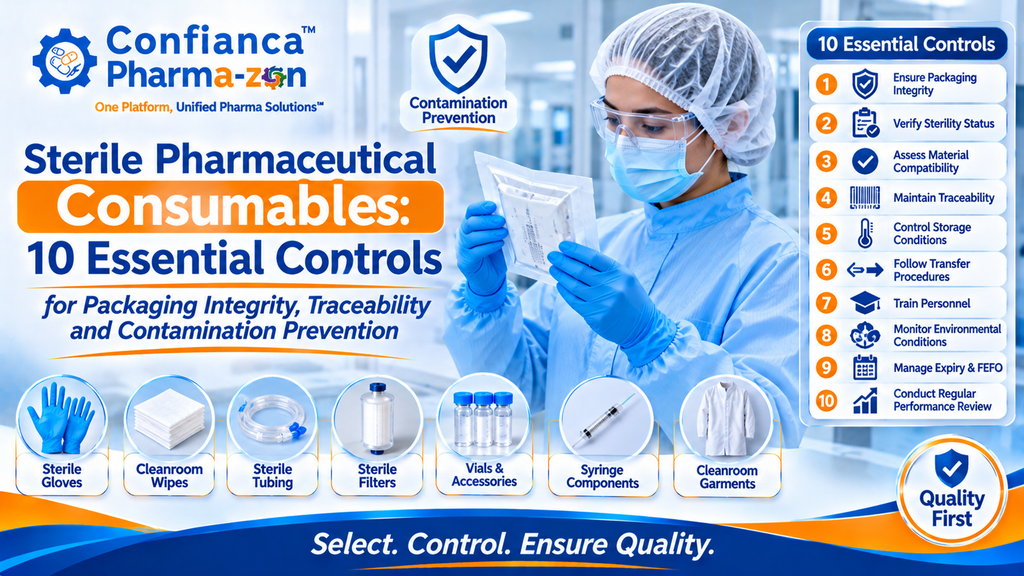
Sterile Pharmaceutical Consumables: 10 Essential Controls for Packaging Integrity, Traceability and Contamination Prevention
Introduction: The Importance of Sterile Consumables in Pharmaceutical Manufacturing
Sterile pharmaceutical manufacturing requires a carefully controlled environment in which contamination risks are managed throughout every stage of production.
From material entry into cleanrooms to aseptic processing, filling, packaging and final product handling, every material introduced into a controlled manufacturing area must be evaluated for its suitability.
Sterile pharmaceutical consumables play an important role in supporting these operations.
Products such as sterile wipes, gloves, sterile tubing, filters, cleanroom accessories, packaging materials and other controlled supplies are commonly used in pharmaceutical and biopharmaceutical facilities.
However, product sterility alone is not sufficient to establish suitability for a particular manufacturing application.
Packaging integrity, product identification, material compatibility, supplier controls, transportation conditions and storage practices also influence the reliability of sterile consumables.
A damaged sterile package, incomplete traceability record or unsuitable material can introduce additional contamination risks into a controlled manufacturing environment.
For this reason, pharmaceutical organizations should establish a systematic approach to the management of sterile consumables.
This article discusses ten essential controls that help manufacturers strengthen sterile material management, improve packaging integrity and support contamination prevention.
1. Understanding the Difference Between Sterility and Cleanroom Suitability
One of the most important considerations in sterile consumable management is understanding that sterility and cleanroom suitability are not interchangeable terms.
A product may be supplied as sterile but still require additional evaluation before it can be used in a specific cleanroom application.
For example, manufacturers may need to consider:
- Particle generation characteristics.
- Fiber shedding potential.
- Chemical compatibility.
- Packaging configuration.
- Material composition.
- Cleanroom classification requirements.
- Sterilization method.
- Intended application.
A sterile wipe, for example, may be appropriate for one cleaning application but not necessarily suitable for every critical processing surface.
Similarly, gloves intended for general cleanroom activities may have different material and performance characteristics from gloves specifically designed for isolator or restricted-access barrier system applications.
Therefore, the selection and approval of sterile consumables should be based on the actual process requirements and documented specifications.
2. Packaging Integrity: Protecting Sterile Consumables Before Use
Packaging integrity is a fundamental element of sterile consumable management.
Sterile products depend on an appropriate packaging system to maintain their required condition during storage, transportation and handling until the point of use.
If the packaging is compromised, the product may no longer be suitable for its intended sterile application.
Important packaging considerations include:
Seal integrity: Packaging seals should remain intact and free from visible damage.
Puncture resistance: Packaging should provide suitable protection against punctures and physical damage during normal handling.
Moisture protection: The packaging configuration should provide the protection required by the product and its validated storage conditions.
Packaging identification: Product name, batch number, sterilization status and other relevant information should be clearly identifiable.
Opening configuration: Packaging should allow controlled presentation of the product during transfer into the relevant manufacturing area.
Packaging integrity checks should form part of the material receipt and pre-use inspection process.
3. Sterile Barrier Systems and Controlled Material Presentation
Sterile pharmaceutical consumables may be supplied in different packaging configurations depending on their intended application.
Some products require multiple packaging layers to support controlled transfer into cleanroom environments.
The packaging system may include:
- Primary protective packaging.
- Secondary packaging.
- Multiple sterile barrier layers.
- Outer transportation packaging.
- Protective covers.
The number and configuration of packaging layers should be appropriate for the product and the intended transfer process.
For critical applications, the method of opening and presenting sterile materials should be established through documented procedures.
This is particularly important when materials are transferred into higher-grade cleanrooms or aseptic processing areas.
An effective transfer process helps minimize unnecessary handling and reduces the possibility of introducing contamination through external packaging.
4. Supplier Qualification and Sterile Consumable Traceability
Supplier management is an essential component of pharmaceutical quality systems.
Sterile consumables should be sourced from suppliers capable of providing appropriate product specifications, quality documentation and traceability information.
Supplier evaluation may consider:
- Manufacturing controls.
- Sterilization arrangements.
- Quality management systems.
- Product specifications.
- Batch identification.
- Packaging controls.
- Change notification practices.
- Complaint management.
- Relevant certifications and supporting documentation.
Traceability should allow the pharmaceutical manufacturer to identify the product, supplier, batch and relevant documentation associated with each received material.
For example, when investigating a packaging concern, the manufacturer should be able to trace the affected product back to its original batch and supplier documentation.
This becomes particularly important during deviations, supplier investigations and product quality reviews.
5. Sterilization Documentation and Batch Release Information
When purchasing sterile pharmaceutical consumables, organizations should review the documentation appropriate to the product and its intended use.
The required information depends on the product category, applicable specifications and supplier quality agreement.
Relevant documentation may include:
- Certificate of Analysis, where applicable.
- Certificate of Sterility, where applicable.
- Sterilization method.
- Batch or lot identification.
- Product specification.
- Expiry or retest information, as applicable.
- Packaging information.
- Storage requirements.
- Relevant technical documentation.
Sterilization-related documentation should be evaluated carefully rather than assuming that every sterile product has identical supporting requirements.
For example, products sterilized through different validated processes may have different material compatibility and residual-related considerations.
The manufacturer’s quality team should define which documents are necessary for each approved product category.
6. Material Compatibility in Aseptic Manufacturing
Sterile consumables frequently come into contact with manufacturing equipment, product-contact components or controlled environmental surfaces.
Their material characteristics should therefore be evaluated against the intended application.
Important compatibility considerations include:
Chemical compatibility: Materials should be suitable for contact with the chemicals and cleaning agents used in the process.
Temperature resistance: Products should be compatible with the temperature conditions to which they may be exposed.
Mechanical properties: Gloves, tubing and other consumables should have suitable physical performance for their intended activities.
Extractables and leachables: Depending on the application, potential extractables and leachables may require evaluation.
Particle generation: Materials should be evaluated for potential shedding or particulate contribution.
For example, gloves used during isolator operations should be appropriate for the equipment configuration and intended chemical exposure.
Similarly, wipes used for critical cleaning operations should have suitable material characteristics for the intended surfaces.
7. Managing Sterile Consumables During Storage and Transportation
Even properly manufactured and packaged sterile consumables can become unsuitable if storage and transportation requirements are not maintained.
Pharmaceutical manufacturers should establish appropriate material management procedures.
Important controls include:
- Defined storage conditions.
- Protection from physical damage.
- Segregation of released and unreleased materials.
- Identification of expired materials.
- Controlled stock rotation.
- Monitoring of relevant environmental conditions.
- Protection from excessive handling.
- Maintenance of batch traceability.
Where the supplier specifies particular storage conditions, these should be followed.
A First Expiry, First Out (FEFO) approach can help ensure that products with earlier expiry dates are used before products with later expiry dates, subject to their approved status and suitability.
A well-managed inventory system also helps reduce the risk of expired or unidentified sterile materials entering production.
8. Cleanroom Transfer Procedures and Contamination Prevention
Material transfer is an important contamination control activity.
Consumables entering cleanrooms may carry contamination on their external packaging surfaces even when the internal product is sterile.
Therefore, manufacturers should establish appropriate transfer procedures based on cleanroom classification and facility design.
These procedures may include:
- Receipt and verification of materials.
- Removal of external transportation packaging in designated areas.
- Inspection of remaining packaging.
- Appropriate cleaning or disinfection of external surfaces.
- Controlled transfer through designated material airlocks.
- Removal of packaging layers according to approved procedures.
- Presentation of materials into the intended cleanroom.
The exact process should be defined by the facility’s contamination control strategy and validated or qualified procedures, as applicable.
Personnel should be trained to avoid unnecessary handling and prevent contact between potentially contaminated outer surfaces and sterile product-contact materials.
9. Choosing Appropriate Sterile Consumables for Critical Applications
Different pharmaceutical manufacturing operations require different categories of sterile consumables.
A standardized product approval process helps ensure that materials are selected according to their intended use.
Common sterile consumable categories include:
Sterile cleanroom wipes
Used for designated cleaning and wiping applications. Product specifications may include material composition, particle generation characteristics, absorbency and packaging configuration.
Sterile gloves
Used in controlled manufacturing operations where suitable hand protection and contamination control are required.
Isolator and RABS gloves
Designed for integration with relevant barrier system configurations. Material compatibility, physical integrity and application-specific specifications are important.
Sterile filters
Used in applicable filtration processes, subject to defined filtration requirements, compatibility and validation considerations.
Sterile tubing and connectors
Used in suitable fluid-transfer applications. Material compatibility, connection design and integrity requirements should be evaluated.
Sterile funnels and fluid-handling accessories
Used in designated processing or laboratory applications, depending on the product design and process requirements.
The product category alone should not determine suitability. Each item should be assessed against its approved intended use.
10. Building a Strong Sterile Consumable Management Program
A reliable sterile consumable program should cover the entire material lifecycle.
This includes supplier qualification, procurement, receiving, inspection, storage, release, transfer, use and disposal.
A practical management framework should address:
Approved supplier management: Purchase materials from qualified and approved sources.
Material specifications: Define product requirements before procurement.
Incoming inspection: Verify identification, packaging condition and relevant documentation.
Traceability: Maintain product and batch-level identification.
Inventory management: Control expiry dates, storage and material status.
Personnel training: Train staff in handling and transfer procedures.
Deviation management: Investigate packaging damage, identification errors and other material-related concerns.
Periodic review: Review supplier performance, complaints and recurring material issues.
This systematic approach can strengthen contamination control and reduce avoidable material-related deviations.
The Role of Sterile Consumables in Modern Aseptic Manufacturing
As pharmaceutical and biopharmaceutical manufacturing processes become more sophisticated, the importance of controlled consumable management continues to increase.
Advanced manufacturing facilities increasingly depend on isolators, restricted-access barrier systems, automated filling lines and controlled material transfer operations.
These environments require consumables that are suitable for specific process conditions.
The focus is not simply on purchasing sterile products. It is on ensuring that each consumable meets its defined specifications, arrives with suitable documentation, maintains its required packaging condition and is handled according to approved procedures.
This is an important part of an effective contamination control strategy.
Sterile Pharmaceutical Consumables from Confianca Pharmazon
Confianca Pharmazon supports pharmaceutical and biopharmaceutical manufacturing requirements through its range of pharmaceutical products and consumable solutions.
The product portfolio includes categories relevant to quality control, microbiology, cleanroom operations and sterile manufacturing.
Depending on the application and available specifications, product requirements may include:
- Sterile wipes.
- Disposable gloves.
- Piercan gloves for isolator and RABS applications.
- Sterile filtration consumables.
- Sterile fluid-handling accessories.
- QC and microbiology consumables.
- Other pharmaceutical manufacturing supplies.
For pharmaceutical procurement teams, choosing the appropriate consumable requires consideration of material specifications, packaging configuration, documentation and intended application.
Confianca Pharmazon aims to support customers in identifying suitable pharmaceutical consumable solutions for their operational requirements.
Conclusion: Strengthening Pharmaceutical Manufacturing Through Better Sterile Consumable Management
Sterile pharmaceutical consumables are essential to modern aseptic manufacturing, but their effectiveness depends on more than their sterile status.
Packaging integrity, supplier qualification, sterilization documentation, material compatibility, traceability, storage conditions and controlled transfer procedures all contribute to their suitability for pharmaceutical applications.
By implementing structured material management practices, manufacturers can improve contamination prevention, strengthen supply-chain controls and reduce avoidable quality risks.
A well-designed sterile consumable program also supports more consistent manufacturing operations and better alignment with pharmaceutical quality system expectations.
Confianca Pharmazon is committed to supporting pharmaceutical manufacturers with quality-focused consumable solutions for sterile manufacturing, cleanroom operations and pharmaceutical quality control.
Contact Confianca Pharmazon to discuss your sterile pharmaceutical consumable requirements and product specifications.