
No products in the cart.
Pharmaceutical Visual Inspection Standardization: 11 Critical Factors for Improving Knapp Kit Performance and Inspection Reliability
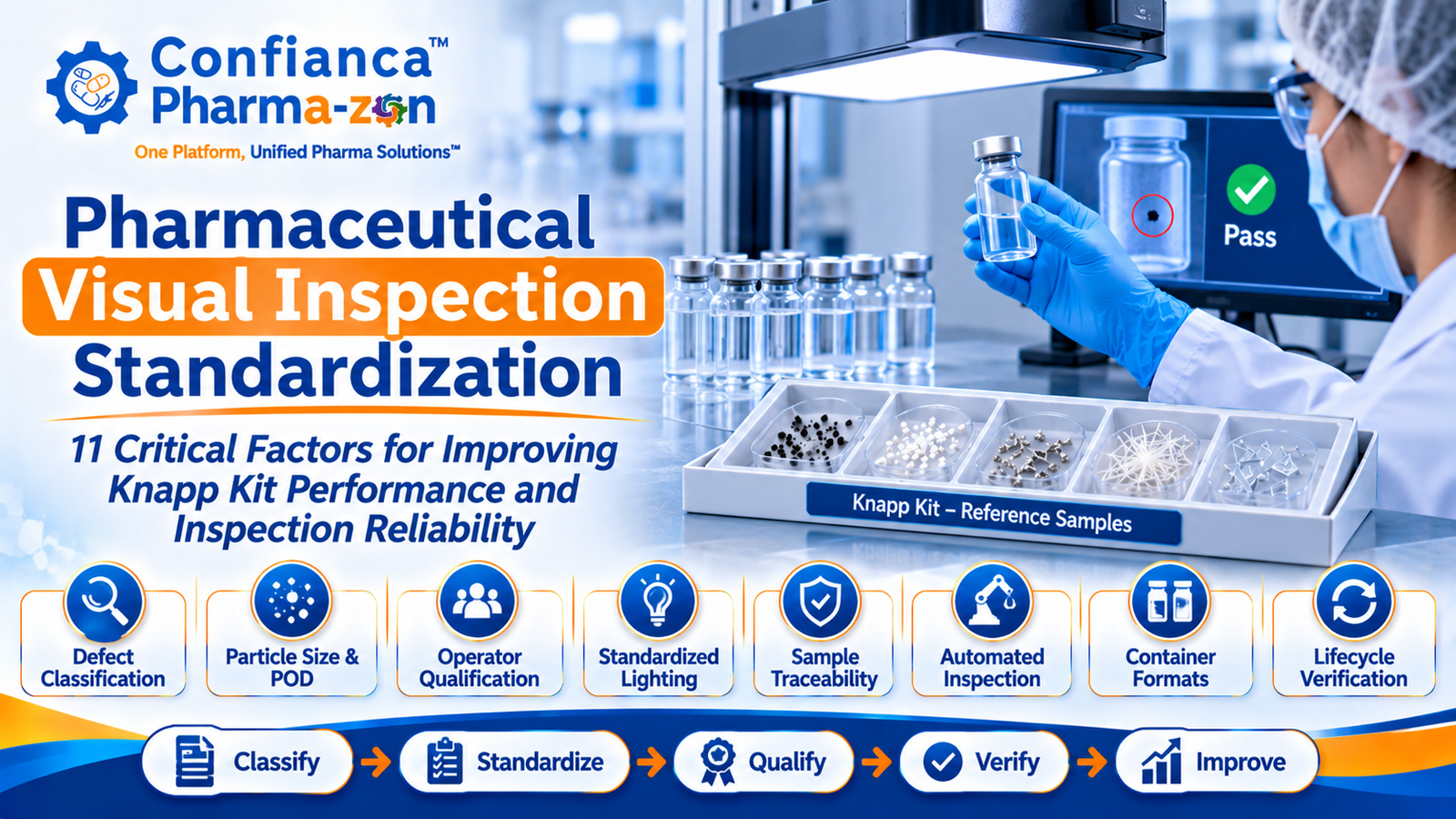
Introduction: Why Visual Inspection Standardization Is Essential in Pharmaceutical Manufacturing
Visual inspection is a critical quality control activity in pharmaceutical manufacturing, especially for sterile injectable products packaged in vials, ampoules, cartridges and prefilled syringes.
The primary objective of visual inspection is to identify visible particulate contamination, container defects, cosmetic abnormalities and other unacceptable product characteristics before products reach patients.
However, visual inspection involves human observation, equipment performance, inspection conditions and defined acceptance criteria. Without a structured approach, inspection results may vary between operators, shifts, production lines and manufacturing facilities.
One operator may identify a particular defect consistently, while another may overlook the same defect under different inspection conditions.
This creates an important challenge for pharmaceutical manufacturers: how can inspection performance be evaluated, standardized and maintained over time?
Pharmaceutical Knapp Kits provide a practical reference system for evaluating visual inspection performance using known defect characteristics and controlled inspection samples.
When properly designed and implemented, Knapp Kits can support operator qualification, inspection process verification, defect recognition training and ongoing performance monitoring.
This article explores 11 important factors that pharmaceutical manufacturers should consider when establishing a reliable visual inspection standardization program.
1. Understanding the Role of Pharmaceutical Knapp Kits
A pharmaceutical Knapp Kit is a reference-based inspection system containing samples with defined particulate or container-related defects.
These samples help manufacturers evaluate whether inspection personnel or automated systems can identify specified defects under controlled inspection conditions.
Depending on the intended application, a Knapp Kit may include:
- Black particles.
- White particles.
- Metallic particles.
- Fiber contamination.
- Glass-related particles.
- Other relevant visual defects.
- Defined particle size categories.
- Different container presentations.
Knapp Kits are particularly valuable because they provide a controlled reference for assessing inspection performance instead of relying exclusively on theoretical training or subjective visual judgments.
2. Defect Classification: The Foundation of a Reliable Inspection Program
An effective visual inspection program begins with a clear understanding of the defects that need to be detected.
Not all visible defects have the same appearance or detection characteristics.
For example, a black particle may be relatively easy to distinguish against a light background, whereas a white particle may require different viewing conditions.
Similarly, metallic particles can exhibit reflective properties that influence their visibility.
A well-structured Knapp Kit should consider different defect categories, including:
Black particles: Useful for evaluating detection of dark foreign particles.
White particles: Important for assessing particles with low contrast against certain backgrounds.
Metallic particles: Useful for evaluating the detection of reflective metallic contamination.
Fibers: Help assess the recognition of elongated foreign materials.
Container-related defects: Support inspection of relevant container appearance abnormalities.
The defect classification should reflect the manufacturer’s product types, process risks and inspection requirements.
3. Particle Size Distribution and Its Impact on Inspection Performance
Particle size is an important factor in visual inspection qualification.
Larger particles are generally easier to observe than smaller particles, but detection is also influenced by color, contrast, shape, movement, lighting and container characteristics.
For this reason, visual inspection reference kits should incorporate appropriately defined particle size categories.
Depending on the application, manufacturers may consider reference particle sizes such as:
- 50 µm.
- 60 µm.
- 70 µm.
- 80 µm.
- 100 µm.
- 150 µm.
These values are examples of possible reference categories, not universal detection acceptance limits.
A suitable particle size distribution helps manufacturers evaluate how inspection performance changes across different defect characteristics.
It also allows organizations to develop more meaningful inspection qualification exercises.
4. Standardizing Inspection Conditions Across Operators and Shifts
Even when the same reference particles are used, inspection outcomes may vary if the inspection environment is inconsistent.
Important inspection conditions include:
- Lighting intensity and suitability.
- Background characteristics.
- Inspection distance.
- Container presentation.
- Inspection duration.
- Product movement.
- Operator positioning.
- Inspection station configuration.
For manual inspection, these factors should be controlled as far as reasonably practical.
For automated inspection, relevant system parameters, image acquisition conditions and defect classification settings should be appropriately established.
A standardized inspection environment makes it easier to compare performance results and investigate unexpected variations.
5. Operator Qualification Through Structured Knapp Kit Exercises
Operator qualification is one of the most important applications of pharmaceutical Knapp Kits.
Visual inspection personnel should demonstrate their ability to identify the defect categories relevant to their assigned responsibilities.
A structured qualification exercise may include:
- Review of inspection procedures.
- Familiarization with reference defects.
- Explanation of inspection conditions.
- Controlled presentation of test samples.
- Recording of individual inspection results.
- Evaluation of detected and missed defects.
- Assessment against predefined qualification criteria.
- Documentation of the qualification outcome.
Qualification criteria should be established by the pharmaceutical manufacturer based on its approved procedures, risk assessment and applicable requirements.
The purpose is to demonstrate that personnel can perform inspection activities consistently under defined conditions.
6. Understanding Probability of Detection in Visual Inspection
Probability of Detection (POD) is an important concept when evaluating visual inspection performance.
POD describes the likelihood that a particular defect will be detected under specified inspection conditions.
Detection performance may change depending on:
- Particle size.
- Particle color.
- Particle material.
- Particle shape.
- Container type.
- Lighting conditions.
- Operator experience.
- Inspection system configuration.
For example, detection of a dark particle in a clear container may differ from detection of a white particle of comparable size.
A structured reference kit can help manufacturers evaluate inspection performance across different defect characteristics.
The resulting data may be used to understand inspection capability, identify training requirements and support improvements in inspection procedures.
However, POD results should be interpreted using an appropriate study design and statistical approach. A small qualification exercise should not automatically be treated as a complete POD validation study.
7. Maintaining Traceability of Knapp Kit Reference Samples
Traceability is essential when reference samples are used for quality-related activities.
Each Knapp Kit should have suitable identification and supporting documentation to establish the identity of its reference components.
Important documentation may include:
- Kit identification number.
- Particle or defect identification.
- Particle material classification, where established.
- Defined particle size information.
- Reference photographs.
- Relevant certificates.
- Inspection and handling instructions.
- Kit issue and return records.
- Maintenance or verification history.
Traceability allows users to identify which reference samples were used during a particular training or qualification activity.
It also supports consistency when inspection results are reviewed during internal quality audits.
8. Knapp Kits for Automated Visual Inspection Systems
Automated visual inspection systems are increasingly used in pharmaceutical manufacturing to improve inspection throughput and reduce dependence on manual inspection activities.
However, automation does not eliminate the need for performance verification.
Automated systems require appropriate evaluation to determine whether their imaging, lighting, handling and defect classification capabilities are suitable for the intended application.
Knapp Kit reference samples can support performance assessment by providing known defect presentations.
Evaluation may include:
- Detection of different particle categories.
- Recognition of defined particle sizes.
- Repeatability of detection results.
- System response to reflective particles.
- False rejection assessment.
- Consistency across inspection runs.
- Performance after relevant system adjustments.
The exact study design should reflect the automated inspection technology and the manufacturer’s qualification strategy.
9. Selecting the Right Container Format for Inspection Reference Kits
Pharmaceutical products are manufactured in several different primary packaging formats.
A reference system intended for vial inspection may not automatically be suitable for evaluating ampoules or prefilled syringes.
Container geometry, material, fill characteristics and product presentation can influence particle visibility.
A suitable Knapp Kit program should therefore consider the relevant packaging format.
Common applications include:
Vials: Reference samples for visual inspection of injectable products in glass containers.
Ampoules: Reference presentations for inspection of sealed glass ampoules.
Cartridges: Samples designed for evaluating relevant inspection characteristics in cartridge presentations.
Prefilled syringes (PFS): Reference presentations for inspection of syringe-based injectable products.
Choosing an appropriate container presentation makes inspection exercises more representative of actual manufacturing conditions.
10. Managing Reference Kit Lifecycle and Periodic Verification
A Knapp Kit should be managed as a controlled quality reference system rather than an ordinary collection of samples.
Over time, reference components may be affected by handling, storage conditions, accidental damage or changes in sample presentation.
A lifecycle management approach should include:
- Defined storage conditions.
- Controlled access.
- Periodic visual examination.
- Verification of component identity.
- Review of reference documentation.
- Investigation of damaged or missing components.
- Replacement of unsuitable samples.
- Maintenance of usage history.
These controls help maintain the reliability of reference materials throughout their intended use.
The manufacturer’s approved procedures should define the frequency and acceptance criteria for periodic verification.
11. Connecting Knapp Kit Results with Continuous Improvement
Knapp Kit performance data can provide useful information for improving pharmaceutical inspection operations.
Instead of treating qualification as a one-time activity, organizations can use the results to identify patterns and opportunities for improvement.
For example:
- Repeated missed detections may indicate a need for additional operator training.
- Differences between shifts may indicate inconsistent inspection conditions.
- Particular particle categories may require enhanced training.
- Changes in automated inspection results may indicate a need for system investigation.
- Repeated failures may justify reviewing inspection procedures.
The information can contribute to training plans, quality reviews and appropriate corrective and preventive actions.
How Confianca Pharmazon Supports Pharmaceutical Visual Inspection
Confianca Pharmazon provides pharmaceutical visual inspection-related products and solutions, including Visual Inspection Knapp Kits designed to support inspection qualification, reference-based training and performance verification activities.
The solutions can be considered for applications involving:
- Manual visual inspection.
- Automated visual inspection.
- Defect recognition training.
- Particle reference standards.
- Pharmaceutical inspection qualification.
- Vial, ampoule and prefilled syringe presentations.
Appropriate documentation and reference specifications are important considerations when implementing a Knapp Kit program.
Confianca Pharmazon aims to support pharmaceutical organizations with practical reference solutions for strengthening visual inspection activities.
Conclusion: Build a More Consistent Pharmaceutical Visual Inspection Process
Visual inspection is an important part of pharmaceutical quality assurance, but reliable inspection performance requires more than simply examining containers.
Organizations need standardized inspection conditions, appropriately designed reference samples, structured operator qualification and documented performance evaluation.
Pharmaceutical Knapp Kits provide a valuable foundation for these activities by allowing manufacturers to assess inspection performance using known defect characteristics.
From particle classification and size distribution to operator qualification, automated inspection verification and reference kit lifecycle management, every element contributes to a more consistent inspection program.
Improve your pharmaceutical visual inspection strategy with reliable Knapp Kit reference solutions from Confianca Pharmazon.
Contact Confianca Pharmazon to discuss pharmaceutical visual inspection Knapp Kits and reference solutions for your manufacturing requirements.