No products in the cart.
Pharmaceutical Particle Contamination Investigation: 9 Essential Strategies for Accurate Root Cause Identification
Introduction: Why Pharmaceutical Particle Contamination Investigation Matters
Particle contamination is one of the most important quality concerns in pharmaceutical manufacturing, particularly in sterile injectable products. Even a small foreign particle can create significant questions regarding product quality, patient safety, manufacturing controls and regulatory compliance.
In pharmaceutical manufacturing, visible and sub-visible particles may originate from several sources, including raw materials, manufacturing equipment, glass containers, elastomeric components, stainless steel surfaces, packaging materials, environmental exposure and handling operations.
Identifying the presence of a particle is only the first step. The more important challenge is determining what the particle is, where it originated, how it entered the product and whether similar contamination could occur in other batches.
This is where pharmaceutical particle contamination investigation becomes essential.
Advanced particle characterization techniques provide valuable scientific information about the morphology, elemental composition, chemical characteristics and possible origin of foreign particles. These findings help pharmaceutical manufacturers move beyond visual observations and develop scientifically supported root cause investigations.
For pharmaceutical quality control teams, microbiologists, analytical scientists and manufacturing professionals, a structured contamination investigation can significantly improve decision-making and strengthen contamination control strategies.
1. Understanding the Complexity of Pharmaceutical Particle Contamination
Pharmaceutical particles are not limited to a single material category. Different particles may have similar visual appearances but completely different chemical compositions and origins.
For example, a dark particle observed in an injectable product may potentially be:
- Metallic contamination from manufacturing equipment.
- Carbonaceous material from a processing component.
- Rubber or elastomeric material from a closure.
- Glass-related contamination.
- Environmental particulate matter.
- Fiber contamination from clothing or packaging.
Visual examination alone may not provide sufficient information to differentiate these materials.
A scientifically structured investigation should therefore consider three important characteristics:
Physical characteristics: Particle size, shape, surface texture, color and morphology.
Elemental characteristics: Presence of elements such as iron, chromium, nickel, silicon, aluminum and other detectable elements.
Chemical characteristics: Identification of possible polymeric, organic, inorganic or other chemical components using appropriate analytical methods.
Combining these characteristics provides a stronger foundation for identifying the possible source of contamination.
2. Establishing a Reliable Particle Investigation Strategy
An effective investigation begins before the analytical instrument is switched on.
The first requirement is to establish a clear investigation objective. Pharmaceutical manufacturers should understand whether the investigation is intended to identify an unknown particle, compare particles from different samples, investigate equipment-related contamination or evaluate a recurring particulate issue.
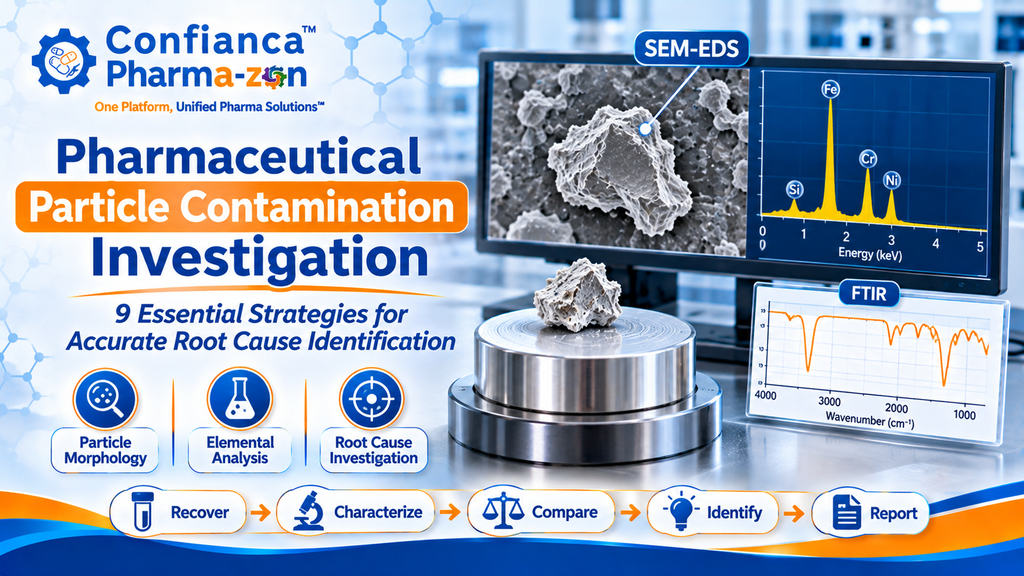
A structured investigation generally includes:
- Sample receipt and identification.
- Documentation of sample condition.
- Particle isolation and recovery, where appropriate.
- Initial microscopic examination.
- Morphological characterization.
- Elemental or chemical analysis.
- Comparison with potential contamination sources.
- Scientific interpretation of analytical results.
- Preparation of a documented investigation report.
Maintaining traceability throughout these activities is important because analytical findings must remain connected to the original sample and investigation.
3. SEM-EDS Analysis for Identifying Unknown Foreign Particles
Scanning Electron Microscopy with Energy Dispersive X-ray Spectroscopy (SEM-EDS) is an important analytical approach for investigating foreign particles in pharmaceutical products.
SEM provides high-resolution imaging that helps evaluate particle morphology, surface structure and physical characteristics.
EDS provides elemental information by detecting characteristic X-rays generated from the sample during electron-beam interaction.
This combination is particularly useful when investigating suspected metallic, inorganic or mineral-based contamination.
For example, an unknown particle may contain iron, chromium and nickel. Such elemental findings can support an investigation into possible stainless-steel-related sources.
Similarly, silicon-rich particles may require further investigation of glass-related or other silicon-containing materials.
However, elemental composition alone does not automatically establish the exact source. Analytical results must be interpreted alongside manufacturing equipment specifications, component materials, process history and other investigation evidence.
4. FTIR Analysis for Investigating Organic and Polymeric Particles
Not all pharmaceutical contaminants are metallic or inorganic.
Polymeric particles, elastomeric fragments, fibers, organic residues and certain packaging-related materials may require complementary analytical techniques.
Fourier Transform Infrared Spectroscopy (FTIR) is widely used for identifying chemical functional groups and evaluating organic material characteristics.
FTIR can be valuable when investigating:
- Rubber and elastomeric fragments.
- Plastic particles.
- Polymer-based packaging materials.
- Organic fibers.
- Certain residues and unknown organic contaminants.
The resulting spectral information can be compared with appropriate reference spectra to support material identification.
Depending on particle size, sample condition and material characteristics, different FTIR sampling configurations may be required.
Using SEM-EDS and FTIR as complementary techniques can provide a more comprehensive understanding of unknown pharmaceutical particles.
5. Particle Morphology: Understanding the Physical Evidence
Particle morphology is an important component of contamination investigations.
Two particles may contain similar elements but exhibit different physical characteristics due to their manufacturing history, degradation mechanism or environmental exposure.
Important morphological observations include:
- Particle shape and geometry.
- Surface roughness.
- Fracture patterns.
- Edges and structural irregularities.
- Porosity.
- Layered or fragmented structures.
- Evidence of abrasion or mechanical damage.
For example, a particle with irregular fractured edges may require investigation of mechanical wear or breakage, while a fiber-shaped particle may indicate a different potential contamination pathway.
Morphological observations should always be documented using appropriate microscopy images.
Combining visual evidence with elemental and chemical analysis improves the scientific strength of the investigation.
6. Identifying Potential Contamination Sources Across Manufacturing Operations
Once the particle characteristics have been established, the next challenge is investigating potential sources.
A pharmaceutical manufacturing facility contains multiple possible sources of particulate contamination.
Manufacturing equipment
Equipment surfaces, moving components, seals, mechanical assemblies and stainless-steel contact parts may contribute particles through wear, abrasion or damage.
Primary packaging components
Glass vials, ampoules, rubber stoppers, plungers and other packaging components should be considered during the investigation.
Filtration and fluid-transfer systems
Filters, tubing, connectors and other fluid-contact components may require investigation when particles are detected in process streams.
Cleanroom operations
Fibers, environmental particles, packaging fragments and particles associated with personnel activities may also require evaluation.
Material handling
Transportation, storage, transfer and handling activities can introduce additional contamination risks.
The objective is not to assume a source based on particle appearance but to compare analytical findings with scientifically relevant source materials and manufacturing evidence.
7. Comparative Particle Analysis: Connecting Evidence with Possible Sources
Comparative particle analysis can be particularly useful when an unknown particle is suspected to originate from a specific manufacturing component.
For example, a foreign particle recovered from an injectable product may be compared with material obtained from a suspected equipment component.
The comparison may consider:
- Elemental composition.
- Morphological characteristics.
- Surface structure.
- Chemical signatures.
- Material-specific characteristics.
A close analytical similarity may support a potential association, but it should not automatically be interpreted as conclusive proof of origin.
Additional investigation evidence, including equipment inspection, maintenance records, batch documentation and process history, is necessary to strengthen source attribution.
This approach supports a more defensible root cause investigation.
8. Particle Characterization Reports: Turning Analytical Results into Actionable Information
A particle characterization report should communicate analytical findings clearly and scientifically.
A comprehensive report may include:
- Sample identification and description.
- Scope of investigation.
- Analytical methodology.
- Instrument details.
- Particle-wise observations.
- Microscopic images.
- SEM micrographs.
- EDS spectra.
- Elemental composition data.
- Relevant chemical analysis results.
- Interpretation of analytical findings.
- Limitations and conclusion.
For elemental analysis, minimum and maximum weight percentages may be useful when multiple analytical locations or particles are evaluated.
It is equally important to distinguish between sample-related elements and possible contributions from the analytical substrate or sample preparation materials.
For example, an element detected in a blank membrane may require careful consideration before being attributed to the foreign particle.
Accurate reporting helps quality assurance teams evaluate the evidence and determine appropriate investigation actions.
9. Strengthening Pharmaceutical Quality Systems Through Particle Characterization
Particle characterization should not be treated only as a reactive analytical activity.
When used effectively, investigation findings can support continuous improvement across pharmaceutical manufacturing operations.
Analytical findings may help manufacturers:
- Identify recurring particulate contamination patterns.
- Evaluate equipment wear and maintenance concerns.
- Investigate packaging component-related particles.
- Strengthen contamination control strategies.
- Improve manufacturing process monitoring.
- Support deviation and CAPA investigations.
- Review supplier-related material concerns.
- Improve risk-based quality decisions.
When similar particles are observed across multiple investigations, trend analysis may help identify recurring patterns that deserve further investigation.
This creates an opportunity to use analytical information proactively rather than relying exclusively on corrective actions after contamination has occurred.
Why Choose Professional Particle Characterization Services?
Unknown pharmaceutical particles require more than basic visual examination.
Professional particle characterization combines appropriate analytical instrumentation, scientific interpretation and structured documentation to help manufacturers understand complex contamination concerns.
At Confianca Pharmazon, particle characterization services are positioned to support pharmaceutical and biopharmaceutical organizations investigating unknown particles and contamination-related quality concerns.
The analytical approach may incorporate techniques such as:
- Scanning Electron Microscopy (SEM).
- Energy Dispersive X-ray Spectroscopy (EDS).
- Fourier Transform Infrared Spectroscopy (FTIR).
- Microscopic particle examination.
- Elemental composition evaluation.
- Comparative particle investigation.
The appropriate analytical method depends on the sample, particle characteristics and investigation objective.
Conclusion: Make Pharmaceutical Contamination Investigations More Scientific and Defensible
Pharmaceutical particle contamination investigation is an essential part of maintaining product quality and understanding potential contamination pathways.
Identifying an unknown particle requires a combination of physical examination, morphological evaluation, elemental characterization and chemical analysis.
Techniques such as SEM-EDS and FTIR can provide valuable analytical evidence to support root cause investigations, while comparative analysis and detailed reporting help connect laboratory findings with manufacturing operations.
For pharmaceutical manufacturers, investing in reliable particle characterization is not simply an analytical requirement. It is an opportunity to strengthen contamination control, improve investigation quality and make better-informed decisions.
Confianca Pharmazon supports pharmaceutical organizations with particle characterization solutions designed to bring greater clarity to complex contamination investigations.
Contact Confianca Pharmazon for professional pharmaceutical particle characterization and analytical investigation support.