
No products in the cart.
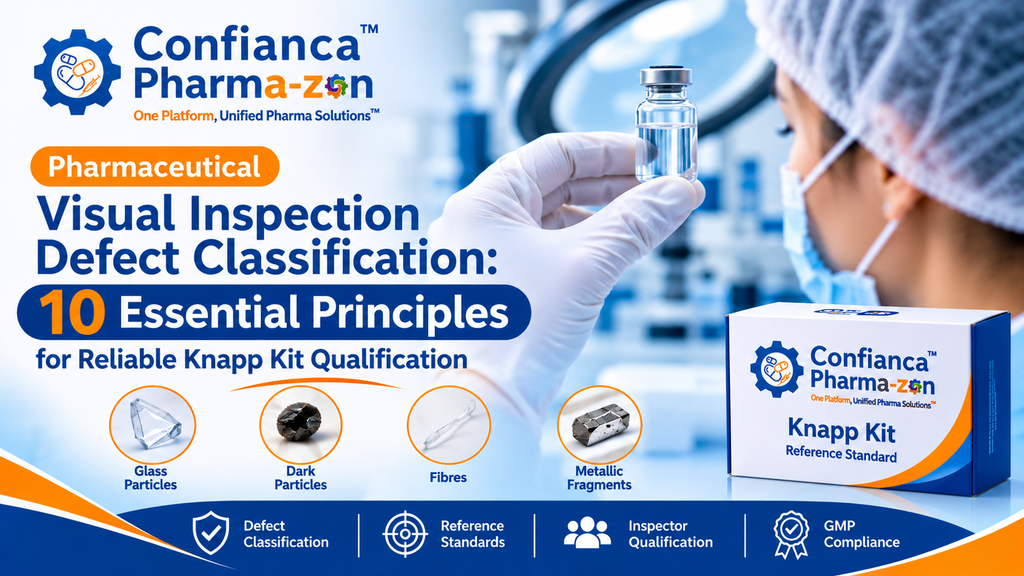
Pharmaceutical Visual Inspection Defect Classification: 10 Essential Principles for Reliable Knapp Kit Qualification
Introduction: Why Defect Classification Is the Foundation of Reliable Visual Inspection
Visual inspection is a critical quality control activity in pharmaceutical manufacturing, particularly for injectable products. The objective is to identify and reject units containing unacceptable visible defects, including particulate matter, container damage and other product or packaging abnormalities.
However, reliable inspection requires more than asking an operator to identify defective units. Different defects have different characteristics, levels of risk and detection challenges.
A transparent glass fragment, a dark particle, a thin fibre, a cosmetic container defect and a seal-related abnormality do not present the same visual challenge. Their detection may depend on particle size, colour contrast, movement, location, background, container characteristics and inspection conditions.
This is why Visual Inspection Defect Classification is an important element of a structured pharmaceutical inspection programme.
A well-designed defect classification system helps manufacturers organize reference samples, establish inspection standards, train personnel, qualify inspectors and evaluate inspection performance.
Pharmaceutical Knapp Kits can support this process by providing characterized reference defects and acceptable units for controlled inspection exercises.
This article explains ten important principles for developing and maintaining a meaningful defect classification and reference-standard programme.
1. What Is Visual Inspection Defect Classification?
Visual inspection defect classification is the systematic grouping of defects according to their nature, characteristics and quality significance.
The classification system helps define what an inspector should identify, how the defect should be recorded and how the inspection result should be evaluated.
Depending on the product and the manufacturer’s approved procedure, defect groups may include:
- Particulate contamination.
- Container and glass defects.
- Closure and seal defects.
- Cosmetic defects.
- Fill-volume or appearance abnormalities.
- Foreign matter and fibres.
- Product-related abnormalities.
The exact categories and acceptance criteria should be established through product-specific risk assessment and approved quality procedures.
Why classification matters
Without a clear classification system, two inspectors may describe the same defect differently. One may record a particle as a dark particulate, while another may classify it as a foreign material fragment.
A controlled classification system improves consistency and helps ensure that inspection data can be compared across shifts, production lines and qualification exercises.
2. Understanding Critical, Major and Minor Defects
Defect criticality is a central consideration when designing an inspection programme.
A useful classification system should connect defect descriptions with documented risk assessment and the intended quality decision.
| Defect classification | General meaning | Example for assessment |
|---|---|---|
| Critical | A defect with potentially serious implications for patient safety or product quality | Certain unacceptable foreign particles or serious container integrity defects |
| Major | A defect that may significantly affect product quality, usability or compliance | A significant container or closure defect |
| Minor | A defect with comparatively lower quality impact, according to the approved assessment | A cosmetic abnormality that does not affect product integrity |
These are general descriptions, not universal acceptance rules. A defect’s classification must be justified for the specific product, container system and manufacturing process.
For example, a small visible particle cannot automatically be classified as minor simply because it is small. Its nature, composition, location, product type and potential impact must be considered.
Why defect criticality should be documented
- It establishes a consistent inspection decision framework.
- It supports qualification criteria.
- It helps prioritize investigation and trending.
- It improves communication between QA, production and inspection personnel.
- It provides traceability during audits.
3. Why Pharmaceutical Knapp Kits Need Representative Defects
A Knapp Kit is commonly used as a reference set for evaluating visual inspection performance. It contains a defined combination of defective and acceptable units, selected according to the purpose of the inspection exercise.
The quality of the kit depends on how well its contents represent the inspection challenges that operators are expected to identify.
A useful reference set should consider:
Particle characteristics: Different particle types may include fibres, metallic fragments, glass-like particles and other representative materials.
Visual appearance: Colour, transparency, contrast and surface characteristics influence detectability.
Particle dimensions: The size range should reflect the intended inspection challenge and the documented qualification strategy.
Container characteristics: Container size, shape, material, fill volume and background may influence defect visibility.
Acceptable units: Good units are necessary to assess whether operators can distinguish acceptable product from defective product.
A kit containing only highly visible, easily detectable defects may not adequately challenge the inspection process.
4. Ten Important Defect Groups to Consider
The following categories can be considered during the development of a product-specific defect library. Not every category will apply to every product.
| Defect group | Examples | Inspection consideration |
|---|---|---|
| Fibres | Thin or elongated foreign matter | Length, orientation and contrast |
| Metallic particles | Metallic fragments | Colour, reflectivity and movement |
| Glass particles | Transparent or reflective fragments | Background, lighting and particle movement |
| Dark particles | Black or dark-coloured fragments | Contrast against the formulation |
| Light-coloured particles | White or pale particles | Contrast against the container and product |
| Rubber or elastomer fragments | Closure-related material | Shape, colour and possible source |
| Container defects | Chips, cracks or cosmetic abnormalities | Location and structural appearance |
| Closure defects | Defective or abnormal closure components | Seal and closure condition |
| Fill or appearance defects | Abnormal fill or product appearance | Product-specific visual requirements |
| Foreign material | Other representative contaminants | Identification and documented classification |
The defect library should be based on actual process risks, historical observations, development knowledge and the approved inspection strategy.
5. Reference Sample Characterization: What Should Be Documented?
A reference defect should be characterized before it is used in a qualification or training programme.
A sample label alone is not sufficient to establish traceability.
Recommended documentation may include:
- Unique sample or defect identification number.
- Defect category.
- Defect description.
- Particle material, where established.
- Particle size or dimensions, where measurable.
- Container type and identification.
- Defect location, where relevant.
- Representative photographs.
- Preparation or sourcing information.
- Inspection and acceptance status.
- Traceability and storage details.
For particulate standards, physical characterization can improve the consistency of sample preparation and provide useful supporting evidence.
For example, a particle described as a metallic fragment should not be labelled as a particular alloy unless that material identification has been established through an appropriate analytical method.
6. How to Design a Representative Knapp Kit
A structured development process helps ensure that the kit reflects the actual inspection requirements.
Step 1: Define the kit’s purpose
Determine whether the kit will be used for:
- Initial inspector qualification.
- Periodic requalification.
- Routine performance monitoring.
- Training and awareness.
- Inspection process evaluation.
The intended use determines the required sample composition and documentation.
Step 2: Identify relevant defect categories
Review product specifications, manufacturing history, rejected units, deviation records and process risks.
Step 3: Select representative defective units
Select samples that reflect relevant defect characteristics and the intended qualification challenge.
Step 4: Include acceptable units
Include good units so that false rejection performance can also be assessed.
Step 5: Characterize the samples
Record the defect description, dimensions where appropriate, images and supporting information.
Step 6: Establish traceability
Assign unique identification numbers and maintain a controlled sample inventory.
Step 7: Establish qualification criteria
Define the inspection procedure, test conditions, scoring method and pass/fail criteria in an approved protocol.
Step 8: Review and approve the kit
QA and relevant technical stakeholders should review the kit’s composition and supporting documentation before use.
7. Probability of Detection and the Importance of Representative Standards
Probability of Detection (PoD) is an important concept in evaluating visual inspection performance.
It describes the likelihood that a particular defect or defect standard will be detected under defined inspection conditions.
A defect that is consistently detected may have a different detection profile from one that is difficult to see because it is small, transparent, low contrast or poorly positioned.
The Knapp and Kushner approach is associated with the statistical evaluation of inspection performance. A documented methodology can use repeated inspections and reference-inspector results to establish a performance baseline.
Why PoD should be considered
- It helps evaluate the relative detectability of defects.
- It supports the development of qualification criteria.
- It provides a structured approach to comparing inspection performance.
- It helps identify defects that may require additional training or investigation.
PoD is not a guarantee that every defective unit will be detected in routine production. Visual inspection has inherent limitations and should operate as part of a broader contamination prevention and quality control strategy.
8. Inspector Qualification: More Than a Pass or Fail Result
A meaningful qualification programme should assess inspection capability under conditions that reflect the intended routine process.
Important considerations include:
Inspection conditions: Lighting, background, viewing distance, container presentation and inspection equipment should be defined.
Inspection speed: The test should reflect the intended inspection rate, where applicable.
Fatigue: The qualification strategy should consider whether performance may change over a working period.
Defect familiarity: Repeated exposure to the same reference set may allow inspectors to memorize individual samples rather than demonstrate transferable inspection ability.
False rejection: Acceptable units should be included to assess whether inspectors incorrectly reject good product.
Requalification: The frequency and triggers for requalification should be defined through the site’s quality system and risk assessment.
The test protocol should clearly define how results are recorded, evaluated and approved.
9. Common Mistakes in Knapp Kit Development and Qualification
| Common mistake | Potential consequence | Recommended improvement |
|---|---|---|
| Using only easily visible defects | Insufficient challenge | Select representative defect standards |
| Missing defect categories | Important inspection challenges may not be assessed | Use a documented defect library |
| Poor sample traceability | Difficult to verify kit history | Assign unique sample IDs |
| Reusing familiar samples without controls | Inspectors may memorize the set | Manage sample rotation and kit lifecycle |
| No good units | False rejection may remain unassessed | Include acceptable samples |
| Unclear pass/fail criteria | Inconsistent qualification decisions | Approve criteria in advance |
| Inadequate fatigue consideration | Test may not reflect actual working conditions | Include risk-based fatigue assessment |
| Unsupported material identification | Incorrect conclusions | Confirm composition when required |
10. Maintaining Knapp Kit Integrity Through Its Lifecycle
A Knapp Kit should be managed as a controlled quality reference rather than an informal collection of samples.
A lifecycle management system should address:
- Kit design and approval.
- Defect characterization.
- Sample identification and labelling.
- Storage and handling.
- Periodic condition checks.
- Sample replacement criteria.
- Change control.
- Retention of qualification records.
- Review of inspection performance trends.
If a sample changes appearance, loses its intended defect, becomes damaged or cannot be reliably identified, its continued suitability should be assessed.
Changes to the kit should be documented and evaluated for their impact on previous and future qualification results.
Frequently Asked Questions
1. What is a pharmaceutical Knapp Kit?
A pharmaceutical Knapp Kit is a reference set of acceptable and defective product units used in visual inspection training, qualification or performance evaluation.
2. What is visual inspection defect classification?
It is a structured method of grouping defects according to their type, characteristics and quality significance.
3. Why are good units included in a Knapp Kit?
Good units help assess whether an inspector can correctly accept conforming product and avoid unnecessary rejection.
4. What is Probability of Detection?
Probability of Detection describes the likelihood that a defined defect will be detected under specified inspection conditions.
5. Can one Knapp Kit be used for every pharmaceutical product?
Not necessarily. Defect types, formulation appearance, container characteristics and inspection conditions may differ between products. The kit should be justified for its intended application.
6. How often should inspectors be requalified?
The frequency should be defined by the manufacturer’s approved procedure and risk assessment, considering applicable requirements and inspection performance.
7. Why is defect characterization important?
It establishes traceability and provides information about the physical and visual characteristics of each reference sample.
8. What is the difference between training and qualification?
Training develops knowledge and inspection skills. Qualification provides documented evidence that an individual meets predefined performance criteria.
9. Can spherical particles represent all real contamination defects?
No. Spherical standards may be useful for selected purposes, but they do not reproduce the appearance and movement of every naturally occurring defect.
10. Does passing a Knapp Kit qualification guarantee zero defective units?
No. Qualification demonstrates performance against a defined reference set under specified conditions. It does not eliminate the inherent limitations of visual inspection or replace broader process controls.
Conclusion: Build a More Consistent Visual Inspection Programme
A reliable pharmaceutical visual inspection programme requires a clearly defined defect classification system, representative reference standards, documented sample characterization and a controlled inspector qualification strategy.
A properly designed Knapp Kit can help standardize training and evaluation while supporting more consistent inspection practices.
Confianca Pharmazon provides pharmaceutical visual inspection Knapp Kit solutions to support defect-based inspection training, qualification and performance evaluation.
Looking to develop or improve your pharmaceutical visual inspection qualification programme? Contact Confianca Pharmazon to discuss your defect categories, reference sample requirements and Knapp Kit application.
Confianca Pharmazon – Supporting Pharmaceutical Quality Through Reliable Technical Solutions.