No products in the cart.
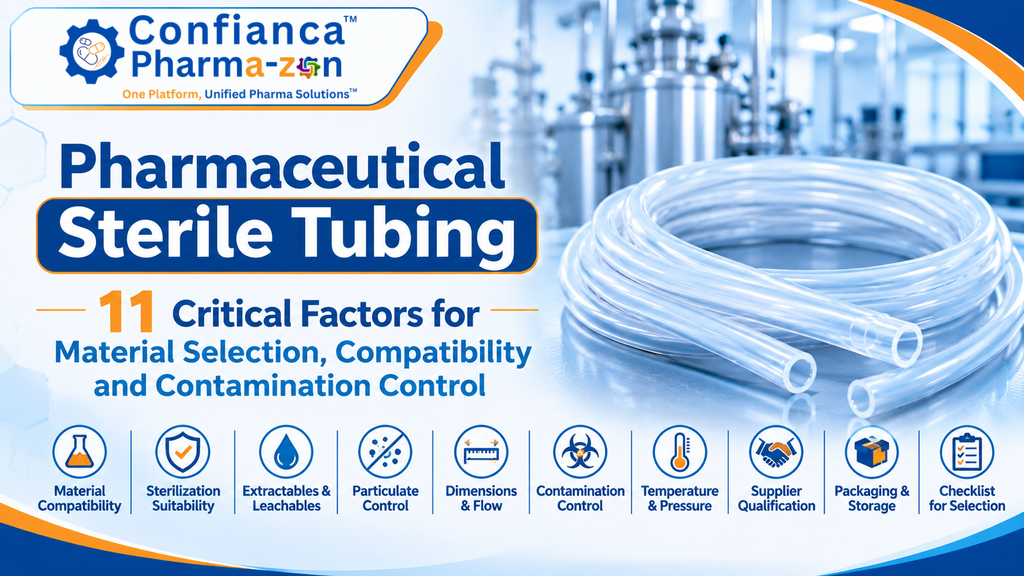
Pharmaceutical Sterile Tubing: 11 Critical Factors for Material Selection, Compatibility and Contamination Control
Introduction: Why Sterile Tubing Selection Matters in Pharmaceutical Manufacturing
Sterile tubing is an important component in pharmaceutical and biopharmaceutical manufacturing. It is used to transfer liquids, connect process equipment, support fluid handling and form part of single-use assemblies.
Although tubing may appear to be a simple consumable, its material, construction, sterilization compatibility and suitability for the process can directly influence product quality and manufacturing reliability.
A tubing assembly may come into contact with purified water, buffers, media, intermediates, process solutions or pharmaceutical products. During this contact, the material must maintain its intended physical and chemical characteristics without introducing unacceptable contamination risks.
Incorrect tubing selection can create problems such as leakage, material degradation, particulate shedding, chemical incompatibility, connection failures or concerns relating to extractables and leachables.
For sterile manufacturing, tubing selection should therefore be based on a documented assessment of the complete process rather than price or material name alone.
This article explains eleven important factors pharmaceutical manufacturers should consider when selecting and controlling sterile tubing.
1. What Is Pharmaceutical Sterile Tubing?
Pharmaceutical sterile tubing is tubing intended for use in a defined sterile or controlled manufacturing application, supplied or processed to meet the relevant requirements of its intended use.
It may be used in:
- Sterile liquid transfer.
- Buffer and media preparation.
- Biopharmaceutical processing.
- Filtration assemblies.
- Sampling systems.
- Single-use manufacturing assemblies.
- Filling and dispensing operations.
- Connections between process equipment.
Sterile tubing may be manufactured from different polymeric materials. The choice depends on the application, process conditions and compatibility requirements.
An important distinction is that tubing described as sterile is not automatically suitable for every pharmaceutical process. Its suitability must be evaluated against the actual intended use.
2. Understanding Common Tubing Materials
Different polymeric materials have different physical and chemical properties.
The material should be selected according to the process fluid, temperature, pressure, contact duration, sterilization method and required flexibility.
| Material | General characteristics | Important selection considerations |
|---|---|---|
| Silicone | Flexible and commonly used in fluid handling | Permeability, extractables, mechanical requirements and process compatibility |
| TPE | Flexible thermoplastic elastomer | Chemical compatibility, processing and sterilization suitability |
| PVC | Available in different formulations and grades | Plasticizer-related considerations and formulation compatibility |
| Polyethylene | Available in different grades | Flexibility, chemical resistance and temperature limits |
| Polypropylene | Used in selected fluid-handling applications | Rigidity, temperature and connection requirements |
| Fluoropolymer materials | Used where specific chemical or process properties are required | Flexibility, connection design and application-specific compatibility |
These descriptions are general. Material grades and formulations can vary significantly between manufacturers. A material name alone is not sufficient evidence of suitability.
3. Chemical Compatibility: The First Major Selection Factor
Chemical compatibility is one of the most important considerations when choosing pharmaceutical sterile tubing.
A tubing material that performs well with one liquid may not perform equally well with another.
The assessment should consider:
- Chemical composition of the process fluid.
- pH and concentration.
- Presence of organic solvents or surfactants.
- Temperature during contact.
- Contact duration.
- Repeated or continuous exposure.
- Cleaning and sanitization chemicals, where applicable.
Practical example
A tubing assembly used for an aqueous buffer may experience different material interactions from one used for a solvent-containing formulation.
Similarly, a tubing assembly exposed to a cleaning agent may require a different compatibility assessment from one used only for product transfer.
Manufacturers should obtain material compatibility information from the supplier and assess it against the actual process conditions.
4. Extractables and Leachables: An Important Risk Assessment
Extractables and leachables are important considerations for polymeric components used in pharmaceutical manufacturing.
Extractables are chemical substances that can be released from a material under defined laboratory extraction conditions.
Leachables are substances that migrate from a material into a process stream or product under actual or simulated conditions of use.
Potential sources include polymer additives, processing aids, stabilizers, residual substances and other material constituents.
Why should manufacturers assess them?
A chemical substance migrating from tubing into a process fluid may create a product quality or safety concern, depending on its identity, concentration and exposure.
The assessment should consider:
- Material of construction.
- Surface area in contact with the process fluid.
- Fluid composition.
- Contact temperature.
- Contact duration.
- Sterilization and processing history.
- Intended product and process stage.
- Available supplier qualification information.
USP General Chapters <665> and <1665> provide relevant frameworks concerning plastic components and systems used in pharmaceutical and biopharmaceutical manufacturing. Their applicability should be evaluated for the specific component and intended use.
5. Sterilization Compatibility and Method Selection
A tubing assembly must be compatible with the sterilization method used for its intended application.
Different sterilization approaches can affect polymeric materials differently.
Examples include:
- Gamma irradiation.
- Electron-beam irradiation.
- Autoclave or moist-heat exposure.
- Other validated sterilization approaches, where applicable.
Potential effects may include changes in flexibility, colour, mechanical strength, dimensional stability or chemical characteristics.
Manufacturers should verify that the complete tubing assembly—not just the base polymer—is suitable for the specified sterilization process.
The supplier’s documentation should identify the sterilization method, relevant validation or qualification information, and any limitations on use.
Sterilization claims should not be assumed to apply to every configuration or processing condition.
6. Physical and Mechanical Properties
The tubing must withstand the mechanical conditions of the manufacturing process.
Important properties include:
Inner diameter: Influences flow characteristics and compatibility with connectors and equipment.
Outer diameter: Important for clamps, fittings and connection integrity.
Wall thickness: Influences pressure resistance and mechanical performance.
Flexibility: Determines how easily tubing can be routed and handled.
Kink resistance: Helps prevent flow restriction during operation.
Tensile strength: Relevant to handling and mechanical loading.
Pressure rating: Must be appropriate for the intended operating conditions.
Connection integrity: Tubing and fittings should form a secure, suitable assembly.
A tubing specification should identify the required dimensions and tolerances rather than relying only on a general product description.
7. Particulate Shedding and Contamination Control
Particulate contamination is an important concern in sterile pharmaceutical manufacturing.
Tubing and connectors should be evaluated as potential contributors to contamination based on the material, process conditions, handling and equipment configuration.
Possible contamination-related concerns include:
- Material fragments.
- Particles generated by mechanical stress.
- Surface damage.
- Improperly prepared connections.
- Particles introduced during cutting or assembly.
- Contamination from handling and packaging.
Good practices
- Use tubing appropriate for the intended process.
- Avoid unnecessary mechanical stress.
- Follow approved cutting and connection procedures.
- Inspect assemblies before use.
- Maintain suitable handling practices.
- Investigate unexplained particulate observations.
- Follow supplier instructions and site procedures.
A clean-looking tubing assembly is not, by itself, proof that it is free from particulate or chemical contamination risks.
8. Tubing Dimensions and Flow Requirements
Selecting the correct tubing dimensions is essential for process performance.
The internal diameter, length, fluid characteristics and flow conditions influence pressure drop and transfer behaviour.
For example, a tubing assembly with an unsuitable internal diameter may create excessive flow resistance or may not deliver the required transfer performance.
A selection assessment should include:
- Required flow rate.
- Fluid viscosity.
- Tubing length.
- Internal diameter.
- Operating pressure.
- Pump type and operating conditions.
- Connection and fitting specifications.
Where tubing is used with peristaltic pumps, the tubing must also be suitable for the mechanical compression and repeated cycling associated with the application.
9. Packaging, Storage and Handling
The condition of sterile tubing at the point of use depends not only on its manufacture but also on packaging, transport, storage and handling.
Important checks include:
- Packaging integrity.
- Product identification.
- Lot or batch number.
- Sterilization status.
- Expiry or retest information, where applicable.
- Storage conditions.
- Manufacturer’s handling instructions.
- Visible damage or contamination.
Tubing should be stored according to the manufacturer’s specified conditions.
Packaging should be opened using approved practices that minimize contamination risk. Once opened, any unused portion should be managed according to the site’s approved procedures and the supplier’s instructions.
10. Supplier Qualification and Documentation
Supplier qualification is an important part of sterile consumable control.
Before approving a tubing product, pharmaceutical manufacturers should assess whether the supplier can provide suitable technical and quality documentation.
Depending on the application, useful documents may include:
| Document | Purpose |
|---|---|
| Product specification | Defines material, dimensions and product characteristics |
| Certificate of Analysis | Provides lot-specific information, where applicable |
| Certificate of Conformance | Confirms conformance to specified requirements |
| Sterilization certificate | Provides relevant sterilization information |
| Material declaration | Identifies material of construction |
| Extractables information | Supports chemical risk assessment |
| Compatibility information | Supports intended-use evaluation |
| Change notification policy | Helps manage material or manufacturing changes |
| Traceability information | Supports batch and lot identification |
The required documentation should be determined through the site’s quality system and risk assessment.
A supplier’s certificate should not automatically be treated as evidence that a product is suitable for every intended pharmaceutical application.
11. Practical Checklist for Selecting Pharmaceutical Sterile Tubing
Before purchasing or approving sterile tubing, use a structured assessment.
| Selection parameter | Key question |
|---|---|
| Application | What process will the tubing support? |
| Fluid compatibility | Is the material suitable for the process fluid? |
| Temperature | Can it withstand operating and processing temperatures? |
| Pressure | Is the pressure rating appropriate? |
| Dimensions | Are the inner diameter, outer diameter and wall thickness correct? |
| Sterilization | Is the assembly compatible with the required sterilization method? |
| Extractables and leachables | Is there adequate supporting information for the risk assessment? |
| Particulate control | Are material and handling-related contamination risks addressed? |
| Connections | Are compatible fittings and connectors available? |
| Packaging | Is the product appropriately packaged for its intended use? |
| Documentation | Can the supplier provide traceable technical and quality documents? |
This checklist can be incorporated into procurement specifications, supplier qualification activities or material approval procedures.
Common Mistakes When Selecting Sterile Tubing
Selecting only by price: A low purchase price may not reflect the total cost of compatibility testing, process failure or replacement.
Assuming all silicone tubing is equivalent: Different formulations, manufacturing processes and product grades may have different properties.
Ignoring sterilization effects: A material may be suitable for one sterilization method but not another.
Overlooking connection compatibility: Incorrect fittings can create leakage or assembly problems.
Ignoring extractables and leachables: Chemical suitability should be assessed based on the actual intended application.
Using incomplete specifications: A material name without dimensions, tolerances and process requirements is insufficient for controlled procurement.
Failing to manage supplier changes: Changes in material formulation, manufacturing location or processing may affect previously assessed suitability.
Frequently Asked Questions
1. What is pharmaceutical sterile tubing?
It is tubing intended for use in defined sterile or controlled pharmaceutical manufacturing applications, subject to the requirements of its intended use.
2. Which material is best for pharmaceutical tubing?
There is no single best material for every application. Selection depends on chemical compatibility, temperature, pressure, flexibility, sterilization and extractables and leachables considerations.
3. Is silicone tubing suitable for pharmaceutical manufacturing?
Silicone tubing is used in various pharmaceutical applications, but its suitability must be established for the specific formulation, process conditions and intended use.
4. What are extractables and leachables in tubing?
Extractables are substances released under defined extraction conditions. Leachables are substances that migrate into the process stream or product under actual or simulated use conditions.
5. Can sterile tubing be autoclaved?
Only when the specific tubing and complete assembly are designed and qualified for the intended autoclave conditions. Manufacturer instructions and validated site procedures should be followed.
6. Why are tubing dimensions important?
Dimensions influence flow, pressure, connection compatibility and mechanical performance.
7. What documents should be requested from a tubing supplier?
Depending on intended use, request product specifications, lot traceability, sterilization information, material declarations, compatibility data and relevant extractables information.
8. Can tubing contribute to particulate contamination?
Yes. Material damage, mechanical stress, unsuitable components and improper handling may contribute to particulate contamination. The actual risk should be assessed for the process.
9. What is the importance of USP <665> and <1665>?
These chapters address plastic components and systems used in pharmaceutical and biopharmaceutical manufacturing, including approaches relevant to material characterization and risk assessment.
10. How should sterile tubing be stored?
Follow the manufacturer’s specified storage conditions, maintain packaging integrity and use approved handling procedures.
Conclusion: Make Sterile Tubing Selection Part of Your Contamination Control Strategy
Sterile tubing is a process-contact component that deserves careful technical evaluation. Material compatibility, sterilization suitability, mechanical performance, particulate control, extractables and leachables, supplier qualification and documentation all contribute to its suitability.
A structured selection process helps pharmaceutical manufacturers reduce avoidable risks and maintain better control over sterile manufacturing operations.
Confianca Pharmazon supports pharmaceutical manufacturing and quality teams with a range of pharmaceutical products and consumable sourcing solutions.
Need support with pharmaceutical consumable requirements? Contact Confianca Pharmazon to discuss your application, technical specifications and procurement requirements.
Confianca Pharmazon – Supporting Pharmaceutical Quality Through Reliable Technical Solutions.