
No products in the cart.
Lyophilized Product Visual Inspection: 9 Critical Considerations for Pharmaceutical Knapp Kit Qualification
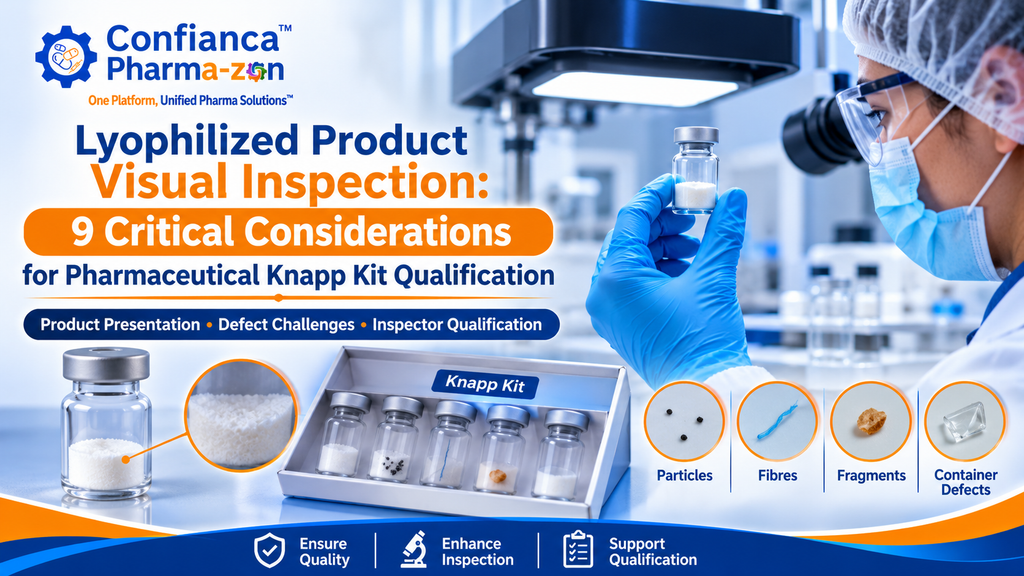
Introduction: Why Does Lyophilized Product Inspection Require a Different Approach?
A lyophilized injectable vial does not present the same visual background as a vial containing a clear liquid solution. Its cake structure, residual moisture appearance, powder distribution, vial geometry and stopper configuration can influence what an inspector sees.
A defect that is easy to observe in a clear liquid product may be difficult to distinguish against a freeze-dried product background. Similarly, a particle may become more visible or less visible depending on its position, contrast and the inspection conditions.
This makes lyophilized product visual inspection an important subject when designing inspector qualification programmes and pharmaceutical Knapp Kit challenges.
A suitable inspection programme should account for the actual product presentation and the defects that inspectors are expected to identify. Reference samples should be selected and documented according to the intended qualification purpose rather than treating every injectable container as visually identical.
This article explains the technical considerations for inspecting lyophilized products, designing relevant Knapp Kit challenges and maintaining a controlled qualification approach.
1. Understanding Lyophilized Product Presentation
Lyophilization, also called freeze-drying, is a process in which frozen product is dried under controlled conditions, generally involving sublimation and subsequent drying.
The final product may appear as a porous cake, powder or another formulation-specific structure inside the container.
Visual characteristics may include:
- Cake shape and height.
- Cake uniformity.
- Cracks or structural separation.
- Product distribution.
- Colour and visible appearance.
- Residual material on the vial wall.
- Container and closure condition.
These characteristics should be interpreted against approved product specifications and established visual standards. A naturally occurring cake feature should not automatically be classified as a defect.
The inspection team must understand the acceptable appearance of the specific formulation and distinguish it from unacceptable product or container conditions.
2. Why Lyophilized Product Visual Inspection Is Different
Visual inspection depends on the relationship between the defect, the product background, the container and the viewing conditions.
For a clear solution, particles may move through the liquid and become visible during controlled examination. In a lyophilized vial, the product is in a dried state, so the inspection context is different.
Important factors include:
- Background contrast: The cake or powder may affect the visibility of foreign material.
- Container geometry: Vial diameter, glass colour and surface reflections influence observation.
- Defect location: A defect near the wall, stopper or product surface may present differently.
- Product appearance: The normal cake structure must be understood before abnormal features can be classified.
- Inspection procedure: Handling, illumination and viewing conditions must follow the approved procedure.
A Knapp Kit used for qualification should therefore represent the relevant container and inspection conditions as closely as practical.
3. Nine Critical Considerations for Lyophilized Product Visual Inspection
3.1 Establish the Acceptable Product Appearance
Before evaluating defects, the team must define the normal appearance of the lyophilized product.
This should be based on approved product specifications, development knowledge, manufacturing experience and quality-approved visual standards.
The reference should address normal variation, such as expected cake structure and appearance.
Without a clear description of acceptable appearance, inspectors may classify normal product characteristics inconsistently.
3.2 Consider Cake Structure and Product Background
The cake can create an irregular visual background. Its surface, colour and distribution may influence the contrast of foreign material or other defects.
The inspection programme should evaluate whether the product background affects the visibility of the target defect.
Where the defect is intended to challenge an inspector, the sample design should be technically justified and its presentation documented.
3.3 Evaluate Container and Closure Defects Separately
Not every inspection challenge is a product-related defect.
Container and closure conditions may include:
- Cracks or chips in the glass.
- Damaged or incorrectly positioned closures.
- Stopper-related defects.
- Seal or cap-related abnormalities.
- External contamination or visible residue.
These defects should be classified according to the site’s approved defect taxonomy and acceptance criteria.
3.4 Consider Foreign Particulate Matter
Foreign particles may originate from different materials, including glass, metal, fibres, polymers or other sources.
The visual appearance of a particle depends on its size, shape, colour, density, orientation and movement.
A representative challenge should identify the particle type and the intended inspection objective. The reference sample should have sufficient supporting documentation to distinguish the known defect from an unidentified or accidental background particle.
For related information, see Pharmaceutical Knapp Kit: Audit-Ready Essentials.
3.5 Define the Inspection State
A lyophilized vial may be examined in its supplied dried state or after reconstitution, depending on the approved product inspection procedure and the specific purpose of the examination.
These are different inspection conditions and should not be treated as interchangeable.
If reconstitution is part of an approved inspection or investigation method, the procedure should define the diluent, volume, mixing method, waiting period and examination conditions.
A Knapp Kit challenge must reflect the intended inspection state. A sample designed for dried-product inspection should not be evaluated using an unrelated reconstitution procedure.
3.6 Control Illumination and Viewing Conditions
Inspection conditions influence defect visibility.
Relevant factors include:
- Illumination intensity.
- Background colour.
- Viewing distance.
- Container orientation.
- Inspection duration.
- Operator rest periods.
- Environmental reflections.
The organisation should define and qualify its inspection conditions according to its procedures and applicable requirements.
3.7 Select Defect Samples According to the Qualification Objective
A qualification kit should not be assembled simply by adding as many defects as possible.
The defect selection should reflect the inspection task, product presentation and risk assessment.
Examples may include:
- Known particulate defects.
- Glass-related defects.
- Fibre defects.
- Container damage.
- Closure-related abnormalities.
- Other product-specific visual defects.
The selected defects should be traceable and suitable for the intended training or qualification purpose.
3.8 Evaluate Defect Detectability Without Overclaiming
A sample being present in a kit does not prove that every inspector or inspection machine will detect it.
Detection depends on multiple factors, including the defect, product background, container, inspection procedure and operating conditions.
A Knapp Kit can provide controlled challenge samples for evaluating inspection performance. The results should be interpreted according to the approved study design and should not be presented as a universal guarantee of detection.
3.9 Maintain Sample Integrity
Reference samples must remain suitable for their intended use.
Potential concerns include:
- Particle movement or loss.
- Container damage.
- Changes in the product background.
- Incorrect sample identification.
- Unintended contamination.
- Deterioration during storage or handling.
The organisation should establish storage, handling, inspection and replacement criteria for its reference samples.
4. Designing a Relevant Knapp Kit Challenge
A pharmaceutical Knapp Kit should be designed around the actual inspection application.
| Design element | Consideration | Supporting record |
|---|---|---|
| Product presentation | Dried or reconstituted state, as applicable | Approved inspection procedure |
| Container | Vial, ampoule, cartridge or PFS | Container specification |
| Defect category | Particle, fibre, glass or container defect | Defect classification |
| Defect identity | Known material or defect description | Defect certificate |
| Particle dimensions | Relevant measured dimensions | Measurement record |
| Sample identification | Unique identification for each unit | Sample register |
| Inspection purpose | Training, qualification or machine challenge | Approved protocol |
| Storage | Conditions suitable for sample stability | Handling and storage procedure |
The kit should clearly distinguish positive challenge samples from acceptable or negative samples where both are part of the study design.
The number and type of samples should be justified by the qualification protocol. There is no universal sample count that is automatically appropriate for every product and inspection programme.
5. Step-by-Step Qualification Approach
Step 1: Define the Scope
Identify whether the programme is intended for manual inspector training, inspector qualification, routine performance evaluation or automated inspection system challenge testing.
These purposes may require different protocols and sample sets.
Step 2: Review the Product Presentation
Document the formulation, container type, product background and approved inspection state.
For lyophilized products, include the expected cake appearance and any relevant product-specific visual characteristics.
Step 3: Establish the Defect Classification
Prepare a list of defects relevant to the product and process.
Define each defect using consistent terminology and establish its classification under the site’s approved procedure.
Step 4: Select and Characterise Reference Samples
Select representative samples with known identities and suitable documentation.
For particulate samples, supporting records may include microscopic images, particle dimensions, material descriptions and unique sample identification.
Step 5: Prepare the Qualification Protocol
The protocol should define:
- Objective and scope.
- Personnel or system under evaluation.
- Sample identification.
- Inspection conditions.
- Test sequence.
- Recording method.
- Acceptance criteria.
- Deviation handling.
- Approval responsibilities.
Step 6: Conduct the Challenge
Perform the inspection under the approved conditions.
Record the outcome for each sample and maintain the identity of the sample throughout the evaluation.
Step 7: Review the Results
Evaluate missed defects, incorrect rejections, inconsistent classifications and procedural deviations.
Do not interpret a single result without considering the protocol, sample design and inspection conditions.
Step 8: Document Follow-Up Actions
Where results are unsatisfactory, assess whether additional training, procedural review, equipment adjustment or further qualification is required.
The decision should be documented and approved through the site’s quality system.
6. Common Inspection and Qualification Mistakes
Using clear-solution samples as a substitute for every product type: A sample may not represent the background and visual conditions of a lyophilized product.
Ignoring normal cake variation: This can create inconsistent defect classification.
Using poorly documented reference samples: Without identification and supporting records, the qualification result may be difficult to interpret.
Changing inspection conditions between evaluations: Differences in lighting, handling or procedure can affect comparability.
Treating every missed sample as an operator failure: Sample suitability, defect presentation and procedural conditions should also be reviewed.
Using the same kit indefinitely without review: Samples can deteriorate, become damaged or lose their suitability.
7. GMP and Documentation Considerations
Visual inspection should operate under approved procedures and a documented quality system.
USP General Chapter <1790> provides guidance on visual inspection of parenteral products, while USP <790> addresses visible particulate matter in injections. The applicable chapter, current official text and product-specific requirements should be reviewed by the organisation.
A qualification programme should maintain, as applicable:
- Approved inspection procedures.
- Defect classification standards.
- Sample identification and certificates.
- Qualification protocols and reports.
- Inspector training records.
- Equipment and illumination records.
- Deviations and corrective actions.
- Periodic review of sample suitability.
Regulatory guidance should not be interpreted as establishing one universal Knapp Kit design or sample count. The programme should be justified according to the product, inspection process and applicable requirements.
8. Frequently Asked Questions
1. What is lyophilized product visual inspection?
It is the examination of freeze-dried pharmaceutical products and their containers for visible defects, abnormal product appearance and foreign particulate matter according to approved inspection procedures.
2. Why is lyophilized inspection different from liquid inspection?
A lyophilized product has a dried cake or powder background rather than a liquid background. This changes the visual presentation and may influence defect contrast and detectability.
3. Can a Knapp Kit be used for lyophilized injectable products?
Yes, a suitable kit can be designed for the intended lyophilized product presentation and inspection objective. Sample selection and preparation should be justified.
4. Should lyophilized products always be reconstituted before inspection?
No universal answer applies. The inspection state must follow the approved product-specific procedure and the objective of the examination.
5. Which defects can be included in a pharmaceutical Knapp Kit?
Depending on the kit specification, examples may include glass, metal, black and white particles, fibres and selected container or closure defects.
6. Why is particle characterisation important for Knapp Kits?
Characterisation supports the description and documentation of reference particles. Depending on the sample, this may include microscopy, dimensional measurement and additional analytical information.
7. Can one Knapp Kit qualify every product and container type?
Not necessarily. Different formulations, container formats and inspection conditions may require different challenge designs.
8. How often should a Knapp Kit be reviewed?
The review frequency should be defined by the organisation according to sample stability, handling, storage conditions, usage and the intended qualification purpose.
9. Can Knapp Kits be used for automated inspection systems?
Suitable reference samples can be used for automated inspection system challenges, provided that the sample design and test protocol are appropriate for the equipment and inspection application.
Conclusion: Build Qualification Around the Actual Product
Lyophilized product visual inspection requires an understanding of the product’s normal appearance, container characteristics, inspection state and potential defects.
A well-designed Knapp Kit should reflect the actual inspection objective rather than simply reproduce a generic collection of visible particles. Proper sample identification, defect documentation, controlled inspection conditions and periodic review make the qualification programme more meaningful.
By considering the specific challenges of lyophilized injectables, pharmaceutical manufacturers can develop a more representative and technically defensible visual inspection programme.
Discuss Pharmaceutical Knapp Kits with Confianca Pharmazon
Confianca Pharmazon supports pharmaceutical companies with manual visual inspection kits, defect reference samples and Knapp Kits for manual and automated visual inspection applications.
Our kit solutions can be discussed for different product presentations and container formats, including vials, cartridges and prefilled syringes. Requirements should be reviewed according to the intended qualification or inspection application.
Explore our Pharmaceutical Knapp Kit and Visual Inspection Solutions.
Confianca Pharmazon – Supporting Pharmaceutical Quality Through Reliable Technical Solutions.