
No products in the cart.
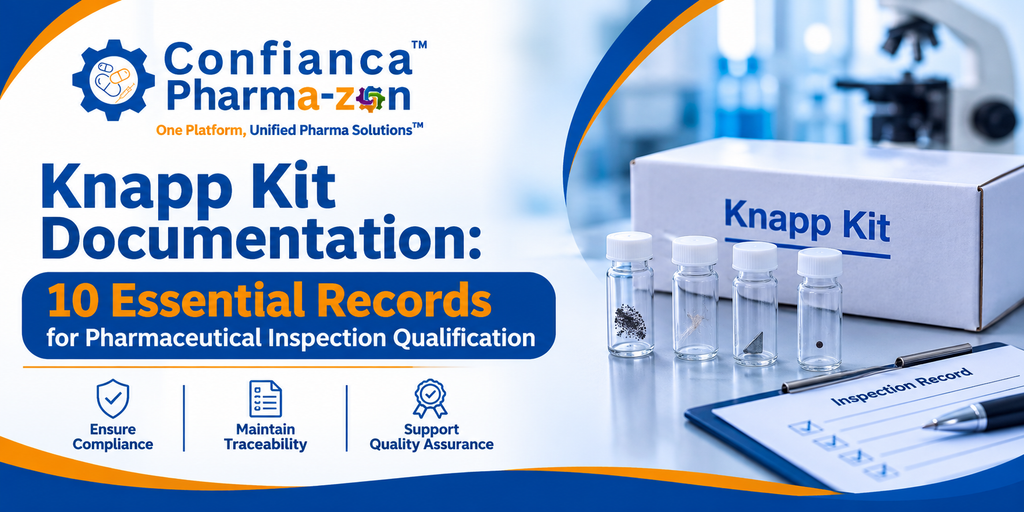
Knapp Kit Documentation: 10 Essential Records for Pharmaceutical Inspection Qualification
Introduction
Visual inspection is an important quality-control activity in pharmaceutical manufacturing, particularly for injectable products.
Even when a pharmaceutical facility has trained inspectors and suitable inspection equipment, maintaining consistent inspection performance requires more than conducting routine checks.
Organizations must establish documented procedures, controlled defect references, qualification records and traceable evidence demonstrating how their visual inspection programme is maintained.
This is where Knapp Kit Documentation becomes important.
A pharmaceutical Knapp Kit provides known defect samples that can be used to support visual inspection training, qualification and assessment activities. However, the value of a kit depends not only on the physical samples but also on the quality of its identification, certification, traceability and associated records.
This article explains ten essential documentation elements that pharmaceutical manufacturers should consider when establishing and maintaining a Knapp Kit programme.
1. Establish a Unique Knapp Kit Identification Record
Every Knapp Kit should have a unique identification reference.
This allows the organization to distinguish between different kits, inspection areas, production lines and qualification activities.
The identification record may include:
- Knapp Kit identification number.
- Kit name and description.
- Manufacturer or supplier details.
- Date of receipt.
- Date of initial inspection.
- Intended application.
- Storage location.
- Responsible department.
- Current status.
For example, a pharmaceutical manufacturer may maintain separate kits for vial inspection, prefilled syringe inspection and cartridge inspection.
Unique identification helps prevent confusion and supports traceability throughout the kit’s use.
2. Maintain a Complete Defect Inventory
A controlled defect inventory helps users understand exactly which defects are included in a particular Knapp Kit.
Depending on the kit design, the inventory may include:
Particulate Defects
- Black particles.
- White particles.
- Metallic particles.
- Glass particles.
- Fibers.
- Other specified particulate materials.
Non-Particulate Defects
- Cracked containers.
- Cosmetic defects.
- Container damage.
- Stopper-related defects.
- Fill-level variations.
- Other relevant visual defects.
Each defect should have an individual reference number or identification code.
The inventory should also indicate the container type, defect category and relevant characteristics.
This is particularly useful when conducting repeat qualification exercises.
3. Maintain Particle and Fibre Characterization Records
A Knapp Kit used for visual inspection qualification should have appropriate information about its particulate challenge materials.
Where applicable, records should identify:
- Particle material.
- Particle category.
- Colour.
- Approximate or characterized dimensions.
- Fibre type.
- Identification reference.
- Applicable certificate.
- Relevant characterization method.
Particle size information is particularly important because defect characteristics can influence visual detection.
For example, a metallic particle and a fibre may present different visual challenges even when their dimensions are comparable.
The documentation should avoid presenting unverified dimensions as certified measurements.
Where certification is supplied, it should be linked to the corresponding defect reference.
4. Maintain Defect-to-Container Traceability
A major documentation challenge is connecting the physical defect to its corresponding record.
The organization should be able to establish which defect is present in each individual container.
A suitable traceability record may include:
| Information | Purpose |
|---|---|
| Container ID | Unique sample identification |
| Defect ID | Identifies the challenge defect |
| Defect category | Particle or non-particle |
| Container type | Vial, syringe or cartridge |
| Characterization record | Supports defect identification |
| Kit reference | Links the sample to its parent kit |
| Status | Available, under review or retired |
This helps ensure that qualification results are associated with the correct challenge samples.
It also reduces the possibility of incorrectly recording an inspection result against another defect.
5. Maintain Inspection Qualification Protocols
A Knapp Kit should be used within a defined inspection qualification procedure.
The protocol should explain:
- Objective of the qualification.
- Scope of the inspection activity.
- Applicable product or container type.
- Inspection conditions.
- Lighting arrangement.
- Background conditions.
- Inspector preparation.
- Defect presentation method.
- Observation and recording procedure.
- Acceptance criteria.
- Result evaluation.
- Approval requirements.
For automated inspection systems, additional information may be necessary regarding equipment settings, challenge presentation and system response.
The protocol should be approved through the organization’s quality system before execution.
6. Document Inspector Training and Qualification
A Knapp Kit can support inspector training, but training and qualification records should be maintained separately from the physical kit inventory.
Useful records include:
- Inspector identification.
- Training date.
- Training material.
- Defects presented.
- Training instructor.
- Qualification protocol reference.
- Assessment results.
- Retraining requirements.
- Approval status.
A structured programme can also identify areas where inspectors require additional training.
For example, an inspector may perform well when identifying large black particles but experience difficulty with smaller fibres or low-contrast defects.
Such observations can guide targeted training.
7. Establish a Controlled Record of Kit Usage
A Knapp Kit should have a usage history.
A controlled usage log may record:
- Date of use.
- Purpose of use.
- Department.
- Inspector or operator.
- Protocol reference.
- Number of samples used.
- Condition before use.
- Condition after use.
- Any discrepancies.
- Reviewer approval.
This record helps demonstrate that the kit is being used according to the intended procedure.
It can also help identify repeated handling problems or damaged containers.
8. Define Inspection, Storage and Handling Controls
Physical condition is an important consideration for maintaining a Knapp Kit.
The kit should be stored in a manner that protects its contents and identification.
Recommended controls include:
- Use designated storage locations.
- Protect containers from impact.
- Avoid unnecessary handling.
- Maintain defect identification labels.
- Prevent mixing of different kits.
- Check container integrity.
- Protect particle-containing samples from unintended movement.
- Maintain storage conditions specified by the manufacturer.
The organization should also establish periodic condition checks based on risk and actual usage.
Any damaged, missing or unidentified sample should be evaluated before further use.
9. Establish Change Control and Requalification Assessment
A Knapp Kit programme should be reviewed when important changes occur.
Examples include:
- Addition of new defect types.
- Replacement of damaged samples.
- Changes in container format.
- Changes in inspection equipment.
- Modification of inspection conditions.
- Changes in qualification protocols.
- Updates to acceptance criteria.
- Introduction of new product presentations.
The quality unit should assess whether the change affects previous qualification evidence or requires additional evaluation.
The assessment and rationale should be documented.
Requalification frequency should be established through the organization’s approved procedures and risk assessment rather than relying on an arbitrary universal interval.
10. Prepare an Audit-Ready Documentation Package
A well-maintained Knapp Kit programme should have an organized documentation package.
The following checklist can help:
- Approved Knapp Kit specification.
- Unique kit identification.
- Defect inventory.
- Particle and fibre characterization records.
- Applicable certificates.
- Defect-to-container mapping.
- Inspection qualification protocol.
- Training records.
- Qualification reports.
- Usage history.
- Storage and condition inspection records.
- Deviation records.
- Change-control documentation.
- Requalification assessment.
- Retirement or replacement records.
The purpose is to demonstrate that the kit is controlled, suitable for its intended use and supported by traceable records.
How Knapp Kit Documentation Supports GMP Quality Systems
Documentation provides evidence that visual inspection activities are planned, executed and evaluated under controlled conditions.
A strong documentation system can support:
Quality Assurance
QA teams can review qualification activities and confirm that required approvals and records are available.
Quality Control
QC personnel can use controlled defect inventories and inspection protocols during practical assessments.
Production
Production departments can maintain consistent training and inspection practices.
Regulatory Audits
Auditors may request evidence showing how inspection systems and inspectors are qualified and monitored.
Continuous Improvement
Historical qualification records can help identify recurring inspection difficulties and opportunities for improvement.
Manual and Automated Visual Inspection: Documentation Considerations
Knapp Kits may support different inspection applications.
Manual Visual Inspection
For manual inspection, documentation may focus on:
- Inspector training.
- Inspection booth conditions.
- Background arrangement.
- Lighting conditions.
- Inspection procedure.
- Individual inspector performance.
- Qualification results.
Automated Visual Inspection
For automated systems, additional documentation may include:
- Equipment identification.
- Software or recipe reference.
- Inspection parameter configuration.
- Defect challenge identification.
- System detection results.
- False rejection observations.
- Challenge-test records.
- Equipment change history.
The documentation approach should reflect the actual inspection process and its associated risks.
Common Knapp Kit Documentation Mistakes
1. Missing Defect Identification
If individual defects cannot be traced to their corresponding records, qualification results may become difficult to verify.
2. Incomplete Particle Characterization Information
Unclear particle-size or material information can reduce confidence in the challenge sample.
3. Uncontrolled Kit Usage
Without a usage log, organizations may not know how frequently the kit has been handled or whether its condition has changed.
4. Missing Qualification Evidence
Having a Knapp Kit does not independently demonstrate that inspectors or automated systems have been qualified.
5. No Documented Change Assessment
Replacing a particle, container or defect sample without an appropriate assessment can affect the consistency of the qualification programme.
6. Poor Storage Controls
Improper storage can damage containers, labels or physical defect samples.
How Confianca Pharmazon Supports Pharmaceutical Visual Inspection Programmes
Confianca Pharmazon provides pharmaceutical visual inspection Knapp Kits and related solutions for manual and automated inspection applications.
Its product documentation describes defect materials that may include:
- Black particles.
- White particles.
- Metallic particles.
- Glass particles.
- Fibres.
- Other specified particulate defects.
Solutions can support inspection applications involving vials, cartridges and prefilled syringes, subject to the selected kit configuration.
Confianca Pharmazon also supports pharmaceutical manufacturers through visual inspection products, particle characterization services and related technical solutions.
The appropriate kit configuration and associated documentation should be evaluated according to the manufacturer’s qualification requirements.
Frequently Asked Questions (FAQs)
1. What is Knapp Kit documentation?
It refers to the records associated with a pharmaceutical visual inspection defect kit, including identification, inventory, characterization, certification, traceability, usage and qualification records.
2. Why are particle certificates important in Knapp Kits?
They can provide supporting information about the identity and characterized dimensions of particulate challenge materials, where applicable.
3. Does purchasing a Knapp Kit qualify an inspector?
No. A kit provides challenge samples. Inspector qualification requires an approved training and assessment programme with documented results.
4. What is a defect inventory?
It is a controlled list identifying the defects included in a Knapp Kit and linking them to their individual identification references.
5. Should Knapp Kits have unique identification numbers?
Yes. Unique identification supports inventory control, traceability, usage monitoring and qualification records.
6. How often should a Knapp Kit be inspected?
The organization should define an appropriate inspection frequency based on risk, supplier recommendations, usage and observed condition.
7. When should a Knapp Kit be replaced?
Replacement should be considered when the kit no longer meets its intended requirements, when defects become damaged or unidentified, or when its condition cannot be reliably established.
8. Can Knapp Kits be used for automated inspection qualification?
Appropriately configured defect kits can support automated visual inspection challenge activities, subject to system-specific protocols and qualification requirements.
Conclusion
A pharmaceutical Knapp Kit is more than a collection of defective containers. It is a supporting tool within a broader visual inspection training and qualification programme.
However, its effectiveness depends on controlled identification, appropriate defect characterization, traceability, storage, usage monitoring and documented qualification procedures.
By maintaining complete Knapp Kit Documentation, pharmaceutical manufacturers can strengthen inspection consistency, improve record management and provide clearer evidence during internal and external audits.
Confianca Pharmazon supports pharmaceutical manufacturers with visual inspection Knapp Kits, particulate defect solutions and related technical services designed for pharmaceutical inspection applications.