
No products in the cart.
Customized Pharmaceutical Knapp Kit: A Selection Guide
Introduction
Pharmaceutical visual inspection is a critical quality activity for products such as injectable solutions, lyophilized medicines, vials, ampoules, cartridges, and prefilled syringes. Inspection systems must be suitable for the products and defects they are intended to evaluate, and manufacturers need a structured approach to training personnel and assessing inspection performance.
However, not every pharmaceutical product presents the same inspection challenge.
A particle that is readily visible in a clear solution contained in a transparent vial may be more difficult to detect in a coloured formulation, a suspension, or a container with limited visibility. Similarly, a defect that can be recognized by a trained human inspector may interact differently with the lighting, imaging, and detection algorithms of an automated inspection machine.
This is why selecting a customized pharmaceutical Knapp Kit should begin with the product and qualification objective, rather than with a standard list of defects alone.
A properly designed kit can provide relevant challenge samples for a defined inspection task. Its usefulness depends on the representativeness of the defects, the container configuration, sample identification, supporting documentation, and the way the kit is incorporated into an approved inspection procedure.
This guide explains how pharmaceutical manufacturers can define their requirements and select a Knapp Kit that is appropriate for their product, inspection process, and quality-system needs.
What Is a Customized Pharmaceutical Knapp Kit?
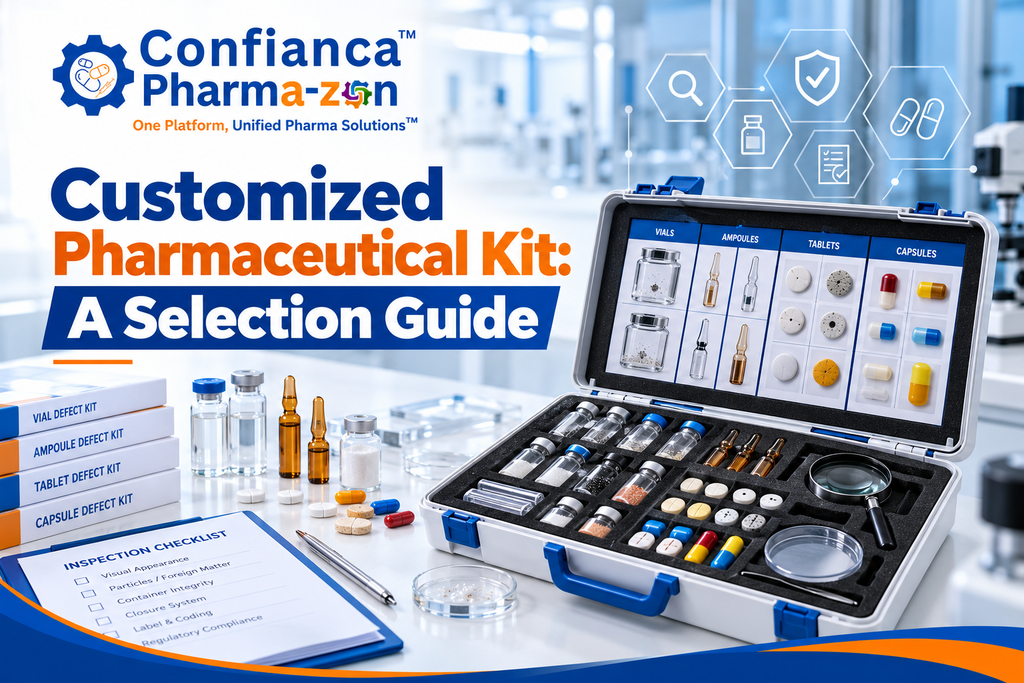
A pharmaceutical Knapp Kit is a controlled set of samples used to support visual inspection training, qualification, or performance evaluation. Depending on its intended use, it may include containers with known particulate defects, physical defects, cosmetic defects, and suitable reference or acceptable units.
A customized kit is prepared around a specific requirement rather than assuming that a single configuration will be appropriate for every product and inspection system.
Customization may involve:
- Product formulation and appearance
- Container type and size
- Particle or fiber categories
- Defect dimensions and characteristics
- Cosmetic and container defects
- Manual or automated inspection
- Sample identification and traceability
- Documentation and reporting requirements
The final configuration should be defined by the manufacturer’s approved protocol, intended use, and applicable quality requirements.
A customized kit does not automatically establish regulatory compliance. It provides challenge samples that can support a suitably designed and documented qualification or evaluation activity.
Why One Knapp Kit Configuration May Not Suit Every Product
1. Formulation affects defect visibility
The optical properties of the formulation can influence how easily a defect is detected.
Clear, transparent solutions may offer a different inspection challenge from coloured liquids, suspensions, emulsions, or products with naturally occurring visible structures.
Product movement, viscosity, contrast, background, and container geometry can also affect detection.
Consequently, the selection of challenge samples should reflect the actual product or a scientifically justified representative configuration.
2. Container geometry affects inspection
Different containers present different visual fields and handling requirements.
A vial, ampoule, cartridge, prefilled syringe, and IV bag may vary in wall thickness, curvature, transparency, dimensions, and available viewing angles.
A defect sample prepared for one container format may not be directly suitable for another. For example, the visibility of a particle may change when it is positioned against a curved surface or observed through a different optical path.
Container compatibility should therefore be confirmed during kit design.
3. Defect categories should reflect the intended evaluation
A kit designed primarily to challenge particulate detection may not adequately address other inspection objectives, such as container cracks, closure defects, or cosmetic abnormalities.
The defect list should be linked to the intended qualification or training activity.
It should also distinguish between particulate challenges and other physical defects so that the purpose of each sample is clear.
4. Manual and automated inspection have different needs
Manual visual inspection depends on the inspector, inspection conditions, viewing technique, product characteristics, and the nature of the defect.
Automated inspection introduces additional variables, including camera configuration, lighting, image-processing settings, container handling, detection algorithms, and rejection mechanisms.
A kit designed for manual inspection should not automatically be assumed suitable for machine qualification without evaluating the relevant requirements.
Step 1: Define the Qualification Objective
Before requesting a customized pharmaceutical Knapp Kit, establish what the kit must demonstrate.
Common objectives include:
Inspector training: Helping personnel learn to recognize relevant particulate and physical defects.
Initial inspector qualification: Evaluating an inspector’s performance against predefined acceptance criteria.
Periodic requalification: Assessing continued inspection capability according to an approved schedule or risk-based trigger.
Inspection-system evaluation: Challenging a manual, semi-automated, or automated inspection process using defined samples.
Machine qualification: Evaluating the detection performance of an automated system for specified defect types and operating conditions.
Investigation support: Providing relevant reference samples for a specific technical or inspection-related investigation, where appropriate.
These activities are related but not interchangeable. Training demonstrates practice and learning, while formal qualification requires a defined protocol, acceptance criteria, controlled execution, and documented review.
The supplier and pharmaceutical manufacturer should agree on the intended use before finalizing the kit specification.
Step 2: Select the Container Format
The kit specification should identify the container type and any relevant physical characteristics.
Typical formats include:
- Clear glass vials
- Amber glass vials
- Clear ampoules
- Cartridges
- Prefilled syringes
- IV bags
- Other product-specific packaging formats
The specification may also include nominal container volume, dimensions, material, closure configuration, and relevant handling characteristics.
Where the kit is intended to represent a particular product, the actual production container may be preferable when technically and practically suitable.
If an alternative container is used, its suitability should be justified. A visually similar container is not necessarily equivalent from an inspection-performance perspective.
For difficult-to-inspect products, container-specific challenges may be especially important.
Step 3: Establish the Defect Matrix
A defect matrix is a controlled list of the challenges included in the kit.
The matrix should identify each defect category, its intended purpose, the relevant sample or container identifier, and any specified characteristics needed for evaluation.
Particulate defects
Depending on the intended application, particulate samples may include:
- Glass particles
- Metallic particles
- Black particles
- White particles
- Elastomeric fragments
- Polymer fragments
- Fibers
- Other product-relevant particulate materials
The specific selection should be based on the product, known contamination risks, historical findings, and qualification objective.
Particle size should not be treated as the only factor determining visibility. Shape, colour, contrast, density, movement, formulation, and container characteristics can also influence detection.
Container and cosmetic defects
Where required, the kit may include challenges representing defects such as:
- Cracks or chips
- Scratches or surface damage
- Damaged or missing closure components
- Crimping or sealing abnormalities
- Fill-volume abnormalities
- Other relevant physical or cosmetic defects
These categories should be defined clearly enough that the person conducting the evaluation knows what each sample is intended to challenge.
A cosmetic defect should not automatically be classified as critical or major without reference to the site’s approved defect classification and product-specific risk assessment.
Good or acceptable reference units
Depending on the protocol, suitable acceptable units may be included to support evaluation of both detection and false rejection.
The appropriate sample composition should be established in advance. There is no universal reject percentage or sample count that automatically makes every Knapp Kit suitable for every application.
Step 4: Specify Particle Characteristics and Measurement Requirements
For kits containing particulate challenges, manufacturers should define which particle characteristics need to be measured and documented.
Relevant information may include:
- Particle or fiber category
- Measured dimensions
- Morphological characteristics
- Available microscopic images
- Measurement method
- Sample identification
- Applicable measurement limitations
Particle measurement is useful for characterizing the challenge sample, but it does not guarantee that the particle will be detected during visual inspection.
A particle’s physical dimensions and its visibility are different concepts. Two particles of similar measured size may have different detection characteristics because their shape, colour, orientation, and contrast differ.
Where measurements are used to support qualification decisions, the measurement method and its limitations should be appropriately documented.
The specification should also distinguish a measured particle dimension from a nominal target size or a visual-detection threshold.
Step 5: Match the Kit to Manual or Automated Inspection
Customized kits for manual visual inspection
Manual inspection kits should reflect the inspection procedure and the product presentation used by trained inspectors.
Relevant considerations include:
- Inspection background and lighting
- Defined inspection sequence
- Product handling and movement
- Inspection duration and rest requirements, where applicable
- Inspector identification
- Defect concealment and sample presentation
- Recording and evaluation of detection outcomes
The qualification protocol should define the number of inspections, acceptance criteria, and the method for evaluating results.
Sample presentation should be controlled to avoid unintended cues that make defects predictable.
Customized kits for automated visual inspection
Automated inspection systems may require samples with clearly defined defect characteristics and compatibility with the machine’s handling and imaging configuration.
The manufacturer should consider:
- Container dimensions and mechanical compatibility
- Camera and lighting configuration
- Relevant defect categories
- Defect orientation and presentation
- Machine recipes and operating settings
- Challenge sequence and sample traceability
- Detection and rejection records
- Repeatability and predefined acceptance criteria
Where possible, the qualification challenge should reflect the conditions under which the machine is intended to operate.
A machine’s ability to detect a defect under one setting does not automatically establish performance for every product, container, or defect category.
Changes to recipes, lighting, camera settings, hardware, or product formats may require an assessment of whether additional challenge testing is appropriate.
Step 6: Define Documentation and Traceability
A customized kit should be supported by documentation appropriate to its intended use.
Depending on the agreed scope, the documentation package may include:
- Kit identification and configuration
- Defect matrix
- Container and sample identification
- Particle characterization information, where applicable
- Relevant particle or fiber images
- Measurement records and supporting instrument information
- Preparation or seeding records, where applicable
- Handling and storage instructions
- Qualification protocol references
- Probability of Detection evaluation records, where included in the service
- Review and approval records
The exact documentation should be agreed upon before the kit is ordered or prepared.
Not every kit requires every document listed above. For example, a kit supplied for training may have a different documentation scope from one prepared for a formal qualification study.
Traceability is particularly important when the same kit is used repeatedly. Each challenge sample should remain identifiable, and any replacement or change should be assessed for its effect on the approved configuration.
Step 7: Understand Probability of Detection
Probability of Detection (POD) describes the likelihood that a defined inspection process detects a specified defect under defined conditions.
A simplified empirical calculation is:
Observed detection proportion = Number of successful detections ÷ Number of inspection opportunities
For example, if a particular defect is detected in 18 out of 20 defined inspection opportunities, the observed detection proportion is 90%.
This is an illustrative calculation, not a universal acceptance threshold.
A scientifically meaningful POD evaluation must define what constitutes an inspection opportunity, how repeated observations are handled, whether observations are independent, and how uncertainty is evaluated.
For formal qualification, acceptance criteria should be established in the approved protocol. A result from one defect or one inspector should not automatically be generalized to every defect, operator, product, or inspection system.
When a kit is intended for POD evaluation, clarify whether the supplier provides the physical samples only or also supports the study design, data collection, analysis, and reporting.
Step 8: Review Regulatory and Quality-System Expectations
Pharmaceutical visual inspection should be designed and controlled within the applicable regulatory and quality-system framework.
Relevant references include:
- USP General Chapter <790>, Visible Particulates in Injections
- USP General Chapter <1790>, Visual Inspection of Injections
- Applicable good manufacturing practice requirements
- The manufacturer’s approved visual inspection procedures
- Product-specific quality requirements and risk assessments
USP <790> addresses visible particulate inspection, while USP <1790> provides guidance on visual inspection of injections. USP also describes visual detection as a process influenced by product characteristics, particle characteristics, and container design. https://doi.org/10.31003/USPNF_M7197_01_01 and https://doi.org/10.31003/USPNF_M7198_06_01
The FDA’s draft guidance on the inspection of injectable products for visible particulates also discusses a holistic, risk-based approach to particulate control, investigation, and corrective action. It is explicitly identified as draft guidance and should not be represented as a finalized binding document. See the FDA guidance page.
A customized Knapp Kit supports the inspection program; it does not independently establish compliance. The manufacturer remains responsible for determining whether the overall procedure, qualification design, documentation, and acceptance criteria are appropriate.
Step 9: Establish Storage, Handling, and Lifecycle Controls
The kit should remain suitable for its intended use throughout its lifecycle.
A written procedure should address:
- Storage conditions appropriate to the samples and containers.
- Protection from damage, contamination, and unauthorized modification.
- Unique identification and controlled issue of samples.
- Periodic inspection for changes in condition.
- Documentation of damaged, missing, or replaced units.
- Review of kit suitability after relevant changes.
- Retention of associated qualification records.
There is no universal shelf life applicable to every customized Knapp Kit. Any assigned shelf life or requalification interval should be supported by the kit’s materials, stability or condition information, supplier documentation, and the manufacturer’s approved quality procedures.
If a challenge sample changes in a way that could affect its intended characteristics, the impact should be assessed before further use.
Common Mistakes When Ordering a Customized Pharmaceutical Knapp Kit
Selecting a kit based only on particle size
Particle dimensions matter, but they do not fully determine visual detectability. The defect’s appearance, formulation, container, and inspection conditions must also be considered.
Using the same configuration for different products without justification
A kit appropriate for one clear solution may not adequately challenge inspection of a different formulation or container.
Failing to define the intended use
Training, initial qualification, requalification, and automated-system evaluation have different objectives. The specification should identify which activity the kit is intended to support.
Assuming that a certificate alone proves qualification
A supplier’s certificate can document defined characteristics, but it does not replace an approved qualification protocol or evidence that the inspector or machine meets the specified criteria.
Ignoring sample identification and replacement controls
Unidentified samples, undocumented substitutions, and uncontrolled changes can undermine the traceability of qualification records.
Using predefined acceptance criteria without assessing suitability
Acceptance criteria should be justified for the intended use and approved through the relevant quality system rather than copied automatically from an unrelated kit or study.
How Confianca Pharmazon Supports Customized Knapp Kit Requirements
Confianca Pharmazon provides visual inspection Knapp Kits and defect kits for pharmaceutical applications involving formats such as vials, ampoules, cartridges, and prefilled syringes.
Depending on the agreed requirements, kit preparation and support may include particulate or cosmetic defect samples, particle characterization information, documentation, particle seeding support, and visual inspection training.
The most appropriate configuration depends on the product, container, intended inspection method, defect matrix, and qualification objective.
Before requesting a quotation, pharmaceutical manufacturers should prepare a concise requirement specification covering:
- Product and formulation type
- Container format and dimensions
- Manual or automated inspection application
- Required particulate and cosmetic defect categories
- Particle measurement or characterization needs
- Required documents and reporting
- Expected quantity and delivery requirements
This information helps establish a clear scope and reduces the risk of ordering a kit that does not adequately represent the intended inspection challenge.
Explore the Confianca Pharmazon Visual Inspection Knapp Kit for product information.
You can also read the Knapp Kit for Pharmaceutical Visual Inspection guide for broader information about defect detection and inspection qualification.
Frequently Asked Questions
What is a customized pharmaceutical Knapp Kit?
It is a visual inspection challenge kit configured for a defined pharmaceutical product, container format, defect matrix, and intended qualification or training objective.
Can a Knapp Kit be customized for prefilled syringes?
A kit may be designed for prefilled syringes when the sample configuration is compatible with the container and the intended inspection procedure. Relevant requirements should be confirmed before preparation.
What defects can be included in a customized Knapp Kit?
Depending on the specification, the kit may include glass, metal, polymeric, elastomeric, or other particulate defects, fibers, cracks, closure defects, and selected cosmetic abnormalities.
Can the same Knapp Kit be used for manual and automated inspection?
Not automatically. Suitability depends on the kit configuration, sample presentation, container compatibility, defect characteristics, and the requirements of each inspection process.
Does every Knapp Kit include POD analysis?
Not necessarily. The scope may cover the physical kit alone or include additional study support and POD evaluation documentation. These deliverables should be agreed upon before ordering.
How should a customized Knapp Kit be selected?
Start with the product and container, define the qualification objective, identify relevant defects, establish measurement and documentation requirements, and confirm compatibility with the intended inspection system.
How often should a Knapp Kit be replaced or requalified?
There is no single interval suitable for every kit. Review and replacement requirements should be established according to sample condition, intended use, documented suitability, and the manufacturer’s quality procedures.
Conclusion
Selecting a customized pharmaceutical Knapp Kit is a technical decision that should reflect the real inspection challenge.
The most useful kit is not necessarily the one containing the largest number of defects. It is the one whose samples, container formats, characterization records, and documentation are appropriate for the intended inspection procedure.
By defining requirements before ordering, maintaining traceability, evaluating sample suitability, and linking the kit to an approved qualification process, pharmaceutical manufacturers can build a more consistent and defensible visual inspection program.
Contact Confianca Pharmazon to discuss your requirements for customized visual inspection Knapp Kits, particulate defect samples, and qualification support.