
No products in the cart.
Knapp Kit for Pharmaceutical Visual Inspection: A Complete Guide to Defect Detection, Qualification, Particle Sizing, and Quality Control
Introduction
Pharmaceutical visual inspection is an essential part of quality control in the pharmaceutical industry, particularly for injectable products such as vials, ampoules, prefilled syringes, and cartridges. These products require careful examination to identify visible particulate matter, container defects, and other visible abnormalities that may affect product quality and patient safety.
A Knapp Kit for pharmaceutical visual inspection is used to support inspector training, visual inspection qualification, and the evaluation of manual and automatic inspection systems. By providing defined defect samples and associated documentation, an appropriately selected kit can help pharmaceutical manufacturers establish a structured approach to evaluating inspection performance.
However, effective visual inspection involves more than simply identifying a particle or detecting a visible defect. Manufacturers must also consider particle characteristics, container properties, inspection conditions, defect detectability, documentation, and predefined acceptance criteria.
This comprehensive guide explains what a Knapp Kit is, how it supports pharmaceutical visual inspection, why particle sizing and documentation matter, and how pharmaceutical manufacturers can select a suitable kit for their quality control and qualification requirements.
1. What Is a Knapp Kit?
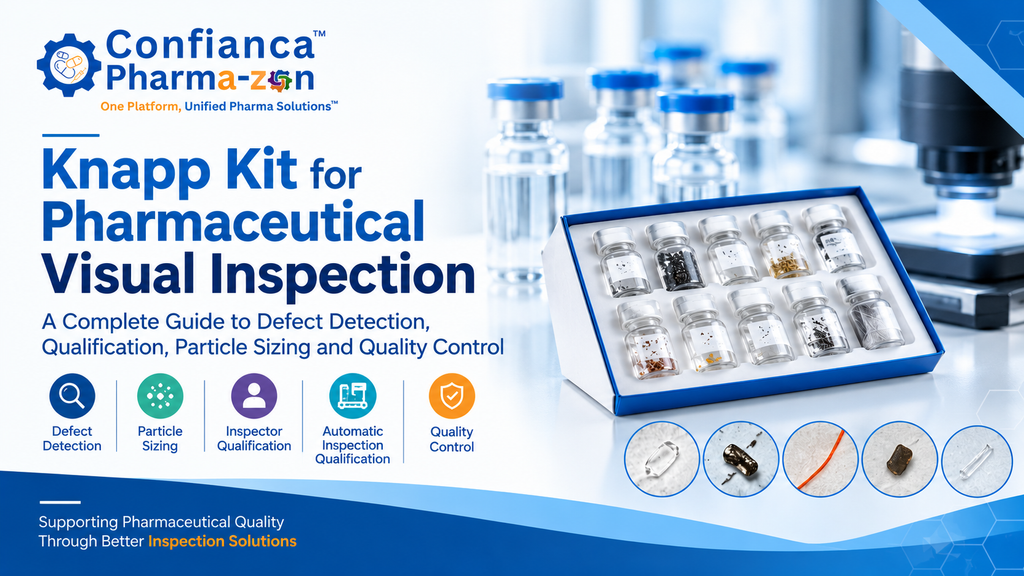
A Knapp Kit is a collection of reference samples designed to support pharmaceutical visual inspection activities. Depending on its configuration and intended application, it may contain containers with characterised particulate matter or other visible defects.
These samples can be used in structured inspection exercises to help assess whether trained personnel or inspection equipment can identify specified defects under defined conditions.
In pharmaceutical manufacturing, Knapp Kits are associated with the broader principles of visual inspection qualification and the evaluation of defect-detection performance.
The exact contents of a Knapp Kit vary according to the intended application, available sample configurations, and supporting documentation. Therefore, manufacturers should review the kit specifications before selecting it for a particular qualification programme.
Why is a Knapp Kit important?
A structured visual inspection programme requires appropriate challenge samples, documented procedures, and consistent evaluation methods.
A Knapp Kit can help organisations:
- Support manual visual inspection training.
- Evaluate inspector performance against predefined criteria.
- Challenge automatic visual inspection machines.
- Support inspection qualification and periodic requalification.
- Improve consistency in defect-recognition exercises.
- Maintain organised records of reference samples and inspection results.
- Identify opportunities for training and process improvement.
The kit is a supporting tool within the overall quality system. It does not independently establish that a product, inspection process, or machine is compliant with every applicable regulatory requirement.
2. Understanding Pharmaceutical Visual Inspection
Visual inspection is the process of examining a pharmaceutical product and its container for visible particles, physical defects, and other specified abnormalities.
For injectable products, visible particulate contamination is an important quality concern because particles may originate from raw materials, manufacturing operations, packaging components, equipment, or other sources.
The inspection programme must be designed according to the product, container, manufacturing process, and applicable quality requirements.
Manual visual inspection
Manual visual inspection involves trained personnel examining containers under defined conditions.
The inspection procedure may specify factors such as:
- Illumination and background conditions.
- Container presentation and handling.
- Inspection duration and sequence.
- Required inspection movements.
- Defect classification.
- Acceptance and rejection criteria.
- Inspector training and qualification requirements.
A suitable Knapp Kit can provide reference samples for training and performance assessment. It can help inspectors become familiar with different visible defect characteristics and support repeatable qualification exercises.
Automatic visual inspection
Automatic visual inspection systems use cameras, image-processing technology, and other equipment-specific methods to detect visible particles and container defects.
These systems may operate at production speeds and can be configured to inspect particular container formats and defect categories.
However, automated inspection performance can be affected by several factors, including:
- Particle size and contrast.
- Particle position and movement.
- Container geometry.
- Liquid appearance and formulation.
- Optical characteristics.
- Camera configuration and lighting.
- Machine settings and inspection algorithms.
- Container handling and presentation.
Appropriately selected Knapp Kit samples can be used to challenge an automatic visual inspection machine and assess its ability to detect specified defects under the defined test conditions.
Manual and automatic inspection are different processes, so the qualification protocol and challenge samples should reflect the intended method.
3. Types of Defects Relevant to Knapp Kit Selection
Understanding the types of defects that need to be detected is an important step when choosing a pharmaceutical defect kit.
The required samples depend on the product, container, manufacturing process, and intended inspection application.
3.1 Particulate matter
Particulate matter refers to discrete, mobile or otherwise visible foreign particles present in a product or container.
Depending on the application, reference samples may represent different particle materials, including:
- Glass particles.
- Metal particles.
- Rubber or elastomeric particles.
- Fibres.
- Other representative particulate materials.
Different materials can have different optical characteristics, shapes, colours, and densities. These differences may influence how easily the particles can be detected during visual inspection.
A qualification exercise should therefore consider the characteristics of the actual challenge samples rather than relying only on a general particle classification.
3.2 Glass particles
Glass particles may be relevant when evaluating visible contamination associated with glass containers, glass handling, or other potential sources.
Their detectability can depend on particle dimensions, transparency, shape, orientation, lighting, and the surrounding liquid.
The selected samples should be appropriate for the inspection method and the intended evaluation.
3.3 Metal particles
Metal particles may differ from other particles in their colour, reflectivity, shape, and optical contrast.
These characteristics can influence their visibility under different inspection conditions. Representative metal-particle samples may therefore be relevant to a defect-detection programme where this particle category is part of the defined risk assessment.
3.4 Rubber and elastomeric particles
Rubber and elastomeric materials may be relevant when considering potential contamination associated with closures, seals, or other product-contact components.
Their appearance can vary according to material composition, colour, shape, and dimensions. Inspection challenge samples should reflect the intended defect category and qualification objective.
3.5 Fibres and other particles
Fibres and other particulate materials can present different inspection challenges because of their shape, orientation, contrast, and movement.
Long, thin particles may behave differently from compact particles of similar overall dimensions. For this reason, particle size alone does not fully describe the visibility of a defect.
A well-planned visual inspection programme considers relevant particle characteristics alongside the inspection conditions.
3.6 Container and cosmetic defects
Some visual inspection programmes also evaluate visible container defects, such as cracks, chips, scratches, or other specified cosmetic abnormalities.
These defects are not the same as particulate contamination. They may require different reference samples and assessment criteria.
Before purchasing a Knapp Kit, manufacturers should confirm whether the required scope includes particulate samples, container defects, or both.
4. Why Particle Sizing Matters in a Knapp Kit
Particle sizing is an important aspect of characterising reference samples used in pharmaceutical visual inspection.
The dimensions of a particle can influence its visibility, but the relationship is not straightforward. Two particles with similar dimensions may have different detectability because of their material, colour, shape, transparency, orientation, or movement.
Particle size and visual detectability
The following factors can influence whether a particle is detected:
Particle dimensions: Larger particles may be easier to identify under certain conditions, but size alone does not guarantee detection.
Particle shape: Fibres, flakes, irregular fragments, and compact particles may produce different visual signals.
Particle material: Different materials may have different transparency, reflectivity, or colour characteristics.
Particle contrast: A particle that contrasts strongly with the surrounding liquid may be easier to see than a similar particle with low contrast.
Particle movement: Movement can change the particle’s position and appearance during inspection.
Container properties: Container size, wall thickness, shape, and optical properties can affect visibility.
Inspection conditions: Lighting, background, viewing angle, inspection duration, and the method of presentation can influence performance.
These factors demonstrate why particle sizing should be considered together with other sample characteristics.
The role of particle sizing documentation
Where applicable, particle sizing documentation can help identify and characterise reference samples.
Useful records may include:
- Sample identification.
- Particle dimensions or stated size range.
- Measurement method.
- Relevant microscopic images.
- Measurement records or certificates.
- Traceability between the physical sample and its documentation.
The availability and detail of these records depend on the specific kit configuration and agreed documentation package.
Pharmaceutical quality teams should review the available records and confirm that the reported measurements are appropriate for the intended use.
5. What Is Probability of Detection (POD)?
Probability of Detection, commonly abbreviated as POD, describes the probability that an inspection method will detect a specified defect under defined conditions.
It is an important concept when evaluating visual inspection performance because a single successful detection does not establish that a defect will always be detected.
For example, a particular particle may be detected during one inspection trial but missed during another. Repeated trials and an appropriate statistical approach can help characterise performance more reliably.
Factors affecting POD
POD can be influenced by:
- Particle dimensions and material.
- Particle shape and visual contrast.
- Product and container characteristics.
- Manual or automatic inspection method.
- Lighting and inspection conditions.
- Inspector training and experience.
- Machine configuration and operating settings.
- Inspection protocol and sample presentation.
POD is not an intrinsic value that applies universally to a particle regardless of the inspection system or conditions. It must be interpreted in the context of the method, sample population, and test procedure.
How Knapp Kit samples can support POD evaluation
When suitable for the intended study, reference samples can be used to challenge an inspection method under a defined protocol.
A structured evaluation may include:
- Identifying the defect categories to be evaluated.
- Confirming sample identity and available characterisation records.
- Establishing the inspection conditions.
- Defining the number and sequence of trials.
- Recording detection outcomes.
- Applying a suitable statistical method.
- Comparing the results with predefined acceptance criteria.
- Documenting conclusions, limitations, and any required corrective actions.
The exact study design should be justified for the application. A Knapp Kit does not automatically provide a statistically valid POD result simply because it contains reference defects.
6. Knapp Kit for Manual Visual Inspection Qualification
Manual visual inspection depends on people, inspection conditions, and the consistency of the procedure.
Even trained inspectors may differ in their ability to recognise particular defects. Training and qualification activities therefore need to be planned and documented.
Supporting inspector training
Knapp Kit reference samples can help inspectors become familiar with representative defect characteristics.
Training may cover:
- Recognition of different particle categories.
- Differences between particles and container defects.
- The influence of particle size, shape, and contrast.
- Correct handling and presentation of challenge samples.
- Application of the approved inspection procedure.
- Consistent recording of inspection outcomes.
The objective is to improve understanding and consistency rather than simply memorising a fixed set of samples.
Inspector qualification
A formal qualification exercise should use a predefined procedure and established acceptance criteria.
The programme may specify the sample set, inspection conditions, test sequence, performance calculation, and documentation requirements.
Results should be reviewed to identify whether the inspector meets the applicable criteria and whether additional training is required.
Periodic requalification
Organisations may also establish periodic requalification based on their quality system, risk assessment, and applicable requirements.
A suitable reference kit can help support repeatable exercises, provided that the samples remain suitable for use and their identity and condition are maintained.
Requalification requirements should be established by the organisation rather than assumed to be identical for every product or facility.
7. Knapp Kit for Automatic Visual Inspection Machine Qualification
Automatic visual inspection machines are often used when pharmaceutical manufacturers need to inspect large numbers of containers consistently.
However, the presence of an automated system does not eliminate the need to verify its performance.
The equipment must be evaluated against its intended use and the relevant defect categories.
Machine challenge testing
Appropriate challenge samples can be introduced into a defined test procedure to assess whether the system detects the intended defects.
The qualification plan should address:
- Compatibility with the machine and container format.
- Defect types included in the test.
- Sample identification and traceability.
- Machine settings and operating conditions.
- Sample presentation and handling.
- Detection and rejection outcomes.
- Acceptance criteria.
- Recording and review of deviations.
The test should be designed to produce meaningful evidence of performance under the specified conditions.
Why sample compatibility matters
A sample suitable for one inspection machine may not be suitable for another.
Differences in container geometry, transport mechanisms, camera arrangement, optical configuration, and inspection algorithms can affect sample presentation and defect detection.
Therefore, manufacturers should verify that the proposed Knapp Kit configuration is appropriate for the target equipment and the intended qualification protocol.
8. How to Choose the Right Knapp Kit for Your Application
Selecting a suitable Knapp Kit begins with understanding the actual requirement.
Rather than choosing a kit solely by its name or the number of samples included, pharmaceutical manufacturers should evaluate the complete application.
Step 1: Define the intended purpose
Determine whether the kit will be used for:
- Manual inspector training.
- Initial inspector qualification.
- Periodic requalification.
- Automatic inspection machine qualification.
- Defect-detection studies.
- A combination of these activities.
The intended purpose determines the relevant sample types, documentation, and test requirements.
Step 2: Identify the container format
Identify whether the application involves vials, ampoules, prefilled syringes, cartridges, or another container type.
Consider the container’s dimensions, material, shape, and compatibility with the inspection process.
Step 3: Define the required defect categories
Identify the particle materials, dimensions, and other defect characteristics relevant to the intended study.
If container defects are also required, confirm whether they are included in the proposed kit or need a separate reference set.
Step 4: Review particle characterisation
Review the particle sizing information and other available sample records.
Confirm that the documented characteristics support the intended evaluation and that each sample can be linked to its corresponding identification and records.
Step 5: Evaluate documentation requirements
Determine what supporting documentation is required by the organisation’s quality system.
This may include sample identification, sizing records, certificates, microscopy images, and relevant traceability information.
Do not assume that every kit automatically includes every document. Confirm the available documentation before purchase.
Step 6: Check compatibility with inspection equipment
For automatic visual inspection, review the equipment requirements and confirm that the proposed samples can be handled and evaluated appropriately.
For manual inspection, confirm that the samples are suitable for the intended training or qualification procedure.
Step 7: Establish the qualification protocol
Before conducting the exercise, define the test method, sample presentation, inspection conditions, acceptance criteria, result calculations, and documentation requirements.
The kit should support the protocol rather than determine the qualification criteria on its own.
9. Documentation and Traceability in Pharmaceutical Quality Control
Documentation is a key part of a controlled visual inspection programme.
Without clear records, it may be difficult to establish which reference sample was used, what defect it represented, or whether the observed results relate to the intended qualification exercise.
Important documentation elements
Depending on the kit and application, manufacturers may review the following:
Sample identification: Each reference sample should be identifiable according to the supplied labelling or documentation system.
Defect description: Records should describe the intended defect category and relevant characteristics.
Particle sizing records: Where supplied, measurements should be linked to the corresponding sample.
Microscopic images: Images may support the visual characterisation of particles and provide additional context for reviewing the sample.
Certificates and supporting records: Review the applicable certificates and records included in the agreed documentation package.
Inspection results: The qualification record should identify the test conditions, inspection outcomes, deviations, and conclusions.
Storage and handling records: Where required, these records help maintain sample condition and traceability.
Maintaining sample integrity
Reference samples should be stored, handled, transported, and maintained according to the supplier’s instructions and the organisation’s approved procedures.
Changes in sample condition may affect its suitability for the intended evaluation.
If a sample is damaged, its identity is uncertain, or its condition has changed, the organisation should assess whether it remains appropriate for use before including it in a qualification exercise.
10. Knapp Kit, Defect Kit, and Particle Reference Samples: Understanding the Difference
The terms Knapp Kit, defect kit, and particle reference samples may be used in related pharmaceutical inspection contexts, but they should not automatically be treated as interchangeable.
A Knapp Kit generally refers to a particular type of reference kit associated with visual inspection training or qualification.
A defect kit is a broader description that may refer to a collection of samples representing specified particulate or container defects.
Particle reference samples may be used to characterise or challenge inspection methods, depending on their design and documentation.
The actual distinction depends on the product specifications and intended use.
When comparing these options, review:
- Intended application.
- Defect types and materials.
- Particle dimensions and characterisation.
- Container compatibility.
- Available certificates and documentation.
- Suitability for manual or automatic inspection.
- Sample traceability.
- Compatibility with the planned qualification protocol.
The most appropriate selection is the one that meets the defined application and documentation requirements, not necessarily the kit with the largest number of samples.
11. Common Mistakes to Avoid When Selecting a Knapp Kit
A careful selection process can help prevent avoidable problems during training, qualification, and inspection-performance evaluation.
Choosing based only on particle size
Particle size is important, but visibility also depends on material, shape, contrast, orientation, and inspection conditions.
Consider the complete sample characteristics.
Ignoring container compatibility
A sample may be unsuitable for the intended machine or container format even when its defect characteristics appear relevant.
Verify physical and operational compatibility before use.
Assuming every kit includes the same documents
Documentation can vary by product and configuration.
Confirm the exact records, certificates, and characterisation information included with the proposed kit.
Using undefined acceptance criteria
Inspection results are meaningful only when they are assessed against appropriate, predefined criteria.
Establish the protocol and acceptance requirements before testing begins.
Treating one successful inspection as proof of consistent performance
A single detection event does not establish consistent defect-detection capability.
Where the study objective requires it, use an appropriate repeated-trial and statistical evaluation method.
Neglecting sample condition and traceability
Reference samples must remain identifiable and suitable for their intended use.
Follow appropriate storage, handling, inspection, and maintenance procedures.
12. The Role of Knapp Kits in Continuous Improvement
Visual inspection performance should be considered part of an ongoing quality improvement process.
Inspection results, training outcomes, and equipment qualification data may help organisations identify areas requiring additional investigation or improvement.
For example, recurring failures to detect a particular defect category may indicate a need to review training, inspection conditions, equipment settings, sample presentation, or the qualification procedure.
The results should be evaluated systematically to determine the underlying cause rather than assuming that every missed defect has the same explanation.
A suitable reference kit can contribute to this process by providing characterised challenge samples for structured evaluation.
When used with appropriate procedures, documented results, and scientifically justified criteria, these samples can help support more consistent inspection practices.
13. Regulatory and Quality Considerations
Pharmaceutical visual inspection is performed within a broader framework of product quality, contamination control, process validation, and quality risk management.
The specific requirements depend on the product, market, applicable regulations, and the organisation’s quality system.
A Knapp Kit may support defined training and qualification activities, but the presence of a kit or certificate does not automatically establish compliance with all applicable requirements.
Manufacturers should determine how the kit fits into their approved procedures and qualification strategy.
Relevant considerations may include:
- Documented risk assessment.
- Approved inspection procedures.
- Training and qualification records.
- Equipment qualification and performance verification.
- Defect classification and acceptance criteria.
- Traceable reference samples.
- Deviation management and corrective actions.
- Periodic review and requalification, where applicable.
The overall objective is to establish a controlled and documented inspection process that is suitable for its intended purpose.
14. Why Choose a Suitable Knapp Kit from Confianca Pharmazon?
Selecting a Knapp Kit involves more than comparing product descriptions. Pharmaceutical manufacturers need to consider the intended application, required defect categories, particle characterisation, equipment compatibility, and documentation expectations.
Confianca Pharmazon provides a point of contact for organisations evaluating Knapp Kit and pharmaceutical visual inspection requirements.
When assessing a kit for your facility, discuss the following details with your supplier:
- Required container format.
- Manual or automatic inspection application.
- Desired particle and defect categories.
- Particle sizing and characterisation requirements.
- Certificate and documentation expectations.
- Compatibility with the intended qualification protocol.
- Any specific requirements from your quality assurance or validation team.
Providing these details at the enquiry stage can help clarify whether the proposed kit matches the intended use.
Explore the product: Knapp Kit – Visual Inspection Kits, Particles and Particulate Matters
Contact Confianca Pharmazon to discuss your pharmaceutical visual inspection requirements and identify an appropriate solution for your application.
Frequently Asked Questions About Knapp Kits
1. What is a Knapp Kit in the pharmaceutical industry?
A Knapp Kit is a collection of reference samples used to support pharmaceutical visual inspection training, qualification, and inspection-performance evaluation. Its suitability depends on the supplied sample configuration and intended application.
2. What is a Knapp Kit used for?
A Knapp Kit can support manual inspector training, inspector qualification, automatic visual inspection machine challenges, and other defined defect-detection evaluation activities.
3. Can a Knapp Kit be used for injectable products?
A suitably configured kit may support visual inspection activities for injectable products. Compatibility with the relevant container, formulation, inspection method, and qualification objective should be confirmed before use.
4. Which particles can be included in a Knapp Kit?
Depending on the configuration, reference samples may represent glass, metal, rubber or elastomeric materials, fibres, and other particulate categories. The exact contents should be confirmed from the product specifications.
5. Why is particle sizing important for visual inspection qualification?
Particle sizing helps characterise reference defects and supports interpretation of inspection results. However, particle dimensions alone do not determine whether a defect will be detected.
6. What is POD in pharmaceutical visual inspection?
Probability of Detection (POD) describes the probability that an inspection method will detect a specified defect under defined conditions. Its evaluation requires an appropriate test design and interpretation of the results.
7. Can Knapp Kits support automatic visual inspection machines?
Appropriate kits can be used to challenge automated inspection equipment. The samples must be compatible with the equipment, container format, and intended qualification procedure.
8. What documentation should be available with a Knapp Kit?
Depending on the configuration, relevant documentation may include sample identification, defect descriptions, particle sizing records, certificates, microscopy images, and supporting traceability information. The supplied documentation should be verified before purchase.
9. How often should a Knapp Kit be used for qualification?
The frequency depends on the organisation’s approved procedures, intended use, risk assessment, and applicable requirements. There is no single frequency that should automatically be assumed suitable for every application.
10. Does purchasing a Knapp Kit guarantee regulatory compliance?
No. A Knapp Kit is a supporting tool. Compliance depends on the overall quality system, applicable requirements, approved procedures, suitable qualification activities, and documented evidence.
11. How do I select the right Knapp Kit?
Start by defining the inspection objective, container format, defect categories, particle characterisation requirements, documentation expectations, and inspection method. Then confirm the suitability of the proposed kit with the supplier.
12. Where can I enquire about a Knapp Kit?
You can review the Confianca Pharmazon Knapp Kit product page and contact the company to discuss your requirements.
Conclusion
A Knapp Kit can be a valuable supporting tool for pharmaceutical visual inspection when it is selected and used according to a clearly defined objective.
From manual inspector qualification to automatic visual inspection machine challenges, the effectiveness of a reference kit depends on its suitability for the intended application, the characteristics of the samples, the quality of the supporting documentation, and the design of the evaluation procedure.
Particle sizing, defect classification, sample traceability, and appropriate acceptance criteria all contribute to a structured inspection programme. By considering these factors before selecting a kit, pharmaceutical manufacturers can better align their reference samples with their quality control and qualification requirements.
The key is to choose a kit based on documented suitability rather than particle size or sample quantity alone.
Looking for a Knapp Kit for pharmaceutical visual inspection?
Visit Confianca Pharmazon to explore the product and discuss your requirements for pharmaceutical defect samples, particle characterisation, manual visual inspection, and automatic inspection machine qualification.
Confianca Pharmazon — Supporting pharmaceutical quality control and visual inspection solutions.