
No products in the cart.
Visual Inspection Defect Library: What Should It Contain for Pharmaceutical Manufacturing in India?
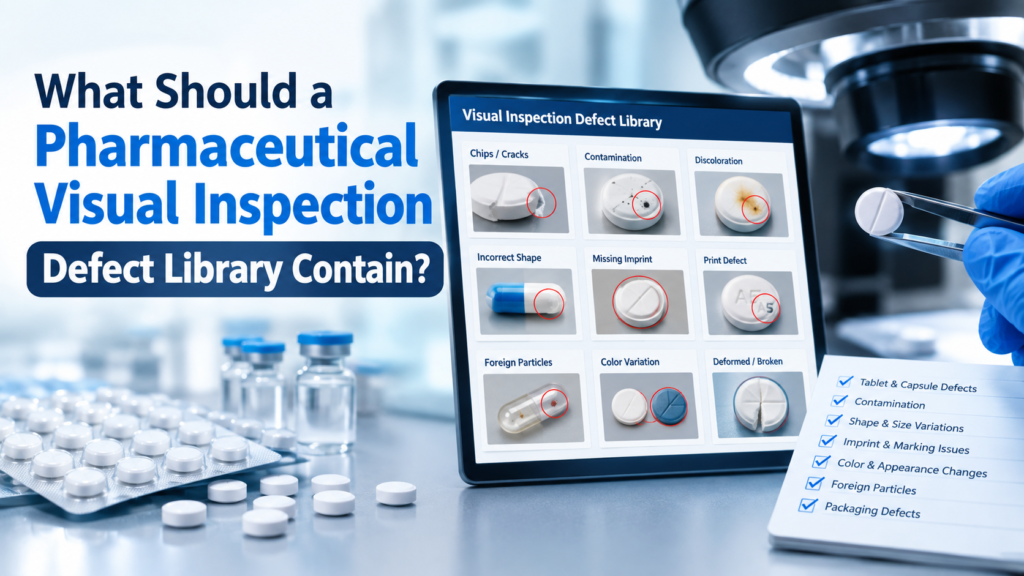
A pharmaceutical visual inspection program is only as strong as the challenges used to train, qualify and evaluate it.
Imagine an operator inspecting an injectable vial. The vial looks clear at first glance. But what happens if it contains a tiny glass particle? A fiber? A dark metal fragment? What if the container has a crack or the stopper is damaged?
These are not theoretical questions.
For parenteral products, visible particulate inspection is an important part of pharmaceutical quality control. USP <790> states that products intended for parenteral administration must be visually inspected for particulate matter and gives examples including fibers, glass, metal, elastomeric materials and precipitates.
This is why a well-designed visual inspection defect library can be an important resource for pharmaceutical manufacturers.
A defect library provides controlled examples of known defects that can be used for training, qualification, performance evaluation and, where appropriate, inspection-system challenges.
But what exactly should it contain?
The answer is more than simply “a collection of defective vials.”
A useful defect library should represent the types of challenges that are relevant to the product, container, manufacturing process and inspection technology.
What Is a Visual Inspection Defect Library?
A visual inspection defect library is a curated collection of known good and defective samples used to support a pharmaceutical visual inspection program.
Depending on the purpose, the library may contain:
- Particulate defects
- Fibers
- Container defects
- Closure defects
- Cosmetic defects
- Product or formulation-related abnormalities
- Different defect sizes
- Different container formats
- Representative good units
The purpose is to provide controlled and repeatable challenges.
Confianca Pharmazon describes its visual inspection defect and Knapp Kit offerings as covering liquid and lyophilized formulations in formats such as vials, cartridges and prefilled syringes, with particulate matter available in different micron-size ranges.
The key principle is:
Known defect → controlled inspection → recorded result → performance evaluation
This is fundamentally different from collecting random rejected production units and calling them a qualification library.
Why Does a Pharmaceutical Defect Library Matter?
Visual inspection is a probabilistic process.
USP <1790> explains that detection probability can vary depending on factors such as:
- Particle size
- Particle shape
- Particle color
- Particle density
- Dosage form
- Container design
- Inspection conditions
The chapter also notes that some products and packaging configurations are more difficult to inspect than clear solutions in transparent containers.
This has an important practical implication:
One defect sample does not represent every possible inspection challenge.
For example, a dark particle may be relatively easy to distinguish from a clear solution, while a small transparent or light-colored particle may present a different challenge.
Similarly, a long fiber behaves differently from a compact particle.
Therefore, a defect library should contain a range of representative challenges, rather than focusing on only one type of defect.
What Should a Visual Inspection Defect Library Contain?
A comprehensive library can be organized into several major categories.
1. Particulate Matter
Particulate matter is one of the most important categories for injectable visual inspection.
USP <790> identifies examples of visible particulate matter including:
- Glass
- Metal
- Fibers
- Elastomeric materials
- Precipitates
The exact defect categories included in an organization’s library should be based on its product and process risk assessment.
A pharmaceutical defect library may therefore include:
Glass particles
Glass is particularly relevant where pharmaceutical products are packaged in glass containers.
Challenge samples may be designed to represent different sizes and visual characteristics.
Metal particles
Metal particles can represent potential manufacturing or equipment-related contamination scenarios.
Black particles
Dark particles can provide a strong visual contrast against some formulations, making them useful for inspection challenges.
White or light-colored particles
These can create a different visual challenge, particularly when contrast with the product or background is limited.
Other relevant particulate matter
Depending on the manufacturing process, the library may include other representative particles relevant to the facility’s contamination risks.
Confianca Pharmazon’s product and educational material describes glass, metal, black and white particles as examples used in visual inspection challenge applications.
2. Fiber Defects
Fibers deserve their own category.
Unlike compact particles, fibers can have different:
- Lengths
- Thicknesses
- Colors
- Shapes
- Orientations
- Movement characteristics
A defect library may therefore contain examples such as:
- Black fibers
- White fibers
- Hair-like fibers
- Other representative fibers
Why is this important?
A fiber can change position as the container moves. Its elongated shape can also make it visually different from a small, compact particle.
USP <790> explicitly includes fibers among examples of visible particulate matter.
For this reason, fiber challenges can be useful when developing an inspection training and qualification program.
3. Container Defects
A visual inspection defect library should not focus exclusively on particles.
The container itself can have defects that require detection.
Examples may include:
- Cracks
- Broken containers
- Container damage
- Surface abnormalities
- Other relevant container defects
This becomes particularly important for injectable products because visual inspection can involve both the contents and the primary packaging.
Confianca Pharmazon’s visual inspection materials identify cracks and broken containers among the defect categories that can be incorporated into training and qualification applications.
Practical tip
When building your library, review actual manufacturing deviations and complaints.
If a particular container defect has occurred historically, it may deserve consideration for inclusion in the training or defect library.
4. Closure and Stopper Defects
The container closure system is another important inspection area.
Potential examples include:
- Damaged rubber stoppers
- Incorrect closure
- Open or defective seals
- Cap-related defects
- Closure abnormalities
The exact examples should reflect the packaging configuration used by the manufacturer.
For example, a manufacturer producing injectable vials may have different closure challenges from a facility producing prefilled syringes.
A visual inspection defect library India program should therefore be customized to the actual packaging formats used at the site.
5. Product and Formulation Defects
Not every visual abnormality originates from packaging or foreign particles.
Depending on the formulation, the library may also include product-related visual challenges.
Examples described in Confianca Pharmazon’s visual inspection material include:
- Wrong solution
- Crystallization
- Changes in product appearance
For liquid formulations, this could involve unexpected visual changes.
For lyophilized products, the visual inspection challenge may be different.
This is why the defect library should be connected to the product’s actual visual characteristics.
6. Cosmetic Defects
Cosmetic defects can also be considered where relevant to the inspection process.
Examples may include:
- Surface imperfections
- Container appearance abnormalities
- Label or presentation-related defects, where part of the defined inspection process
- Other visible abnormalities
Not every cosmetic defect should automatically become a qualification challenge.
The selection should be based on risk, product requirements, internal procedures and the purpose of the library.
7. Different Defect Sizes
A useful defect library should not necessarily contain defects of only one size.
USP <1790> makes clear that particle characteristics, including size, influence visual detection probability.
Therefore, a challenge strategy may consider:
- Smaller particles
- Larger particles
- Different shapes
- Different colors
- Different materials
Confianca Pharmazon states that its Knapp Kit offering can include particulate matter in different micron-size ranges.
Important consideration
Do not assume that “smaller” automatically means “better.”
The appropriate challenge size should be scientifically justified and relevant to the inspection objective.
8. Good or Acceptable Samples
A defect library should not necessarily consist only of defective units.
Good units can provide an important reference point.
They can help inspectors understand:
- What an acceptable unit looks like
- Normal product appearance
- Normal container appearance
- Expected closure configuration
- Normal visual variability
This can be especially useful during training.
The objective is to teach inspectors to distinguish acceptable variation from genuine defects.
9. Samples for Different Container Formats
Indian pharmaceutical manufacturers may produce multiple dosage forms and packaging configurations.
A facility may work with:
- Vials
- Ampoules
- Cartridges
- Prefilled syringes
A library designed for one format may not automatically be appropriate for another.
Confianca Pharmazon’s current product information describes visual inspection kits for liquid and lyophilized formulations across vial, cartridge and prefilled-syringe formats.
Therefore, the library should be organized according to the actual container formats that operators inspect.
10. Documentation and Traceability
This is one of the most overlooked parts of a defect library.
A physical sample is useful, but a properly controlled sample needs identification and traceability.
Documentation may include:
- Unique sample identification
- Defect description
- Defect type
- Particle material, where applicable
- Particle size or dimensions, where applicable
- Container information
- Preparation or seeding information
- Certificate or supporting documentation
- Date of preparation
- Storage requirements
- Validity or review information
- Inspection history
Confianca Pharmazon describes documentation such as master certificates and Probability of Detection evaluation sheets as part of its Knapp Kit ecosystem.
For an Indian pharmaceutical site, documentation should also fit the company’s own SOPs and quality-management system.
How to Build a Visual Inspection Defect Library in India
Creating a library should start with a risk-based assessment rather than simply purchasing the largest available kit.
Step 1: Identify Your Products
List the products requiring visual inspection.
For example:
- Liquid injectables
- Lyophilized injectables
- Biological products
- Ophthalmic products
- Other parenteral products
Step 2: Identify Container Formats
Document:
- Vial sizes
- Ampoules
- PFS
- Cartridges
- Closure types
Step 3: Review Historical Defects
Review:
- Deviations
- Rejected units
- Complaints
- CAPA records
- Manufacturing investigations
- Supplier issues
This can reveal which defect types are particularly relevant to your facility.
Step 4: Define Defect Categories
Create a matrix covering:
| Category | Examples |
|---|---|
| Particles | Glass, metal, black, white |
| Fibers | Black, white, hair-like |
| Container | Cracks, breaks, damage |
| Closure | Stopper, seal, cap defects |
| Product | Crystallization, wrong solution |
| Cosmetic | Relevant visible abnormalities |
Step 5: Define Qualification Purpose
Ask what the library will support:
- Training
- Initial qualification
- Periodic requalification
- Performance evaluation
- Manual inspection
- Automatic inspection
- POD studies
Step 6: Establish Acceptance Criteria
Define the expected performance before conducting qualification.
The acceptance criteria should be scientifically justified and approved through the organization’s quality system.
Manual vs Automatic Visual Inspection Defect Libraries
The inspection method also influences how the library is used.
Manual visual inspection
For manual inspection, samples can be used to assess whether trained inspectors detect known challenges under defined inspection conditions.
USP <1790> focuses substantially on manual reference inspection while also discussing semi-automated and automated approaches.
The qualification process may consider:
- Inspector training
- Inspection environment
- Lighting
- Background
- Inspection time
- Fatigue
- Defect characteristics
- Qualification results
Automatic visual inspection
Automated inspection requires a different challenge approach.
The machine may need to be challenged with representative defects to demonstrate its ability to detect the intended defect categories.
A Knapp Kit can be configured for manual and automatic visual inspection applications. Confianca Pharmazon specifically describes its Knapp Kits for both manual inspection and automatic visual inspection machines.
The key point is that the same physical sample should not automatically be assumed suitable for every inspection technology.
How Knapp Kits Fit Into a Defect Library
A Knapp Kit can serve as a controlled set of challenge samples within a broader visual inspection program.
Confianca Pharmazon describes Knapp Kits containing known particulate challenges and other defect categories for applications including inspector training, qualification and automatic inspection-machine assessment.
Potential applications include:
Inspector training
Operators learn to recognize relevant defects.
Inspector qualification
Known challenge samples are used to evaluate inspection performance.
Requalification
Existing inspectors can periodically be reassessed according to the site’s approved procedure.
Automatic machine qualification
Representative defects can be used to challenge an automated inspection system.
POD studies
Where scientifically appropriate, controlled samples can support Probability of Detection studies.
The important distinction is that the Knapp Kit is a tool within the qualification program, not the qualification program itself.
Five Tips for Maintaining a Pharmaceutical Defect Library
1. Keep the library relevant
Do not allow the library to become a collection of random defects.
Review it periodically against:
- Current products
- New container formats
- Deviations
- Complaints
- CAPA
- Inspection trends
2. Maintain traceability
Every challenge sample should have clear identification and appropriate documentation.
3. Control storage
Some samples may require specific handling and storage conditions.
Follow the supplier’s instructions and internal SOP.
4. Separate training from uncontrolled samples
Qualification samples should be controlled so that their identity and status are known to the appropriate personnel.
5. Review the library periodically
A defect library should evolve with the manufacturing process.
If the facility introduces a new PFS line, for example, the inspection library may need to be reviewed for relevance.
Example: Building a Defect Library for an Indian Injectable Manufacturer
Consider an Indian pharmaceutical company manufacturing a clear liquid injectable in glass vials.
The company identifies the following inspection risks:
Particulate risks
- Glass
- Metal
- Black particles
- Fibers
Container risks
- Cracks
- Broken containers
Closure risks
- Damaged stopper
- Seal-related defects
Product risks
- Crystallization
- Unexpected appearance
The QA team then develops a controlled library containing representative samples.
The samples are documented and identified.
Operators are trained using the library.
During qualification, selected challenge samples are introduced according to the approved protocol.
Results are recorded and reviewed.
The same library can then become a controlled resource for periodic training and requalification, subject to the organization’s procedures.
This approach creates a repeatable system rather than relying on whatever rejected samples happen to be available on the production floor.
Indian Regulatory Considerations
For Indian pharmaceutical manufacturers, visual inspection requirements should be interpreted alongside applicable GMP requirements, pharmacopoeial standards and the company’s approved procedures.
India’s Schedule M includes a specific requirement that individual containers of parenteral and ophthalmic preparations be examined against black/white backgrounds with diffused light after filling to ensure freedom from foreign matter.
USP <790> also establishes visual inspection expectations for parenteral products and identifies several categories of visible particulate matter.
USP <1790> adds important context by explaining that visual inspection performance depends on product, particle and container characteristics.
Therefore, an Indian pharmaceutical manufacturer should avoid treating a defect library as a generic checklist.
It should be integrated into the site’s:
- Risk assessment
- SOPs
- Training program
- Qualification protocol
- Defect classification
- Documentation system
- CAPA and investigation processes
Common Mistakes When Creating a Defect Library
Mistake 1: Including only particles
A visual inspection library should consider more than particulate matter where relevant.
Mistake 2: Ignoring container defects
Cracks and broken containers can be important inspection challenges.
Mistake 3: Using only large, obvious defects
A qualification exercise should be designed around relevant and scientifically justified challenges.
Mistake 4: Using irrelevant container formats
A vial challenge may not represent the inspection characteristics of a prefilled syringe.
Mistake 5: Poor documentation
An unidentified sample has limited value for a controlled qualification program.
Mistake 6: Treating a commercial kit as automatically compliant
A purchased kit does not, by itself, establish GMP compliance. Its configuration, use, qualification protocol, documentation and acceptance criteria all matter.
Visual Inspection Defect Library Checklist
Before finalizing your library, ask:
Product
- Are all relevant formulations identified?
- Are liquid and lyophilized products considered?
- Are product-specific visual challenges included?
Container
- Are relevant vial sizes covered?
- Are PFS or cartridges included where applicable?
- Are closure systems represented?
Defects
- Glass particles?
- Metal particles?
- Black particles?
- White particles?
- Fibers?
- Cracks?
- Broken containers?
- Stopper/closure defects?
- Product-specific abnormalities?
Qualification
- Training requirements defined?
- Qualification protocol approved?
- Requalification requirements defined?
- Manual or automatic application identified?
- Acceptance criteria documented?
Documentation
- Unique sample identification?
- Defect description?
- Particle information where applicable?
- Certificates?
- Traceability?
- Storage requirements?
Frequently Asked Questions
What is a visual inspection defect library?
A visual inspection defect library is a controlled collection of known good and defective pharmaceutical samples used for visual inspection training, qualification and performance evaluation.
What should a pharmaceutical defect library contain?
It may contain particulate matter, fibers, container defects, closure defects, cosmetic abnormalities, product-related defects and representative good samples. The exact contents should be based on product and process risk.
Is a Knapp Kit the same as a defect library?
Not necessarily. A Knapp Kit can function as a controlled challenge set within a broader defect-library and visual inspection qualification program. Its exact configuration depends on the intended application. Confianca Pharmazon describes Knapp Kits for both manual and automatic visual inspection applications.
Which particles should be included?
Potential examples include glass, metal, black and white particles, along with other relevant particulate materials. USP <790> identifies fibers, glass, metal, elastomeric materials and precipitates among examples of particulate matter.
Should fibers be included?
Where relevant to the product and contamination risks, yes. Fibers are specifically recognized as an example of particulate matter in USP <790>.
Should container defects be part of the library?
They can be. Cracks, broken containers and other relevant packaging defects may be important visual inspection challenges.
Can one defect library be used for manual and automatic inspection?
It depends on the samples and the qualification objective. Manual and automated systems have different inspection mechanisms, so the challenge strategy should be evaluated for each application.
How often should a defect library be reviewed?
The review frequency should be defined by the pharmaceutical company’s quality system. It is sensible to reassess the library when products, containers, manufacturing processes, inspection systems or historical defect trends change.
Conclusion: Build a Defect Library Around Real Inspection Risks
A well-designed visual inspection defect library is much more than a box of defective samples.
It should represent the actual challenges that pharmaceutical inspectors and inspection systems may encounter.
For Indian pharmaceutical manufacturers, this can include:
- Glass and metal particles
- Black and white particles
- Fibers
- Container cracks
- Broken containers
- Closure and stopper defects
- Product-specific visual abnormalities
- Different defect sizes
- Different container formats
- Appropriate good units
- Controlled documentation and traceability
USP <790> establishes the importance of visual inspection for parenteral products, while USP <1790> highlights why inspection performance varies with particle and container characteristics. India’s Schedule M also addresses examination of individual parenteral containers against black/white backgrounds with diffused light to ensure freedom from foreign matter.
For manufacturers, the practical lesson is straightforward:
Build the library around your products, packaging systems, historical defects and qualification objectives—not simply around the number of samples in the kit.
A properly selected visual inspection defect kit or Knapp Kit can then provide controlled challenge samples for training, qualification and inspection-system performance activities.
Confianca Pharmazon offers Knapp Kits and visual inspection defect kits covering applications such as manual and automatic inspection, different pharmaceutical container formats and particulate challenges in different size ranges.
Ready to strengthen your pharmaceutical visual inspection program? Explore the Knapp Kit and Visual Inspection Defect Kit range and select challenge samples according to your product, container and qualification requirements.
Your trusted partner for pharma skills, systems, and solutions.