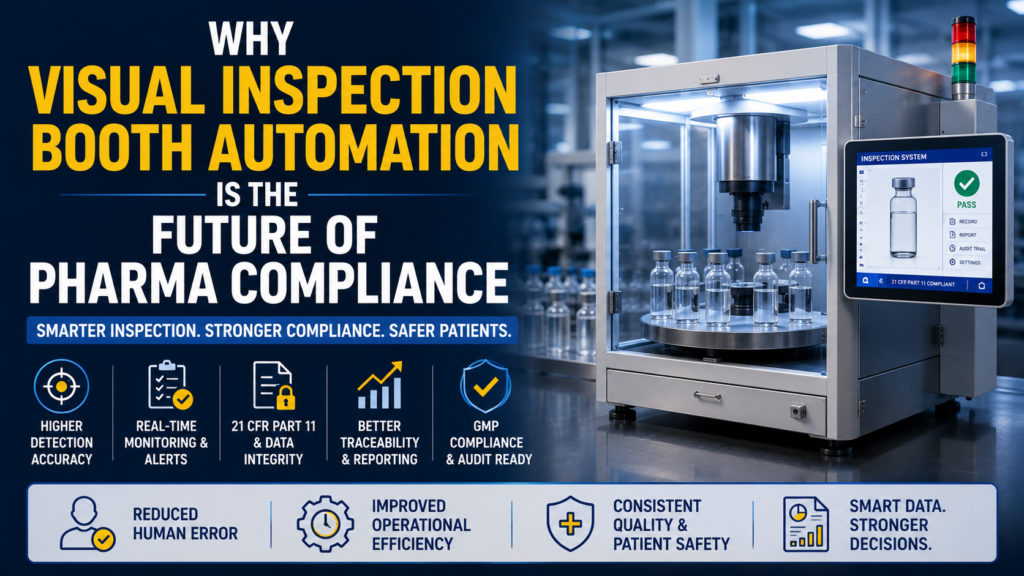
Why Visual Inspection Booth Automation is the Future of Pharma Compliance
Introduction
The pharmaceutical industry operates under some of the strictest regulatory requirements in the world. Every injectable vial, ampoule, cartridge, and prefilled syringe must meet stringent quality standards before reaching patients. Even a minor defect, particulate contamination, or packaging issue can lead to product recalls, regulatory observations, financial losses, and most importantly, risks to patient safety.
Traditionally, visual inspection has relied heavily on trained operators manually examining pharmaceutical products under controlled lighting conditions. While manual inspection remains important, increasing regulatory scrutiny, growing production volumes, and the need for data integrity have pushed manufacturers toward automation.
This is where Visual Inspection Booth Automation is changing the game.
Modern automated visual inspection booths are helping pharmaceutical companies improve inspection accuracy, ensure compliance with global regulations, enhance traceability, and significantly reduce human error. As regulators continue to emphasize data integrity and quality-by-design principles, automated inspection solutions are becoming a necessity rather than a luxury.
In this article, we will explore why Visual Inspection Booth Automation is becoming the future of pharma compliance and how manufacturers can benefit from adopting this technology.
What is Visual Inspection Booth Automation?
A visual inspection booth is a dedicated workstation designed to help inspectors identify visible defects in pharmaceutical products.
These defects may include:
- Glass particles
- Metal particles
- Black particles
- White particles
- Fibers
- Cracks
- Seal defects
- Cosmetic defects
- Container closure defects
- Product discoloration
Traditional booths provide:
- Black and white backgrounds
- Controlled lighting
- Magnifying lenses
- Adjustable workstations
Modern Visual Inspection Booth Automation goes much further by integrating:
- Digital monitoring systems
- Automated reporting
- Electronic records
- Real-time lux measurement
- Operator alerts
- Data logging
- Audit trails
- 21 CFR Part 11 compliance features
The result is a smarter, more compliant inspection environment that supports both operators and quality teams.
Why Manual Inspection Alone is No Longer Enough
Human Limitations Affect Inspection Accuracy
Even highly trained visual inspectors can experience:
- Eye fatigue
- Reduced concentration
- Inconsistent decision-making
- Environmental distractions
- Subjective judgment
Studies across the pharmaceutical industry have demonstrated that human detection capability decreases significantly when inspections are repetitive or prolonged.
As production volumes increase, these challenges become even more significant.
Regulatory Expectations are Increasing
Global regulatory agencies now expect manufacturers to demonstrate:
- Consistent inspection practices
- Traceable records
- Controlled environments
- Data integrity
- Evidence-based decision making
Manual documentation processes make achieving these requirements increasingly difficult.
This is one of the biggest reasons why Visual Inspection Booth Automation is gaining rapid adoption worldwide.
The Compliance Challenges Facing Pharma Manufacturers
Data Integrity Requirements
Regulatory authorities expect data to be:
- Attributable
- Legible
- Contemporaneous
- Original
- Accurate
Often referred to as ALCOA principles.
Manual records can be:
- Lost
- Misinterpreted
- Altered unintentionally
- Difficult to retrieve during audits
Automated systems create secure electronic records that improve compliance and traceability.
Audit Readiness
During inspections, auditors frequently ask:
- Who performed the inspection?
- Was the inspector qualified?
- Was the inspection environment controlled?
- Were lighting conditions validated?
- Were deviations documented?
Automated booths provide instant access to:
- Inspection records
- Audit trails
- Operator activity logs
- Environmental data
This dramatically improves audit preparedness.
Increasing Production Volumes
Pharmaceutical manufacturing is expanding rapidly worldwide.
More production means:
- More batches
- More inspections
- More documentation
- Greater compliance risks
Automation helps organizations scale quality operations without proportionally increasing inspection complexity.
Key Benefits of Visual Inspection Booth Automation
1. Improved Inspection Consistency
One of the biggest advantages of Visual Inspection Booth Automation is consistency.
Automated systems help standardize:
- Lighting conditions
- Inspection workflows
- Inspection timing
- Operator behavior
This reduces variability between inspectors and shifts.
Consistent inspections lead to more reliable product quality decisions.
2. Enhanced 21 CFR Part 11 Compliance
Electronic record requirements continue to grow in importance.
Modern automated inspection booths can provide:
- Electronic records
- Secure audit trails
- User access controls
- Electronic signatures
- Time-stamped activities
These features support compliance with:
- US FDA 21 CFR Part 11
- EU GMP Annex 11
- Data Integrity Guidelines
For regulated manufacturers, these capabilities are becoming essential.
3. Better Data Integrity
Data integrity is one of the most common areas cited during regulatory inspections.
Automation reduces risks associated with:
- Manual record entry
- Missing data
- Incorrect documentation
- Unauthorized changes
Every inspection activity becomes traceable and verifiable.
4. Reduced Human Error
Even experienced inspectors can miss defects due to fatigue.
Automated inspection environments support operators through:
- Standardized workflows
- Eye-rest reminders
- Audio alerts
- Controlled lighting
- Real-time monitoring
These improvements help reduce human-related variability.
5. Faster Investigations
When deviations occur, quality teams need answers quickly.
Automated systems make it easier to retrieve:
- Inspection histories
- Operator records
- Lighting validation records
- Product inspection outcomes
This accelerates root cause investigations and CAPA activities.
How Automated Visual Inspection Supports GMP Compliance
Controlled Inspection Environment
Good Manufacturing Practice (GMP) requires processes to be controlled and reproducible.
Automated inspection booths support GMP by ensuring:
- Validated lighting
- Defined backgrounds
- Standardized procedures
- Consistent operator conditions
These controls help maintain inspection reliability.
Qualification and Validation Support
Automated systems generate documentation that supports:
- Installation Qualification (IQ)
- Operational Qualification (OQ)
- Performance Qualification (PQ)
This documentation is valuable during inspections and audits.
Traceable Records
Regulators increasingly expect evidence.
Automated booths provide:
- Electronic logs
- User activity tracking
- Inspection history
- Environmental monitoring records
These records strengthen compliance programs.
The Role of Automation in Visual Inspector Qualification
Inspector qualification remains a critical requirement.
Automated booths can help manage:
- Qualification schedules
- Performance monitoring
- Training records
- Requalification reminders
When integrated with visual inspection training programs and Knapp Kits, automation creates a more robust qualification process.
This ensures inspectors remain competent and compliant over time.
Real-World Example
Consider a pharmaceutical company producing injectable products.
Before automation:
- Inspection records maintained manually
- Lighting verification performed manually
- Limited traceability
- Audit preparation required extensive effort
After implementing Visual Inspection Booth Automation:
- Inspection activities logged automatically
- Lux levels monitored digitally
- Operator performance tracked
- Audit reports generated instantly
Results included:
- Improved compliance
- Reduced documentation effort
- Faster audits
- Better inspection consistency
This is why many leading pharmaceutical manufacturers are investing in automation initiatives.
Features to Look for in an Automated Visual Inspection Booth
When selecting a solution, consider the following features:
Compliance Features
- 21 CFR Part 11 compliance
- Electronic signatures
- Audit trails
- User access control
Inspection Features
- Black and white background
- Adjustable lighting
- Magnifying lens
- Operator guidance
Monitoring Features
- Online lux measurement
- Real-time monitoring
- Alert systems
- Eye-rest reminders
Reporting Features
- Automated reports
- Data analytics
- Trend monitoring
- Audit-ready documentation
A well-designed system should support both operational efficiency and regulatory compliance.
Why Automation is the Future of Pharma Compliance
Several industry trends are accelerating adoption:
Industry 4.0 Initiatives
Pharmaceutical manufacturers are embracing:
- Smart manufacturing
- Digital transformation
- Connected systems
- Advanced analytics
Visual inspection automation aligns perfectly with these initiatives.
Data-Driven Quality Systems
Quality decisions increasingly rely on real-time data.
Automated inspection booths provide:
- Reliable data capture
- Trend analysis
- Compliance metrics
- Performance monitoring
This supports proactive quality management.
Regulatory Focus on Data Integrity
Data integrity observations continue to rise globally.
Automated systems help address these concerns by ensuring:
- Secure records
- Accurate documentation
- Controlled access
- Traceable activities
Growing Demand for Operational Excellence
Manufacturers are under pressure to:
- Improve efficiency
- Reduce costs
- Maintain compliance
- Enhance product quality
Automation supports all four objectives simultaneously.
Best Practices for Successful Implementation
To maximize benefits:
1. Conduct Risk Assessment
Evaluate current inspection challenges and compliance risks.
2. Train Inspectors Thoroughly
Technology should complement human expertise.
3. Validate the System
Ensure proper IQ, OQ, and PQ execution.
4. Integrate with Quality Systems
Connect inspection data with broader quality processes.
5. Monitor Performance Continuously
Use analytics to identify trends and improvement opportunities.
Frequently Asked Questions (FAQ)
What is Visual Inspection Booth Automation?
Visual Inspection Booth Automation is a technology-enabled inspection environment that combines controlled inspection conditions with electronic records, automated monitoring, audit trails, and compliance-focused features.
Why is visual inspection important in pharmaceuticals?
Visual inspection helps identify particulate contamination, cosmetic defects, cracks, and packaging issues that could impact patient safety and product quality.
How does automation improve pharma compliance?
Automation improves compliance by providing traceable records, secure audit trails, controlled inspection environments, and support for 21 CFR Part 11 requirements.
Can automated booths replace human inspectors?
No. Automation is designed to support and enhance inspector performance, not completely replace human judgment.
Is Visual Inspection Booth Automation suitable for injectable products?
Yes. Automated inspection booths are particularly valuable for injectable products where particulate contamination and defect detection are critical quality requirements.
Conclusion
The pharmaceutical industry is entering a new era where compliance, data integrity, and operational excellence are increasingly dependent on digital technologies.
Visual Inspection Booth Automation is no longer simply an efficiency improvement—it is becoming a strategic compliance tool. By enhancing inspection consistency, supporting 21 CFR Part 11 requirements, improving audit readiness, reducing human error, and strengthening data integrity, automated inspection solutions are helping pharmaceutical manufacturers meet the demands of modern regulatory environments.
Organizations that invest in automation today will be better positioned to maintain compliance, improve product quality, and protect patient safety in the years ahead.
Call to Action
Looking to modernize your visual inspection process and strengthen regulatory compliance?
Explore Confianca Pharmazon’s advanced Visual Inspection Booth Automation solutions designed specifically for pharmaceutical and biopharmaceutical manufacturing environments. From 21 CFR Part 11 compliant reporting and online lux measurement to operator support features and audit-ready documentation, our solutions help you achieve higher inspection accuracy and stronger compliance outcomes.
Visit the product page today to learn how your facility can benefit from next-generation inspection technology.
Your trusted partner for pharma skills, systems, and solutions.