
Visual Inspection in Pharma: Human vs Automated Visual Inspection – Which is Better for Quality and Compliance?
Introduction
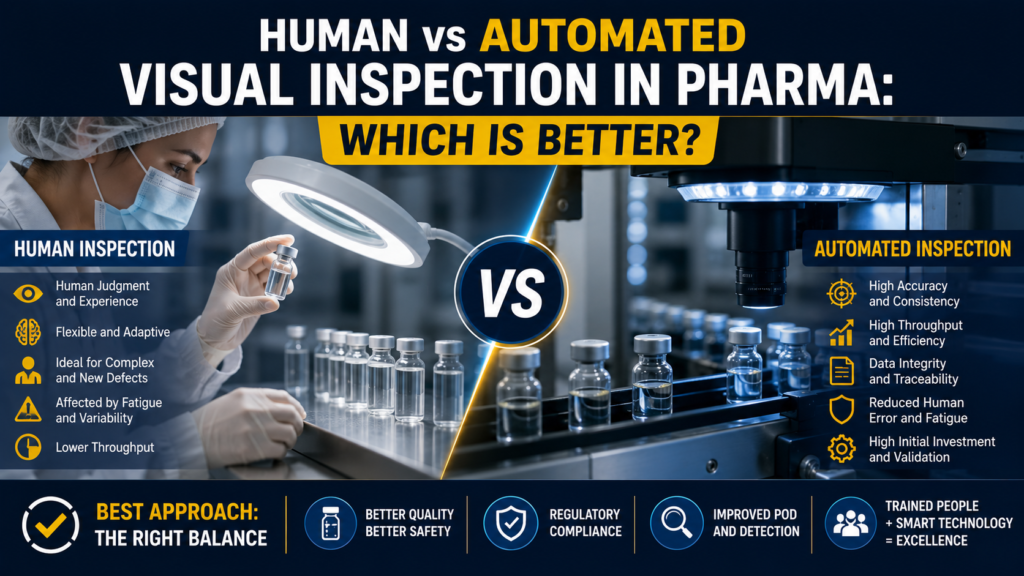
In the pharmaceutical industry, patient safety is non-negotiable. Every injectable vial, cartridge, prefilled syringe, or sterile product that reaches a patient must be free from visible defects and particulate contamination. This makes Visual Inspection in Pharma one of the most critical quality assurance activities in pharmaceutical manufacturing.
Regulatory agencies such as the FDA, EMA, MHRA, and WHO require manufacturers to ensure that injectable products are essentially free from visible particulate matter and defects before release to the market. Standards such as USP <790> and USP <1790> provide guidance on visual inspection processes and qualification requirements.
However, a common question remains:
Should pharmaceutical companies rely on manual visual inspection performed by trained inspectors, or should they invest in automated visual inspection systems?
The answer isn’t as straightforward as choosing one over the other.
In this article, we’ll compare human and automated inspection systems, discuss their strengths and weaknesses, and explain how organizations can build a robust inspection program using training tools such as Knapp Kits and defect libraries.
Why Visual Inspection Matters in Pharma
Before comparing the two approaches, it’s important to understand why Visual Inspection in Pharma is so critical.
The primary objective of visual inspection is to detect:
- Glass particles
- Metal particles
- Rubber fragments
- Fibers
- Cracks
- Cosmetic defects
- Improper filling levels
- Container closure defects
- Foreign particulate contamination
Failure to detect these defects can lead to:
- Product recalls
- Regulatory observations
- Warning letters
- Patient safety risks
- Brand reputation damage
According to industry studies, particulate contamination remains one of the leading causes of sterile product recalls worldwide.
Understanding Manual Visual Inspection
What is Manual Visual Inspection?
Manual visual inspection involves trained inspectors examining pharmaceutical containers under controlled lighting conditions to identify visible defects.
Inspectors typically inspect:
- Vials
- Ampoules
- Cartridges
- Prefilled syringes
- Lyophilized products
The process involves:
- Picking up the container
- Swirling or inverting it
- Viewing against black and white backgrounds
- Detecting particulate matter or defects
- Accepting or rejecting the product
Advantages of Manual Visual Inspection
1. Human Judgment
Humans can identify unusual defects that machines may not have been programmed to detect.
For example:
- Unexpected fibers
- Rare cosmetic defects
- Unusual particulate behavior
Experienced inspectors often recognize anomalies based on visual cues and prior experience.
2. Flexibility
Manual inspection can adapt quickly to:
- New product launches
- Small batch production
- Clinical trial products
- Customized packaging formats
No extensive machine reprogramming is required.
3. Lower Initial Investment
Compared to automated systems, manual inspection requires:
- Inspection booths
- Training programs
- Qualification kits
This makes it attractive for smaller manufacturers.
Limitations of Manual Visual Inspection
Despite its advantages, manual inspection has significant challenges.
1. Human Fatigue
Visual inspectors can experience:
- Eye strain
- Reduced concentration
- Fatigue-related errors
Research indicates that defect detection capability decreases after prolonged inspection sessions.
2. Subjective Decision Making
Two inspectors may evaluate the same defect differently.
Factors affecting performance include:
- Experience
- Training quality
- Lighting conditions
- Alertness level
This variability impacts consistency.
3. Lower Throughput
Manual inspection is significantly slower than automated systems.
Large-volume manufacturing facilities may struggle to meet production demands using only human inspectors.
Understanding Automated Visual Inspection
What is Automated Visual Inspection?
Automated Visual Inspection (AVI) uses advanced technologies such as:
- High-speed cameras
- Machine vision
- Artificial Intelligence
- Pattern recognition algorithms
- Motion analysis
These systems inspect pharmaceutical products automatically without direct human involvement.
How Automated Inspection Works
A typical system:
- Rotates the container
- Captures multiple images
- Processes images through software
- Detects defects
- Sorts accepted and rejected units
Modern systems can inspect hundreds of units per minute.
Advantages of Automated Visual Inspection
1. Consistency
Machines do not suffer from:
- Fatigue
- Mood variations
- Concentration loss
This provides consistent inspection performance.
2. High Throughput
Automated systems can inspect:
- Thousands of units per hour
- Multiple defect categories simultaneously
This is essential for commercial-scale sterile manufacturing.
3. Data Integrity
Modern systems generate:
- Electronic records
- Audit trails
- Performance reports
Supporting compliance with 21 CFR Part 11 requirements.
4. Better Trend Analysis
Manufacturers can:
- Track defect rates
- Identify recurring issues
- Improve manufacturing processes
This creates a proactive quality culture.
Limitations of Automated Visual Inspection
1. High Capital Investment
A complete automated inspection line may cost hundreds of thousands of dollars.
Costs include:
- Equipment
- Validation
- Maintenance
- Software upgrades
2. Complex Validation Requirements
Automated systems require:
- IQ
- OQ
- PQ
- Requalification
These activities demand significant resources.
3. Detection Challenges
Certain defects remain difficult to detect:
- Transparent particles
- Floating fibers
- Irregular contaminants
Human verification often remains necessary.
Human vs Automated Visual Inspection: Side-by-Side Comparison
| Factor | Manual Inspection | Automated Inspection |
|---|---|---|
| Initial Cost | Low | High |
| Throughput | Low | Very High |
| Flexibility | High | Moderate |
| Consistency | Moderate | High |
| Fatigue Risk | High | None |
| Data Integrity | Limited | Excellent |
| Validation Requirement | Low | High |
| Defect Adaptability | Excellent | Limited |
| Regulatory Acceptance | High | High |
| Scalability | Limited | Excellent |
Which Option Do Regulators Prefer?
Interestingly, regulators do not explicitly mandate one method over another.
What regulators expect is:
- Qualified inspectors
- Validated systems
- Documented procedures
- Defect detection effectiveness
- Patient safety assurance
USP <1790> emphasizes that both manual and automated inspection methods must demonstrate adequate performance and defect detection capability.
Therefore, success depends more on process robustness than on choosing human or machine inspection alone.
Why the Best Pharma Companies Use Both
Leading pharmaceutical companies rarely rely exclusively on either approach.
Instead, they implement a hybrid model:
Automated Inspection Handles:
- High-volume production
- Routine defect detection
- Data collection
Human Inspectors Handle:
- Investigation samples
- Borderline defects
- Qualification studies
- Periodic verification
This approach combines efficiency with human expertise.
The Critical Role of Knapp Kits in Visual Inspection
Regardless of whether inspection is manual or automated, training and qualification remain essential.
This is where Knapp Kits Visual Inspection solutions become invaluable.
Knapp Kits are specially designed defect kits containing:
- Certified glass particles
- Metal particles
- Black particles
- White particles
- Fibers
- Cosmetic defects
These kits help organizations:
- Train inspectors
- Conduct qualification studies
- Evaluate Probability of Detection (POD)
- Support regulatory inspections
Why Probability of Detection (POD) Matters
One of the most important metrics in Visual Inspection in Pharma is Probability of Detection (POD).
POD measures:
The likelihood that a defect will be correctly identified during inspection.
Factors affecting POD include:
- Particle size
- Container type
- Lighting conditions
- Inspector skill
- Product formulation
Using qualified defect libraries and Knapp Kits allows companies to scientifically assess and improve POD performance.
Building an Effective Visual Inspection Program
Step 1: Establish Qualified Procedures
Create SOPs covering:
- Inspection technique
- Rejection criteria
- Eye-rest requirements
- Lighting specifications
Step 2: Train Inspectors
Provide:
- USP <790> training
- USP <1790> training
- Defect recognition exercises
- Practical qualification sessions
Step 3: Use Defect Libraries
Maintain reference samples containing:
- Critical defects
- Major defects
- Minor defects
These improve consistency and inspector confidence.
Step 4: Conduct Regular Requalification
Inspectors should be requalified periodically using:
- Knapp Kits
- POD studies
- Blind sample testing
Step 5: Leverage Automation Strategically
Evaluate:
- Production volume
- Budget
- Product complexity
Then determine whether manual, automated, or hybrid inspection is most suitable.
Future Trends in Pharma Visual Inspection
The future of Automated Visual Inspection is rapidly evolving.
Emerging technologies include:
Artificial Intelligence
AI systems can learn from inspection data and improve defect recognition over time.
Machine Learning
Algorithms can detect subtle defect patterns previously missed by conventional systems.
Digital Twins
Virtual simulation models can optimize inspection performance before implementation.
Industry 4.0 Integration
Inspection data can be integrated with:
- MES systems
- Quality Management Systems
- Manufacturing analytics platforms
These advancements are transforming pharmaceutical quality assurance.
Frequently Asked Questions (FAQs)
Is automated visual inspection better than manual inspection?
Not always. Automated systems provide consistency and speed, while human inspectors offer flexibility and judgment. Most pharma companies use both.
What is a Knapp Kit?
A Knapp Kit is a certified defect training and qualification kit used for visual inspector training, POD studies, and regulatory readiness programs.
Why is visual inspection important in pharma?
It helps detect particulate contamination and defects that could compromise product quality, regulatory compliance, and patient safety.
What is USP <790>?
USP <790> provides requirements for visible particulate matter in injections.
What is Probability of Detection (POD)?
POD measures the likelihood that an inspector or system will correctly identify a defect during inspection.
Conclusion
The debate between manual and automated inspection is not about choosing a winner.
The real objective is ensuring patient safety, regulatory compliance, and product quality.
Visual Inspection in Pharma remains one of the most important quality control activities in sterile manufacturing. While automated systems offer speed, consistency, and traceability, trained inspectors provide critical judgment and flexibility.
The most successful pharmaceutical organizations combine both approaches while investing heavily in inspector training, qualification programs, defect libraries, and certified Knapp Kits. Confianca Pharmazon provides specialized Visual Inspection Knapp Kits, qualification kits, particulate matter standards, training programs, and regulatory support to help pharmaceutical companies strengthen their inspection processes and improve compliance readiness.
Ready to Strengthen Your Visual Inspection Program?
Explore Confianca Pharmazon’s Visual Inspection Knapp Kits, particulate matter standards, qualification kits, and expert training solutions to enhance defect detection, improve inspector qualification, and achieve regulatory excellence.
Your trusted partner for pharma skills, systems, and solutions.