
How Automated Visual Inspection Booths Improve GMP Readiness in Pharmaceutical Manufacturing
Introduction
In today’s pharmaceutical industry, maintaining GMP readiness is no longer just a regulatory requirement—it’s a business necessity. Regulatory agencies such as the US FDA, EU GMP, MHRA, and WHO continue to increase their focus on product quality, data integrity, contamination control, and inspection processes.
One area that directly impacts product quality and patient safety is visual inspection. Whether inspecting injectable vials, ampoules, cartridges, or pre-filled syringes, pharmaceutical manufacturers must ensure products are free from particulate matter, cosmetic defects, cracks, seal defects, and contamination.
Traditional inspection methods often depend heavily on operator skill, environmental conditions, and documentation practices. This is where Automated Visual Inspection Booths become a game-changing investment.
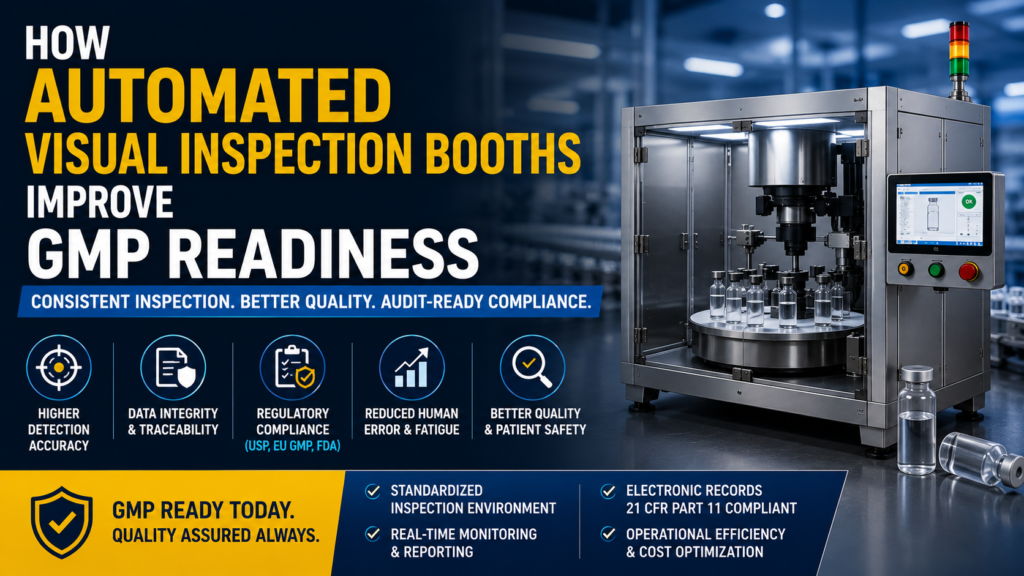
Modern visual inspection booth automation helps pharmaceutical companies create standardized inspection environments, improve defect detection rates, maintain compliance with GMP guidelines, and strengthen audit readiness.
In this article, we’ll explore how Automated Visual Inspection Booths enhance GMP readiness, improve inspection accuracy, and support regulatory compliance in pharmaceutical manufacturing.
Understanding GMP Readiness in Pharmaceutical Manufacturing
What Does GMP Readiness Mean?
Good Manufacturing Practice (GMP) readiness refers to an organization’s ability to consistently meet regulatory expectations related to:
- Product quality
- Patient safety
- Documentation
- Data integrity
- Process control
- Personnel qualification
- Equipment validation
- Contamination prevention
A GMP-ready facility can confidently face inspections and audits without scrambling to gather records or explain process inconsistencies.
Regulators expect manufacturers to demonstrate:
- Controlled manufacturing environments
- Qualified operators
- Validated systems
- Reliable inspection processes
- Accurate documentation
- Risk-based quality management
Visual inspection plays a significant role in all these areas.
Why Visual Inspection Matters in GMP Compliance
The Risk of Defective Products
Visible defects can have serious consequences:
Critical Defects
- Glass particles
- Metal particles
- Fiber contamination
- Cracks in vials
- Broken containers
- Seal integrity failures
Major Defects
- Cosmetic defects
- Cap defects
- Fill volume issues
- Labeling inconsistencies
Failure to detect these defects can lead to:
- Product recalls
- Regulatory observations
- Warning letters
- Customer complaints
- Patient safety risks
This is why regulators emphasize robust visual inspection programs aligned with USP <790>, USP <1790>, EU GMP Annex 1, and FDA expectations.
What Are Automated Visual Inspection Booths?
An Automated Visual Inspection Booth is a specialized inspection workstation designed to create a controlled and standardized environment for pharmaceutical product inspection.
These booths provide optimal lighting, background contrast, ergonomic support, and digital monitoring to improve defect detection and inspection consistency.
Modern systems include features such as:
- Black and white inspection backgrounds
- Standardized illumination
- Adjustable workstation height
- Magnifying lenses
- Online lux monitoring
- Rejection storage compartments
- Operator eye-rest alerts
- Digital data capture
- 21 CFR Part 11 compliance capabilities
Confianca Pharmazon’s visual inspection booth solutions are designed to support GMP-compliant pharmaceutical inspection processes and help manufacturers improve regulatory readiness. Their systems include standardized lighting environments, online lux measurement, operator support features, and 21 CFR Part 11-compliant reporting capabilities.
How Automated Visual Inspection Booths Improve GMP Readiness
1. Standardized Inspection Environment
One of the biggest challenges in manual inspection is environmental variability.
Different lighting conditions can dramatically affect defect visibility.
An automated booth ensures:
- Consistent lux levels
- Uniform backgrounds
- Controlled inspection conditions
- Repeatable inspection processes
This reduces operator-to-operator variation and strengthens process consistency.
GMP Benefit
Auditors prefer standardized and validated inspection environments because they reduce subjective decision-making.
2. Improved Detection of Particulate Matter
Particulate contamination remains one of the highest-risk quality concerns in sterile manufacturing.
Common contaminants include:
- Glass particles
- Metal fragments
- Rubber particles
- Black fibers
- White fibers
- Hair fibers
Advanced inspection booths improve visibility through:
- Optimized illumination
- Enhanced contrast backgrounds
- Controlled viewing angles
- Magnification systems
This helps inspectors detect smaller particles that might otherwise be missed.
GMP Benefit
Improved detection reduces the probability of releasing contaminated products into the market.
3. Better Compliance with USP 790 and USP 1790
USP <790> and USP <1790> emphasize:
- Visual inspection processes
- Inspector qualification
- Defect detection capability
- Environmental controls
An automated inspection booth supports these requirements by providing:
- Controlled lighting
- Standardized procedures
- Operator qualification support
- Consistent inspection conditions
Organizations implementing booth automation often experience improved inspector qualification results and better defect detection performance.
4. Enhanced Operator Performance
Human fatigue is one of the leading causes of visual inspection errors.
Inspectors often review thousands of units daily.
As fatigue increases:
- Attention decreases
- Defect detection drops
- False acceptance rates increase
Automated inspection booths improve ergonomics through:
- Adjustable workstation height
- Comfortable positioning
- Eye-rest reminders
- Reduced strain
This helps inspectors remain focused throughout their shifts.
GMP Benefit
Better operator performance directly improves product quality and compliance outcomes.
5. Support for Data Integrity Requirements
Regulators are increasingly focused on data integrity.
Manual records can create challenges such as:
- Missing entries
- Incomplete documentation
- Altered records
- Traceability gaps
Modern Automated Visual Inspection Booths can generate electronic records that support:
- Inspection traceability
- Audit trails
- Electronic signatures
- Secure data storage
GMP Benefit
Improved compliance with:
- 21 CFR Part 11
- EU Annex 11
- ALCOA+ principles
6. Improved Audit Readiness
Many pharmaceutical companies struggle during audits because inspection documentation is fragmented.
Automated systems simplify audit preparation by providing:
- Digital records
- Inspection history
- Qualification records
- Environmental monitoring data
- Lux measurement reports
Instead of manually collecting records, quality teams can quickly retrieve data.
GMP Benefit
Faster audit responses and stronger compliance confidence.
7. Reduction in Human Error
Human error remains one of the most common causes of deviations and audit observations.
Automation helps reduce:
- Incorrect defect classification
- Missed defects
- Documentation errors
- Inspection inconsistencies
Benefits include:
- Standardized workflows
- Guided inspections
- Automated alerts
- Digital reporting
GMP Benefit
Lower deviation rates and improved quality metrics.
8. Increased Inspection Consistency Across Sites
Global pharmaceutical companies often operate multiple manufacturing facilities.
Without standardization:
- Inspection practices vary
- Defect acceptance criteria differ
- Training quality fluctuates
Automated booth systems create consistency by ensuring:
- Uniform lighting
- Standardized workflows
- Common reporting structures
- Harmonized inspection procedures
GMP Benefit
Improved global quality system alignment.
Practical Example: Injectable Manufacturing Facility
Imagine a sterile injectable facility producing:
- Vaccines
- Biologics
- Injectable drugs
- Oncology products
The company experiences:
- Frequent audit observations
- High inspector variability
- Increased complaint rates
After implementing Automated Visual Inspection Booths, the facility achieves:
Results
✓ Standardized inspection conditions
✓ Improved particulate detection
✓ Faster inspector qualification
✓ Better documentation practices
✓ Reduced audit observations
✓ Enhanced GMP readiness
The investment not only improves compliance but also strengthens overall product quality.
Key Features to Look for in an Automated Visual Inspection Booth
When selecting a system, pharmaceutical manufacturers should evaluate:
Inspection Environment
- Black and white backgrounds
- Controlled illumination
- Lux monitoring
Ergonomics
- Adjustable height
- Comfortable workstation design
- Operator fatigue reduction
Compliance Features
- 21 CFR Part 11 support
- Electronic records
- Audit trail capability
Quality Enhancements
- Magnification systems
- Defect visualization support
- Rejection storage management
Reporting
- Automated reports
- Inspection history
- Data analytics
Best Practices for Successful Implementation
Train Inspectors Thoroughly
Even the best equipment requires skilled operators.
Training should include:
- Defect identification
- Inspection techniques
- GMP expectations
- Risk assessment
Establish Qualification Programs
Regular qualification ensures inspectors maintain proficiency.
Programs should evaluate:
- Defect recognition
- Detection rates
- Consistency
Monitor Performance Metrics
Track:
- Detection accuracy
- False reject rates
- Complaint trends
- Audit observations
Integrate with Quality Systems
Connect inspection data with:
- QMS
- CAPA systems
- Deviation management
- Training records
Future Trends in Visual Inspection Automation
The pharmaceutical industry is rapidly embracing Industry 4.0 technologies.
Emerging trends include:
Artificial Intelligence
AI-powered defect recognition can enhance detection accuracy.
Machine Learning
Systems continuously improve based on inspection data.
Digital Twins
Virtual simulations optimize inspection processes.
Real-Time Analytics
Managers gain immediate visibility into inspection performance.
Smart Compliance
Automated compliance reporting reduces manual effort.
Companies investing early in visual inspection automation will be better positioned for future regulatory expectations.
Frequently Asked Questions (FAQs)
What is an Automated Visual Inspection Booth?
An Automated Visual Inspection Booth is a GMP-compliant inspection workstation that provides controlled lighting, standardized backgrounds, ergonomic support, and digital documentation capabilities to improve pharmaceutical product inspection.
How do Automated Visual Inspection Booths support GMP compliance?
They provide standardized inspection environments, reduce human error, improve documentation, enhance defect detection, and support data integrity requirements.
Are visual inspection booths required by GMP regulations?
While regulations may not specifically mandate a booth, regulators expect controlled inspection conditions and validated inspection processes that booths help achieve.
What defects can be detected using visual inspection booths?
Common defects include:
- Glass particles
- Metal particles
- Fibers
- Cracks
- Cosmetic defects
- Seal integrity issues
- Fill defects
Do Automated Visual Inspection Booths support 21 CFR Part 11 compliance?
Modern systems can support electronic records, audit trails, and secure documentation practices that align with 21 CFR Part 11 requirements.
How do visual inspection booths improve audit readiness?
They provide standardized processes, digital records, inspection traceability, and easily retrievable documentation that auditors frequently request.
Conclusion
As pharmaceutical regulations continue to evolve, manufacturers must strengthen their quality systems and inspection processes to remain compliant and competitive.
Automated Visual Inspection Booths play a critical role in achieving this goal by providing standardized inspection environments, improving particulate detection, reducing human error, enhancing data integrity, and supporting regulatory compliance.
Organizations that invest in Automated Visual Inspection Booths not only improve GMP readiness but also strengthen patient safety, product quality, and operational excellence. With growing regulatory scrutiny and increasing expectations around data integrity and contamination control, visual inspection automation is quickly becoming an essential component of modern pharmaceutical manufacturing.
Ready to Improve Your GMP Readiness?
Discover Confianca Pharmazon’s advanced Visual Inspection Booth Automation solutions designed to support GMP compliance, inspection accuracy, audit readiness, and pharmaceutical quality excellence. Learn more about their visual inspection solutions and regulatory-focused product offerings.
Your trusted partner for pharma skills, systems, and solutions.