
Visual Inspection Defect Kit for Pharmaceutical Manufacturing: The Complete Guide for India
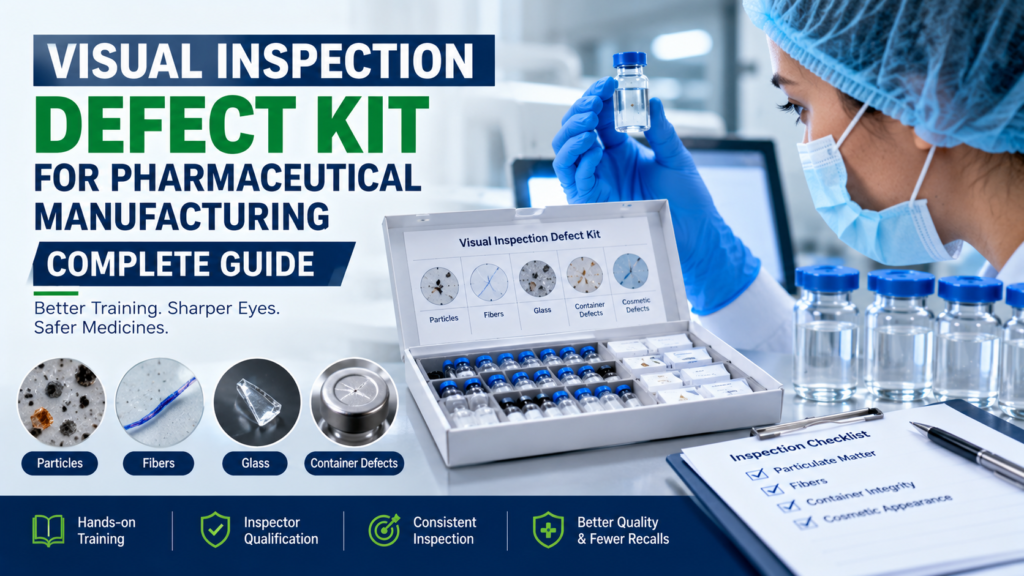
In pharmaceutical manufacturing, visual inspection is one of those activities that can appear simple but requires considerable skill, consistency, and control.
An inspector may be asked to examine vials, ampoules, syringes, cartridges, or other containers and determine whether a product contains visible particles, fibers, cracks, cosmetic defects, or other abnormalities.
The challenge is that visual inspection is performed by people, and people can interpret defects differently without structured training and qualification.
This is where a visual inspection defect kit becomes an important training and qualification resource.
A well-designed defect kit provides controlled examples of representative defects that inspectors can use during training, practice, qualification, and periodic reassessment. Instead of relying entirely on theoretical explanations or photographs, personnel can work with physical examples that help them understand what different defects may look like under inspection conditions.
For pharmaceutical manufacturers in India, this can be particularly useful when developing a consistent visual inspection program for injectable products.
This guide explains what a visual inspection defect kit is, why it matters, how it can support inspector qualification, which defect categories should be considered, and how pharmaceutical organizations can build a more structured visual inspection training program.
What Is a Visual Inspection Defect Kit?
A visual inspection defect kit is a collection of representative pharmaceutical inspection samples used to train and assess personnel responsible for visual inspection.
The samples can represent different types of defects that an inspector may encounter during routine inspection.
Depending on the kit and intended application, examples may include:
- Visible particulate matter
- Fibers
- Foreign particles
- Container defects
- Cosmetic defects
- Cracks
- Scratches
- Other inspection-relevant abnormalities
The purpose is not simply to show inspectors that defects exist.
The objective is to help personnel develop the ability to:
- Recognize relevant defects.
- Understand differences between acceptable and unacceptable conditions.
- Perform inspection consistently.
- Apply established inspection procedures.
- Demonstrate their inspection capability during qualification.
A physical reference sample can provide a more practical learning experience than relying solely on written descriptions.
Why Visual Inspection Matters in Pharmaceutical Manufacturing
Visual inspection plays an important role in pharmaceutical quality control, particularly for injectable products.
USP <790>, Visible Particulates in Injections, addresses visible particulate matter in injections and defines visible particulate matter as extraneous, mobile, undissolved particles unintentionally present in solutions.
USP <1790>, Visual Inspection of Injections, provides additional information on the broader visual inspection process, including factors that can affect inspection performance.
The important point for manufacturers is that visual inspection is not simply a matter of looking at a container.
Inspection performance can be influenced by factors such as:
- Lighting
- Background
- Container characteristics
- Particle characteristics
- Inspection procedure
- Inspector experience
- Fatigue
- Training
- Inspection environment
This makes structured training and qualification essential components of a controlled visual inspection program.
The Role of a Visual Inspection Defect Kit in Inspector Training
Imagine a new inspector joining an injectable manufacturing facility.
The inspector has read the SOP and understands the inspection procedure.
But knowing the procedure on paper does not necessarily mean the inspector can consistently recognize different physical defects.
A visual inspection defect kit gives the inspector an opportunity to practice with representative samples.
A typical learning progression can be:
Understand the procedure
↓
Observe representative defects
↓
Practice defect recognition
↓
Perform supervised inspections
↓
Demonstrate inspection capability
↓
Complete qualification according to the site’s approved procedure
This creates a more structured training pathway.
What Defects Should Inspectors Learn to Recognize?
The exact defect categories should be determined by the pharmaceutical site’s product, process, risk assessment, inspection procedure, and applicable requirements.
However, training programs may consider several broad categories.
1. Particulate Matter
Particles are among the most important considerations for injectable products.
They may include materials such as:
- Glass
- Metal
- Polymer
- Elastomer
- Fibers
- Other foreign materials
The appearance of a particle can vary considerably.
Factors such as color, size, shape, density, and movement can influence how easily it is detected.
2. Fibers
Fibers can have different visual characteristics from compact particles.
Their appearance may depend on:
- Length
- Thickness
- Color
- Shape
- Orientation
- Movement within the product
Including representative fiber defects in training can help inspectors become familiar with different visual presentations.
3. Glass-Related Defects
For products packaged in glass containers, inspection programs may need to consider potential glass-related abnormalities.
Training can help personnel understand the difference between:
- A visible particle
- A container-related defect
- A surface feature
- A true product-quality concern
The actual acceptance and rejection criteria must always come from the approved inspection procedure.
4. Container Defects
Visual inspection may also involve examining the container itself.
Examples can include:
- Cracks
- Chips
- Scratches
- Surface damage
- Abnormalities in container appearance
Training samples can help inspectors understand what types of conditions they are expected to recognize.
5. Cosmetic or Appearance Defects
Not every visual abnormality is necessarily a particulate defect.
Depending on the product and inspection specification, inspectors may need to distinguish between:
- Acceptable appearance variations
- Cosmetic defects
- Critical defects
- Major defects
- Particulate contamination
This is one reason documented defect classification and training are important.
Visual Inspection Defect Kit vs. Theoretical Training
Classroom training has an important role in pharmaceutical operations.
Inspectors need to understand:
- SOP requirements
- Inspection principles
- Acceptance criteria
- Safety requirements
- Documentation
- Qualification procedures
But theoretical knowledge alone may not provide sufficient exposure to real inspection scenarios.
A visual inspection defect kit can complement classroom learning by providing physical examples.
Consider the difference:
Theoretical training
“Inspectors should be able to identify visible foreign particles.”
Practical training
The inspector is presented with representative samples and asked to identify whether a visible defect is present according to the approved procedure.
The second approach creates an opportunity for hands-on practice and assessment.
How a Visual Inspection Defect Kit Supports Qualification
Qualification is different from basic training.
Training is intended to develop knowledge and skills.
Qualification is intended to provide documented evidence that an individual has demonstrated the required capability according to established criteria.
A visual inspection program may therefore use defect samples during qualification activities, subject to the organization’s approved protocol.
A structured approach might include:
Step 1: Define qualification requirements
Determine:
- Who needs qualification?
- Which products or container types are covered?
- Which defects need to be recognized?
- What are the acceptance criteria?
- How often is reassessment required?
Step 2: Prepare representative samples
Use controlled samples appropriate to the qualification program.
Step 3: Establish inspection conditions
Maintain the conditions specified in the approved procedure.
Step 4: Conduct the assessment
Present samples in a controlled manner without unintentionally revealing the expected result.
Step 5: Record results
Document:
- Inspector identification
- Date
- Sample identification
- Observation
- Result
- Qualification outcome
Step 6: Address failures
If an inspector does not meet the defined qualification criteria, follow the organization’s established investigation, retraining, and requalification process.
Why Standardized Defect Samples Matter
One of the biggest challenges in training is consistency.
If one instructor describes a defect as “small and dark” while another describes it differently, the learning experience can become subjective.
Standardized samples can provide a common reference.
This can help create consistency across:
- Training sessions
- Different instructors
- Different shifts
- Different manufacturing areas
- Initial qualification
- Periodic reassessment
A standardized reference set can also make discussions between Quality Assurance and training teams more concrete.
Instead of discussing an abstract defect, personnel can refer to a physical example.
Building an Effective Visual Inspection Training Program
A defect kit works best when it is integrated into a broader training system.
H3: 1. Start With Your Inspection Procedure
Before selecting training samples, understand the site’s actual inspection process.
Review:
- Product type
- Container format
- Inspection method
- Lighting requirements
- Background requirements
- Inspection duration
- Defect categories
- Acceptance criteria
The kit should support the procedure rather than operate independently from it.
H3: 2. Map Defects to Real Manufacturing Risks
Training should reflect realistic risks.
For example, if a facility has a significant focus on injectable products, particulate and container-related defects may deserve appropriate emphasis.
Create a matrix such as:
| Defect Category | Training Required | Qualification Relevance |
|---|---|---|
| Visible particles | Yes | Site-defined |
| Fibers | Yes | Site-defined |
| Glass-related defects | As applicable | Site-defined |
| Container defects | As applicable | Site-defined |
| Cosmetic defects | As applicable | Site-defined |
The final criteria should always be controlled by the organization’s quality system.
Manual Visual Inspection Requires Human Factors Management
A major reason training matters is that human performance can vary.
Visual inspection can be influenced by:
- Fatigue
- Repetition
- Attention
- Experience
- Environmental conditions
- Expectations
- Inspection speed
Therefore, a strong inspection program should address the human element rather than assuming that qualification is a one-time event.
Practical measures may include:
- Initial training
- Hands-on practice
- Qualification
- Periodic reassessment
- Refresher training
- Controlled inspection conditions
- Appropriate work-rest practices
- Trend monitoring
- Investigation of recurring inspection errors
A defect kit can support several of these activities.
Using Defect Kits for Periodic Refresher Training
Training should not necessarily end after initial qualification.
Organizations can establish refresher training based on their procedures, risk assessments, performance data, and applicable requirements.
A refresher session can use representative defects to revisit:
- Particle recognition
- Fiber recognition
- Container abnormalities
- Defect classification
- Inspection procedure
- Common mistakes
This can be particularly useful when:
- An inspector has not performed inspection for an extended period.
- A new product is introduced.
- The inspection process changes.
- Recurring inspection errors are identified.
- A deviation indicates a potential training gap.
How to Select a Pharmaceutical Visual Inspection Defect Kit
When evaluating a visual inspection defect kit, pharmaceutical companies should look beyond the number of samples included.
Consider the following factors.
1. Defect relevance
Does the kit include defects relevant to your inspection program?
2. Sample quality
Are the samples suitable for repeated controlled training and assessment?
3. Documentation
Is sufficient information supplied to support identification, control, and traceability?
4. Training application
Can the samples be incorporated into practical training exercises?
5. Qualification application
Can the kit support the organization’s qualification protocol?
6. Product relevance
Are the samples appropriate for the container and dosage forms being inspected?
7. Supplier support
Can the supplier provide technical information and assistance where needed?
Common Mistakes When Using Visual Inspection Defect Kits
Even a high-quality kit needs to be used correctly.
Mistake 1: Treating the kit as a replacement for the SOP
The kit is a training and qualification aid. It should not replace the approved inspection procedure.
Mistake 2: Using only easy-to-see defects
Training should reflect the range of relevant inspection challenges defined by the organization’s program.
Mistake 3: Not controlling samples
Samples should be appropriately identified, stored, and managed.
Mistake 4: Failing to document training
Training and qualification activities should be documented according to the site’s quality system.
Mistake 5: Treating qualification as permanent
Organizations should follow their established requirements for periodic reassessment and requalification.
A Practical Example: Training an Injectable Product Inspector
Consider an Indian pharmaceutical facility manufacturing sterile injectable products.
A new visual inspection operator is assigned to the inspection area.
Week 1: Classroom learning
The operator learns:
- Inspection SOP
- Product characteristics
- Defect categories
- Inspection conditions
- Acceptance criteria
- Documentation requirements
Week 2: Practical training
The operator works with representative samples from a visual inspection defect kit.
The trainer introduces different defect types and discusses their characteristics.
Week 3: Supervised practice
The operator performs inspections under controlled conditions.
Errors are reviewed and discussed.
Qualification
The operator undergoes the site’s documented qualification assessment using controlled samples and predefined criteria.
Ongoing monitoring
The operator participates in refresher training and reassessment according to the organization’s established program.
This creates a more structured connection between knowledge, practice and demonstrated performance.
The Importance of Documentation and Traceability
Pharmaceutical training activities should be supported by appropriate documentation.
For a defect-kit-based training or qualification exercise, records may include:
- Kit identification
- Sample identification
- Training date
- Trainer
- Trainee
- Procedure or protocol reference
- Inspection conditions
- Results
- Qualification status
- Retraining requirements, if applicable
Good documentation helps demonstrate that the training process is controlled and reproducible.
It can also make internal audits and quality reviews easier.
Visual Inspection Defect Kits and Quality Culture
A strong visual inspection program is more than compliance paperwork.
It helps build a quality culture where inspectors understand why their work matters.
A defect that appears tiny to the naked eye may have significant implications depending on the product and defect type.
Practical training helps connect the inspector’s daily activity with the larger pharmaceutical quality system.
The message is simple:
Every inspection decision matters.
A structured visual inspection defect kit can help make that principle practical by giving personnel an opportunity to see, recognize, discuss, and assess representative defects.
FAQ: Visual Inspection Defect Kits for Pharmaceutical Manufacturing
What is a visual inspection defect kit?
A visual inspection defect kit is a collection of representative samples used to support training, practice, and potentially qualification of personnel involved in pharmaceutical visual inspection.
Why do pharmaceutical companies use defect kits?
They can provide hands-on exposure to representative defects and help create a more consistent training and assessment process.
Are visual inspection defect kits required by USP <790>?
USP <790> establishes requirements and principles related to visible particulate matter in injections. It does not simply state that every manufacturer must purchase a particular commercial defect kit. Manufacturers should establish suitable training and qualification controls within their quality systems and applicable requirements.
Can a defect kit be used for inspector qualification?
It can support qualification activities when incorporated into an appropriately designed and approved qualification protocol.
What types of defects can be included?
Depending on the kit and application, examples may include particles, fibers, glass-related defects, container defects, and other inspection-relevant abnormalities.
Can the same kit be used for training and qualification?
Potentially, but the organization should establish appropriate controls to ensure that training and qualification remain objective, controlled, and consistent with its approved procedures.
How often should visual inspection personnel be retrained?
The appropriate frequency depends on the organization’s procedures, risk assessment, regulatory expectations, performance data, and other applicable requirements. Refresher training may also be triggered by process changes, deviations, or identified training gaps.
Does a defect kit replace automated visual inspection?
No. Manual and automated inspection are different approaches. A defect kit is primarily useful for training and assessment of personnel and can also support understanding of defect characteristics relevant to inspection systems.
Best Practices Checklist for Indian Pharmaceutical Manufacturers
Before implementing or reviewing a visual inspection training program, consider this checklist:
Inspection procedure
- Current SOP is approved and available.
- Inspection conditions are clearly defined.
- Defect categories are documented.
- Acceptance/rejection criteria are established.
Training
- Personnel receive theoretical training.
- Hands-on defect recognition is included.
- Representative samples are used.
- Training results are documented.
Qualification
- Qualification criteria are predefined.
- Samples are controlled.
- Results are recorded.
- Failed qualification is handled through an established process.
- Requalification requirements are defined.
Continuous improvement
- Inspection errors are monitored.
- Training gaps are investigated.
- Refresher training is performed when appropriate.
- Defect trends are reviewed.
How Knapp Kits Can Support Visual Inspection Training
For pharmaceutical organizations looking for structured physical examples for visual inspection training and qualification, Knapp kits can be considered as part of a broader visual inspection training strategy.
A suitable defect kit can help training teams create practical exercises around defect recognition rather than relying exclusively on classroom explanations.
The important consideration is how the kit fits into your organization’s:
- Inspection SOP
- Training program
- Qualification protocol
- Defect classification system
- Quality management system
- Applicable regulatory requirements
The kit should be treated as a controlled training resource rather than as a standalone substitute for the pharmaceutical manufacturer’s inspection procedures.
Conclusion: Build a More Consistent Visual Inspection Program
Visual inspection is a critical quality activity for pharmaceutical manufacturing, particularly for injectable products.
However, consistent inspection requires more than simply instructing an operator to “look carefully.”
Personnel need knowledge, practical experience, appropriate inspection conditions, clear defect definitions, and a structured qualification process.
A visual inspection defect kit can provide valuable physical examples that help bridge the gap between theoretical learning and practical defect recognition.
For Indian pharmaceutical manufacturers, integrating representative defect samples into a controlled training and qualification program can support:
- Better hands-on learning
- Consistent defect recognition
- Structured inspector qualification
- Refresher training
- Practical assessment
- Stronger training documentation
The most effective approach is to combine the defect kit with a well-defined SOP, appropriate inspection conditions, documented training, qualification criteria, and ongoing quality oversight.
If your organization is looking for a practical resource for pharmaceutical visual inspection training and qualification, explore Knapp Kits – Visual Inspection Defect Kits to understand how the product can fit into your inspection training program.
Your trusted partner for pharma skills, systems, and solutions.