
Effective Root Cause Analysis of Foreign Particles in Pharmaceutical Manufacturing: A Practical Guide for India
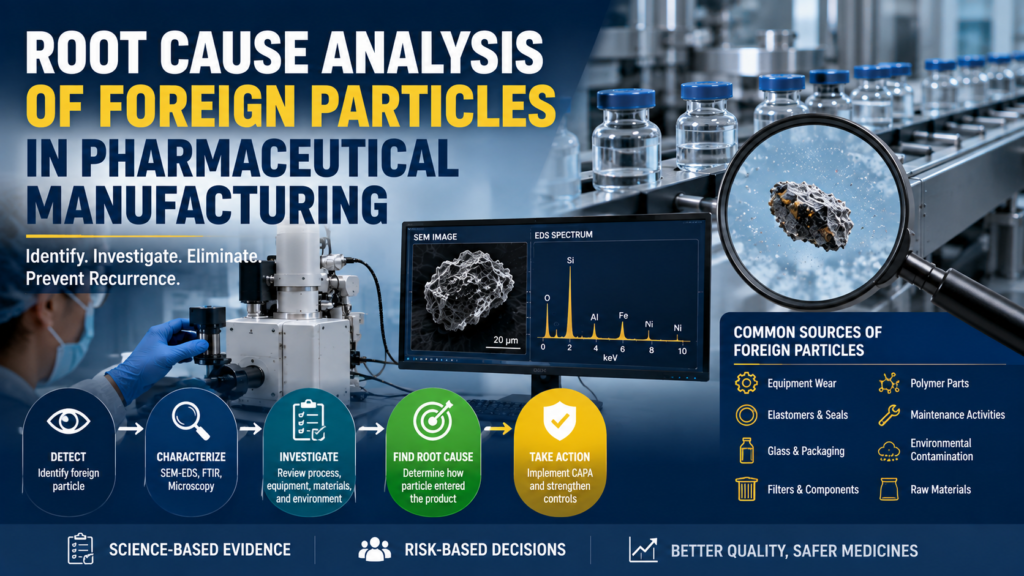
A foreign particle discovered in a pharmaceutical product can turn an ordinary quality observation into a detailed investigation.
The first question is usually simple:
What is that particle?
But for a pharmaceutical manufacturer, identifying the particle is only the beginning. The more important questions are:
- Where did it originate?
- How did it enter the product?
- Was the source associated with equipment, components, packaging or the process?
- Could the same contamination happen again?
- What corrective and preventive actions are necessary?
This is why root cause analysis of foreign particles in pharmaceutical manufacturing requires more than visual observation.
A structured investigation combines particle recovery, microscopic examination, analytical characterization, manufacturing-process review and comparison with potential source materials. Depending on the particle, techniques such as SEM-EDS, FTIR, thermal analysis and microscopic analysis can provide complementary information.
For pharmaceutical manufacturers in India, particularly those handling sterile or injectable products, a systematic approach can help turn an unknown particle into actionable quality information.
This guide explains how to investigate foreign particles, how particle characterization supports root cause analysis, common contamination sources, analytical techniques, investigation mistakes and practical steps manufacturers can implement.
Why Foreign Particle Investigation Matters in Pharmaceutical Manufacturing
Foreign particles can potentially originate from many areas of a pharmaceutical manufacturing operation.
Potential sources include:
- Manufacturing equipment
- Product-contact components
- Stainless-steel parts
- Glass containers
- Polymer components
- Elastomeric seals and gaskets
- Filters
- Tubing
- Packaging components
- Cleaning activities
- Maintenance operations
- Process interventions
- Personnel-related sources
- Environmental sources
- Raw or packaging materials
The challenge is that many of these materials can produce particles with similar visual characteristics.
For example, a dark particle might be:
- A polymer fragment
- An elastomeric material
- A burnt or degraded process residue
- An environmental contaminant
- Another organic material
Similarly, a shiny particle could potentially be metallic, glass-like or another reflective material.
Therefore, visual inspection is an important detection tool, but it may not provide sufficient information to establish material identity.
That is where pharmaceutical particle characterization becomes important.
What Is Root Cause Analysis of Foreign Particles?
Root cause analysis of foreign particles in pharmaceutical manufacturing is the systematic process of determining the underlying reason a foreign particle entered, appeared in or was detected within a pharmaceutical product or process.
The investigation should distinguish between three different questions:
1. What is the particle?
This is the analytical identification question.
2. Where could the particle have come from?
This is the source-assessment question.
3. Why did the particle enter the product?
This is the root-cause question.
These questions are connected, but they are not identical.
For example, an analytical laboratory might determine that an unknown particle is consistent with a particular polymer.
That finding can narrow the potential sources.
However, the investigation must still establish whether that polymer was used in the manufacturing process, whether the relevant component could contact the product, and what event could have caused the material to enter the product.
Particle identification provides evidence. Root cause requires connecting that evidence to the manufacturing process.
Step-by-Step Foreign Particle Investigation
A strong investigation should follow a logical sequence rather than immediately jumping to conclusions.
Step 1: Document the Observation
Start by recording everything known about the particle.
Important information can include:
- Product name
- Batch or lot number
- Manufacturing stage
- Container information
- Location of detection
- Date and time of observation
- Particle appearance
- Approximate size
- Color
- Shape
- Number of particles observed
- Initial inspection method
Photographs can also be valuable for preserving the original observation.
Why documentation matters
Particles can be extremely small and difficult to preserve.
Once the sample is recovered or moved, important visual information may be lost.
Good documentation creates a baseline for the investigation.
Step 2: Recover the Particle Carefully
Particle recovery is a critical stage.
The objective is to obtain the unknown material while minimizing the possibility of introducing additional contamination.
The recovery approach should be suitable for:
- The product
- Particle size
- Particle location
- Particle characteristics
- Laboratory requirements
The recovered particle should be properly identified and handled.
Avoid a common mistake
Do not allow an unknown particle to become an unidentified sample with uncertain history.
Sample traceability should be maintained from recovery through analysis.
Step 3: Perform Microscopic Examination
Microscopy provides an important first level of characterization.
An analyst may evaluate:
- Shape
- Color
- Surface appearance
- Morphology
- Fiber-like structure
- Approximate dimensions
- Agglomeration
- Surface texture
Microscopic analysis can also help determine which analytical techniques may be appropriate.
For example, a particle that appears metallic may warrant elemental analysis, while a polymer-like fragment may benefit from molecular characterization.
Step 4: Characterize the Unknown Particle
Once the particle has been recovered and initially examined, the next step is selecting appropriate analytical techniques.
Potential techniques include:
SEM-EDS
Scanning Electron Microscopy provides high-resolution morphology, while Energy Dispersive X-ray Spectroscopy provides elemental information.
SEM-EDS can be particularly useful for investigating:
- Metallic particles
- Inorganic materials
- Glass-related particles
- Equipment-related fragments
- Other particles where elemental composition is informative
FTIR
Fourier Transform Infrared Spectroscopy provides molecular or chemical-structure information.
It can be useful for:
- Polymers
- Elastomers
- Fibers
- Organic materials
- Certain residues
TGA/STA
Thermal analysis can provide information about material behavior when heated and may help characterize certain materials or mixtures.
Microscopic Analysis
Microscopy provides morphology and visual characteristics that can complement instrumental analysis.
The best technique depends on the particle and the investigation objective.
Step 5: Compare the Particle With Potential Sources
This is where analytical characterization becomes especially useful for root cause investigation.
Manufacturers should create a list of potential sources based on the process.
For example:
| Potential Source | Relevant Question |
|---|---|
| Stainless-steel equipment | Could wear or damage generate the particle? |
| Elastomeric seal | Could degradation or damage produce a fragment? |
| Polymer tubing | Could abrasion or deterioration generate particles? |
| Glass container | Could breakage or surface damage contribute? |
| Filter | Could the component shed material? |
| Packaging | Could packaging materials introduce foreign matter? |
| Maintenance activity | Was work performed near the affected process? |
| Cleaning | Could cleaning tools or materials contribute? |
The unknown particle can then be compared against representative materials where appropriate.
Why a Particle Reference Library Can Strengthen Investigations
One of the most useful proactive strategies is developing a particle reference library.
Rather than waiting for a contamination event and then trying to identify every possible material in the facility, manufacturers can characterize relevant materials in advance.
A reference library may include materials from:
- Product-contact components
- Non-product-contact components
- Equipment
- Filters
- Tubing
- Seals
- Gaskets
- Packaging
- Other relevant process materials
A structured library can contain analytical information describing each reference material.
When an unknown particle is subsequently discovered, the laboratory can compare the particle against potential references.
Example
Suppose an injectable manufacturer has several polymeric components in the production system.
An unknown particle is recovered.
Instead of starting from zero, investigators can compare the unknown particle’s analytical profile against characterized reference materials.
This can help narrow the investigation and identify which components deserve closer examination.
How SEM-EDS Supports Root Cause Analysis
SEM-EDS can be particularly useful when elemental information is relevant.
Imagine that an unknown particle is suspected to originate from manufacturing equipment.
SEM can reveal detailed particle morphology.
EDS can provide elemental information.
The investigation team can then compare the result against relevant equipment materials.
For example, if the unknown particle shows an elemental profile that is consistent with a material used in a product-contact component, that result can provide an important lead.
However, the investigation should continue.
The team should ask:
- Is that component located in the relevant process area?
- Can it physically contact the product?
- Was it damaged?
- Was maintenance recently performed?
- Was there evidence of wear?
- Could the particle have been generated during the relevant batch?
- Are similar particles present elsewhere?
This prevents the investigation from confusing material similarity with confirmed source.
How FTIR Supports Foreign Particle Investigation
FTIR can provide complementary information when the suspected particle is organic or polymeric.
For example, suppose an unknown particle appears rubber-like.
Potential sources could include:
- Gaskets
- Seals
- Tubing
- Other elastomeric components
FTIR may help characterize the chemical nature of the material and support comparison with candidate components.
This is particularly valuable when several components look visually similar.
A complementary approach
For an uncertain particle, the investigation might use:
Microscopy → SEM-EDS → FTIR → Reference comparison
Each technique contributes different evidence.
Common Sources of Foreign Particles
1. Manufacturing Equipment
Mechanical wear can potentially generate particles from equipment components.
Areas requiring attention can include:
- Moving parts
- Contact surfaces
- Seals
- Bearings
- Valves
- Transfer systems
- Pumps
- Filling equipment
Maintenance records should therefore form part of the investigation.
2. Product-Contact Components
Product-contact materials deserve particular attention because of their proximity to the pharmaceutical product.
Potential materials include:
- Elastomers
- Polymers
- Stainless steel
- Filters
- Tubing
- Gaskets
The investigation should determine whether any component could realistically shed material under process conditions.
3. Glass Containers
For injectable products, glass-related particulate contamination may require careful investigation.
Potential contributing factors can include:
- Container damage
- Mechanical interaction
- Breakage
- Handling
- Filling or sealing operations
Analytical characterization can help determine whether an unknown particle is consistent with glass or another material.
4. Packaging Materials
Packaging components can also become potential sources of foreign matter.
Investigators should consider:
- Primary packaging
- Secondary packaging
- Closure systems
- Component handling
- Packaging-line activities
5. Maintenance Activities
Maintenance can introduce unusual materials into a production environment if appropriate controls are not maintained.
The investigation should review:
- Maintenance records
- Work orders
- Component replacement
- Tools used
- Lubricants or materials
- Area clearance
- Cleaning after maintenance
A Practical Root Cause Analysis Framework
When conducting root cause analysis of foreign particles in pharmaceutical manufacturing, consider the following framework.
People
Ask:
- Were there unusual interventions?
- Were operators trained for the relevant activity?
- Were procedures followed?
- Were there personnel-related contamination risks?
Equipment
Ask:
- Was equipment operating normally?
- Was there unusual wear?
- Was maintenance performed?
- Were components replaced?
- Could mechanical damage generate particles?
Materials
Ask:
- Which product-contact materials were used?
- Which polymers and elastomers were present?
- Could packaging components contribute?
- Are supplier materials consistent?
Process
Ask:
- Were there process deviations?
- Were interventions performed?
- Were there changes to operating conditions?
- Could the process generate or mobilize particles?
Environment
Ask:
- Was there an environmental event?
- Were cleaning activities performed?
- Were construction or maintenance activities occurring nearby?
- Were contamination-control measures followed?
Measurement and Detection
Ask:
- How was the particle detected?
- Was the inspection method appropriate?
- Was the particle recovered correctly?
- Was the analytical method suitable?
This approach helps investigators avoid focusing too narrowly on the first suspected cause.
Example Investigation: Unknown Particle in an Injectable Product
Consider a hypothetical Indian pharmaceutical manufacturer that detects an unknown particle in an injectable vial.
Initial observation
The particle appears dark and irregular.
Stage 1: Microscopy
The laboratory documents its morphology and confirms that it is a discrete foreign particle.
Stage 2: SEM-EDS
SEM provides detailed morphology and EDS indicates elemental characteristics that narrow the possible material categories.
Stage 3: FTIR
Because the results suggest a potentially polymeric component, FTIR is also considered.
Stage 4: Reference comparison
The results are compared against materials used in the manufacturing process.
Stage 5: Manufacturing investigation
The quality team reviews:
- Equipment history
- Maintenance
- Component replacement
- Batch records
- Process interventions
- Cleaning activities
Stage 6: Root-cause conclusion
The laboratory evidence is combined with manufacturing evidence.
The conclusion should clearly explain:
- What the particle was determined to be
- Which potential source was identified
- What evidence supports the source
- What process event could explain its presence
- What corrective actions are appropriate
This is a much stronger approach than simply documenting the particle as “foreign matter.”
Common Mistakes in Foreign Particle Root Cause Investigations
Mistake 1: Stopping at Visual Identification
Seeing a particle is not the same as identifying it.
Mistake 2: Assuming the First Plausible Source Is the Root Cause
A particle that matches a manufacturing material may still have several possible pathways into the product.
Mistake 3: Using Only One Analytical Technique
Complex particles may require complementary analytical methods.
Mistake 4: Poor Sample Recovery
A contaminated recovery tool or poorly controlled handling process can compromise the investigation.
Mistake 5: Ignoring Reference Materials
Without reference data, source comparison can become unnecessarily difficult.
Mistake 6: Separating Laboratory and Manufacturing Investigations
Analytical results are most useful when the laboratory and manufacturing teams work together.
7 Best Practices for Pharmaceutical Particle Investigations
1. Establish a documented investigation procedure
Define how particles are:
- Detected
- Recovered
- Stored
- Characterized
- Reported
2. Preserve the original sample
Avoid unnecessary handling.
3. Use multiple analytical techniques when justified
Select techniques according to the particle and investigation objective.
4. Build a reference-material library
Characterize important manufacturing materials before contamination events occur.
5. Involve manufacturing experts
Laboratory data must be interpreted in the context of the actual process.
6. Document analytical limitations
Do not overstate what an analytical result proves.
7. Connect findings to CAPA
The ultimate objective is not simply to identify a particle but to reduce the possibility of recurrence where a preventable source is established.
How Particle Characterization Supports CAPA
A good investigation should eventually lead to appropriate corrective and preventive action where warranted.
For example, if the investigation identifies a component as a credible source, possible actions could include:
- Component replacement
- Equipment inspection
- Preventive-maintenance changes
- Process modification
- Supplier review
- Additional inspection
- Training
- Procedural improvements
- Increased monitoring
The specific CAPA should be based on the established cause and risk assessment.
Analytical characterization therefore acts as an evidence-generating component of the wider quality system.
Why Third-Party Particle Characterization Can Be Valuable
Pharmaceutical companies may not always have every specialized analytical capability available internally.
A third-party laboratory can potentially provide access to complementary technologies and specialist analytical expertise.
This may be particularly useful when:
- An unknown particle requires advanced characterization.
- An internal investigation needs independent analytical support.
- Specialized instrumentation is unavailable.
- A complex contamination event requires multiple techniques.
- A reference-material library needs to be developed.
- The investigation involves recurring or difficult-to-identify particles.
For Indian pharmaceutical manufacturers, choosing an analytical partner should involve evaluating technical capability, sample handling, reporting, turnaround requirements and the suitability of the analytical approach for the investigation.
FAQ: Foreign Particle Root Cause Analysis
What is the first step when a foreign particle is found?
The first step is to document the observation and establish controlled recovery and sample identification. The investigation can then proceed to microscopic and instrumental characterization as appropriate.
Can visual inspection identify the root cause?
Visual inspection can detect and describe a particle, but it generally cannot establish the complete material identity or manufacturing root cause by itself.
Which technique is best for unknown particle identification?
There is no single technique that is best for every particle. SEM-EDS, FTIR, microscopy and thermal analysis provide different types of information and may be used individually or together depending on the investigation.
Why is SEM-EDS useful for pharmaceutical particles?
SEM provides detailed morphology, while EDS provides elemental information. This combination can be particularly useful for metallic and inorganic particles and for investigating potential equipment-related contamination.
When is FTIR useful?
FTIR can be useful when investigating organic, polymeric, elastomeric or fiber-like materials where molecular information is important.
Can particle characterization prove root cause?
Particle characterization can provide important scientific evidence, but material identification alone does not necessarily prove root cause. The analytical results should be evaluated alongside manufacturing, equipment, maintenance and process information.
Is particle characterization important for injectable products?
Yes. Characterizing unexpected particles can provide important evidence during foreign-matter and contamination investigations, particularly when the source of the particle is unknown.
Conclusion
Root cause analysis of foreign particles in pharmaceutical manufacturing should go beyond asking what a particle looks like.
A strong investigation connects three levels of information:
Particle detection → Scientific characterization → Manufacturing root cause
Microscopy can establish morphology.
SEM-EDS can provide valuable elemental information.
FTIR can provide molecular information for suitable materials.
Thermal analysis can contribute additional material characteristics.
Reference libraries can then help investigators compare unknown particles against known manufacturing materials.
But analytical testing is only one part of the investigation.
The final root-cause assessment should also consider equipment condition, product-contact components, maintenance, materials, process interventions, personnel activities and contamination-control practices.
For Indian pharmaceutical manufacturers, adopting a structured particle characterization analysis approach can make foreign-particle investigations more systematic, evidence-based and actionable.
If your team is investigating an unknown particle, recurring particulate contamination or a foreign-matter event, specialized Particle Characterization Analysis Services can provide analytical support for identifying and understanding the material.
Explore Particle Characterization Analysis Services
Your trusted partner for pharma skills, systems, and solutions.