No products in the cart.
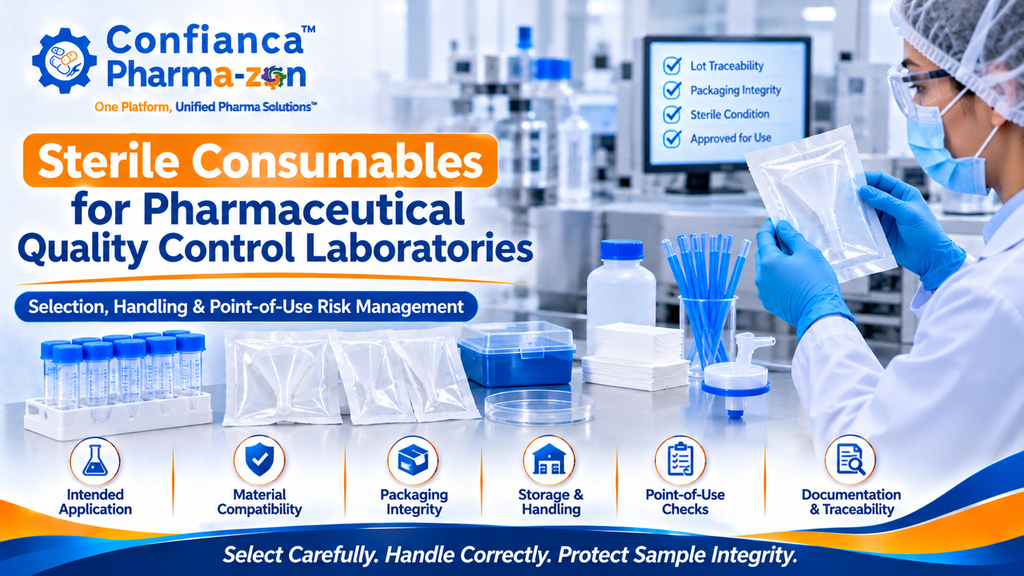
Sterile Consumables for Pharmaceutical Quality Control Laboratories: Selection, Handling and Point-of-Use Risk Management
Introduction
Pharmaceutical quality control laboratories depend on a wide range of consumables to perform routine testing, sample preparation, microbiological activities, and analytical operations. These materials may appear to be small components of a laboratory workflow, but their suitability can directly influence contamination control, test reliability, sample integrity, and operational consistency.
Selecting a product simply because it is labelled sterile is not enough. Laboratories must also consider the intended application, material compatibility, packaging integrity, storage conditions, handling requirements, and suitability for the specific analytical procedure.
Sterile consumables for pharmaceutical laboratories should therefore be selected through a risk-based approach that considers both product quality and the way the consumable will be used.
This article explains how pharmaceutical QC and microbiology laboratories can evaluate consumables, manage point-of-use risks, and establish practical controls for commonly used laboratory materials.
1. Understanding Sterile Consumables in Pharmaceutical Laboratories
Sterile consumables are materials that have undergone a suitable sterilization process and are supplied with an appropriate sterile barrier system intended to maintain their sterile condition until use, subject to the manufacturer’s instructions.
They may be used in:
- Pharmaceutical microbiology laboratories
- Sterility testing activities
- Environmental monitoring
- Sample preparation
- Aseptic processing support
- Cleanroom operations
- Quality control testing
- Pharmaceutical manufacturing support activities
Examples may include sterile filtration assemblies, suitable sterile tubes, sterile funnels, sterile sampling accessories, and other application-specific materials.
Not every laboratory consumable is required to be sterile. Some products may instead be cleanroom-compatible or suitable for controlled laboratory use. The required condition should be defined by the application and relevant procedure.
2. Start With the Intended Application
The first step in selecting a consumable is understanding exactly where and how it will be used.
A product suitable for general laboratory handling may not be suitable for a sterile operation or a product-contact application.
Before selecting a consumable, consider:
- Will it contact the product or sample?
- Will it be used in a sterile testing procedure?
- Is it required for a cleanroom environment?
- Will it be exposed to disinfectants or cleaning agents?
- Does it need to withstand a particular temperature?
- Is chemical compatibility important?
- Is the product intended for single use?
- Does the procedure require a specific material or dimensional specification?
These questions help prevent the selection of materials that are unsuitable for the intended process.
3. Material Compatibility: A Critical Selection Factor
Material compatibility is important because a consumable can interact with the sample, chemicals, or process conditions.
The selection should consider the material of construction and its suitability for the intended use.
3.1 Polymer Compatibility
Laboratory consumables may be manufactured from materials such as polypropylene, polyethylene, polystyrene, or other polymers.
The suitability of a polymer depends on the chemical exposure, temperature, duration of contact, and application.
A material that performs well with one solvent or sample type may not be suitable for another.
3.2 Chemical Resistance
Where consumables are exposed to disinfectants, cleaning agents, or laboratory reagents, their chemical compatibility should be reviewed.
Potential concerns include:
- Swelling
- Cracking
- Discolouration
- Loss of mechanical strength
- Chemical interaction
- Changes in material performance
Manufacturer compatibility information should be considered rather than assuming that all products made from the same broad polymer category will behave identically.
3.3 Sample Contact Considerations
For consumables that contact pharmaceutical samples, additional attention may be required for extractables, leachables, adsorption, and other material-related interactions.
The level of evaluation should be proportionate to the intended use and the risk associated with the sample or process.
4. Packaging Integrity and Sterile Barrier Protection
A sterile consumable can only be relied upon as sterile when its sterile barrier remains intact and the product has been stored and handled according to its approved conditions.
Packaging integrity is therefore an important point-of-use check.
Before using a sterile consumable, personnel should check:
- Packaging is not torn or punctured
- Seals are intact
- No evidence of moisture or damage is present
- Product identification is readable
- The stated expiry or use-by date has not passed
- Storage conditions have been maintained
- The packaging configuration is appropriate for the intended transfer process
If the sterile barrier is damaged or its integrity is uncertain, the item should not be used as a sterile consumable.
The organization should define the appropriate rejection and documentation process in its procedures.
5. Storage and Handling of Sterile Laboratory Consumables
Storage conditions can affect packaging integrity and product suitability.
Sterile consumables should be stored according to the manufacturer’s instructions and the site’s approved procedures.
Important controls include:
5.1 Storage Environment
Storage areas should protect materials from excessive heat, moisture, direct sunlight, dust, and physical damage where relevant.
5.2 Stock Rotation
Inventory should be managed to support use within the manufacturer’s stated shelf life.
A suitable stock rotation method helps reduce the possibility of expired materials remaining in active inventory.
5.3 Segregation
Sterile products, non-sterile products, rejected materials, and expired stock should be appropriately identified and segregated.
5.4 Handling Before Use
Personnel should avoid damaging packaging while removing, moving, or preparing consumables for use.
Handling procedures should be designed to reduce the risk of contaminating the product or its sterile barrier.
6. Point-of-Use Checks Before Opening a Sterile Consumable
The point of use is an important control stage because packaging damage or incorrect product selection may not be noticed during routine storage.
A simple verification checklist can improve consistency.
| Checkpoint | What to verify |
|---|---|
| Product identity | Correct item and specification |
| Sterile status | Required sterile condition is stated and supported by product documentation |
| Packaging | Sterile barrier is intact |
| Expiry | Within the stated shelf life |
| Storage | Conditions comply with manufacturer instructions |
| Compatibility | Suitable for the intended procedure |
| Quantity | Sufficient material is available |
| Documentation | Required batch or lot information is traceable |
These checks should be incorporated into the laboratory’s applicable procedures.
7. Common Sterile and Laboratory Consumables Used in QC Operations
Different laboratory activities require different consumables. The selection should always follow the intended application and approved procedure.
7.1 Centrifuge Tubes
Centrifuge tubes may be used for sample preparation, separation, and laboratory handling.
Selection considerations include:
- Material of construction
- Capacity
- Dimensional compatibility
- Centrifugation suitability
- Chemical compatibility
- Sterile or non-sterile requirement
- Closure design
The tube’s rated operating conditions should be checked before use.
7.2 Sterile M-Funnels
Sterile funnels may be used in suitable microbiological or filtration-related laboratory applications.
Important considerations include the intended method, material compatibility, packaging configuration, and the manufacturer’s stated use.
7.3 Cell Spreaders
Cell spreaders are used in suitable microbiological workflows for distributing samples across culture media.
Selection factors may include material, design, handling characteristics, and whether a sterile, individually packed product is required.
7.4 Sterile Filters and Filtration Accessories
Filtration products should be selected according to the fluid, sample characteristics, membrane material, pore-size requirement, operating conditions, and intended application.
The nominal pore size alone does not establish suitability for every process. Compatibility and validated process requirements should also be considered.
7.5 Gloves for Controlled Environments
Gloves may be used for laboratory, cleanroom, isolator, or other controlled operations.
Selection should consider the required cleanliness or sterility status, material compatibility, length, size, dexterity, and compatibility with the relevant process.
A glove intended for one application should not automatically be assumed suitable for another.
7.6 Sterile Wipes and Cleaning Accessories
Wipes and cleaning accessories may be used in controlled environments where the relevant product specification and cleaning procedure permit their use.
Considerations include:
- Particle and fibre generation
- Material compatibility
- Absorbency
- Packaging
- Sterility status, where required
- Compatibility with the cleaning agent
8. Contamination Risks Associated With Incorrect Consumable Selection
Incorrect consumable selection may introduce several types of risk.
8.1 Particulate Contamination
Damaged, unsuitable, or poorly controlled materials may release particles or fibres.
The risk should be assessed in relation to the material, process, handling method, and application.
8.2 Microbial Contamination
A product that is not sterile, or whose sterile barrier has been compromised, may introduce microbial contamination into an operation requiring sterile materials.
8.3 Chemical Contamination
Material interactions may introduce unwanted chemical substances or affect the sample under certain conditions.
8.4 Loss of Sample Integrity
Inappropriate containers, filters, or handling accessories may affect the sample through adsorption, incompatibility, or other interactions.
8.5 Documentation and Traceability Gaps
If lot identification and relevant product records are not retained, it may become difficult to investigate a consumable-related issue.
9. Documentation and Traceability for Laboratory Consumables
Good documentation helps laboratories identify which materials were used during a particular activity.
Depending on the application and quality system, records may include:
- Product name and specification
- Manufacturer or supplier
- Batch or lot number
- Sterility information, where applicable
- Expiry date
- Receipt and inspection records
- Storage information
- Relevant certificates or supporting documentation
- Usage records where required by the procedure
Traceability becomes particularly important when an investigation identifies a possible material-related contamination concern.
The organization should retain records in accordance with its approved document control and retention procedures.
10. Developing a Practical Consumable Selection Matrix
A selection matrix can help QC and procurement teams compare different products against defined requirements.
| Evaluation factor | Key question |
|---|---|
| Intended use | Is the product suitable for the laboratory activity? |
| Sterility | Is sterile supply required and documented? |
| Material | Is the material appropriate for the sample or process? |
| Dimensions | Does it fit the equipment or procedure? |
| Packaging | Does the packaging protect the product adequately? |
| Shelf life | Is the remaining shelf life acceptable? |
| Compatibility | Is it compatible with chemicals and operating conditions? |
| Traceability | Can the product lot be identified? |
| Documentation | Are required technical documents available? |
The matrix should be customized to the laboratory’s actual procedures rather than used as a universal approval checklist.
11. Common Mistakes in Sterile Consumable Management
Mistake 1: Assuming Every Cleanroom Product Is Sterile
Cleanroom-compatible and sterile are not interchangeable terms. The required condition must be verified.
Mistake 2: Ignoring Packaging Damage
Even a suitable sterile product should not be used as sterile if its sterile barrier is damaged or questionable.
Mistake 3: Selecting Only by Price
Cost is important, but product suitability, documentation, compatibility, and operational requirements must also be considered.
Mistake 4: Overlooking Material Compatibility
A consumable may be unsuitable for a particular chemical or sample despite appearing physically acceptable.
Mistake 5: Missing Lot Traceability
Poor recordkeeping can make contamination investigations more difficult.
Mistake 6: Using Products Outside Their Intended Application
The manufacturer’s instructions and the site’s approved procedure should guide the use of each consumable.
12. Regulatory and GMP Considerations
Sterile consumable management should be aligned with the applicable pharmaceutical quality system and the contamination control strategy.
Relevant considerations may include:
- EU GMP Annex 1 for sterile medicinal product manufacturing, where applicable
- Applicable requirements under 21 CFR Parts 210 and 211
- Site procedures for material receipt, storage, dispensing, and use
- Risk assessments for materials entering controlled environments
- Packaging integrity and transfer controls
- Material compatibility and supplier documentation
The EU GMP Annex 1 emphasizes controlling contamination risks associated with materials and components entering cleanroom environments. The exact controls should be determined according to the material, process, cleanroom grade, and approved contamination control strategy.
Frequently Asked Questions
1. What are sterile consumables in pharmaceutical laboratories?
They are laboratory materials supplied in a sterile condition and protected by an appropriate sterile barrier system until use, subject to the manufacturer’s instructions.
2. Are all cleanroom consumables sterile?
No. Some products are designed for cleanroom use but are not supplied sterile. The required status should be verified from the product specification and documentation.
3. Why is packaging integrity important?
Packaging protects the product and, for sterile items, helps maintain the sterile barrier. Damaged or compromised packaging can make the item unsuitable for sterile use.
4. What should be checked before using a sterile consumable?
Personnel should verify product identity, packaging integrity, expiry, storage conditions, required sterile status, and suitability for the intended procedure.
5. Why is material compatibility important?
The consumable may interact with the sample, chemical, or process conditions. Compatibility assessment helps reduce the risk of material degradation, sample alteration, or unwanted contamination.
6. Which consumables are commonly used in pharmaceutical QC laboratories?
Examples include centrifuge tubes, sterile filters, suitable funnels, cell spreaders, gloves, wipes, and other laboratory accessories selected according to the relevant procedure.
Conclusion
Sterile consumables play an important role in pharmaceutical QC laboratories and controlled manufacturing operations. Their suitability depends on more than product appearance or a sterile label. Material compatibility, packaging integrity, storage, traceability, and point-of-use checks all contribute to effective consumable management.
A structured selection and handling approach helps laboratories reduce avoidable contamination risks and maintain consistent testing practices.
Looking for pharmaceutical sterile consumables and QC laboratory supplies? Contact Confianca Pharmazon to discuss your requirements for centrifuge tubes, sterile M-funnels, cell spreaders, gloves, wipes, filters, and other application-specific consumables.
Confianca Pharmazon – Your Partner for Pharmaceutical Products and Technical Solutions.