
No products in the cart.
Mastering Probability of Detection Visual Inspection: A Proven Guide to Qualifying Pharmaceutical Inspection in Saudi Arabia
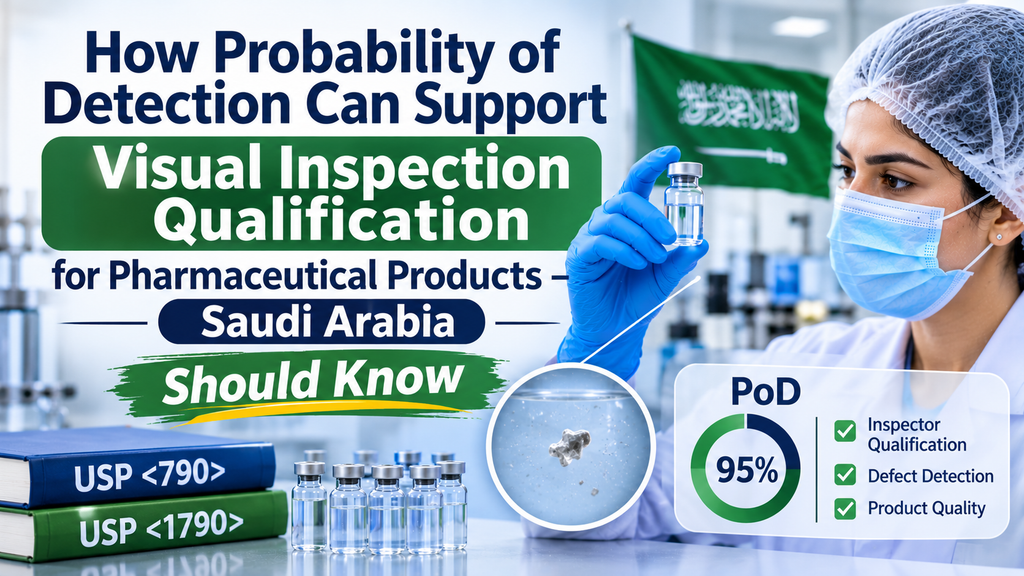
Can Your Inspection Process Reliably Detect Defects?
Visual inspection is one of the most important quality controls for pharmaceutical products, particularly injectable medicines. A vial may look acceptable at first glance, but a small glass particle, fibre, seal defect or other visible abnormality can create a potential patient-safety concern.
For pharmaceutical manufacturers in Saudi Arabia, effective visual inspection is not simply about asking an inspector to look at a container and decide whether it is acceptable. Manufacturers need a structured qualification programme that demonstrates inspectors can recognize relevant defects under defined inspection conditions.
This is where probability of detection visual inspection becomes useful.
Probability of Detection (PoD) provides a way to evaluate how consistently an inspector or inspection system detects a defined defect under specified conditions. When used with appropriate defect samples, documented procedures and a risk-based qualification programme, PoD can help pharmaceutical companies understand inspection capability and identify opportunities for improvement.
KNAPP kits, also known as visual inspection defect kits, can support this process by providing known defect samples for training, qualification and performance evaluation.
In this blog, we explore how PoD can support pharmaceutical visual inspection qualification in Saudi Arabia, how KNAPP kits can be used, and what quality teams should consider when developing an effective inspection programme.
What Is Probability of Detection in Visual Inspection?
Probability of Detection (PoD) describes the likelihood that a particular defect will be detected during an inspection under defined conditions.
In pharmaceutical visual inspection, the probability of detecting a defect can vary depending on several factors, including:
- Particle size and shape
- Particle colour and contrast
- Particle movement
- Product formulation
- Container material and design
- Lighting and background
- Inspection duration
- Inspector experience and fatigue
- Inspection technique
For example, a dark particle moving in a clear solution inside a transparent vial may be easier to detect than a small, low-contrast particle in a coloured or viscous formulation.
This means that visual inspection is not a perfectly consistent process. The same inspector may detect a particular defect during one inspection and miss it during another.
PoD helps pharmaceutical teams evaluate this variability in a structured way.
A Simple PoD Calculation
A basic observed detection rate can be calculated using the following formula:
Observed PoD (%) = Number of defects correctly detected ÷ Number of defect presentations × 100
For example, suppose an inspector is presented with a known defect 20 times during a controlled evaluation.
- Correct detections: 16
- Total defect presentations: 20
Observed detection rate:
16 ÷ 20 × 100 = 80%
This means the inspector detected the defect in 80% of those presentations.
However, this example is only an illustration of the calculation. It does not establish that 80% is an acceptable qualification result or that 20 presentations provide a statistically robust estimate of detection capability.
Acceptance criteria, sample size, defect selection and qualification design should be established through a documented, scientifically justified procedure.
Why PoD Matters for Pharmaceutical Visual Inspection Qualification in Saudi Arabia
Pharmaceutical companies in Saudi Arabia operate within a quality and regulatory environment that places importance on controlled manufacturing processes, documented inspection and product quality.
The SFDA GMP Guide Version 4.4, Annex 1, provides relevant expectations for visual inspection of parenteral products.
1. Supporting Inspector Qualification
A qualification programme should demonstrate that an inspector can identify the defects relevant to the product and inspection process.
PoD can help teams evaluate whether an inspector consistently detects selected defect types rather than relying only on attendance at training or completion of a checklist.
2. Identifying Difficult-to-Detect Defects
Some defects are more challenging than others.
Examples include:
- Small glass particles
- Low-contrast particles
- Fibres
- Particles in coloured solutions
- Defects in amber containers
- Particles in products with challenging visual characteristics
A PoD-based evaluation can help identify which defect categories require additional training or improved inspection conditions.
3. Supporting Inspection Process Improvement
If an inspector repeatedly misses a particular defect category, the result can prompt a review of:
- Inspection technique
- Lighting and background
- Container presentation
- Inspection duration
- Training effectiveness
- Qualification sample design
PoD therefore supports a broader quality improvement approach instead of treating qualification as a one-time administrative activity.
What Do SFDA GMP Expectations Mean for Visual Inspection Qualification?
The SFDA GMP Guide Version 4.4, Annex 1, includes several important points for manufacturers of sterile medicinal products.
Individual Inspection and Defect Libraries
Clause 8.30 states that filled containers of parenteral products should be inspected individually for extraneous contamination or other defects.
It also addresses defect classification, criticality, batch performance analysis and the need to maintain a defect library covering known defect classes.
A defect library can help ensure that inspectors are trained using representative examples of defects relevant to the manufacturing process.
Manual Inspector Qualification
Clause 8.31 addresses controlled illumination and background conditions, appropriately controlled and qualified inspection rates, and visual inspection qualification of operators at least annually.
The qualification should use appropriate samples from the manufacturer’s defect library and consider challenging conditions such as inspection time, line speed, container size and fatigue.
Automated Inspection
Clause 8.32 addresses validation of automated inspection methods to detect known defects that may affect product quality or safety. It also calls for performance challenges using representative defects before start-up and at regular intervals during the batch.
Recording and Trending
Clause 8.33 addresses recording inspection results and trending defect types, defect numbers and reject levels using statistical principles.
PoD can complement these activities by providing structured information about detection performance during qualification or evaluation.
It should not be interpreted as replacing the manufacturer’s approved inspection procedure, acceptance criteria or regulatory obligations.
How KNAPP Kits Support Probability of Detection Visual Inspection
KNAPP kits are specialized visual inspection defect kits designed to support inspector training, qualification and inspection system evaluation.
They contain known defect samples that can be used to challenge inspection performance under controlled conditions.
A well-designed kit can help create a more consistent qualification experience across inspectors, shifts or inspection stations.
Types of Defects in Visual Inspection Kits
Depending on the kit configuration, defect samples may include:
- Clear glass particles
- Amber glass particles
- Metal particles
- Black particles
- White particles
- Black fibres
- White fibres
- Hair fibres
- Customer-specified particles or fibres
Defect kits may also include containers representing different defect categories, such as critical, major and minor defects, according to the manufacturer’s qualification design.
For example, a qualification programme may include a cracked container, a visible particle, a fibre and a cosmetic defect. The inspector’s response should be assessed against the approved defect classification and qualification procedure.
Known Defects Improve Evaluation Consistency
Using known defect samples allows the qualification team to establish which defects were presented and which were detected.
This helps reduce uncertainty during performance evaluation.
However, the kit must be suitable for the product, container and inspection purpose. A defect kit should not automatically be considered representative of every product or every manufacturing condition.
How to Use KNAPP Kits in a PoD-Based Qualification Programme
A structured approach can help pharmaceutical companies make better use of visual inspection defect kits.
Step 1: Define the Qualification Objective
Before starting the evaluation, decide what you want to assess.
Examples include:
- Initial qualification of a new inspector
- Annual requalification
- Additional training after a performance concern
- Evaluation of a new container presentation
- Assessment of an automated inspection system
The objective should be documented before selecting the samples.
Step 2: Select Representative Defect Samples
Choose defects based on product and process risk.
Consider:
- Product formulation
- Container type
- Expected defect sources
- Particle characteristics
- Defect criticality
- Inspection difficulty
A clear solution in a transparent vial may require a different challenge design from a coloured solution in an amber vial.
Step 3: Establish Controlled Inspection Conditions
The evaluation should take place under defined conditions.
Record relevant parameters such as:
- Inspection background
- Lighting conditions
- Inspection duration
- Container presentation method
- Inspection sequence
- Inspector identification
- Qualification sample identification
If the inspection process normally uses a particular technique, the qualification should assess the inspector using the approved technique.
Step 4: Conduct the Inspection
Present the qualification samples according to the approved procedure.
The inspector should make an independent decision for each sample without being told whether it contains a defect.
The qualification team should record the result accurately and maintain sample traceability.
Step 5: Calculate and Review Detection Results
The qualification team can calculate observed detection rates for selected defect categories.
For example, results may be reviewed separately for:
- Glass particles
- Metal particles
- Fibres
- Container defects
- Low-contrast defects
Reviewing categories separately can be more informative than combining all defects into one overall percentage.
Step 6: Document the Outcome and Follow Up
The final qualification record should include:
- Qualification objective
- Approved protocol
- Defect kit identification
- Defect sample details
- Inspection conditions
- Results
- Deviations or missed defects
- Qualification decision
- Training or corrective actions, where required
If an inspector does not meet the predefined criteria, the company should follow its approved procedure for investigation, retraining and requalification.
Important Considerations When Interpreting PoD Results
PoD results are useful, but they need to be interpreted carefully.
A Detection Percentage Is Not Automatically a Regulatory Acceptance Limit
A detection rate such as 80%, 90% or 95% should not be presented as a universal pharmaceutical qualification threshold.
The appropriate criteria depend on the approved qualification programme, defect category, inspection purpose and applicable requirements.
Sample Size Matters
A small number of presentations can produce a detection percentage that appears precise but has considerable uncertainty.
For example, detecting 9 out of 10 presentations gives an observed rate of 90%. It does not prove that the inspector will detect 90% of similar defects in routine production.
A robust study may require a scientifically justified number of presentations, appropriate defect selection and consideration of statistical uncertainty.
Repeated Presentations Can Affect Results
If an inspector sees the same defect repeatedly, learning or memory may influence the outcome.
The qualification design should consider presentation order, randomization where appropriate, and whether repeated samples adequately represent routine inspection conditions.
Product and Container Differences Matter
A qualification result for one product presentation may not automatically transfer to another.
Differences in formulation, container colour, container size, particle characteristics or inspection conditions may affect detection capability.
Qualification and requalification should therefore follow the company’s approved, risk-based approach.
Common Mistakes to Avoid During Visual Inspection Qualification
Pharmaceutical teams should avoid these common mistakes:
- Using the same easy-to-detect defects for every qualification
- Treating attendance at training as proof of inspection capability
- Using a single overall detection percentage without reviewing defect categories
- Ignoring lighting, background or inspection duration
- Failing to document missed defects
- Using qualification criteria that have not been scientifically justified
- Assuming one kit is suitable for every product and container
- Treating PoD as a replacement for routine inspection controls
A better approach is to use PoD as one component of a comprehensive qualification and performance monitoring programme.
How to Select a KNAPP Kit Supplier for Saudi Pharmaceutical Operations
When evaluating a KNAPP kit supplier, pharmaceutical companies should consider more than the number of defect samples included.
Important considerations include:
Defect Variety and Suitability
The kit should offer defect types relevant to the company’s products, packaging components and inspection risks.
Sample Identification and Documentation
Defect samples should be identifiable and supported by appropriate documentation. The qualification team should be able to trace the samples used during an evaluation.
Training and Technical Support
Training can help inspectors understand defect presentation, handling techniques and the principles of visual inspection qualification.
Manual and Automated Inspection Support
Manufacturers using manual inspection and automated visual inspection may need different qualification or challenge arrangements.
Replacement and Kit Maintenance
The company should understand how to handle damaged, missing or non-viable samples and how kit condition is maintained over time.
Confianca Pharmazon offers manual visual inspection defect kits, training and qualification kits, and KNAPP kits for automated visual inspection machine qualification. Its brochure describes particle and fibre samples, defect certificates, a PoD evaluation sheet and technical support for kit handling and qualification activities.
The brochure also describes a PoD evaluation sheet in which each container is inspected 10 times. This can be used as a practical recording aid, but the ten presentations alone should not be treated as proof of statistical robustness or as a universal acceptance standard.
For product details, visit the KNAPP Kit – Visual Inspection Kits page.
Practical Tips for Pharmaceutical Quality Teams
To make a PoD-based qualification programme more effective:
- Start with risk assessment. Identify the defects that matter most for the product and process.
- Use representative samples. Include appropriate defect types, sizes and visual characteristics.
- Keep conditions controlled. Document lighting, background, inspection duration and presentation method.
- Review results by defect category. A high overall score can conceal weaknesses in detecting a particular defect.
- Investigate missed critical defects. Follow the approved quality system and assess potential impact.
- Use results for improvement. Provide targeted training and review qualification design when needed.
- Maintain traceability. Record kit identification, sample details and qualification outcomes.
- Review the programme periodically. Consider changes in products, packaging, inspection equipment and defect trends.
Frequently Asked Questions
1. What is probability of detection visual inspection?
Probability of detection visual inspection refers to evaluating the likelihood that an inspector or inspection system will detect a defined defect under specified conditions. It can support performance evaluation and qualification when the study design is appropriate.
2. Is PoD mandatory for every pharmaceutical visual inspection qualification in Saudi Arabia?
PoD is a useful evaluation concept, but it should not be described as a universal standalone regulatory requirement or acceptance criterion. Manufacturers should follow current SFDA requirements and their approved, risk-based qualification procedures.
3. How do KNAPP kits support inspector qualification?
KNAPP kits provide known defect samples that can be used for training, qualification and performance evaluation. They help teams challenge inspectors with selected defect types and document the inspection results.
4. Can a 10-time inspection sheet establish a reliable PoD?
A 10-time inspection sheet can help record repeated observations. However, ten presentations alone do not establish statistical robustness. Sample size and study design should be justified for the intended purpose.
5. Can PoD results be used for automated visual inspection?
Yes. Representative defect samples can support challenges of automated inspection systems. The evaluation should follow the system’s validation and qualification procedures and applicable regulatory expectations.
6. How often should manual visual inspectors be qualified?
The SFDA GMP Guide Version 4.4, Annex 1, clause 8.31, states that operators performing manual inspection should undergo visual inspection qualification at least annually. Companies should also follow their approved procedures for initial qualification and additional qualification when needed.
Strengthen Visual Inspection Qualification with PoD and KNAPP Kits
Effective visual inspection qualification requires more than a checklist or a single inspection exercise. Pharmaceutical manufacturers need a structured approach that considers defect characteristics, product presentation, inspection conditions, inspector capability and documented performance.
Probability of detection visual inspection can help quality teams evaluate how consistently defects are detected and identify areas where additional training or process improvement may be needed.
When combined with appropriate KNAPP kits, controlled inspection conditions and a scientifically justified qualification programme, PoD can provide useful evidence to support inspector qualification and visual inspection performance evaluation.
For pharmaceutical companies in Saudi Arabia, the objective is to build a reliable inspection programme aligned with applicable SFDA GMP expectations and the company’s quality system.
Explore Confianca Pharmazon KNAPP kits to learn more about visual inspection defect kits, qualification support and training solutions for pharmaceutical operations.
Your trusted partner for pharma skills, systems, and solutions.