No products in the cart.
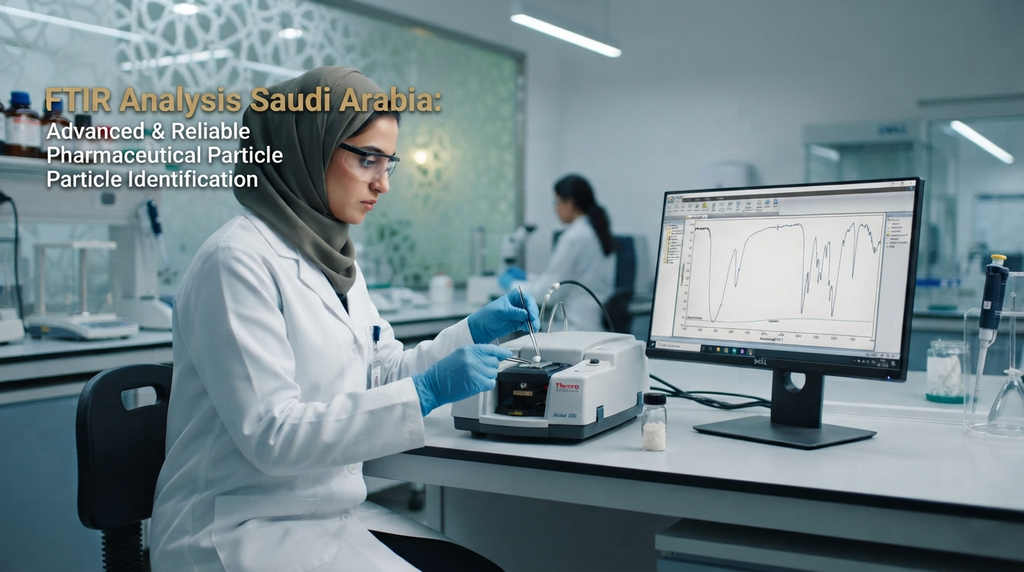
FTIR Analysis Saudi Arabia: Advanced & Reliable Pharmaceutical Particle Identification
An unexpected particle in a pharmaceutical product can turn a routine quality observation into a detailed investigation.
A particle may be visible during inspection, recovered from a filter, observed during laboratory testing, or identified as part of a deviation or complaint. But seeing the particle is only the beginning.
What is the particle made of?
Does it resemble a known manufacturing component?
Could it have originated from a polymer, powder, ceramic, packaging component, or another material?
And perhaps most importantly:
Can analytical evidence help the investigation team understand its potential source?
These questions are increasingly important for pharmaceutical manufacturers and quality teams operating in Saudi Arabia and across the wider Middle East.
Fourier Transform Infrared Spectroscopy, commonly called FTIR, can provide valuable molecular-structure information for suitable materials. It can therefore complement other particle-characterization techniques when an investigation requires more than visual examination or elemental analysis.
The particle-characterization information provided by Confianca Pharmazon describes FTIR as a technique for qualitative and quantitative characterization of molecular structures across a wide spectral range. The described system is intended for analysis of powders, thin films, polymers, ceramics, liquids, and other solid-state materials, excluding gases.
This article explains how FTIR analysis Saudi Arabia can fit into pharmaceutical particle investigations, when FTIR may be appropriate, how it can complement SEM-EDS and other techniques, and what pharmaceutical QA, QC, R&D, and manufacturing teams should consider when developing a particle-characterization strategy.
What Is FTIR Analysis?
FTIR stands for Fourier Transform Infrared Spectroscopy.
In simple terms, FTIR provides information associated with the molecular structure of a material by analyzing how it interacts with infrared radiation.
That makes FTIR different from several other analytical techniques commonly used in particle investigations.
For example:
- Microscopy helps visualize particles and contaminants.
- SEM provides detailed surface morphology.
- EDS provides elemental composition information.
- FTIR provides molecular-structure-related information.
- TGA/STA can provide information about weight changes and thermal events.
The Confianca Pharmazon reference material describes its FTIR system as a high-performance instrument designed for qualitative and quantitative molecular characterization, with a stated signal-to-noise ratio of 35000:1 and a temperature-controlled DLATGS detector.
For pharmaceutical investigations, the key point is that FTIR can answer a different analytical question from SEM-EDS.
Why Is FTIR Relevant to Pharmaceutical Particle Identification?
Suppose a pharmaceutical manufacturer discovers an unexpected particle.
Initial visual examination may show that it is:
- Dark or light
- Irregular or fibrous
- Smooth or rough
- Large or microscopic
- Apparently metallic, polymeric, organic, or inorganic
But appearance alone may not be enough to establish its identity.
A deeper investigation may need to understand the material’s molecular characteristics.
This is where FTIR can become useful for suitable samples.
FTIR may be considered when investigators need to investigate:
- Molecular structure
- Polymer-type materials
- Powders
- Thin films
- Ceramics
- Suitable liquids
- Other suitable solid-state materials
The documented Confianca Pharmazon material specifically identifies these categories among the FTIR application areas.
For Saudi pharmaceutical manufacturers, this can make FTIR a useful component of a broader pharmaceutical particle characterization Saudi Arabia strategy.
When Should FTIR Be Used for Pharmaceutical Particle Identification?
There is no universal rule that FTIR must be used for every unknown particle.
The correct analytical technique depends on the investigation question, sample characteristics, and type of information required.
However, FTIR can be particularly relevant when molecular or chemical characteristics are important to the investigation.
1. When Molecular Structure Is Important
Consider an unknown particle that appears to be polymeric.
Visual examination may suggest that it is polymer-like, but investigators may need additional evidence.
FTIR can provide molecular-structure-related spectral information that can be compared with appropriate reference materials.
This can help transform a visual observation into a more structured analytical investigation.
2. When Investigating Polymer-Based Materials
Pharmaceutical manufacturing processes can involve various polymeric materials.
Potential sources may include:
- Process components
- Equipment-related materials
- Packaging components
- Filters
- Tubing
- Other relevant polymer-containing materials
When a recovered particle is suspected to be polymeric and is suitable for FTIR analysis, molecular characterization can contribute useful evidence.
Example
Imagine a pharmaceutical facility uses several different polymer-containing components.
An unknown particle is recovered during a product investigation.
Rather than relying only on its appearance, investigators can characterize suitable reference materials and compare their analytical information with the unknown.
The results can then be evaluated alongside:
- Particle morphology
- Manufacturing history
- Equipment records
- Component specifications
- Other analytical results
This creates a more evidence-based approach to contamination investigation.
FTIR and Particle Characterization: Why a Multi-Technique Approach Matters
FTIR is not necessarily a replacement for other analytical techniques.
In many investigations, different techniques provide different pieces of information.
The documented Confianca Pharmazon library-preparation workflow uses four technologies for characterization of collected component coupons:
- SEM with EDS
- FTIR
- TGA/STA
- Microscopic analysis
This integrated model is valuable because no single analytical technique necessarily answers every investigation question.
A simplified comparison
| Technique | Information It Can Provide |
|---|---|
| Microscopic analysis | Detection and visual examination of microscopic contaminants |
| SEM | High-resolution morphology and surface characteristics |
| EDS | Elemental composition |
| FTIR | Molecular-structure-related information |
| TGA/STA | Weight changes and thermal events |
The appropriate combination should be determined according to the material and investigation objective.
FTIR vs SEM-EDS for Pharmaceutical Particle Analysis
A common question is:
Should we use FTIR or SEM-EDS?
The answer depends on what the investigation needs to establish.
SEM-EDS
SEM with EDS can be useful when the investigation requires information about:
- Surface morphology
- Particle structure
- High-resolution imaging
- Elemental composition
- Potential metallic or inorganic materials
The source material describes SEM with EDS as providing high-resolution surface morphology and elemental composition analysis, with the referenced SEM capable of imaging up to 300,000×.
FTIR
FTIR can be useful when investigators need molecular-structure-related information for suitable materials such as:
- Polymers
- Powders
- Thin films
- Ceramics
- Liquids
- Other solid-state materials
Therefore, the decision should not simply be FTIR versus SEM-EDS.
Instead, ask:
What information do we need to answer the contamination-investigation question?
Sometimes one technique may be sufficient. In other cases, complementary techniques can provide stronger characterization.
How FTIR Can Support a Pharmaceutical Contamination Investigation
A successful particle investigation normally requires more than an instrument result.
A practical workflow can involve several stages.
Step 1: Detect the Particle
The particle may be identified during:
- Visual inspection
- Product testing
- Filter examination
- Deviation investigation
- Complaint investigation
- Routine quality-control activities
The initial observation should be documented carefully.
Step 2: Recover the Particle
The particle should be recovered using an appropriate procedure designed to preserve the sample and minimize introduction of additional contamination.
Step 3: Conduct Preliminary Examination
Microscopic examination can provide initial information about:
- Shape
- Color
- Approximate size
- Surface appearance
- Fibrous or particulate structure
Step 4: Define the Analytical Question
Before selecting FTIR, determine what needs to be established.
For example:
- Is the material consistent with a polymer?
- Does it resemble a known reference material?
- Can molecular information help distinguish potential sources?
- Is FTIR appropriate for the recovered sample?
Step 5: Perform FTIR Analysis Where Appropriate
The sample can then undergo FTIR analysis if it is suitable for the technique.
Step 6: Compare With Reference Materials
Reference materials can make analytical findings more useful.
Step 7: Integrate the Evidence
Results can be evaluated alongside:
- SEM-EDS findings
- Microscopy
- Manufacturing records
- Equipment history
- Packaging information
- Component information
- Previous contamination investigations
This helps move the investigation from detection → characterization → source assessment.
Building a Pharmaceutical Particle Reference Library
A reference library can be especially valuable for recurring or complex contamination investigations.
The documented Confianca Pharmazon workflow includes an optional Gemba activity with the client to identify product-contact and non-contact parts. Based on those identified components, coupons can be collected and analyzed using SEM with EDS, FTIR, TGA/STA, and microscopic analysis.
The result is a structured body of analytical information about relevant materials.
A reference library may include:
- Product-contact components
- Non-contact components where relevant
- Process equipment materials
- Filters
- Packaging materials
- Polymer-containing components
- Other potential contamination sources
The actual scope should be determined according to the manufacturing process and investigation needs.
Why a Reference Library Helps FTIR Investigations
Consider two different scenarios.
Scenario A: No reference library
An unknown polymer-like particle is discovered.
The investigation team knows several polymer-containing materials are used in the facility.
There are multiple possible sources.
Scenario B: Reference library available
The facility already has analytical information for relevant components.
The unknown can be evaluated against known reference materials.
The second scenario gives the investigation team a stronger starting point.
A reference library does not automatically prove the source of a particle. However, it can provide valuable comparative information that can be considered alongside process and manufacturing evidence.
This is one reason FTIR analysis Saudi Arabia can be incorporated into a proactive particle-characterization program rather than used only after a contamination event.
Applications of FTIR for Pharmaceutical Particle Characterization
Polymer Characterization
FTIR can be useful for investigating suitable polymeric materials and comparing their molecular characteristics with reference samples.
Powder Analysis
The documented FTIR capability includes powders among the material types suitable for analysis.
This can be relevant when investigating an unidentified powder or particulate material where molecular characterization is appropriate.
Thin Films
Thin films are also listed within the described FTIR application range.
Ceramic Materials
Ceramics are another material category identified in the source material.
Suitable Liquid and Solid-State Materials
The documented FTIR system is also described for liquids and other solid-state materials, with gases excluded from the stated application range.
FTIR Analysis for Contamination Source Investigation
One important distinction should be understood:
Characterizing a particle is not necessarily the same as proving its source.
For example, FTIR may indicate molecular characteristics consistent with a particular material.
But investigators should still consider:
- Is that material actually used in the manufacturing process?
- Where is it located?
- Does its physical morphology match?
- Could the material have entered the product through another pathway?
- Are there equipment or maintenance records supporting the hypothesis?
- Are there other potential sources with similar characteristics?
Therefore, FTIR results should be integrated into the complete investigation.
The source documentation specifically describes the use of a product-contact component library to provide morphology and bonding-structure information, while unknown particles or fibers are recovered and investigated using SEM with EDS to analyze the contamination source.
This distinction is important when designing an investigation strategy.
Practical Tips for Pharmaceutical Companies in Saudi Arabia
For companies evaluating FTIR analysis Saudi Arabia, the following practices can improve the quality of an investigation.
1. Start With the Investigation Question
Do not begin with:
“Which instrument should we use?”
Start with:
“What do we need to know about this particle?”
The answer determines the appropriate analytical approach.
2. Preserve the Original Sample
Small particles can be difficult to recover.
Use appropriate sample-handling and documentation practices.
3. Avoid Unnecessary Handling
Every additional manipulation can potentially affect the sample or introduce extraneous material.
4. Develop Reference Materials Proactively
Characterizing relevant components before a major investigation can save time when an unknown particle is later discovered.
5. Consider Complementary Techniques
FTIR may provide molecular information while SEM-EDS and microscopy provide other dimensions of particle characterization.
6. Record Manufacturing Context
Analytical data should be considered together with:
- Equipment information
- Batch records
- Maintenance activities
- Component specifications
- Packaging information
- Process history
7. Avoid Overinterpreting Results
A spectral match or similarity should be evaluated as part of the complete investigation rather than automatically considered definitive proof of source.
What Should Saudi Pharmaceutical Companies Ask a Particle Characterization Laboratory?
When selecting particle characterization services Saudi Arabia, do not evaluate a provider only on whether it has access to an FTIR instrument.
Ask about the complete analytical workflow.
Sample handling
- How should the unknown particle be recovered?
- How should it be packaged?
- What sample quantity or condition is required?
- Can the laboratory assess sample suitability?
Analytical capability
- Can the laboratory perform FTIR analysis?
- Can reference materials be characterized?
- Is qualitative analysis available?
- Can quantitative characterization be performed where appropriate?
Complementary techniques
Ask whether the service can support:
- SEM
- EDS
- Microscopic analysis
- TGA/STA
- Other appropriate characterization techniques
Reporting
Ask whether the final report can document:
- Analytical methodology
- Observations
- Spectral information
- Reference comparisons
- Relevant limitations
- Interpretation of findings
A complete investigation-focused service can be more useful than a standalone instrument test.
FTIR Particle Investigation Checklist
Before submitting a sample for FTIR analysis, prepare the following information:
- Product name
- Batch or lot information
- Description of the particle
- Approximate particle size
- Particle photographs, if available
- Particle recovery method
- Sample location
- Potential source materials
- Product-contact component information
- Packaging information
- Equipment information
- Relevant deviation history
- Available reference samples
- Specific investigation question
- Required analytical report details
The better the investigation context, the easier it is to select an appropriate analytical pathway.
FTIR Analysis Support for Saudi Pharmaceutical Manufacturers
Confianca Pharmazon documents a laboratory in Ahmedabad for Library Preparation & Particle Characterization Testing. Its described library-preparation process includes optional Gemba activity with clients, identification of product-contact and non-contact parts, collection of coupons, and analysis using SEM with EDS, FTIR, TGA/STA, and microscopic analysis.
For companies in Saudi Arabia, this type of capability can be relevant when evaluating an external particle-characterization partner for investigations, reference-library development, or analytical support.
Importantly, the provided source documents describe the laboratory capability in Ahmedabad rather than claiming that the facility is located in Saudi Arabia. Therefore, Saudi manufacturers evaluating such services should confirm sample logistics, project requirements, documentation expectations, and applicable service arrangements directly with the provider.
When FTIR May Not Be the First Choice
FTIR is a valuable technique, but it is not automatically the best first test for every unknown particle.
If the primary question concerns:
- Detailed surface morphology
- Elemental composition
- Metallic contamination
- Inorganic material characterization
SEM-EDS may be more directly relevant.
For unknown particles, the documented Confianca Pharmazon workflow specifies particle recovery followed by SEM with EDS to investigate the contamination source.
If the investigation concerns molecular characteristics of a suitable material, FTIR may provide complementary information.
The practical lesson is simple:
Select the technique based on the question, not simply on the instrument.
Internal Linking Suggestions
1. Particle Characterization Analysis Services
Use the anchor text “particle characterization analysis services” when discussing external analytical support.
Particle Characterization Analysis Services
2. Knapp Kit – Visual Inspection Kits, Particles & Particulate Matters
Link this resource when discussing initial visual detection, particulate defects, and the transition from visual inspection to advanced characterization.
Knapp Kit – Visual Inspection Kits, Particles & Particulate Matters
3. Visual Inspection Booth Automation
Link this page in content discussing the relationship between particulate detection, visual inspection systems, and subsequent laboratory investigation.
Visual Inspection Booth Automation
Frequently Asked Questions About FTIR Analysis Saudi Arabia
What is FTIR analysis used for in pharmaceutical particle identification?
FTIR can provide molecular-structure-related information for suitable materials. It can support characterization of materials such as polymers, powders, thin films, ceramics, liquids, and other solid-state materials identified in the documented FTIR application range.
When should FTIR be used for an unknown pharmaceutical particle?
FTIR can be considered when molecular or chemical characteristics are important to the investigation and the recovered material is suitable for FTIR analysis.
Can FTIR identify the source of pharmaceutical contamination?
FTIR can provide useful characterization evidence, but it should not automatically be treated as standalone proof of contamination source. Reference comparison, manufacturing information, morphology, and other analytical findings may also be required.
Is FTIR better than SEM-EDS?
No single technique is universally better. SEM-EDS provides morphology and elemental information, while FTIR provides molecular-structure-related information. The appropriate method depends on the investigation question.
Can FTIR analyze pharmaceutical polymers?
Yes. The provided Confianca Pharmazon material specifically identifies polymers among the material types suitable for the described FTIR application.
Can FTIR be combined with other particle characterization methods?
Yes. The documented library-preparation workflow combines SEM with EDS, FTIR, TGA/STA, and microscopic analysis.
Why should a pharmaceutical company develop a particle reference library?
A reference library can provide analytical information about relevant product-contact and non-contact components, making comparison with an unknown particle more systematic during a future investigation.
Is FTIR analysis available specifically in Saudi Arabia?
The provided Confianca Pharmazon material documents its particle-characterization laboratory in Ahmedabad, India. It does not establish a Saudi Arabia-based FTIR laboratory. Saudi pharmaceutical companies should therefore confirm service availability, sample logistics, and project arrangements directly with the selected provider.
Conclusion: Using FTIR as Part of a Smarter Particle Investigation
An unknown particle is rarely just a small visual defect.
For a pharmaceutical manufacturer, it can trigger questions about materials, equipment, process controls, packaging, contamination pathways, and potential recurrence.
That is why effective particle investigation begins by asking what information is needed to characterize the material and assess its potential source.
FTIR analysis Saudi Arabia can be a valuable analytical option when molecular-structure-related information is required for a suitable pharmaceutical particle or reference material. It can be particularly relevant to the characterization of polymers, powders, thin films, ceramics, liquids, and other appropriate solid-state materials.
At the same time, FTIR should be viewed as part of a broader particle characterization analysis Saudi Arabia strategy when an investigation requires multiple types of evidence.
Microscopy can help with initial examination. SEM can provide high-resolution morphology. EDS can provide elemental information. FTIR can contribute molecular-structure information. TGA/STA can provide thermal information. Reference libraries can then help investigators compare unknown materials against known components.
For pharmaceutical manufacturers operating in Saudi Arabia, the goal should not simply be to obtain an analytical result. The goal should be to generate relevant, documented, and interpretable evidence that supports the quality investigation.
If your QA, QC, R&D, or manufacturing team is investigating an unknown particle, developing a component reference library, or evaluating contamination-characterization requirements, consider a structured particle characterization strategy tailored to your material and investigation objective.
Explore professional particle characterization analysis services and discuss your sample, analytical question, and investigation requirements with an experienced technical team.
Your trusted partner for pharma skills, systems, and solutions.