No products in the cart.
FTIR Analysis Laboratory India: A Proven Solution for Accurate Pharmaceutical Particle Identification
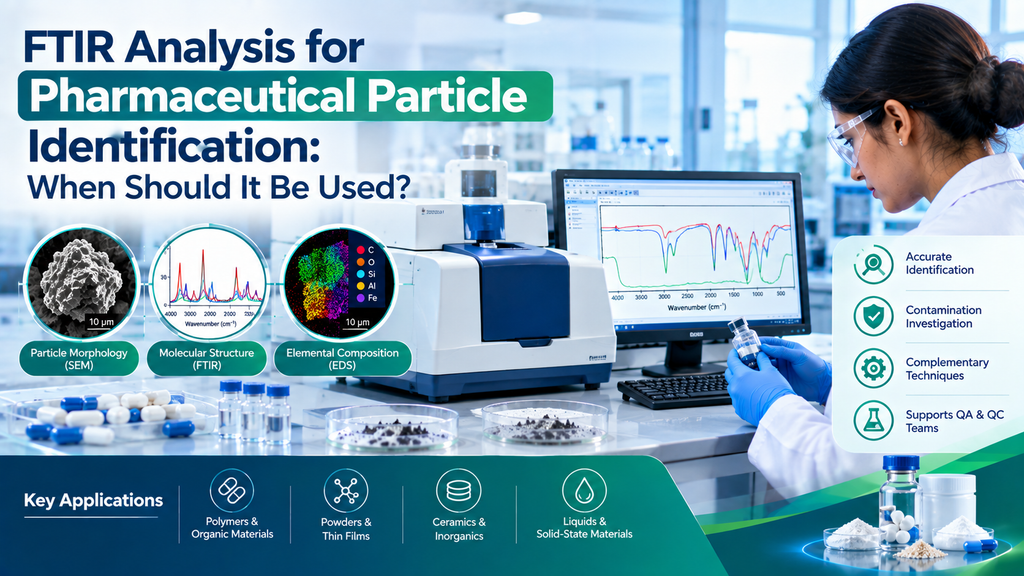
FTIR analysis laboratory India provides reliable analytical solutions for accurately identifying and characterizing unknown pharmaceutical particles, contaminants, and materials.
An unexpected particle in a pharmaceutical product can raise a difficult question: what exactly is this material?
Visual inspection may tell you that a particle is present. Microscopy may provide information about its appearance and morphology. SEM-EDS can provide high-resolution imaging and elemental composition. But what happens when the investigation needs information about the molecular structure or chemical characteristics of the material?
This is where Fourier Transform Infrared Spectroscopy, commonly known as FTIR, can become an important part of a pharmaceutical particle-characterization strategy.
For pharmaceutical manufacturers, QA/QC teams, R&D groups, and contamination-investigation teams, understanding when FTIR should be used is just as important as knowing what the instrument does.
The objective is not to use every analytical technique for every particle. Instead, the goal is to select an appropriate analytical pathway based on the material, sample characteristics, investigation question, and available reference information.
Confianca Pharmazon’s particle-characterization material describes FTIR as a technique for qualitative and quantitative characterization of molecular structures and identifies applications across materials such as powders, thin films, polymers, ceramics, liquids, and other solid-state materials, excluding gases.
This article explains where FTIR fits into pharmaceutical particle identification, when it can be particularly useful, how it can complement SEM-EDS and other techniques, and what Indian pharmaceutical companies should consider when selecting a particle characterization service.
What Is FTIR Analysis?
FTIR stands for Fourier Transform Infrared Spectroscopy.
At a high level, FTIR provides information related to the molecular structure of a material by analyzing its infrared spectral characteristics.
This makes it different from techniques that primarily focus on physical appearance or elemental composition.
For example:
- Microscopy → helps visualize a particle.
- SEM → provides high-resolution morphology.
- EDS → provides elemental composition.
- FTIR → helps characterize molecular structure.
- TGA/STA → provides information about weight changes and thermal events.
The Confianca Pharmazon reference material describes FTIR as a high-performance technique designed for precise qualitative and quantitative characterization of molecular structures across a wide spectral range. It also describes the referenced FTIR system as having a signal-to-noise ratio of 35000:1 and a temperature-controlled DLATGS detector.
For pharmaceutical particle investigations, this means FTIR can provide a different type of evidence from SEM-EDS.
Why Is FTIR Important in Pharmaceutical Particle Identification?
Imagine that a small unknown particle is discovered during a pharmaceutical manufacturing investigation.
The first questions might be:
Is it metal? Is it glass? Is it a polymer? Is it an organic material? Does it resemble a known component?
SEM-EDS may be highly useful if elemental composition is an important part of the investigation.
But if the investigation requires information about molecular structure, FTIR may provide complementary information.
This is particularly relevant for materials where molecular or chemical characteristics are more informative than elemental composition alone.
Potential investigation materials can include:
- Polymers
- Powders
- Thin films
- Ceramics
- Certain liquids
- Other suitable solid-state materials
The documented Confianca Pharmazon material specifically identifies these material categories as suitable areas for the referenced FTIR system, while excluding gases.
When Should FTIR Be Used for Pharmaceutical Particle Analysis?
There is no single answer that applies to every particle.
The appropriate technique depends on what the investigation needs to establish.
However, FTIR can be considered when the investigation requires information about molecular structure or material identity and the recovered sample is suitable for FTIR analysis.
1. When Molecular Structure Matters
One of the strongest reasons to consider FTIR is when investigators need information about the molecular characteristics of a material.
For example, a particle may appear to be a polymeric or organic material based on its visual appearance.
Rather than relying only on appearance, FTIR can provide molecular-structure-related spectral information that can support further characterization.
This can be especially useful when reference materials are available for comparison.
2. When Investigating Unknown Polymer-Type Particles
Pharmaceutical manufacturing environments can contain polymeric components and materials.
An unknown particle that appears flexible, irregular, or fibrous may require additional characterization.
FTIR can be considered when the investigation involves suitable polymeric material and the objective is to understand its molecular characteristics.
A reference-library approach can make the investigation more useful.
Example
Suppose a facility uses several polymeric materials in product-contact or process components.
An unknown particle is recovered from a product.
The investigation team can consider characterizing relevant reference materials and comparing analytical information from the unknown with the available references.
The result can then be evaluated alongside:
- Manufacturing-process information
- Component specifications
- Equipment history
- Particle morphology
- Other analytical results
This creates a more evidence-based investigation.
FTIR and Pharmaceutical Particle Characterization: A Multi-Technique Approach
One of the most important points for QA and QC teams is that FTIR does not always have to work alone.
The documented Confianca Pharmazon workflow describes a library-preparation approach in which product-contact and non-contact components can be identified, coupons can be collected, and the coupons can be analyzed using four technologies:
- SEM with EDS
- FTIR
- TGA/STA
- Microscopic analysis
This integrated strategy can provide different types of information about the same reference material.
Think of it this way:
| Technique | Primary Investigation Value |
|---|---|
| Microscopic analysis | Visual examination and detection of microscopic contaminants |
| SEM | High-resolution morphology |
| EDS | Elemental composition |
| FTIR | Molecular-structure characterization |
| TGA/STA | Thermal behavior and weight changes |
The best approach depends on the specific particle and investigation objective.
FTIR vs SEM-EDS: What Is the Difference?
Pharmaceutical teams sometimes ask whether they should choose FTIR or SEM-EDS.
In many cases, the more useful question is:
What information does the investigation need?
SEM-EDS
SEM-EDS is particularly useful when the investigation requires:
- High-resolution particle imaging
- Surface morphology
- Particle structure
- Elemental composition
- Investigation of potential inorganic or metallic materials
The Confianca Pharmazon documentation describes SEM with EDS as providing high-resolution surface morphology analysis and elemental composition information.
FTIR
FTIR is useful when the investigation requires:
- Molecular-structure information
- Characterization of suitable polymers
- Characterization of powders
- Characterization of thin films
- Characterization of ceramics
- Characterization of suitable liquids or other solid-state materials
The choice should therefore be based on the investigation question rather than treating one technique as universally superior.
How FTIR Can Support a Pharmaceutical Contamination Investigation
An analytical result is most valuable when it contributes to the broader investigation.
A practical workflow can include the following stages.
Step 1: Detect the Particle
The particle may be detected during:
- Visual inspection
- Product examination
- Filtration
- Laboratory testing
- A deviation investigation
- A customer complaint
The initial observation should be documented carefully.
Step 2: Recover the Particle
Particle recovery is critical.
The objective is to preserve the sample and minimize introduction of additional material.
The recovery process should be documented so the analytical laboratory understands how the sample was obtained.
Step 3: Conduct Preliminary Examination
Initial microscopy can help determine:
- Approximate appearance
- Shape
- Size
- Color
- Surface characteristics
- Whether the material appears fibrous, particulate, or irregular
Step 4: Define the Analytical Question
Before selecting FTIR, ask:
What do we need to know?
For example:
- Is this material consistent with a polymer?
- Does it have molecular characteristics similar to a known component?
- Can it be differentiated from another reference material?
- Would molecular characterization help identify the material?
Step 5: Perform FTIR Analysis Where Appropriate
If the sample is suitable, FTIR can be used to characterize molecular-structure-related information.
Step 6: Compare Against Reference Materials
Reference materials can make the result more meaningful.
For example, relevant product-contact components can be collected as coupons and characterized as part of a reference library.
Step 7: Combine With Other Evidence
The analytical result should be evaluated with:
- SEM/microscopy findings
- EDS results, where applicable
- Manufacturing records
- Equipment information
- Packaging information
- Process history
- Component information
- Previous investigations
Building a Pharmaceutical Particle Reference Library
A proactive reference library can make future investigations more efficient.
Confianca Pharmazon’s documented library-preparation process includes an optional Gemba activity with the client to identify product-contact and non-contact parts. Coupons from identified components can then be analyzed using SEM with EDS, FTIR, TGA/STA, and microscopic analysis.
This approach can help create a structured analytical reference base.
A reference library may include information from:
- Product-contact parts
- Non-contact parts where relevant
- Process components
- Filters
- Packaging-related materials
- Other potential contamination sources
The exact scope should be based on the manufacturing process and contamination-risk assessment.
Why Reference Materials Matter for FTIR Analysis
An FTIR spectrum becomes much more useful when investigators have appropriate reference information.
Consider this scenario.
A pharmaceutical company identifies an unknown particle that appears to be polymeric.
The facility has several polymer-containing components.
Without reference data, the investigation may have several possible explanations.
With a well-developed reference library, investigators may be able to compare the unknown against characterized materials from relevant components.
The analytical evidence can then contribute to a broader source-investigation process.
This is one reason FTIR analysis laboratory India services can be valuable for pharmaceutical organizations that want more than a one-time test.
Applications of FTIR in Pharmaceutical Particle Characterization
Polymer Characterization
FTIR can be useful for investigating suitable polymeric materials and comparing molecular characteristics against reference materials.
Powder Characterization
The documented FTIR system is described as suitable for powder analysis.
This can be relevant when an investigation involves an unknown powder or particulate material where molecular characterization is appropriate.
Thin Films
Thin films are also identified among the suitable material types in the provided particle-characterization documentation.
Ceramic Materials
Ceramics are another listed application area.
Liquid Samples
The source material also identifies liquids among the suitable material types, subject to sample suitability and analytical requirements.
7 Practical Tips for Pharmaceutical Teams
If your company is considering FTIR analysis laboratory India services, the following steps can help make the investigation more effective.
1. Define the Investigation Question
Do not begin with the instrument.
Begin with the question.
What information is missing?
2. Preserve the Particle
Small particles can be difficult to recover again. Appropriate handling and documentation are essential.
3. Avoid Unnecessary Sample Manipulation
Every additional handling step can introduce uncertainty.
Maintain appropriate sample-control practices.
4. Characterize Potential Source Materials
If possible, develop reference information for relevant manufacturing components before a major investigation occurs.
5. Use Complementary Techniques
FTIR can provide molecular information, while SEM-EDS and microscopy can provide other dimensions of particle characterization.
6. Document the Manufacturing Context
Analytical data should be evaluated against process information.
7. Do Not Overinterpret One Result
A spectral similarity or analytical characteristic should be interpreted as part of the complete investigation rather than automatically treated as proof of source.
What Should You Ask an FTIR Analysis Laboratory in India?
Choosing an FTIR analysis laboratory India provider should involve more than checking whether an FTIR instrument is available.
Ask the laboratory:
Sample suitability
- Can the laboratory evaluate whether the particle is suitable for FTIR?
- What quantity or sample condition is required?
- How should the sample be packaged?
Analytical scope
- Is the service qualitative, quantitative, or both where applicable?
- What type of molecular characterization will be reported?
- Can reference materials be analyzed?
Complementary analysis
- Is SEM-EDS available?
- Is microscopic analysis available?
- Is TGA/STA available?
- Can the laboratory support a multi-technique investigation?
Reporting
- Will the report include relevant spectra?
- Will reference comparisons be documented?
- Will limitations or sample constraints be clearly stated?
These questions can help QA/QC teams select a service that supports the actual investigation rather than simply delivering an isolated analytical result.
When FTIR May Not Be the First Choice
FTIR is powerful, but it should not automatically be selected for every particle.
For example, if the primary investigation question concerns detailed morphology or elemental composition, SEM-EDS may be more directly relevant.
The documented workflow for unknown particles at Confianca Pharmazon describes particle recovery followed by SEM with EDS for investigating the contamination source.
This reinforces an important principle:
Choose the analytical technique according to the question you need to answer.
For some investigations, FTIR may be one part of a larger characterization program rather than the only test.
Why Pharmaceutical Manufacturers in India Should Consider Integrated Particle Characterization
Modern pharmaceutical contamination investigations can involve multiple potential materials and sources.
An integrated approach can provide a broader evidence base.
Confianca Pharmazon documents a particle-characterization laboratory in Ahmedabad for library preparation and particle characterization testing, with the described workflow incorporating SEM with EDS, FTIR, TGA/STA, and microscopic analysis.
The company’s broader testing-services material also documents a collaboration with Umed Labs, Telangana, for particle characterization testing and lists FTIR among the laboratory’s analytical capabilities.
For Indian pharmaceutical manufacturers, the value of such an approach is the ability to select analytical techniques according to the material and investigation objective.
FTIR Particle Investigation Checklist
Before sending a sample for analysis, prepare:
- Product name
- Batch/lot details
- Description of the particle
- Approximate particle size
- Particle photographs, if available
- Sample-recovery details
- Suspected source materials
- Product-contact component information
- Packaging information
- Equipment/process information
- Previous related deviations
- Available reference materials
- Specific analytical question
- Required report/documentation expectations
This information helps the analytical team understand the investigation context.
Internal Linking Suggestions
1. Particle Characterization Analysis Services
Use anchor text such as “particle characterization analysis services” in the introduction or section discussing analytical service selection.
Particle Characterization Analysis Services
2. Knapp Kit – Visual Inspection Kits, Particles & Particulate Matters
Link the discussion of visual particle detection and inspection to the relevant product page.
Knapp Kit – Visual Inspection Kits, Particles & Particulate Matters
3. Visual Inspection Booth Automation
This can be linked where the article discusses the connection between routine visual inspection and laboratory particle investigation.
Visual Inspection Booth Automation
Frequently Asked Questions
What is FTIR analysis used for in pharmaceutical particle identification?
FTIR is used to characterize molecular-structure-related information in suitable materials. It can support identification and comparison of materials such as polymers, powders, thin films, ceramics, liquids, and other appropriate solid-state samples.
When should FTIR be used for an unknown pharmaceutical particle?
FTIR can be considered when molecular or chemical characteristics are important to the investigation and the recovered material is suitable for the technique.
Can FTIR identify the source of a pharmaceutical particle?
FTIR can provide useful characterization information, but identifying the source generally requires comparison with reference materials and consideration of manufacturing and process evidence. It should not automatically be treated as standalone proof of contamination source.
Is FTIR better than SEM-EDS?
Neither technique is universally better. SEM-EDS provides high-resolution morphology and elemental information, while FTIR provides molecular-structure-related information. The appropriate technique depends on the investigation question.
Can FTIR analyze polymer particles?
Yes, the provided Confianca Pharmazon material specifically identifies polymers among the materials suitable for its described FTIR application.
Can FTIR be combined with other particle characterization techniques?
Yes. The documented Confianca Pharmazon workflow combines SEM with EDS, FTIR, TGA/STA, and microscopic analysis for reference-library and particle-characterization activities.
Why is a reference library useful?
A reference library provides analytical information about relevant components and materials, making it easier to compare an unknown particle against potential sources during an investigation.
Conclusion: When Should You Choose FTIR for Pharmaceutical Particle Identification?
When an unknown pharmaceutical particle is discovered, the most important first step is not choosing an instrument—it is defining what you need to know about the particle.
If the investigation requires molecular-structure-related information and the sample is suitable, FTIR can be a valuable component of a pharmaceutical particle-characterization strategy.
FTIR analysis laboratory India services can support investigations involving suitable polymers, powders, thin films, ceramics, liquids, and other solid-state materials. The technique can become even more valuable when its findings are combined with microscopy, SEM-EDS, TGA/STA, reference-library information, and manufacturing-process evidence.
For pharmaceutical manufacturers, the strongest approach is therefore not simply “FTIR versus SEM-EDS.” It is selecting the right combination of analytical techniques to answer the investigation question with meaningful evidence.
If your QA, QC, R&D, or manufacturing team is dealing with an unknown particle, investigating a potential contamination event, or developing a reference library for product-contact materials, consider a structured particle characterization analysis strategy.
Explore professional particle characterization analysis services and discuss your sample, investigation objective, and required analytical information with an experienced laboratory team.
Your trusted partner for pharma skills, systems, and solutions.