
Best Practices for Setting Up a Pharma Visual Inspection Booth for GMP-Compliant Manufacturing
Introduction
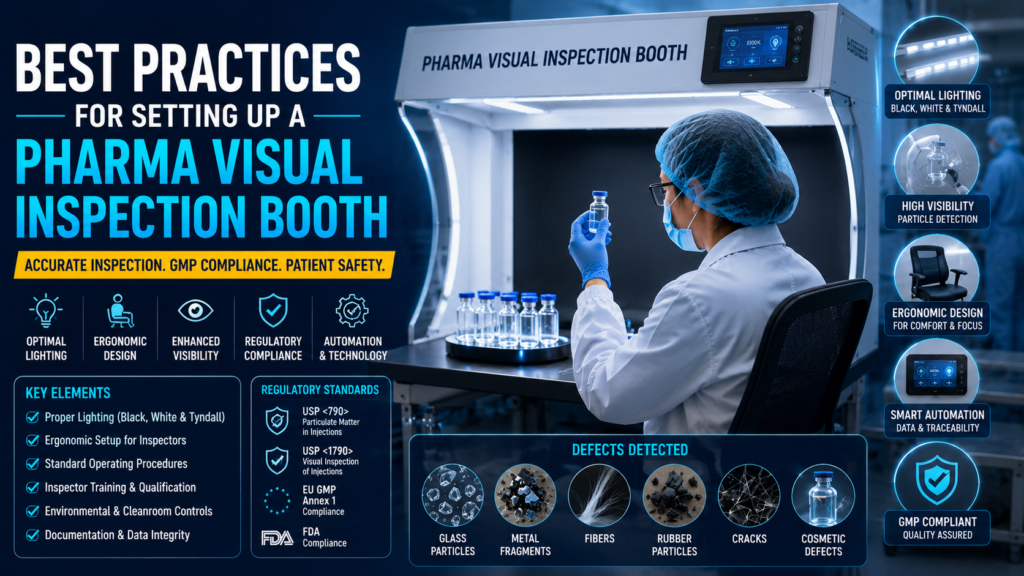
In the pharmaceutical industry, patient safety starts with product quality. Even the smallest particulate contamination, fiber, crack, or cosmetic defect in injectable products can lead to severe regulatory consequences, product recalls, or risks to patient health. That is why setting up a properly designed Pharma Visual Inspection Booth has become one of the most critical investments for pharmaceutical manufacturers.
Today’s pharmaceutical companies are moving beyond traditional inspection practices and embracing intelligent, GMP-compliant, and automation-enabled visual inspection systems that improve accuracy, productivity, and compliance.
Whether you manufacture injectables, vials, ampoules, cartridges, or prefilled syringes, your inspection setup directly impacts:
- Product quality
- Regulatory compliance
- Audit readiness
- Operator efficiency
- Batch rejection rates
- Patient safety
A modern Pharma Visual Inspection Booth is no longer just a table with black and white backgrounds. It is now a sophisticated inspection ecosystem that integrates:
- Controlled lighting
- Ergonomic operator positioning
- AI-powered inspection support
- Automated rejection systems
- 21 CFR Part 11 compliance
- Real-time monitoring
- GMP documentation
In this comprehensive guide, we will explore the best practices for designing and implementing a world-class pharma visual inspection setup that aligns with USP <790>, USP <1790>, EU GMP Annex 1, and FDA expectations.
Why Visual Inspection Is Critical in Pharmaceutical Manufacturing
Visual inspection is one of the final and most important quality assurance steps before pharmaceutical products reach patients.
Injectable products are especially sensitive because they bypass the body’s natural defense mechanisms. Even microscopic contamination can create serious complications.
Common defects identified during visual inspection include:
- Glass particles
- Metal fragments
- Fibers
- Rubber particles
- Cracks
- Cosmetic defects
- Improper sealing
- Incorrect fill volume
- Stopper defects
- Crystallization
Regulatory bodies including FDA, WHO, and EU GMP expect pharmaceutical manufacturers to establish scientifically designed inspection processes with validated systems and trained inspectors.
According to industry reports:
- Human visual inspection accuracy can vary significantly based on lighting and fatigue.
- Poor inspection setup contributes to high false rejection rates.
- Automated and optimized inspection environments can improve detection consistency by over 40%.
This is why investing in a GMP-compliant Pharma Visual Inspection Booth is essential for modern sterile manufacturing.
Key Regulatory Requirements for Pharma Visual Inspection Booths
Before designing a booth, manufacturers must understand the regulatory expectations governing visual inspection.
USP <790> — Visible Particulates in Injections
USP <790> focuses on visible particulate matter in injectable products and establishes expectations regarding:
- Detection capability
- Inspection environment
- Training
- Defect classification
- Inspection conditions
USP <1790> — Visual Inspection of Injections
USP <1790> provides detailed guidance on:
- Manual inspection methods
- Automated inspection systems
- Probability of Detection (POD)
- Defect characterization
- Qualification processes
EU GMP Annex 1
EU GMP Annex 1 emphasizes:
- Contamination control strategy
- Operator qualification
- Inspection validation
- Environmental controls
- Risk management
FDA Expectations
FDA inspections commonly evaluate:
- Visual inspection SOPs
- Lighting qualification
- Booth design
- Training records
- Defect libraries
- Knapp kits
- Audit trail compliance
Modern Visual Inspection Booth Automation solutions help manufacturers maintain documentation integrity and audit readiness.
Best Practices for Setting Up a Pharma Visual Inspection Booth
1. Select the Right Booth Design
A properly designed booth creates the ideal environment for accurate defect detection.
The booth should include:
- Black and white inspection backgrounds
- Controlled illumination
- Ergonomic working height
- Anti-glare surfaces
- Adjustable operator positioning
- Low distraction environment
A high-quality Manual Visual Inspection Booth should also support long-duration inspections without causing excessive operator fatigue.
Recommended Features
- Height-adjustable structure
- Magnifying lens integration
- Rejection storage compartments
- Eye-rest alert systems
- Online lux monitoring
- GMP-compliant design
Modern solutions available from Confianca Pharmazon also include advanced compliance features such as 21 CFR Part 11 support.
2. Optimize Lighting Conditions
Lighting is one of the most important elements in visual inspection accuracy.
Poor illumination leads to:
- Missed defects
- False rejects
- Operator strain
- Inconsistent inspection performance
Ideal Lighting Setup
A GMP-compliant Pharma Visual Inspection Booth should maintain:
- Uniform illumination
- Proper lux intensity
- Minimal glare
- Adjustable lighting controls
Recommended Lux Levels
Typical pharmaceutical visual inspection systems operate within:
- 2000–3750 lux for clear solutions
- Controlled lighting for amber containers
- Tyndall lighting for particulate visibility
Use Tyndall Lighting
Tyndall lighting improves visibility of particles suspended in injectable solutions by enhancing light scattering.
This is especially useful for detecting:
- Fibers
- Glass particles
- Metallic contamination
3. Focus on Ergonomics and Operator Comfort
Visual inspectors often perform repetitive tasks for extended durations.
Poor ergonomics can result in:
- Fatigue
- Reduced concentration
- Lower detection accuracy
- Increased human error
Ergonomic Best Practices
Include:
- Adjustable seating
- Foot support
- Proper viewing angles
- Comfortable arm positioning
- Eye-rest reminders
Many advanced Visual Inspection Booth Automation systems now include audio buzzers for scheduled eye-rest intervals.
4. Implement Black and White Background Standards
Visual inspection requires contrasting backgrounds for detecting different types of particles.
Black Background Helps Detect
- White fibers
- Glass particles
- Transparent contamination
White Background Helps Detect
- Black particles
- Dark fibers
- Rubber fragments
The transition between black and white backgrounds should be smooth and ergonomically positioned.
5. Integrate Automated Visual Inspection Technologies
Pharmaceutical companies are increasingly adopting hybrid inspection models that combine manual and automated systems.
Benefits of Automated Visual Inspection Systems
- Higher consistency
- Reduced human dependency
- Faster inspection speeds
- Better traceability
- Lower batch rejection rates
- Enhanced data analytics
Modern AI-powered systems use:
- Machine vision
- High-speed cameras
- Pattern recognition
- Real-time analytics
- Automated rejection mechanisms
These systems are particularly effective for high-volume sterile manufacturing operations.
6. Maintain 21 CFR Part 11 Compliance
Digital inspection environments must comply with FDA data integrity requirements.
Your System Should Include
- Audit trails
- Electronic records
- User authentication
- Secure data storage
- Timestamped logs
A compliant Pharma Visual Inspection Booth helps reduce audit observations and improves regulatory readiness.
7. Use Knapp Kits and Defect Libraries
Visual inspection qualification requires standardized defect samples.
Knapp kits help inspectors identify:
- Particulate contamination
- Cracks
- Fibers
- Cosmetic defects
- Seal defects
According to Confianca Pharmazon’s visual inspection solutions, defect kits can include:
- Certified glass particles
- Black fibers
- White particles
- Metal fragments
- Customized defect libraries
Using standardized kits improves inspector qualification consistency.
8. Train and Qualify Visual Inspectors
Even the best booth setup cannot compensate for untrained inspectors.
Training Should Cover
- Defect identification
- Swirling and inversion techniques
- Inspection timing
- Eye-rest methods
- Defect categorization
- POD principles
- USP <790> and USP <1790> guidance
Qualification Programs
A strong qualification program includes:
- Initial training
- Defect recognition testing
- Probability of Detection studies
- Periodic requalification
- Performance trending
9. Establish Environmental Controls
The inspection area should support sterile manufacturing standards.
Important Environmental Controls
- Controlled temperature
- Humidity management
- Low particulate environment
- Cleanroom compatibility
- Noise reduction
Inspection areas should also minimize visual distractions.
10. Improve Data Collection and Analytics
Modern pharmaceutical manufacturing relies heavily on data-driven quality systems.
A digitalized Pharma Visual Inspection Booth should capture:
- Defect trends
- Rejection rates
- Inspector performance
- Batch-level analytics
- POD data
- Audit trail information
Benefits of Analytics
- Continuous improvement
- Faster investigations
- Reduced recalls
- Better CAPA management
- Enhanced compliance
Common Mistakes to Avoid
Poor Lighting Calibration
Inconsistent lux levels reduce inspection reliability.
Ignoring Ergonomics
Operator fatigue increases defect escape risk.
Inadequate Training
Unqualified inspectors create compliance vulnerabilities.
Lack of Automation
Manual-only systems struggle with scalability and consistency.
Weak Documentation Practices
Poor records increase FDA and EU GMP audit risk.
How Automation Is Transforming Pharma Visual Inspection
The pharmaceutical industry is rapidly adopting smart manufacturing technologies.
AI-Powered Inspection Systems Now Offer
- Defect classification algorithms
- Machine learning analytics
- Real-time rejection validation
- Automated trend analysis
- Predictive quality insights
This evolution is helping pharmaceutical manufacturers move toward:
- Pharma 4.0
- Digital quality systems
- Zero-defect manufacturing
- Continuous compliance
Companies implementing advanced Visual Inspection Booth Automation solutions gain a major competitive advantage in regulatory readiness and manufacturing efficiency.
Choosing the Right Visual Inspection Partner
Selecting the right solution provider is critical.
Look for partners who offer:
- GMP-compliant systems
- Validation support
- Customized booth design
- Defect libraries
- Knapp kits
- Inspector training
- Automation integration
- Regulatory expertise
Confianca Pharmazon Visual Inspection Booth Automation Solutions provides comprehensive solutions tailored for sterile pharmaceutical manufacturing.
Internal Linking Suggestions
Include internal links to:
- Visual Inspection Booth Automation product page
- Knapp Kit solutions
- Pharma training services
- GMP compliance consulting
- Sterile manufacturing solutions
Suggested anchor texts:
- “Advanced Visual Inspection Booth Automation”
- “Pharma Knapp Kit Solutions”
- “USP 790 Inspection Training”
- “Sterile Manufacturing Compliance Solutions”
Frequently Asked Questions (FAQ)
What is a Pharma Visual Inspection Booth?
A Pharma Visual Inspection Booth is a controlled inspection environment designed for detecting particulate matter and defects in injectable pharmaceutical products.
Why is lighting important in visual inspection?
Proper lighting improves defect visibility, inspection consistency, and operator accuracy while reducing fatigue.
What is USP <790>?
USP <790> provides guidance on visible particulate matter inspection in injectable products.
What is the benefit of automated visual inspection systems?
Automated systems improve consistency, reduce human error, enhance traceability, and increase inspection speed.
What defects are commonly detected during visual inspection?
Common defects include:
- Glass particles
- Fibers
- Metal fragments
- Cracks
- Rubber particles
- Cosmetic defects
How often should visual inspectors be qualified?
Most pharmaceutical companies conduct periodic requalification annually or based on performance monitoring trends.
Conclusion
Setting up a GMP-compliant Pharma Visual Inspection Booth is no longer optional for modern pharmaceutical manufacturers. As regulatory expectations continue to evolve, companies must establish robust inspection environments that prioritize accuracy, consistency, compliance, and patient safety.
From lighting optimization and ergonomic design to AI-powered automation and digital audit trails, every aspect of the inspection process contributes to manufacturing excellence.
By implementing the best practices discussed in this guide, pharmaceutical companies can:
- Improve defect detection accuracy
- Reduce batch rejection rates
- Strengthen regulatory compliance
- Enhance operator productivity
- Build a stronger contamination control strategy
If your organization is planning to upgrade its inspection infrastructure, investing in advanced Visual Inspection Booth Automation solutions can significantly improve operational performance and audit readiness.
Explore advanced inspection solutions here:
Confianca Pharmazon Visual Inspection Booth Automation
Your trusted partner for pharma skills, systems, and solutions.