
No products in the cart.
Particle Characterization in the Pharmaceutical Industry: A Complete Guide to Identifying and Investigating Contamination
Introduction
Particle contamination is a critical quality concern in the pharmaceutical industry, particularly in injectable drugs, biologics, ophthalmic preparations, and other sterile pharmaceutical products. Even when a product appears clear to the naked eye, microscopic particles may be present and require further investigation to determine their identity, source, and potential impact on product quality.
Particle characterization in the pharmaceutical industry is the systematic process of examining particles to understand their physical properties, morphology, size, and chemical or elemental composition. It supports contamination investigations, root cause analysis, quality risk assessments, and the development of effective corrective and preventive actions (CAPA).
For pharmaceutical manufacturers, particle characterization is more than a laboratory exercise. It is an important component of contamination control, product quality assurance, and patient safety.
What Is Particle Characterization?
Particle characterization is the scientific evaluation of particulate matter using analytical techniques that reveal its measurable properties and composition.
In pharmaceutical applications, particles may originate from raw materials, manufacturing equipment, primary packaging components, processing environments, filtration systems, personnel, or product degradation.
Characterization helps quality control (QC), quality assurance (QA), microbiology, engineering, and manufacturing teams distinguish between different types of contaminants and establish an evidence-based investigation.
Common characteristics evaluated include:
- Particle size: The dimensions of individual particles, measured using an appropriate analytical method.
- Morphology: The shape, surface texture, and structural appearance of the particle.
- Elemental composition: The elements present, such as iron, chromium, nickel, silicon, or other detectable elements.
- Chemical composition: The chemical identity or material class, where the analytical technique supports identification.
- Particle distribution: The range and variation of particle sizes or types within a sample.
- Potential source: A scientifically supported assessment of the likely origin of the contaminant.
The appropriate characterization strategy depends on the product, sample quantity, particle characteristics, investigation objectives, and applicable regulatory requirements.
Why Is Particle Characterization Important in Pharmaceuticals?
1. Supporting Injectable Product Quality
Particulate matter in injectable products requires careful evaluation because the product is administered directly into the body. The significance of a particle depends on factors such as its nature, size, shape, quantity, route of administration, and the characteristics of the affected product.
Visual inspection and compendial particulate matter testing serve important purposes, but they do not necessarily establish the identity or origin of an observed particle.
Particle characterization provides additional analytical evidence to support a product-specific investigation.
2. Identifying Foreign Particulate Matter
Particles may be classified broadly as metallic, glass, polymeric, fibrous, mineral, or other organic and inorganic materials.
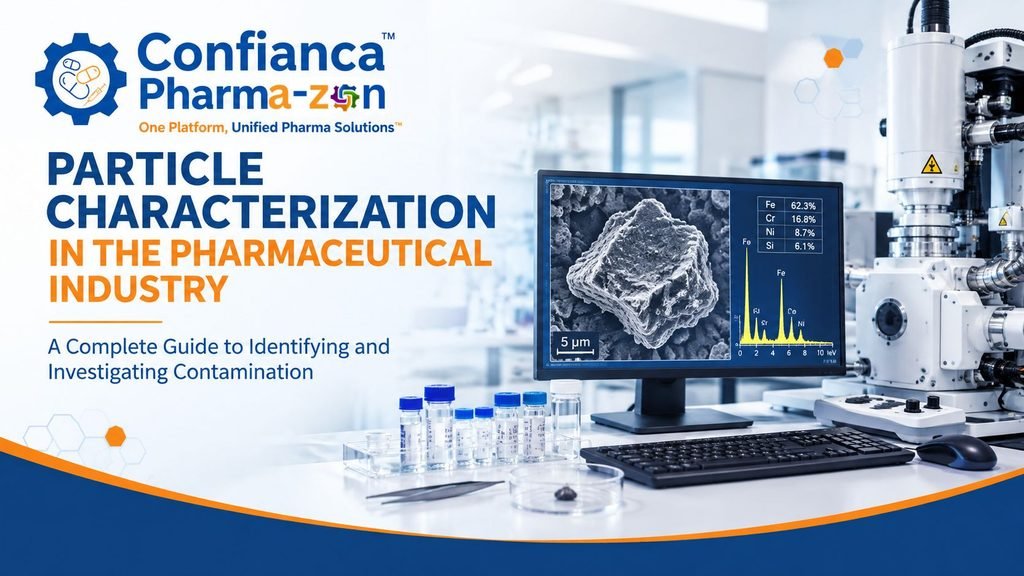
For example, a particle containing iron, chromium, and nickel may be consistent with a stainless-steel-related source. However, elemental composition alone does not prove that the particle originated from a specific piece of equipment.
Additional evidence, including morphology, material comparisons, manufacturing records, and equipment inspection, may be necessary to establish the source.
3. Strengthening Root Cause Analysis
An effective contamination investigation should establish more than the presence of a particle. It should determine what the available evidence supports about its origin and how the contamination may have occurred.
Particle characterization can help investigators evaluate potential sources such as:
- Manufacturing equipment and component wear
- Glass containers, ampoules, and vials
- Elastomeric closures and polymeric components
- Filters and filtration assemblies
- Fibers from garments, wipes, or packaging materials
- Raw materials and processing aids
- Environmental and handling-related contamination
Analytical results should be correlated with manufacturing history and other relevant evidence before a definitive root cause is assigned.
4. Supporting CAPA and Contamination Control
When a probable contamination source is established, manufacturers can use the findings to determine appropriate corrective and preventive actions.
Depending on the investigation, these actions may include equipment maintenance, component replacement, improved handling practices, supplier investigations, enhanced cleaning controls, or modifications to monitoring and inspection procedures.
The effectiveness of CAPA should be verified using documented, risk-based criteria.
Common Types of Particles Found in Pharmaceutical Products
Metallic Particles
Metallic particles may arise from equipment components, abrasion, corrosion, machining residues, or other manufacturing-related sources.
Scanning electron microscopy coupled with energy-dispersive X-ray spectroscopy (SEM-EDS) can provide information about particle morphology and elemental composition. Elements such as iron, chromium, nickel, and molybdenum may help investigators evaluate possible metallic sources.
However, the interpretation must account for the actual material composition and potential analytical interferences.
Glass Particles
Glass particles may be associated with primary packaging components, including glass ampoules and vials, or with other glass-contact processes.
Their appearance and elemental composition can help distinguish glass-related material from other contaminants. The presence of silicon and oxygen may be consistent with a silicate material, but these elements alone are not sufficient to confirm the identity of a particular glass type.
Fibrous Particles
Fibers may originate from garments, wipes, packaging, filters, environmental sources, or other materials used during manufacturing.
Microscopy can reveal fiber shape, length, width, surface features, and color. FTIR or Raman spectroscopy may help identify polymeric or other molecular materials when the sample is suitable for analysis.
Polymeric and Elastomeric Particles
Polymeric particles may originate from plastic components, tubing, seals, gaskets, container-closure systems, or other process-contact materials.
FTIR and Raman spectroscopy can be useful for polymer identification, while microscopy and SEM-EDS may provide complementary information about structure and elemental composition.
Mineral and Other Inorganic Particles
Mineral particles, silicates, and other inorganic materials may enter a process through raw materials, environmental sources, equipment, or handling.
Their identification requires consideration of morphology, elemental composition, and, where appropriate, complementary chemical or structural techniques.
Major Analytical Techniques Used in Particle Characterization
1. Optical Microscopy
Optical microscopy is often an initial technique for examining visible or isolated particles.
It can provide information about size, color, shape, transparency, and surface appearance. It is also useful for selecting representative particles for more advanced analysis.
Best suited for: Initial particle screening, morphology assessment, and sample selection.
2. Scanning Electron Microscopy (SEM)
SEM produces high-resolution images of particle surfaces and structures. It is useful for examining small particles and identifying morphological features that may not be clearly visible using conventional optical microscopy.
SEM can reveal particle shape, surface texture, fractures, and other features relevant to contamination investigations.
Best suited for: Detailed morphological examination of microscopic particles.
3. Energy-Dispersive X-ray Spectroscopy (EDS or EDX)
EDS is commonly coupled with SEM to evaluate elemental composition.
When the electron beam interacts with a sample, characteristic X-rays can be generated and measured to identify elements within the analyzed region. The resulting spectrum can help differentiate certain metallic, mineral, glass-related, and other inorganic materials.
EDS results must be interpreted carefully. Sample preparation, substrate contributions, particle size, beam interaction volume, and overlapping spectral peaks can affect the results. EDS identifies elements; it does not independently establish every compound or the precise source of a particle.
Best suited for: Elemental screening and comparison of potential inorganic contamination sources.
4. Fourier Transform Infrared Spectroscopy (FTIR)
FTIR evaluates molecular vibrations to help identify chemical functional groups and materials. It is commonly used for organic materials, polymers, fibers, and other substances that produce interpretable infrared spectra.
The suitability of FTIR depends on particle size, sample condition, substrate, and the analytical configuration.
Best suited for: Identification of many organic and polymeric particles.
5. Raman Spectroscopy
Raman spectroscopy provides molecular information based on inelastic scattering of light. It can support identification of organic and inorganic materials, depending on their Raman response and the sample characteristics.
Fluorescence, particle size, sample condition, and other factors may limit its usefulness in particular cases.
Best suited for: Complementary chemical identification when Raman spectra can be obtained and interpreted reliably.
6. Particle Size Measurement
Particle size may be assessed using calibrated microscopy, image analysis, or other suitable sizing techniques.
The method should match the particle type and the investigation objective. Results from different techniques may not be directly comparable because they can measure different dimensions or physical properties.
For irregular particles, the reported size should clearly state the measurement approach and relevant limitations.
SEM-EDS vs FTIR: Which Technique Should You Choose?
SEM-EDS and FTIR provide different types of analytical information. Selecting between them depends on the material being investigated and the question the laboratory needs to answer.
| Parameter | SEM-EDS | FTIR |
|---|---|---|
| Primary information | Morphology and elemental composition | Molecular and chemical-bond information |
| Typical applications | Metallic, mineral, and other inorganic particles | Many polymers, fibers, and organic materials |
| Particle imaging | High-resolution SEM images | Depends on the FTIR configuration |
| Element identification | Yes, for detectable elements | Not a direct elemental analysis technique |
| Material identification | Often requires interpretation and supporting evidence | Can identify materials through suitable reference-spectrum comparisons |
| Key limitation | Does not independently establish complete chemical identity or source | May be limited by particle size, substrate, mixtures, or spectral quality |
In some investigations, using both methods provides more complete evidence than either method alone. The analytical plan should be justified by the nature of the sample and the specific question being investigated.
A Step-by-Step Workflow for Pharmaceutical Particle Characterization
Step 1: Define the Investigation Objective
Determine whether the investigation requires particle identification, source comparison, elemental screening, chemical identification, size measurement, or a combination of these objectives.
The objective should guide sample selection and analytical method choice.
Step 2: Collect and Document the Sample
Record sample identification, product and batch details where applicable, collection location, date, handling conditions, and chain of custody.
Use appropriate precautions to prevent introducing extraneous particles during collection, transfer, and preparation.
Step 3: Perform Initial Microscopic Examination
Document particle appearance and select suitable particles for further analysis. Where possible, retain representative images and record the selection criteria.
Avoid assuming that all particles in a sample have the same origin.
Step 4: Select the Appropriate Analytical Technique
Choose SEM-EDS, FTIR, Raman spectroscopy, or another suitable method based on the material, particle size, sample availability, and investigation objective.
Consider whether substrate correction, blank analysis, or complementary techniques are necessary.
Step 5: Analyze and Interpret the Results
Evaluate spectra, images, elemental profiles, and other analytical data. Record limitations and distinguish measured findings from hypotheses about the source.
Reference materials and comparison samples may strengthen the interpretation when they are relevant and representative.
Step 6: Compare Potential Sources
Compare the analytical findings with materials used in the manufacturing process, equipment components, packaging materials, and other plausible sources.
Source attribution should be supported by multiple lines of evidence rather than a single elemental match or visual resemblance.
Step 7: Prepare the Investigation Report
A comprehensive report should generally include:
- Sample identification and investigation objective
- Analytical methods and relevant operating conditions
- Particle images and morphology observations
- EDS spectra, FTIR spectra, or other analytical data, as applicable
- Elemental or chemical findings and interpretation
- Method limitations and relevant blank or control results
- Comparison with potential source materials, where available
- Conclusions and recommendations supported by the evidence
Step 8: Link Findings to CAPA
Use the investigation results to support an appropriate risk assessment, source investigation, and corrective or preventive action plan. Verify CAPA effectiveness using predefined criteria.
Regulatory and Quality Considerations
Pharmaceutical particle investigations should be conducted within the manufacturer’s established quality system and applicable regulatory framework.
For injectable products, relevant compendial chapters may include USP General Chapters <788>, Particulate Matter in Injections; <790>, Visible Particulates in Injections; and <1790>, Visual Inspection of Injections.
These chapters address related but distinct aspects of particulate matter testing and visual inspection. Particle characterization complements these activities; it does not replace required compendial testing or qualified visual inspection procedures.
The applicability of each chapter depends on the product, jurisdiction, and current compendial requirements. Manufacturers should consult the current official text and applicable regulatory expectations when designing their procedures.
Common Challenges in Particle Characterization
Limited Sample Quantity
Some investigations provide only a few particles. Sample handling and analytical method selection must therefore be planned to preserve material for the most informative tests.
Substrate Interference
Particles collected on filters or membranes may produce signals that interfere with the analysis. Appropriate substrate selection, blank analysis, and careful interpretation can help address this issue.
Mixed or Heterogeneous Particles
A particle may contain multiple materials or surface deposits. Analyzing one location may not represent the composition of the entire particle.
Overinterpretation of Results
An elemental spectrum or chemical match may support a material classification without proving the precise manufacturing source. Reports should clearly separate analytical observations, interpretation, and final source conclusions.
Inadequate Documentation
Missing sample details, poorly documented analytical conditions, or insufficient image and spectrum records can weaken an investigation. Consistent documentation improves traceability and scientific defensibility.
How Confianca Pharmazon Supports Pharmaceutical Contamination Investigations
Confianca Pharmazon supports pharmaceutical industry professionals through particle characterization-related services, visual inspection and Knapp kits, and pharmaceutical consumable products.
A structured approach to particle analysis can help pharmaceutical manufacturers organize analytical findings, investigate potential contamination sources, and document evidence for quality investigations.
The appropriate service or analytical approach should be selected according to the sample, investigation requirements, and technical capabilities needed for the specific case.
Conclusion
Particle characterization in the pharmaceutical industry is an important tool for understanding particulate contamination and supporting evidence-based quality investigations.
By combining microscopy, SEM-EDS, FTIR, Raman spectroscopy, and suitable particle-sizing techniques where appropriate, pharmaceutical teams can build a clearer understanding of particle properties and evaluate potential sources.
The most reliable investigations connect analytical findings with manufacturing knowledge, documented procedures, risk assessment, and effective CAPA. This integrated approach strengthens contamination control and supports consistent pharmaceutical product quality.
Need support with pharmaceutical particle characterization or contamination investigation?
Visit Confianca Pharmazon to explore our pharmaceutical products and related services.