No products in the cart.
Sterile Consumable Products in the Pharmaceutical Industry: Types, Applications, and Selection Guide
Introduction
Sterile manufacturing requires carefully controlled environments, validated processes, appropriate materials, and strict contamination prevention practices. From sterile injectable production to aseptic filling and microbiological testing, pharmaceutical facilities rely on specialized consumable products to support product quality and protect critical manufacturing operations.
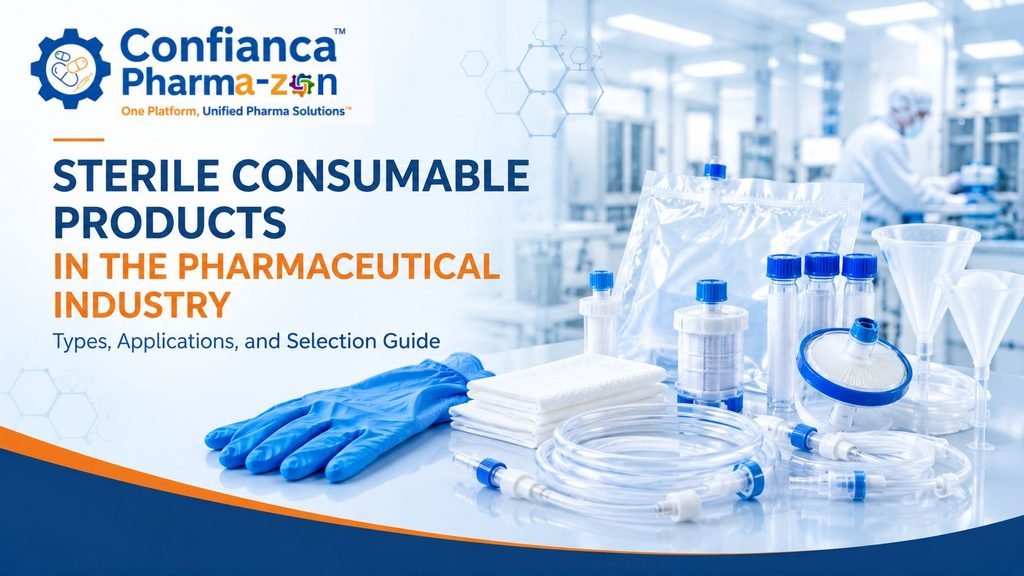
Sterile consumable products in the pharmaceutical industry include single-use or disposable items designed for use in sterile or controlled environments. Depending on the application, these products may include sterile gloves, cleanroom wipes, sterile filters, tubing, sampling accessories, sterile funnels, and other process-contact or environmental-control supplies.
Selecting the right consumables is important because an unsuitable product can introduce contamination risks, interfere with a manufacturing process, or fail to meet the requirements of its intended use.
This guide explains the common types of sterile pharmaceutical consumables, their applications, key selection criteria, and best practices for handling and storage.
What Are Sterile Consumable Products?
Sterile consumable products are materials or disposable items supplied with a defined sterility status and intended for applications where sterility is required.
Their suitability depends on factors such as the intended use, manufacturing process, material compatibility, packaging integrity, sterilization method, and applicable quality requirements.
Not every cleanroom consumable is sterile, and not every disposable pharmaceutical product is intended for direct contact with a sterile product.
Pharmaceutical manufacturers should therefore distinguish between sterile consumables, non-sterile cleanroom supplies, and products specifically qualified for product-contact applications.
Why Are Sterile Consumables Important?
1. Supporting Aseptic Processing
Aseptic processing involves handling sterile product, components, or equipment under conditions designed to prevent microbial contamination.
Sterile consumables can support operations such as component handling, equipment assembly, sampling, cleaning activities, and interventions within designated controlled environments.
Their use must be consistent with approved procedures and the facility’s contamination control strategy.
2. Reducing Contamination Risks
Consumables may contribute to contamination through microorganisms, fibers, particles, chemical residues, or incompatible materials.
Selecting products with appropriate cleanliness, particle-release, microbial, and chemical characteristics helps address these risks.
The required controls depend on whether the product is used near exposed sterile product, inside an isolator, in a cleanroom, or in a non-product-contact area.
3. Maintaining Process Consistency
Standardized consumable specifications support consistent manufacturing operations. Defined product requirements, supplier qualification, incoming inspection, and traceability can help reduce variation between batches and deliveries.
4. Supporting Quality and Regulatory Compliance
Pharmaceutical facilities must ensure that materials used in production and testing are appropriate for their intended purpose.
Consumables should be evaluated within the quality management system, considering applicable GMP requirements, risk assessments, supplier documentation, and process-specific controls.
Common Types of Sterile Consumable Products
1. Sterile Gloves
Sterile gloves are used where hand protection and contamination control are required during designated operations.
Common materials include nitrile, latex, and other polymers. The appropriate selection depends on chemical compatibility, tactile sensitivity, mechanical strength, allergen considerations, and the specific process.
For isolators and restricted-access barrier systems (RABS), gloves or gauntlets must be suitable for the system, its glove ports, and the intended operating conditions.
Key selection criteria:
- Confirmed sterility status and appropriate packaging
- Material and chemical compatibility
- Correct size, fit, and dexterity
- Suitable integrity and physical performance
- Traceability and relevant supplier documentation
2. Sterile Cleanroom Wipes
Wipes are used for cleaning and disinfection activities in controlled manufacturing environments. Depending on the application, they may be made from polyester, nonwoven materials, or other suitable substrates.
Sterile wipes may be required for specific aseptic areas or tasks. Their suitability depends on particle and fiber release, absorbency, chemical compatibility, and packaging.
Important considerations:
- Sterility status and packaging integrity
- Low particle and fiber shedding
- Compatibility with approved cleaning agents
- Suitability for the relevant cleanroom classification
- Validated or qualified use where required by the facility
A wipe intended for general cleanroom cleaning should not automatically be assumed suitable for critical product-contact surfaces.
3. Sterile Filters
Sterile filters are used in pharmaceutical processes where filtration is required to remove microorganisms or particulates, depending on the filter design and intended application.
Sterilizing-grade filtration requires appropriate validation and control of the filtration process. Filter selection should consider membrane material, pore rating, product compatibility, extractables and leachables where relevant, flow characteristics, and integrity testing requirements.
A nominal pore size or a supplier’s product description alone does not establish that a filter is suitable for a particular sterilizing filtration application.
Key considerations:
- Membrane and housing compatibility
- Validated retention performance for the intended use
- Product recovery and adsorption characteristics
- Extractables and leachables assessment where applicable
- Filter integrity testing and traceability
- Compatibility with the process and sterilization conditions
4. Sterile Tubing and Transfer Assemblies
Sterile tubing and transfer assemblies support the movement of liquids, gases, and other process materials in suitable pharmaceutical applications.
Depending on the design, these products may be made from silicone, thermoplastic elastomers, fluoropolymers, or other materials.
The material should be compatible with the product, temperature, pressure, cleaning or sterilization process, and intended duration of contact.
Connection integrity, particulate generation, and potential chemical interactions should also be considered.
5. Sterile Funnels and Sampling Accessories
Sterile funnels, sampling devices, connectors, and related accessories may be used during sampling, transfer, or laboratory testing.
These products should be appropriate for the sample type and intended procedure. Their packaging, sterility status, material composition, and compatibility should be confirmed before use.
Where a device contacts a pharmaceutical product or sample, its suitability should be supported by relevant specifications and risk assessment.
6. Sterile Bags and Containers
Sterile bags and containers can be used for collection, transfer, storage, or processing of suitable pharmaceutical materials.
Selection criteria include material compatibility, closure integrity, required barrier properties, sterilization compatibility, and the intended storage conditions.
For critical applications, manufacturers should evaluate relevant extractables, leachables, and other product-contact risks.
7. Sterile Swabs and Microbiological Sampling Supplies
Sterile swabs and sampling accessories support environmental monitoring, microbiological testing, and other approved sampling procedures.
The sampling material should be compatible with the target surface, the recovery method, and the laboratory’s validated or qualified procedure.
For environmental monitoring, the selection of the swab, contact material, neutralizing agent, and recovery method should be appropriate to the monitoring objective.
8. Sterile Funnels and Membrane Filtration Accessories for Microbiology
Microbiology laboratories may use sterile funnels, membranes, filtration assemblies, and related accessories for testing pharmaceutical water, process samples, and other materials.
The appropriate configuration depends on the test method, sample properties, required recovery, and applicable pharmacopoeial or validated laboratory procedure.
For example, sterile membrane filtration accessories may be used in microbial enumeration or sterility testing workflows where the relevant method specifies their use. A consumable’s sterility alone does not establish that it is suitable for every test.
Sterile Consumables vs. General Cleanroom Consumables
Although these terms are sometimes used interchangeably, they describe different product characteristics.
| Feature | Sterile Consumables | General Cleanroom Consumables |
|---|---|---|
| Sterility status | Supplied as sterile for the specified application | May be sterile or non-sterile |
| Primary purpose | Support applications requiring sterile materials | Support cleanliness and contamination control |
| Typical examples | Sterile gloves, sterile wipes, sterile transfer assemblies | Cleanroom garments, wipes, paper, and cleaning accessories |
| Required evidence | Appropriate sterility and product documentation | Documentation appropriate to the product and intended use |
| Selection priority | Sterility, compatibility, packaging, and intended use | Cleanliness, shedding, compatibility, and intended use |
The exact requirements depend on the manufacturing area and task. Facilities should not rely on product names alone to determine suitability.
How to Select the Right Sterile Consumables
Step 1: Define the Intended Application
Determine where and how the consumable will be used. A product intended for a general cleanroom area may not be suitable for use in an aseptic processing zone or for direct product contact.
Step 2: Confirm Sterility Requirements
Verify whether the application requires a sterile product. Review the supplied sterility information, packaging configuration, sterilization details where applicable, and relevant documentation.
Step 3: Evaluate Material Compatibility
Assess the consumable’s material against the pharmaceutical product, process fluids, cleaning agents, disinfectants, temperature, and other operating conditions.
For product-contact applications, consider chemical compatibility and extractables and leachables risks where appropriate.
Step 4: Review Cleanliness and Particle Characteristics
Depending on the application, relevant factors may include particle shedding, fiber release, bioburden, endotoxin levels, and other contamination-related characteristics.
Do not assume that every sterile product has the same particle, endotoxin, or chemical cleanliness specification.
Step 5: Check Packaging Integrity and Shelf Life
Inspect the packaging before use. Confirm the expiry or retest date, storage conditions, lot identification, and any restrictions following package opening.
Damaged packaging or an expired product should be handled according to approved procedures rather than used on the assumption that sterility remains assured.
Step 6: Qualify Suppliers and Review Documentation
Supplier assessment should be proportionate to the criticality of the product and its intended use.
Depending on the application, relevant documentation may include:
- Product specifications and technical data sheets
- Certificate of Analysis (CoA), where applicable
- Certificate of Conformance (CoC), where applicable
- Sterility documentation and sterilization information
- Material composition and compatibility data
- Relevant particle, endotoxin, or bioburden information
- Lot traceability and change-notification arrangements
The exact documentation required should be defined by the manufacturer’s quality system and product risk assessment.
Step 7: Establish Storage and Handling Controls
Store consumables under the conditions specified by the manufacturer. Maintain segregation, traceability, and appropriate stock rotation.
Use procedures that minimize contamination during transport, disinfection of outer packaging where appropriate, transfer into controlled areas, and package opening.
Best Practices for Handling and Storage
Proper handling is essential to maintain the condition of sterile consumables throughout their use.
Inspect before use. Verify the product identity, lot number, expiry date, and package integrity.
Follow approved transfer procedures. Use the facility’s established methods for moving materials into cleanrooms, isolators, or other controlled areas.
Avoid unnecessary exposure. Open packaging only when needed and follow the specified handling procedure.
Maintain traceability. Record lot information where required for critical consumables and manufacturing operations.
Use appropriate stock rotation. Apply the facility’s approved inventory controls and follow manufacturer-defined storage conditions and shelf life.
Investigate discrepancies. Report damaged packaging, unexpected particles, product defects, or documentation gaps according to the applicable quality procedure.
Common Mistakes to Avoid
Assuming All Disposable Products Are Sterile
Disposable products may be supplied sterile or non-sterile. Verify the product specification and packaging label.
Selecting Products by Price Alone
A lower-cost consumable may not meet the required cleanliness, compatibility, or performance specifications. Total suitability should take precedence over price alone.
Ignoring Material Compatibility
Incompatible materials may degrade, shed particles, adsorb product components, or release unwanted substances.
Overlooking Packaging Integrity
Sterility assurance can be compromised if the packaging is damaged or handled outside specified conditions.
Failing to Maintain Traceability
Incomplete lot and supplier records can make investigations and product-impact assessments more difficult.
The Role of Sterile Consumables in Contamination Control Strategies
A contamination control strategy should consider materials, personnel, premises, equipment, processes, cleaning and disinfection, environmental monitoring, and other relevant controls.
Sterile consumables form one part of this broader system. They should be selected, qualified, handled, and monitored according to their intended use and contamination risks.
For aseptic manufacturing, this approach should align with the applicable GMP framework, including relevant requirements under EU GMP Annex 1 or other regulations and guidance applicable to the facility.
A consumable should never be treated as a substitute for validated processes, appropriate environmental controls, or effective aseptic practices.
How Confianca Pharmazon Supports Pharmaceutical Manufacturing
Confianca Pharmazon supports pharmaceutical and biopharmaceutical professionals with pharmaceutical consumables and related products for quality control, microbiology, visual inspection, and controlled manufacturing applications.
Depending on product availability and specifications, the portfolio may include items such as sterile microbiology supplies, cell spreaders, centrifuge tubes, sterile M-Funnels, cleanroom consumables, and other pharmaceutical products.
Before purchasing, customers should confirm the exact product specification, sterility status, packaging, and intended application with the supplier.
Explore pharmaceutical products and services at Confianca Pharmazon.
Conclusion
Sterile consumable products are essential supporting materials for pharmaceutical manufacturing, microbiology, and aseptic processing. Their correct selection helps maintain process consistency and manage contamination risks.
By evaluating sterility status, material compatibility, cleanliness, packaging integrity, supplier documentation, and storage conditions, pharmaceutical organizations can make informed purchasing and qualification decisions.
The most effective approach combines appropriate consumables with robust quality systems, trained personnel, validated processes, and a comprehensive contamination control strategy.
Looking for pharmaceutical consumables for your manufacturing or laboratory requirements?
Visit Confianca Pharmazon to explore our product range and discuss your requirements.