
Visual Inspection Defect Kit Saudi Arabia: The Ultimate Guide to Selecting the Right Kit for Pharmaceutical Manufacturing
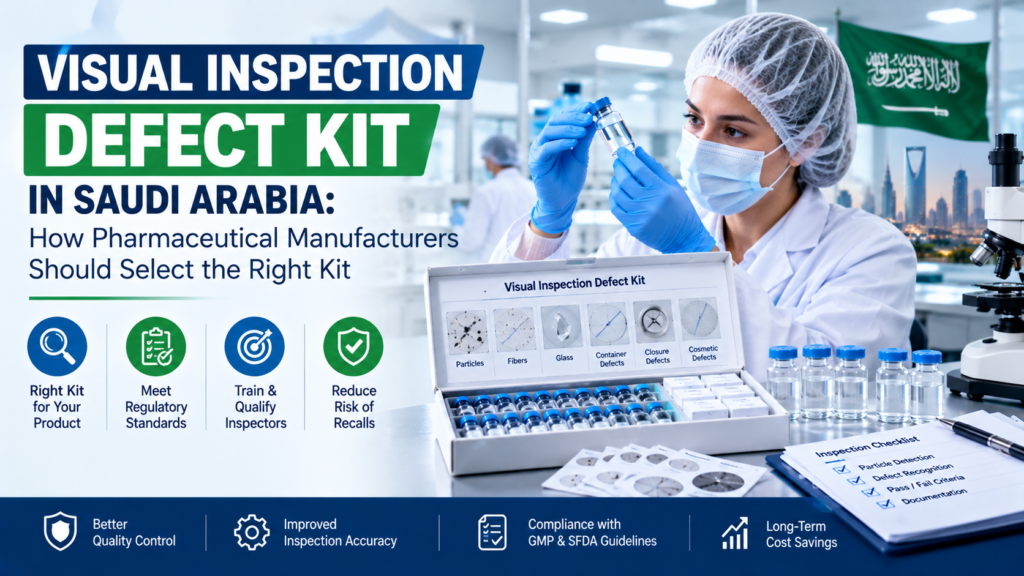
In pharmaceutical manufacturing, visual inspection is more than simply looking at a vial under a light.
For sterile and injectable products, manufacturers need a structured approach for identifying visible particles, fibers, container defects, closure problems, and other visual abnormalities. The inspection process also needs to be appropriately qualified so that personnel and automated systems can demonstrate their ability to detect relevant defects.
This is where selecting the right visual inspection defect kit Saudi Arabia becomes important.
A well-designed defect kit can provide controlled challenge samples for training, qualification, and inspection performance assessment. But not every kit is suitable for every pharmaceutical facility. The right choice depends on the product, container format, inspection method, defect types, particle characteristics, and qualification objective.
Saudi pharmaceutical manufacturers also need to consider applicable GMP expectations. The Saudi Food and Drug Authority (SFDA) GMP guideline states that manually performed inspection should take place under suitable, controlled illumination and background conditions, with appropriately controlled and qualified inspection rates. It also states that operators should undergo visual inspection qualification at least annually using appropriate samples from the manufacturer’s defect library, considering worst-case conditions.
So, how should a pharmaceutical company select the appropriate kit?
Let’s break it down.
What Is a Visual Inspection Defect Kit?
A visual inspection defect kit is a controlled collection of good and defective pharmaceutical containers or challenge samples used to evaluate an inspection process.
Depending on its purpose, the kit can support:
- Manual visual inspector training
- Inspector qualification
- Visual inspection requalification
- Defect recognition training
- Probability of Detection (POD) studies
- Automated visual inspection machine qualification
- Defect library development
- Investigation and troubleshooting
The concept is straightforward:
Known defect → controlled inspection → recorded result → performance evaluation
This is more structured than relying only on naturally occurring rejected samples.
For example, a manufacturer producing injectable vials may want to evaluate whether an inspector can consistently identify different types of particulate matter. A suitable kit can provide controlled samples representing relevant challenges.
Confianca Pharmazon’s product information describes its Knapp Kits for manual and automatic visual inspection applications, including liquid and lyophilized formulations in formats such as vials, cartridges, and prefilled syringes, with particulate matter available in different micron-size ranges.
Why Selecting the Right Kit Matters in Saudi Pharmaceutical Manufacturing
Choosing a defect kit should not be treated as simply purchasing a box of defective samples.
The kit needs to reflect the actual inspection challenge faced by the manufacturing operation.
Consider two facilities:
Facility A manufactures clear liquid injections in glass vials.
Facility B manufactures lyophilized products in vials and uses automated visual inspection equipment.
Both may need visual inspection qualification, but their challenge requirements can be different.
The inspection characteristics can vary according to:
- Product formulation
- Container type
- Container size
- Product clarity
- Particle characteristics
- Inspection method
- Manual or automated inspection
- Inspection speed
- Lighting conditions
- Defect criticality
USP <1790> explains that visual inspection for visible particles is a probabilistic process and that detection probability can vary with particle size, shape, color, density, dosage form, and container design.
That makes kit selection an important technical decision rather than a generic purchasing exercise.
7 Factors to Consider When Selecting a Visual Inspection Defect Kit
1. Match the Kit to Your Pharmaceutical Product
The first question should be:
What exactly are you inspecting?
A defect kit should be appropriate for the product and container configuration used at your facility.
For example, a manufacturer may work with:
- Glass vials
- Cartridges
- Prefilled syringes
- Liquid formulations
- Lyophilized formulations
- Other injectable presentations
A kit designed for one container format may not automatically represent the same inspection challenge in another.
Confianca Pharmazon’s product information specifically identifies manual visual inspection kits for liquid and lyophilized formulations using vials, cartridges, and prefilled syringes.
Practical tip
Before selecting a kit, document:
- Product type
- Container material
- Container size
- Fill volume
- Closure configuration
- Inspection method
- Typical visual defects
- Intended qualification purpose
This creates a clearer technical specification for the supplier.
2. Determine Whether You Need Manual or Automated Inspection Qualification
This is one of the most important selection decisions.
Manual Visual Inspection
Manual inspection relies on trained personnel examining pharmaceutical containers under controlled inspection conditions.
For this application, a kit can be used for:
- Inspector training
- Initial qualification
- Periodic requalification
- Refresher training
- Defect recognition exercises
The SFDA GMP guideline specifically addresses operator qualification for manual inspection and states that qualification should use appropriate samples from the manufacturer’s defect library while considering worst-case conditions.
Automatic Visual Inspection
Automated inspection systems use cameras, lighting, image-processing systems, and defined detection parameters.
Here, the challenge set needs to be appropriate for the machine and its intended inspection capability.
The SFDA GMP guideline states that when automated inspection methods are used, the process should be validated to detect known defects that may impact product quality or safety and should be equal to or better than manual inspection methods.
Therefore, if your facility operates an automated inspection line, ask whether the kit is specifically suitable for automatic visual inspection machine qualification rather than assuming a manual training kit will meet the same objective.
3. Check Which Defect Types Are Included
A pharmaceutical defect kit should contain challenges that are relevant to the facility’s risk profile.
Depending on the kit and application, examples can include:
Particulate defects
- Glass particles
- Metal particles
- Black particles
- White particles
- Other visible particulate matter
Fiber defects
- Black fibers
- White fibers
- Hair-like fibers
Container defects
- Cracks
- Container damage
- Broken containers
Closure-related defects
- Damaged stoppers
- Closure abnormalities
- Seal-related defects
- Cap-related defects
Product-related visual defects
- Appearance abnormalities
- Crystallization
- Wrong solution or product appearance
Confianca Pharmazon’s published material describes Knapp Kits and visual inspection kits involving particulate matter, fibers, container defects, closure defects, cosmetic defects, and other inspection challenges.
The important point is not to select the kit with the longest defect list.
Select the defect categories that are relevant to your product, process, and qualification strategy.
4. Consider Particle Size and Characteristics
Particle detection is not simply a question of whether a particle exists.
Its visibility can be affected by:
- Size
- Shape
- Color
- Density
- Movement
- Orientation
- Product background
- Container characteristics
USP <1790> specifically notes that detection probability varies according to particle characteristics and container/product conditions.
This is why manufacturers should ask suppliers about the characteristics of particulate challenges supplied with a kit.
Useful questions include:
- What particle types are included?
- What size ranges are available?
- How are particles measured?
- Is particle sizing documented?
- Is there traceability for individual defects?
- Are certificates supplied?
- Can the kit be customized for specific challenges?
Confianca Pharmazon’s product information describes known-size particulate matter in different micron-size ranges and certified particle-related documentation for its visual inspection offerings.
5. Look for Documentation and Traceability
A pharmaceutical qualification activity should produce records that can be reviewed later.
Therefore, documentation should be part of your selection criteria.
Depending on the kit, useful documentation may include:
- Certificate of particulate matter
- Defect identification records
- Particle size information
- Kit identification number
- Master certificate
- POD evaluation sheets
- Inspection records
- Defect library information
- Handling instructions
- Qualification guidance
This documentation can help connect the physical challenge samples to the qualification protocol and final records.
Why does this matter?
Imagine an auditor asks:
“How did you demonstrate that the inspector was challenged with an appropriate defect?”
The answer should come from your documented qualification system—not from memory.
6. Consider Probability of Detection (POD)
Probability of Detection, or POD, is an important concept when assessing visual inspection performance.
Visual inspection is not an absolute process where every particle of a particular size will always be detected.
USP <1790> describes visual inspection as probabilistic.
A structured challenge set can therefore help organizations evaluate inspection performance using predefined defects.
A POD-oriented approach may help answer questions such as:
- Which defects were detected?
- Which defects were missed?
- Are certain defect types more difficult to identify?
- Does inspection performance change under different conditions?
- Does an automated system detect relevant challenge defects?
- Does inspector performance remain consistent during qualification?
For Saudi pharmaceutical manufacturers, POD evaluation can therefore form part of a broader, documented visual inspection qualification strategy.
7. Evaluate Supplier Support, Not Just the Kit
One common purchasing mistake is to compare suppliers only by the number of samples included.
A visual inspection defect kit is part of a qualification system.
Before purchasing, ask whether the supplier can support:
- Kit selection
- Defect selection
- Manual inspector training
- Automated machine qualification
- POD studies
- Qualification methodology
- Documentation
- Defect handling
- Replacement or maintenance requirements
- Technical questions
This becomes particularly valuable when a pharmaceutical facility is implementing a visual inspection qualification program for the first time.
Manual vs Automatic: What Should Saudi Manufacturers Choose?
There is no universal answer because the appropriate kit depends on what the facility is qualifying.
| Requirement | Manual Inspection Kit | Automatic Inspection Kit |
|---|---|---|
| Inspector training | Suitable | Not primary purpose |
| Manual inspector qualification | Suitable | Not primary purpose |
| Defect recognition training | Suitable | Can support system challenges |
| Automated machine qualification | Not necessarily | Suitable when specifically designed for it |
| POD evaluation | Can be incorporated | Can be incorporated |
| Defect library | Suitable | Suitable |
| Requalification | Suitable | Suitable |
| Machine parameter challenge | Not applicable | Relevant |
A facility using both manual inspection and automated inspection may require different challenge configurations for each application.
A Practical Example: Selecting a Kit for an Injectable Manufacturer
Consider a hypothetical pharmaceutical manufacturer in Saudi Arabia producing liquid injectable products in glass vials.
The company uses manual inspection as part of its visual inspection process.
Its selection process could look like this:
Step 1: Define the product
- Liquid injectable
- Transparent glass vial
- Defined fill volume
Step 2: Identify relevant defects
The quality team identifies potential challenges including:
- Glass particles
- Metal particles
- Black particles
- White particles
- Fibers
- Cracks
- Closure defects
Step 3: Define qualification objectives
The company needs to:
- Train new inspectors
- Qualify inspectors
- Conduct periodic requalification
- Maintain a defect library
Step 4: Select representative challenge samples
The manufacturer chooses samples that represent relevant inspection challenges.
Step 5: Establish controlled inspection conditions
Lighting, background, inspection time, inspection rate, and other relevant conditions are defined.
Step 6: Document the outcome
Inspection results are recorded and evaluated according to the approved procedure.
This approach creates a structured connection between the physical kit and the company’s quality system.
Common Mistakes When Buying Visual Inspection Defect Kits
Mistake 1: Choosing Based Only on Price
The lowest-cost kit may not provide the documentation, defect types, container formats, or technical support your facility requires.
Mistake 2: Ignoring the Container Format
A kit should reflect the actual inspection presentation whenever practical.
Mistake 3: Using the Same Challenge Set for Every Application
Manual inspection and automated inspection can have different qualification requirements.
Mistake 4: Focusing Only on Particles
A comprehensive visual inspection program may also need to address fibers, cracks, container defects, closure defects, and other relevant visual abnormalities.
Mistake 5: Forgetting Documentation
Without appropriate traceability, demonstrating how a qualification challenge was controlled can become more difficult.
Mistake 6: Treating the Kit as a Standalone Compliance Solution
A defect kit supports qualification; it does not replace a complete SOP, trained personnel, suitable inspection conditions, documented acceptance criteria, or an appropriate quality system.
How to Build a Kit Selection Checklist
Before ordering a visual inspection defect kit Saudi Arabia, your QA, QC, engineering, and production teams can review the following checklist.
Product compatibility
- Product type identified
- Liquid or lyophilized formulation identified
- Container type confirmed
- Container size confirmed
- Closure configuration documented
Inspection requirements
- Manual or automated inspection identified
- Qualification objective defined
- Relevant defect categories identified
- Worst-case conditions considered
- POD requirements considered
Defect characteristics
- Particle types identified
- Particle size requirements defined
- Fiber requirements defined
- Container defects considered
- Closure defects considered
Documentation
- Certificates available
- Defect identification records available
- Traceability available
- POD documentation available where applicable
- Supplier technical support confirmed
This checklist can make procurement discussions much more specific and productive.
Why Knapp Kits Can Support a Structured Visual Inspection Program
Knapp Kits are designed around the concept of controlled visual inspection challenges.
Confianca Pharmazon describes its Knapp Kit offering for both manual and automatic visual inspection applications and lists particulate matter in different micron-size ranges.
For pharmaceutical manufacturers, the potential applications include:
- Manual inspector training
- Inspector qualification
- Automated inspection machine qualification
- Defect recognition
- POD studies
- Visual inspection performance assessment
The important consideration is selecting the configuration that matches the intended application.
A kit containing the wrong container type or irrelevant defects may provide less meaningful information than a properly specified challenge set.
Frequently Asked Questions
What is a visual inspection defect kit used for?
A visual inspection defect kit provides controlled samples that can be used for visual inspector training, qualification, defect recognition, and inspection-system challenge activities.
Depending on its configuration, it can also support automated visual inspection machine qualification and POD studies.
Is a visual inspection defect kit mandatory in Saudi Arabia?
The SFDA GMP guideline requires manual inspection to be appropriately controlled and qualified and states that operator qualification should use appropriate samples from the manufacturer’s defect library, considering worst-case scenarios. It does not, in the cited section, name a commercial product called a “Knapp Kit” as mandatory.
Therefore, the important requirement is the suitability and effectiveness of the qualification approach, rather than simply purchasing a particular commercial kit.
How often should visual inspectors be qualified?
The SFDA GMP guideline states that operators performing manual inspection should undergo visual inspection qualification at least annually, with appropriate samples and consideration of worst-case conditions.
Facilities should also follow their approved procedures and applicable regulatory requirements.
Can one kit be used for manual and automatic inspection?
Some Knapp Kit configurations are designed for both manual and automatic visual inspection applications. However, manufacturers should confirm that the specific kit configuration is appropriate for the intended qualification objective.
What defects should a pharmaceutical defect kit contain?
The answer depends on the product and inspection risk. Potential challenges include glass, metal, black and white particles, fibers, cracks, container defects, closure defects, and other product-specific visual abnormalities.
Why are particle characteristics important?
Particle size, shape, color, density, and other characteristics can affect visibility. USP <1790> identifies these factors as variables that can influence detection probability.
Final Takeaway: Choosing the Right Kit Starts With the Inspection Process
Selecting a visual inspection defect kit Saudi Arabia pharmaceutical manufacturers can rely on should begin with the inspection process—not the product catalog.
Start by defining:
- What product are you inspecting?
- What container and closure are being used?
- Is inspection manual, automated, or both?
- Which defects represent realistic challenges?
- What particle sizes and characteristics are required?
- What qualification or POD activities are planned?
- What documentation and traceability are required?
- What supplier support is available?
For Saudi pharmaceutical manufacturers, this approach can help connect visual inspection training and qualification with a documented quality system.
SFDA GMP guidance specifically highlights controlled inspection conditions, operator qualification, defect-library samples, worst-case considerations, and validation of automated inspection methods. Meanwhile, USP <1790> emphasizes that visible-particle inspection is probabilistic and affected by product, particle, and container characteristics.
That means the goal should not simply be to buy a defect kit. The goal should be to select appropriate, traceable challenge samples that support your specific inspection and qualification strategy.
Explore Knapp Kits for Pharmaceutical Visual Inspection
Confianca Pharmazon provides Knapp Kits and visual inspection defect kits for manual and automatic inspection applications, including different pharmaceutical container formats and particulate challenges.
For Saudi pharmaceutical manufacturers evaluating their visual inspection qualification requirements, the next step is to define the product, container, defect types, inspection method, and documentation requirements before selecting the appropriate kit.
Knapp Kit – Manual Visual Inspection Kits, Particles & Particulate Matters
Your trusted partner for pharma skills, systems, and solutions.